
What if the best way to understand autonomous systems is to follow how a system senses, makes decisions, and acts? Autonomous systems education can feel broad and technically intimidating, especially when classroom concepts seem far removed from practical skills. A clear learning path makes the subject more approachable: build systems literacy, practice applying it, and reflect on responsible use.
Students, parents, and educators also need to know which learning path fits their goals. This article explains the core ideas learners encounter, how instruction can progress from fundamentals to applied work, and how to choose a useful next step. Drone and Unmanned Aircraft Systems (UAS) learning offers a concrete way to explore autonomy, safety, and operational decision-making while keeping the wider field in view.
Resources such as a Drone Simulator, AINautics University’s Train-the-Teacher Program, and UAS Student Scholars support different learning needs. Whether you’re planning your studies, shaping a classroom, or building an institutional program, use the guidance here to move from concepts toward practice.
Key Takeaways
- Autonomous systems education connects technology with human judgment, safety, and real-world context.
- A practical learning progression moves from core concepts to structured practice, applied tasks, and reflection.
- Educators can match learning objectives and student readiness with suitable resources and supervision.
- Assess progress through evidence of reasoning, safe decisions, technical skills, and project work.
- Choose a next step that fits your role, from Part 107 Training to an educator or institutional pathway.
What Does Autonomous Systems Education Teach, and Why Does It Matter?
Autonomous systems education explores how machines and software sense their surroundings, interpret information, and act with varying levels of human oversight. It covers systems designed for specific tasks as well as those that can adjust actions as conditions change. A system’s capabilities and the role of its human operator depend on the technology and the situation.
Learning about autonomy means more than studying sensors, software, or machines in isolation. Students consider what information a system receives, how it selects an action, and how that action affects people and the environment. They also examine safety, human judgment, system limits, and operating context. A drone in a structured learning activity, for example, raises different practical questions from a drone used in a more complex outdoor setting.
Systems literacy helps learners understand not only what a technology can do, but also when human judgment must guide its use. That perspective matters in education and work because decisions about design, operation, oversight, and purpose shape how autonomous technologies are used.
How Is Autonomy Different from Automation?
Automation carries out a task according to defined instructions or conditions. Autonomy adds the ability to use sensed information to adapt actions, though the degree of adaptation varies. The distinction isn’t absolute: a system can combine automated steps with autonomous responses, while people set goals, supervise operation, or intervene.
Example, not a universal behavior: an automated device might follow a preset route, while an autonomous one could use sensor information to respond to an obstacle. The actual behavior depends on how a particular system is designed. Because autonomy exists on a spectrum, ask what the system senses, what decisions it can make, and where human oversight fits.
Which Technologies Can Students Explore?
Uncrewed aircraft systems (UAS), robotics, and other autonomous technologies give students different ways to study shared ideas. A foundational overview of the Autonomous Robot can introduce how robots use sensing and action across a range of applications. Learners can then investigate sensing, decision-making, control, and human-system interaction in different contexts.
Programs don’t need identical equipment to explore these ideas. One class might examine how a drone uses information to support a task; another might study a robot’s response to changing conditions. The common question is how a system perceives, chooses, acts, and remains appropriately supervised. AINautics University’s Drone Simulator supports simulation-based learning in the UAS context, giving students a way to explore system behavior without treating one technology as a stand-in for every autonomous system.
This framework makes a broad technical field easier to approach. Start with what a system is designed to do, then examine its inputs, decisions, actions, limits, and human oversight. These questions establish a practical foundation for exploring specific technologies and developing deeper skills.
How Autonomous Systems Learning Builds from Concepts to Applied Skills
A strong learning pathway doesn’t jump straight from theory to independent operation. It builds understanding in stages, helping learners connect system behavior with sound decisions before taking on more complex tasks. In autonomous systems education, the goal is not simply to use a tool. It’s to understand its capabilities, work within appropriate limits, and explain the reasoning behind each action.
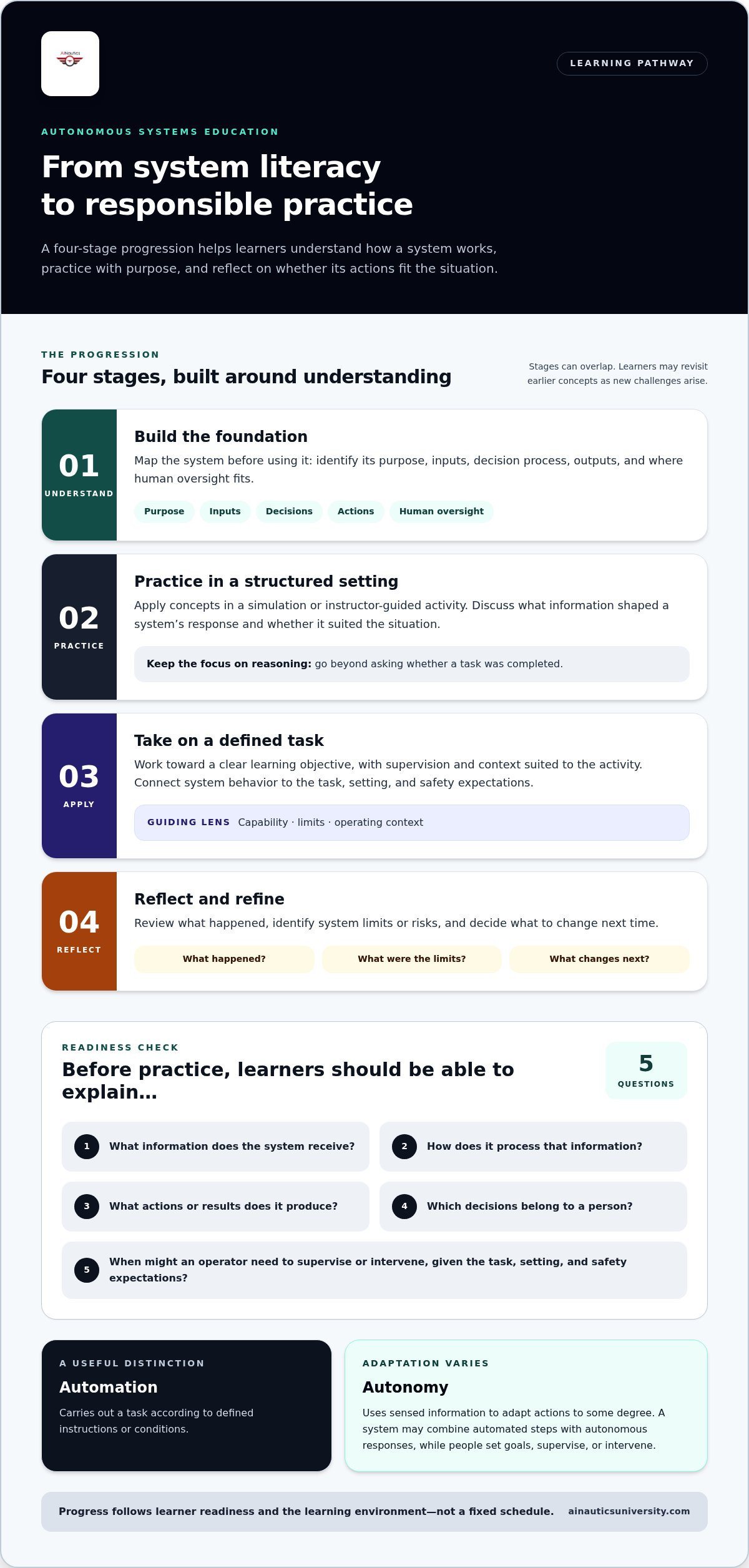
Effective learning moves from understanding how a system works to practicing how to use it, then reflecting on whether its actions were appropriate. The stages can overlap, and learners may revisit earlier concepts as new challenges arise. Progress should reflect learner readiness and the learning environment, not a fixed schedule.
- Build the foundation: Identify a system’s purpose, inputs, decision process, outputs, and human oversight.
- Practice in a structured setting: Use a simulation or instructor-guided activity to apply concepts and discuss decisions.
- Take on an applied task: Work toward a defined learning objective with appropriate supervision and context.
- Reflect and refine: Review what happened, identify limits or risks, and decide what to change next time.
What Should Learners Understand Before Practicing?
Before practicing, learners should be able to describe a system’s inputs, the information it receives, and its outputs, the actions or results it produces. They should also understand how the system processes information, what decisions a person makes, and when an operator may need to supervise or intervene. In a UAS activity, connect these questions to the task, setting, and safety expectations.
This foundation makes practice more purposeful. Instead of asking only whether a task was completed, learners can consider what information shaped the system’s response and whether that response suited the situation. For ideas on learning through immersive scenarios, explore immersive drone training technology as part of your curriculum planning.
How Can Simulation Support Skill Development?
Simulation gives learners a structured setting to rehearse concepts before moving into relevant real-world activities. It can support practice and discussion, but it doesn’t replace instruction, appropriate oversight, certification, or any separate authorization required for an operation. Treat it as one stage of learning, not proof of readiness on its own.
AINautics University’s Drone Simulator is a simulation-based training resource. Educators can include it in a broader pathway, pairing practice with clear objectives and a review of learner decisions. Simulation practice alone doesn’t provide FAA Part 107 certification or independently authorize someone to operate a drone. Learners pursuing UAS knowledge can explore AINautics University’s Part 107 Training as a distinct part of their learning journey.
At each stage, ask learners to explain what they understand, what they practiced, and what they would reassess before moving forward. This habit connects technical skills with responsible application and gives instructors room to adapt the pathway to learner needs and available resources.
How Can Schools and Educators Fit Autonomous Systems into Learning?
Start with the learning goal, not the equipment. Decide what students should understand or demonstrate, then consider their readiness, available resources, and the supervision the activity requires. This keeps autonomous systems education focused and age-appropriate rather than turning it into a standalone technology demonstration.
The topic can connect with science, technology, engineering, and mathematics (STEM) through questions about sensing, data, design, and testing. Career and technical education (CTE) can show how systems are used in practical work and how people interact with them. Connections depend on the course and its learning objectives, so don’t assume that one project automatically aligns with every curriculum or standard.
Projects make system concepts visible by giving students a process to examine. For example, a class could plan a simple UAS learning activity, identify the information a system uses, observe its behavior in a structured exercise, and record what happened. Students can then consider how the plan, conditions, or human decisions shaped the result. A focused drone curriculum guide for educators can offer further ideas for classroom instruction.
How Can Teachers Make the Topic Accessible?
Begin with a familiar example, such as a system responding to information from its surroundings. Introduce technical terms as learners need them, and define each in plain language. Break a project into manageable roles: students might observe, plan, document, or evaluate. These roles offer different ways to participate while keeping attention on how the system works and how people guide its use.
Educators can build confidence through structured preparation. AINautics University’s Train-the-Teacher Program helps educators bring drone and UAS topics into learning. Teacher preparation can connect an activity to clear objectives, student readiness, and appropriate guidance, while leaving room for different classroom materials and approaches.
What Does a Responsible Classroom Activity Include?
A responsible activity sets expectations before students begin. Explain the learning goal, what learners should observe or demonstrate, how supervision will work, and which safety considerations apply to that activity. Set aside time to discuss decisions and reflect afterward. Assessment can consider the quality of students’ reasoning and documentation, not only whether they completed a task.
Choose a format that fits the objective and setting. AINautics University’s VR Trailer Mobile Lab provides an immersive learning resource for hands-on education. Whatever the format, keep the educational purpose in view: students should connect what they observed with the system’s behavior and the choices people made around it.
Before launching a project, use four planning questions: What should students learn? What prior knowledge do they need? Which resources and level of oversight fit the activity? How will students demonstrate and reflect on their learning? Clear answers create a practical starting point for classroom integration.
How Can Learners and Educators Evaluate Progress in Autonomous Systems?
Progress is easier to assess when educators define what learners should know or be able to do before an activity begins. In autonomous systems education, that might include explaining a system’s decisions, planning a task, documenting observations, or identifying when human judgment matters. Participation shows engagement, but it doesn’t by itself show what a learner understands.
Observable evidence is a stronger signal of learning than participation alone. A practical assessment approach gathers evidence across understanding, process, project work, and reflection. Choose measures that match the stated learning objective.
What Evidence Shows That a Learner Is Progressing?
Look for evidence of how learners think and act, not only whether they completed an activity. Depending on the objective, useful evidence may include:
- Explanations: Can learners describe how a system uses information or why it responded in a particular way?
- Planning records: Do they define the task, identify relevant considerations, and prepare a clear process?
- Scenario decisions: Can they explain their choices and recognize when a person should reassess or intervene?
- Project documentation and reflection: Can they record observations, interpret results, and identify what they would change?
A rubric can clarify expectations by assessing reasoning, safe decision-making, documentation, and technical execution together. If the objective is to interpret system behavior, for example, a learner’s explanation and evidence may matter more than completing a technical step quickly. Formative feedback, or guidance given during learning, can point to a useful next step: clarify a concept, strengthen a plan, or practice explaining a decision.
Keep the scope of assessment clear. Evidence that a learner met course objectives isn’t, by itself, proof of external certification, authorization to operate, or employment readiness. Those are separate outcomes with their own requirements.
How Do Learning Formats Serve Different Needs?
Learning formats serve different purposes, so assessment should reflect those differences. Self-paced study gives learners room to work through material independently; educator-led instruction supports guidance and discussion; simulation supports structured practice; and a student program can provide a broader learning pathway. AINautics University offers Self-Paced Certification for independent study and UAS Student Scholars for student learning pathways. Neither format is a universal measure of progress.
Match evidence to the format. A learner studying independently might explain a concept or complete a knowledge task, while a guided activity could also include observed decisions and discussion. For a student project, planning notes and reflection can show how understanding develops. Assess the intended learning, not simply the format used.
Use results to set the next learning goal. If learners can describe a system but struggle to justify their decisions, focus feedback on reasoning before increasing task complexity. Explore AINautics University’s student learning pathways to consider options for continued UAS learning.
How Can an Autonomous Systems Education Pathway Lead to a Next Step?
A useful next step starts with a clear goal. Are you exploring how autonomous systems work, building UAS knowledge, preparing to teach, or planning a learning program? Naming your immediate goal helps you choose a relevant activity instead of trying to cover every technology at once. An autonomous systems education pathway can grow over time, with foundational learning, guided practice, and focused study serving different purposes.
Choose resources for the stage you’re working on, rather than treating any one resource as a promise of certification, employment, or a specific outcome. A Drone Simulator supports simulation-based practice. AINautics University’s Part 107 Training builds UAS knowledge, while educator preparation and student programs support classroom and student learning.
Which Learning Step Fits Students and Career Explorers?
Start by choosing an area of interest. You might want to understand autonomous-system concepts broadly or focus on UAS operations. Build a foundation in how systems work, use simulation or guided activities to explore ideas, and treat relevant certification preparation as a separate step. AINautics University offers Part 107 Training for learners pursuing UAS knowledge and Self-Paced Certification for independent study. Each supports a different learning purpose.
Keep the next step manageable: write down what you want to understand or practice, then choose an activity that addresses that goal. If you’re considering a career direction, explore the range of roles and pathways discussed in a guide to the future of drone careers. Use that perspective to identify skills or subjects to investigate, rather than treating any one course as a complete career plan.
Which Learning Step Fits Educators and Institutions?
For educators, begin with curriculum goals, instructor readiness, student needs, and practical resources. Decide what learners should take away, then choose an approach that fits the classroom context. AINautics University’s Train-the-Teacher Program supports educator development, while the VR Trailer Mobile Lab offers an immersive learning format. The UAS Student Scholars program provides a student-focused learning pathway. Let the learning objectives guide how you use these resources.
Institutions can take a similar approach at the program level. Identify where autonomous-systems topics fit existing learning priorities, what instructors need to feel prepared, and which resources suit the intended activities. Start with a focused pilot or lesson plan, gather feedback on how learners engage with the material, and use that feedback to shape what comes next. Adapt the pathway to your students and instructional context.
Choose one action you can take now: students can define an area of interest, educators can outline a lesson objective, and institutions can identify a curriculum need. If a UAS learning resource fits that goal, explore AINautics University’s relevant training or education programs as a next step.
Take the Next Step in Your Learning Journey
The most useful next step is one connected to a clear goal. Choose a concept to explore, a skill to practice, or a learning activity to develop. As your interests grow, your pathway can grow with them. That flexibility is central to meaningful autonomous systems education: learners build knowledge steadily while educators shape opportunities around their students and goals.
AINautics University offers resources for different stages of learning, including Part 107 Training, Self-Paced Certification, the Train-the-Teacher Program, the VR Trailer Mobile Lab, the Drone Simulator, and UAS Student Scholars. These options support needs ranging from individual study to classroom preparation and student learning.
Explore autonomous systems learning with AINautics University and choose the resource that matches your next step. Start with the goal that matters most to you, then build from there.
Frequently Asked Questions
What is autonomous systems education?
It’s a learning pathway for understanding technologies that make or support decisions with limited continuous human input. A useful course description identifies its focus, such as system design, data, testing, human oversight, or a specific application. Compare a course’s stated learning objectives with your own goal, whether that’s classroom exploration, UAS knowledge, or further technical study.
How is autonomous systems education different from robotics education?
The programs can overlap, but their learning objectives may differ. A robotics course might emphasize designing a robot or working with its physical components, while an autonomous-systems course may focus more broadly on decision-making, data, or how people supervise technology. Compare the projects and subjects in each program rather than relying on its title alone.
Can students study autonomous systems without prior coding experience?
Yes. Students can start without writing code by analyzing a case study, sketching a system’s possible responses, or comparing how different conditions might change a result. These activities build observation and reasoning skills. If coding becomes part of a later course, learners can approach it as another tool for testing ideas. Review course prerequisites when selecting a program.
Do students need a college degree to learn about autonomous systems?
No. Students can begin through school projects, independent study, or focused training without first earning a college degree. Formal education may be relevant for some advanced programs or career paths, but expectations differ by institution and role. Learners can document class projects, study notes, and practiced skills to track their development and identify what to pursue next.
Does autonomous systems education include drones?
Yes. Drone and UAS learning can be one route into the field. Students interested in this area might explore how aerial data is organized and used in contexts such as mapping or inspection, alongside relevant UAS knowledge. AINautics University offers Part 107 Training for learners pursuing that knowledge. The right course focus depends on whether a student is exploring technology, preparing for certification, or considering a particular application.
Is simulation useful for autonomous systems education?
It can be useful for repeating a scenario and comparing decisions under different conditions. Learners can keep a simple practice log: record the scenario, explain their choice, note what changed on a repeat, and identify a question for an instructor. This makes progress easier to discuss. A simulator represents a learning environment, so consider which details of an actual setting it may not capture.
How can teachers introduce autonomous systems in a classroom?
Try a short case-based activity before planning a larger project. Present students with a school-related task, such as deciding whether a technology would suit a proposed use. Ask them to list who could be affected, what information they’d need, and what concerns they’d raise before recommending a course of action. This encourages practical analysis without requiring specialized equipment or advanced technical vocabulary.

Article by
AINautics University Team
The team behind AINautics University, dedicated to drone education and FAA Part 107 certification prep, VR flight simulation, and STEM training programs for students and educators.


