
If you’re wondering how to get FAA drone license approval for business-related flying, the credential to focus on is the Part 107 Remote Pilot Certificate. Recreational flyers follow a different path, so start by identifying the purpose of your planned flights and which FAA rules apply. That distinction helps you choose the right preparation and avoid studying for a pathway that doesn’t fit your goals.
Eligibility, test registration, applications, and the identifiers you’ll need can make the process feel complicated. This guide breaks it into manageable stages, from checking eligibility and preparing for the knowledge test to applying after you pass. You’ll also find practical ways to organize your study and build flight readiness. AINautics University’s Part 107 Training, Self-Paced Certification options, and Drone Simulator can support your preparation. The FAA is responsible for testing and issuing certificates, so training is a foundation for the process, not a substitute for its required steps.
Key Takeaways
- “FAA drone license” usually means the Remote Pilot Certificate under Part 107, which applies to many small-drone operations for work or business.
- Getting FAA drone license approval involves following the FAA’s required steps. Check current eligibility and testing instructions directly with the FAA.
- Compare self-study, structured Part 107 learning, and simulator practice based on how you learn. Training supports exam preparation but doesn’t issue the certificate.
- After passing, assess each mission’s airspace, operating limits, and authorization requirements before flying.
- Use certification as a starting point for continued learning and practical UAS skills that support your education or career goals.
What an FAA Drone License Means and Who Needs Part 107
An “FAA drone license” usually refers to the Remote Pilot Certificate issued by the Federal Aviation Administration for pilots operating under Part 107. “License” is common shorthand, but it isn’t the credential’s formal name. A course can help you prepare; only the FAA can issue the certificate.
Part 107 sets rules for many small-drone operations conducted for work or business. If you’re researching how to get FAA drone license approval, first consider the purpose and circumstances of your planned flying. These factors help determine which FAA pathway applies. Don’t assume that the same rules cover every flight.
What is the FAA Remote Pilot Certificate?
The Remote Pilot Certificate is an FAA credential for operating a small unmanned aircraft under Part 107. It shows that a pilot has met the FAA’s certification requirements, but it isn’t blanket permission to fly anywhere or in any conditions. You must still follow the applicable operating rules for each mission.
For broader background on the aircraft themselves, see Unmanned aircraft on Wikipedia. For certification and operating requirements, rely on current FAA guidance.
When does Part 107 apply instead of recreational rules?
Recreational flying and work-related flying follow different FAA pathways. Capturing property images for a real estate business, documenting construction progress for a client, or gathering aerial information as part of paid work may call for Part 107. These examples can help you assess your plans, but they aren’t an exhaustive legal test.
Consider the flight’s purpose and circumstances, not only whether money changes hands during that specific flight. An operation may support a larger project or be part of your job even if it isn’t paid for separately. If you’re unsure which pathway applies, review the FAA’s current guidance on recreational flying and Part 107 before you fly. Checking the rules early helps you choose relevant training and plan your next steps.
How to Get an FAA Drone License: The Part 107 Steps
Understanding how to get FAA drone license credentials means separating FAA requirements from the study choices that can help you prepare. The process has distinct stages, and its details can change. Use the FAA's official guide to becoming a drone pilot as your reference. Review the latest instructions before booking a test or submitting an application.
FAA steps: eligibility, testing, and application
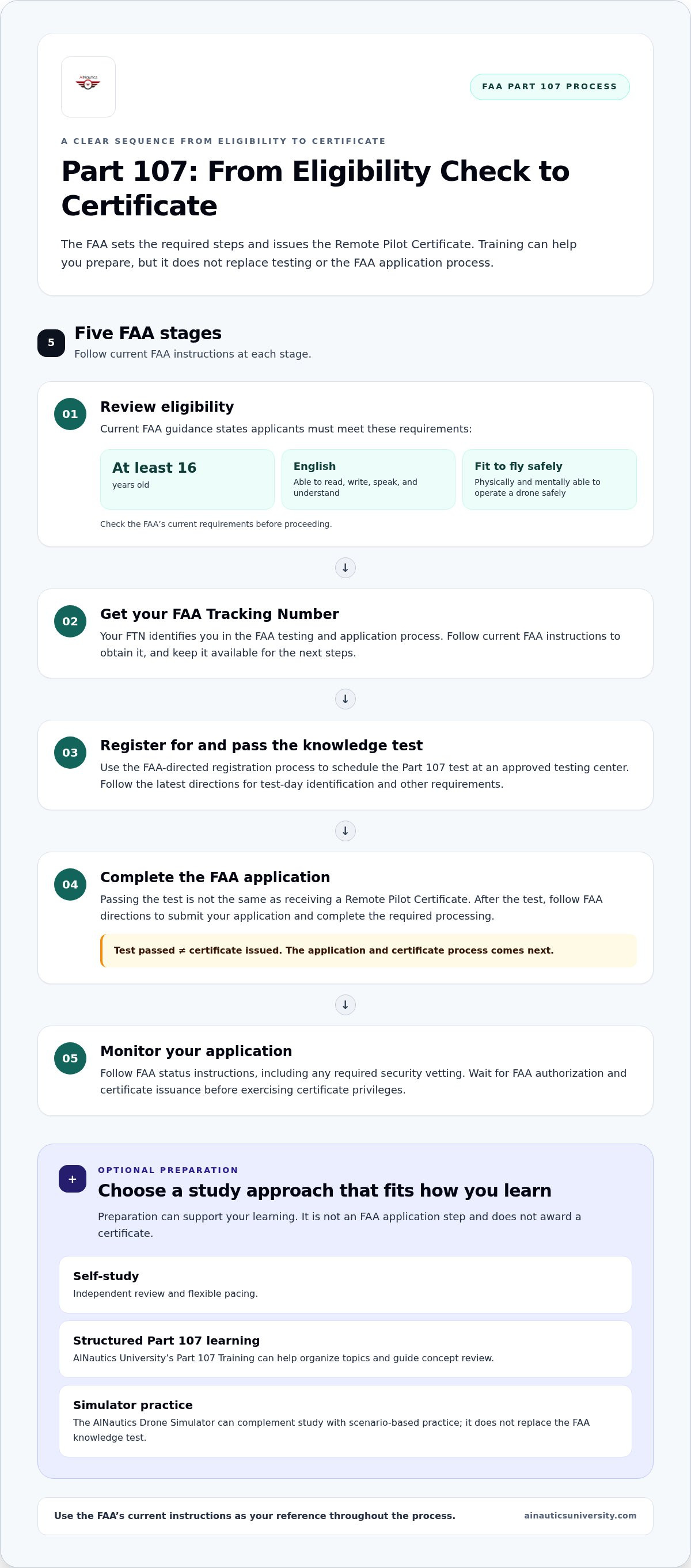
- Review eligibility. FAA guidance currently states that applicants must be at least 16, be able to read, write, speak, and understand English, and be physically and mentally able to safely fly a drone. Check the FAA’s current requirements before proceeding.
- Get your FAA Tracking Number. Your FTN identifies you in the FAA testing and application process. Follow current FAA instructions to obtain it, and keep it available for the next steps.
- Register for and pass the knowledge test. Use the FAA-directed registration process to schedule the Part 107 test at an approved testing center. Follow the latest instructions for test-day identification and other requirements.
- Complete the FAA application. Passing the test is not the same as receiving a Remote Pilot Certificate. After the test, follow FAA directions to submit your application and complete the required processing.
- Monitor your application. Follow FAA status instructions, including any required security vetting. Wait for FAA authorization and certificate issuance before exercising certificate privileges.
Optional preparation: build knowledge before test day
Preparation supports the process, but it isn’t an FAA application step and doesn’t award a certificate. You can study independently or use structured learning to organize topics and practice applying concepts. AINautics University’s Part 107 Training provides a structured way to prepare, while the FAA remains responsible for testing and certification. As you study, note concepts that need more review and return to them rather than relying on a last-minute recap.
Keep your identifying information consistent across testing and application steps, and read each FAA instruction before submitting. If a registration procedure has changed since you started studying, follow the current FAA directions rather than an older checklist. The sequence is eligibility review, testing, then a separate application and certificate issuance process.
Part 107 Test Preparation: What Training Can and Cannot Do
A course can help you prepare for the Part 107 knowledge test, but completing one doesn’t grant a Remote Pilot Certificate. The FAA manages the test and certificate process. Use training to build and organize your knowledge, not as a replacement for FAA requirements or a guarantee of passing.
Which Part 107 study approach fits your learning needs?
Choose a preparation approach based on how you learn and how much structure you need. Self-paced study offers flexibility if you can set goals and track your progress. Structured Part 107 Training can organize topics and guide review. The AINautics Drone Simulator can complement study with scenario-based practice, but it doesn’t replace the FAA knowledge test.
| Option | What it supports | FAA requirement? |
|---|---|---|
| Self-study | Independent review and flexible pacing | No, it’s optional preparation |
| Part 107 Training | Structured learning and concept review | No, course completion doesn’t issue a certificate |
| AINautics Drone Simulator | Practice applying learning in simulated scenarios | No, it doesn’t replace the knowledge test |
| FAA knowledge test and application | Required steps in the certification process | Yes, follow current FAA instructions |
What should a useful preparation plan include?
Build a steady routine you can maintain instead of relying on a last-minute review. Set study sessions, note the topics that feel difficult, and revisit them until you can explain the underlying ideas in your own words. Connect rules and concepts to flight-planning decisions rather than memorizing definitions in isolation.
Use realistic situations to test your understanding. For a planned operation, ask what information you’d need, which limitations might affect the flight, and where you’d verify the requirements. This turns test preparation into practice reasoning through the decisions pilots face beyond the exam.
If you’re choosing between independent study and guided instruction, AINautics University’s Self-Paced Certification options and Part 107 Training offer different ways to organize learning. For more guidance on evaluating course formats, look for the Professional FAA Part 107 Drone Training guide. Keep one distinction clear as you plan how to get FAA drone license certification: preparation builds readiness, while the FAA’s required testing and application steps determine certification.
After Passing the FAA Drone Test: Certificate Use and Continued Readiness
Receiving your Remote Pilot Certificate is an important milestone, but it doesn’t grant automatic permission for every flight. Before a mission, review the airspace, applicable Part 107 operating limits, and whether the operation requires authorization. Aerial photography, mapping, and inspection work can involve different locations and conditions, so plan for the specific mission rather than relying on the certificate alone.
What can you do once the FAA issues your certificate?
You can operate under Part 107 within the rules that apply to your flight. Check current FAA guidance for airspace restrictions and authorization requirements, and consider the operation’s conditions before launching. Some flights may need FAA authorization or a waiver. Your certificate is a qualification, not a job offer or blanket approval for every type of operation.
Legal qualification shows you’ve met certification requirements; job readiness also depends on sound judgment, practical skills, and responsible mission planning. Build those abilities over time. Before a flight, identify its purpose, review relevant restrictions, and determine whether you have the permissions needed to proceed.
How do you keep building practical UAS skills?
Practice can help you develop confidence in planning and decision-making. Simulator-based exercises let you work through scenarios before applying those skills in real operations. A simulator complements learning, but it doesn’t replace real-world experience, FAA requirements, or your responsibility to assess each flight.
Keep your certificate distinct from your eligibility to exercise its privileges. The Remote Pilot Certificate itself doesn’t expire, but pilots must complete FAA recurrent training every 24 calendar months to remain current. The FAA’s free online recurrent course, ALC-677, applies to most pilots. Check the FAA’s current instructions for the course and your requirements, and plan ahead to keep your currency up to date.
Certification can also be a foundation for wider UAS career development. Explore the Future of Drone Careers guide as you consider how specialized knowledge and practical experience could support your next steps. The AINAutics Drone Simulator offers scenario-based practice alongside continued study and responsible flying.
Choose a Part 107 Learning Path and Take Your Next Step
The right preparation format is one you can use consistently and that supports your goals. Consider your schedule, how you learn best, and what you want to do with UAS skills. A student exploring drone technology may want to connect certification study with broader STEM learning. An aspiring professional may focus on building knowledge that supports future work.
Match your training format to your goals
If you prefer to set your own pace, self-paced learning can help fit study around school, work, or other responsibilities. Choose structured instruction if guided explanations and organized review help you stay on track. AINautics University’s Self-Paced Certification options and Part 107 Training support preparation in different ways. Neither is an FAA-issued credential; the FAA controls testing and certificate issuance.
Educators have a related but distinct goal. Individual certification preparation helps a learner build knowledge for the FAA process. Classroom program development equips educators to bring UAS learning into instruction. AINautics University’s Train-the-Teacher Program supports that educator-focused pathway.
Turn certification preparation into a career pathway
Keep the broader sequence in view: understand current FAA requirements, prepare in a way that fits your learning needs, complete the required testing and application steps, then continue developing practical skills. The certificate is a foundation, not a complete career plan. Consider how UAS knowledge could connect with your STEM interests, educational goals, or future professional direction.
Students exploring that wider path can also learn about the UAS Student Scholars program. Think about what you want to learn next, then choose a step that moves you toward it. You might set a study schedule, review a challenging concept, or build practical familiarity with a simulator alongside knowledge study.
If you’re deciding how to get FAA drone license certification, start with your learning preferences and make a manageable plan. AINautics University’s Part 107 Training can support learners who want structured preparation. Use it to guide your study, then follow current FAA instructions for the official testing and certification process.
Build Your Part 107 Skills for What Comes Next
Knowing how to get FAA drone license certification means understanding the sequence: check current FAA requirements, prepare for and pass the knowledge test, complete the application process, then keep building operational judgment. The Remote Pilot Certificate is a key milestone, but each mission still calls for careful planning and compliance with applicable rules.
Choose preparation that fits your schedule and learning style. AINautics University’s Part 107 Training and Self-Paced Certification options support exam preparation, while the AINAutics Drone Simulator offers scenario-based practice alongside knowledge study. These learning tools don’t issue an FAA certificate. Students and educators can also connect UAS learning with broader education and workforce pathways.
Ready to strengthen your Part 107 knowledge? Explore AINautics University Part 107 Training and choose a learning step that fits your goals. Focused preparation and continued practice can help you move forward with confidence.
Frequently Asked Questions
Is an FAA drone license the same as a Remote Pilot Certificate?
Yes, people commonly use “FAA drone license” as shorthand for the Remote Pilot Certificate under Part 107. The certificate is the FAA’s formal credential name, so use that term when reviewing FAA instructions or completing an application. Holding it doesn’t remove the need to follow operating rules, check airspace, or obtain applicable authorizations for a planned flight.
Do I need a Part 107 certificate to fly a drone for work?
Many work-related small-drone operations fall under Part 107, but the applicable rules depend on the flight’s purpose and circumstances. For example, using a drone to gather images or information for a business may involve Part 107. Don’t decide based only on the drone model or your experience. Review current FAA guidance for the planned activity, especially if the situation has unusual details.
How do I register for the FAA Part 107 knowledge test?
To understand how to get FAA drone license certification, start with the FAA’s current eligibility and testing instructions. Applicants must currently be at least 16, understand English, and be physically and mentally able to safely operate a drone. Obtain your FAA Tracking Number, then follow FAA-directed instructions to schedule the test at an approved testing center. After passing, complete the separate FAA application process.
Can I get an FAA drone license entirely online?
You can prepare online, including through self-paced learning, but an online course doesn’t issue the Remote Pilot Certificate. Follow current FAA instructions for the required knowledge test and application steps; the test is scheduled through the FAA-directed process at an approved testing center. A course can help organize your study and explain concepts, but it can’t guarantee a passing result or replace FAA certification steps.
Does passing the Part 107 test mean I can fly commercially right away?
No. A passing test result is one step, not proof that the FAA has issued your certificate. Complete the FAA-directed application and processing requirements, and follow official status instructions about when you’re authorized to exercise the certificate’s privileges. Before each operation, also review applicable Part 107 rules, airspace requirements, and any authorization needed for that specific flight.
How often do I need recurrent training for a Part 107 certificate?
Most remote pilots must complete FAA recurrent training every 24 calendar months to exercise their certificate privileges. The FAA’s free online course, ALC-677, applies to most pilots. The certificate itself doesn’t expire, but pilots need to stay current. Check the FAA’s latest instructions for the applicable course and process, and keep a record of your completion for future reference.
Will Part 107 training guarantee that I pass the FAA test?
No. Training can structure your study, explain technical ideas, and help you practice applying concepts, but it can’t guarantee a passing score or an FAA certificate. AINautics University’s Part 107 Training and Self-Paced Certification options support exam preparation, while the FAA manages testing and certification. Choose a format that fits your schedule, review challenging topics, and verify current FAA requirements as you prepare.

Article by
AINautics University Team
The team behind AINautics University, dedicated to drone education and FAA Part 107 certification prep, VR flight simulation, and STEM training programs for students and educators.


