
The most practical UAV training school may not be the one that gets you into the air fastest. Start with your next step: preparing for FAA Part 107 certification, exploring a drone-related career, or bringing UAS learning into a classroom. When comparing self-paced study, simulators, and educator training, look for a clear connection between the format and what you want to learn.
A strong program connects foundational knowledge with opportunities to practise and apply what you learn. This guide explains how to compare training formats, identify useful elements of UAS education, and choose a path that fits your role and goals. AINautics University offers Part 107 Training, Self-Paced Certification, a Drone Simulator, a Train-the-Teacher Program, a VR Trailer Mobile Lab, and UAS Student Scholars. Whether you’re an aspiring pilot, a student exploring STEM, or an educator developing a school program, use the guidance below to identify a practical next step.
Key Takeaways
- Define whether your next step is certification preparation, classroom instruction, or student exploration.
- Choose a uav training school that connects UAS fundamentals with safety, compliance, and applied learning.
- Compare self-paced study, simulation, and educator-focused learning based on your role and schedule.
- Use simulation to practise scenarios in a structured environment as one part of a broader learning path.
- Explore AINautics University’s training and student pathways as learning resources, not as guarantees of certification or employment.
What Does a UAV Training School Teach, and Who Is It For?
A uav training school helps learners understand unmanned aircraft systems and develop knowledge for their safe, purposeful use. Training may cover foundational concepts, operational awareness, simulation, or preparation for a specific learning goal. Choose based on what you want to do next, not simply whether a course includes the word “drone.”
UAS education serves several audiences. An individual may want to prepare for the FAA Part 107 knowledge test. A school may want to introduce students to aviation technology and STEM. An educator may need support integrating autonomous systems into existing instruction. These goals call for different learning experiences. Completing a course by itself does not guarantee an FAA certificate or employment.
How is UAV training different from general aviation training?
General aviation education can cover a broad range of aircraft, flight principles, and aviation pathways. UAS learning focuses on unmanned aircraft systems: aircraft operated without a pilot onboard, along with the knowledge and skills involved in their use. UAV and drone often refer to the aircraft, while UAS emphasizes the broader system. For a foundational overview, see Unmanned aerial vehicle (UAV).
The two learning paths have different scopes. A learner interested in piloting a crewed aircraft may pursue general aviation education through an academy like Flight School USA. Someone exploring drones, Part 107 preparation, or classroom UAS projects needs instruction focused on unmanned systems.
Who can benefit from a UAV training school?
Students can use UAS learning to explore technology, problem-solving, and potential career directions. Parents can compare options by asking what a student will learn and how that learning connects to future study or work. AINautics University’s UAS Student Scholars program supports student-focused learning, while its Drone Simulator provides a setting for structured practice.
Educators may want to connect UAS topics with STEM or existing curriculum. AINautics University’s Train-the-Teacher Program supports educators integrating autonomous systems into instruction, and its VR Trailer Mobile Lab provides an immersive learning resource for schools. Adult learners may choose Part 107 Training or Self-Paced Certification to prepare for a professional goal. These options serve different purposes, so match the learning format to the learner’s role, experience, and next step.
What Should a Strong UAV Training Program Include?
A strong program builds understanding in a clear sequence. Learners need foundational UAS concepts, safety awareness, and knowledge of the rules relevant to their goals. They also need ways to apply what they learn, such as working through scenarios or connecting lessons to practical activities. When a course focuses only on memorization, learners may find it harder to apply those concepts to responsible operations.
A well-rounded UAS training program combines foundational knowledge, safety and compliance concepts, structured practice, and opportunities to apply learning to real-world goals. For a uav training school, that means connecting lessons to how learners may use their knowledge, whether they’re preparing for certification, exploring UAS in a classroom, or developing skills for future work.
How do simulation and scenario-based learning support UAS education?
Simulation gives learners a structured setting to practise decision-making before flight activities. A scenario might ask a learner to consider the task, the surrounding environment, and whether a planned operation is appropriate. This helps connect abstract ideas to the choices involved in practice. A simulator supports learning, but it does not replace instruction or real-world preparation.
AINautics University’s Drone Simulator supports this practice-focused approach. Scenario-based learning is most useful when learners discuss why they made a decision, revisit the concepts behind it, and consider how those concepts apply beyond the exercise. Simulation can bridge learning and application, but it does not guarantee skill or certification.
How should a UAV school address certification preparation?
Part 107 Training should help learners prepare by focusing on knowledge relevant to the FAA Remote Pilot Certificate and their learning goals. Training supports preparation; it is not the certificate itself. The FAA sets the certification process and issues the credential, so use the agency’s current FAA drone pilot certification guidance for official requirements and steps.
Certification preparation is one part of broader operational understanding. Learners benefit from connecting study to safety-minded decisions and practical scenarios, rather than treating a test as the entire learning journey. For a closer look at preparation, see Professional FAA Part 107 Drone Training: The Ultimate 2026 Certification Guide.
AINautics University offers Part 107 Training and a Drone Simulator to support different parts of that pathway. Explore AINautics University’s UAS learning options to find resources suited to your next educational step.
UAV Training School Formats: Self-Paced, Simulation, or Educator-Focused?
Training format affects how learning fits into a person’s routine and role. Self-paced study can suit someone who needs flexibility. Simulator-supported learning provides a structured way to practise decisions. Educator-focused programs help teachers bring UAS concepts into instruction. A uav training school may offer several approaches, but no single format is right for every learner.
Self-paced study lets learners choose when to review material, while simulator-supported instruction gives them a structured environment to practise applying ideas. These formats can complement each other, but they address different learning needs.
When can self-paced drone certification fit a learner’s needs?
Self-paced learning can work well for people balancing study with school, work, or other commitments. Learners can follow material on their own schedule and revisit concepts as needed. AINautics University’s Self-Paced Certification is an option for learners preparing toward a certification goal. The training supports preparation, while certification remains a separate FAA process.
Before choosing this format, consider whether you’re comfortable organizing your study time and whether independent learning suits your goals. For another perspective on course formats, see UAS Certification Training: Online vs. Self-Paced.
How can simulation support practice?
A simulator gives learners a structured setting to work through scenarios and think through decisions. AINautics University’s Drone Simulator connects UAS concepts with decision-making before flight activities. It complements instruction rather than replacing broader learning or practical preparation.
When can educators use teacher training or a mobile lab?
Educators have a distinct goal: helping students learn UAS concepts through classroom instruction and relevant activities. AINautics University’s Train-the-Teacher Program supports educators integrating autonomous systems into instruction. The VR Trailer Mobile Lab offers an immersive educational resource for school-based learning. These tools help educators consider how UAS topics fit existing curriculum and student learning goals.
For classroom planning ideas, see Drone Curriculum for Educators: A Comprehensive Guide to Classroom Integration. Match the format to the learner’s role, available study time, and next objective. An individual preparing for certification, a student exploring UAS, and an educator developing classroom instruction may each benefit from a different combination of study, simulation, and teaching support.
How to Choose a UAV Training School for Your Next Step
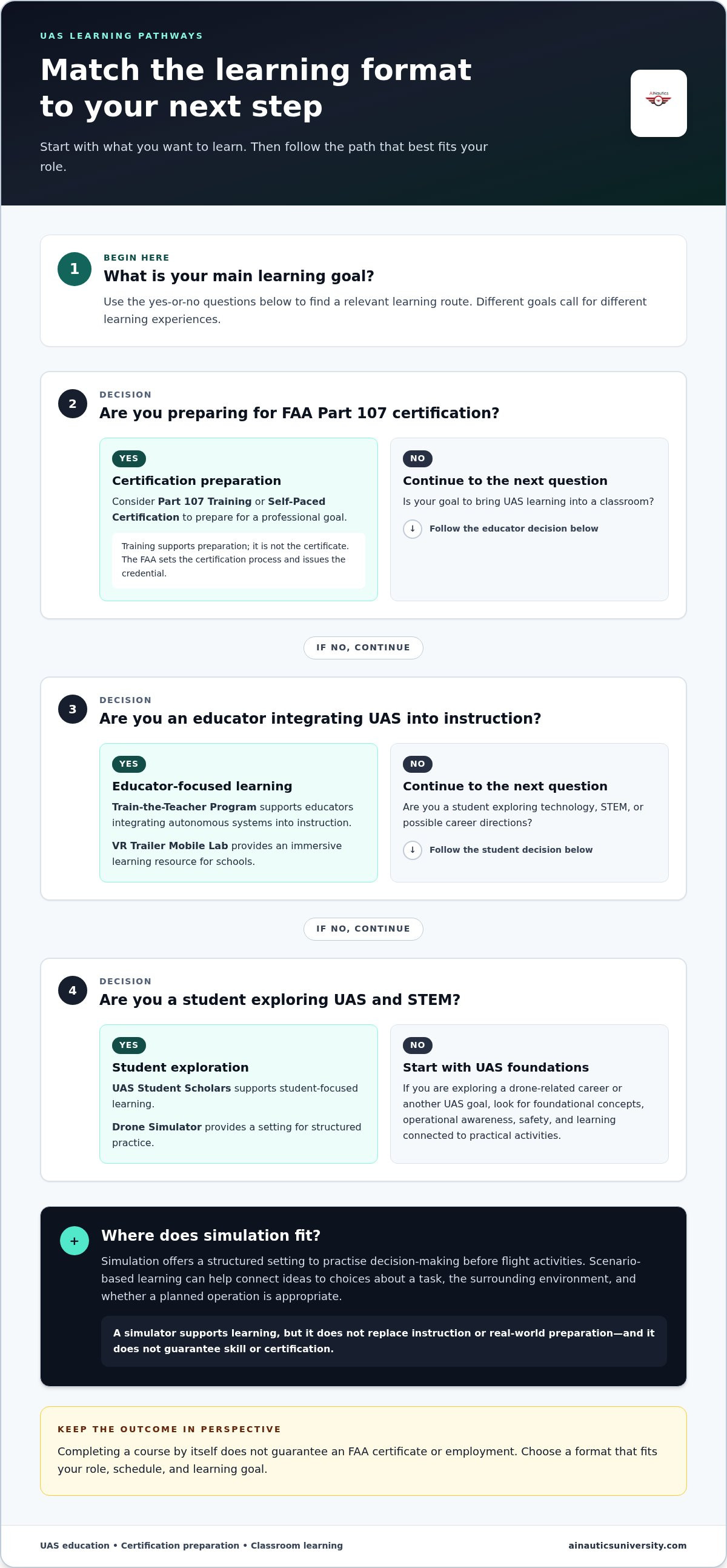
Work backward from the outcome you want. A student exploring UAS, an adult preparing for Part 107, and a teacher planning classroom instruction have different needs. Use this four-step framework to narrow your options:
- Define the goal. Decide whether you want foundational UAS knowledge, certification preparation, classroom integration, or a starting point for exploring career pathways.
- Identify the learner. Consider age, experience, role, and preferred study format. A student’s first exposure to UAS may call for a different experience than an adult’s professional development.
- Compare learning needs. Decide whether flexible study, simulator-supported practice, educator development, or hands-on STEM learning best supports the goal. Look for a clear connection between lessons and practical application.
- Choose a next step. Select a learning option that moves the learner toward the goal without assuming one course or credential will suit everyone.
Which training path fits a student, parent, or career explorer?
Someone seeking FAA Part 107 preparation may benefit from focused training. Students who are still exploring can start with foundational UAS learning and activities that connect technology with problem-solving. Parents can help by discussing a student’s interests and intended next step, rather than treating certification as the only measure of progress.
AINautics University’s UAS Student Scholars program offers a student-focused pathway to consider. Adult learners can decide whether their immediate priority is Part 107 preparation or broader professional development. Match the option to the learner’s current stage and goals. For families exploring student pathways, UAS Scholarship 2026: High School Career Pathway Guide covers a related topic.
What should educators consider when planning UAS learning?
For a school, start with curriculum fit. Consider how UAS topics could support existing instruction, STEM or STEAM initiatives, or CTE pathways. Then plan for instructor preparation and ways students can apply ideas through hands-on learning. AINautics University aligns curriculum with state and district standards, and its Train-the-Teacher Program supports educators integrating autonomous systems into instruction.
A school drone program can use a structured 90-day rollout from planning to flight operations. Treat this as a planning framework, not a fixed schedule for every school. Implementation should reflect the school’s goals and context.
Explore AINautics University’s UAS education programs to identify a practical next step for individual learning, student exploration, or classroom planning.
Build Your UAS Learning Pathway with AINautics University
UAS learning can progress from first concepts to focused study and future application. AINautics University offers resources for different points along that path: Part 107 Training and Self-Paced Certification for certification preparation, the Drone Simulator for structured practice, the Train-the-Teacher Program for educator development, and UAS Student Scholars for student learning. The right combination depends on whether you’re learning individually or developing instruction for a school.
Learn, Train, Certify, Fly, Work describes a possible progression, not a promise of results. Learn the fundamentals, then build knowledge and practise decisions. Certification may be a goal for learners pursuing the FAA process, but completing training does not guarantee a certificate. Flying and exploring work are further steps that depend on readiness, applicable requirements, and individual opportunities.
How can learners move from training toward applied experience?
Start with knowledge that fits your goal, then connect it with practice. Foundational study builds understanding, while simulator practice gives learners a structured setting to think through scenarios. Part 107 preparation may be a step for someone pursuing that credential. Students may first want to explore UAS through broader learning activities.
As interests develop, learners can investigate how UAS knowledge connects to different fields and roles. AINautics University’s resources support learning and preparation, but they don’t guarantee certification or employment. For more context on possible directions, explore Future of Drone Careers: 2026 Industry Outlook and Career Paths.
How can schools begin building a drone education program?
Schools can start by setting learning goals, identifying where UAS topics fit the curriculum, preparing educators, and planning for appropriate flight operations. Aligning instruction with state and district standards, CTE pathways, or STEM and STEAM initiatives can connect drone education to existing priorities. Hands-on learning gives students opportunities to apply classroom concepts.
AINautics University’s Train-the-Teacher Program supports educators integrating autonomous systems into instruction. The VR Trailer Mobile Lab provides another resource for immersive learning. Alongside a clear plan, these offerings can help schools shape an approach around their students, curriculum, and implementation needs.
Whether you’re an individual learner choosing a uav training school or an educator planning UAS instruction, begin with the next skill or learning experience you want to build. Explore AINautics University’s training and education programs to find a path that fits your goals.
Take the Next Step in Your UAS Learning Journey
The right uav training school matches the learner’s goal with suitable preparation. Individuals may focus on Part 107 Training, Self-Paced Certification, or simulation. Students can explore UAS learning, while educators can develop classroom instruction. Training builds knowledge and supports preparation, but certification and career outcomes depend on further steps.
AINautics University brings these pathways together through learner-focused programs, educator training, and student learning opportunities. For schools, the Train-the-Teacher Program and curriculum alignment support UAS education connected to school standards. A structured 90-day rollout can guide a drone program from planning to flight operations, with implementation shaped around the school’s needs.
Choose one practical next step: build foundational knowledge, prepare for certification, or plan a classroom pathway. Explore AINautics University training and education programs and keep moving toward your UAS learning goals.
Frequently Asked Questions
Is a UAV training school worth it if I can study online?
It can be, depending on your goals and how you learn best. Online study offers flexibility, while a structured program can connect foundational UAS knowledge with certification preparation, simulation, or educator resources. AINautics University offers Self-Paced Certification and a Drone Simulator for different parts of a learning pathway. Consider whether you need independent study, scenario practice, or support for classroom learning before choosing a format.
Can a UAV training school prepare me for the FAA Part 107 exam?
Yes. Part 107 Training can help you prepare by focusing your study on knowledge relevant to the FAA Remote Pilot Certificate. Training is preparation, not the certificate itself. The FAA administers the certification process, and completing a course doesn’t guarantee a test result. AINautics University’s Part 107 Training and Self-Paced Certification are learning options for people working toward this goal.
How do I choose a UAV training school for a student or career goal?
Start with the learner’s next step. A student exploring UAS may benefit from foundational learning, while someone pursuing a professional goal may prioritize Part 107 preparation. Educators need resources for classroom integration. Compare options by intended learner, study format, and opportunities to apply concepts. AINautics University’s UAS Student Scholars supports student-focused learning, while its Train-the-Teacher Program serves educators.
What is the difference between a drone simulator and hands-on flight training?
A drone simulator provides a structured environment for practising scenarios and thinking through decisions. Hands-on flight training involves learning through physical flight activities. Simulation can connect concepts to practice, but it doesn’t replace real-world flight experience or instruction. AINautics University’s Drone Simulator supports scenario-based learning as part of broader UAS education.
Do educators need special training to teach drones in school?
Educator-focused preparation can help teachers bring UAS concepts into classroom instruction. The right approach depends on the school’s goals and curriculum. Schools can also consider alignment with state and district standards, STEM or STEAM initiatives, and hands-on activities. The VR Trailer Mobile Lab is another resource for school-based UAS learning.
How long does it take to complete UAV training?
There isn’t one timeline for every learner or program. Completion depends on the learning format, program structure, and learner’s pace. Self-paced study lets learners organize progress around their schedules, while school-based program planning follows a different timeline. AINautics University’s documented 90-day rollout refers to launching a school drone program from planning to flight operations, not the duration of an individual course.
Does completing a UAV training course guarantee an FAA certificate or a drone job?
No. Completing a course doesn’t automatically grant an FAA certificate or guarantee employment. Training can build knowledge and help prepare learners for certification or future career exploration, but those outcomes depend on separate steps. Treat a course as part of a broader pathway: build foundational skills, practise where appropriate, and pursue certification or work goals based on your interests and readiness.

Article by
AINautics University Team
The team behind AINautics University, dedicated to drone education and FAA Part 107 certification prep, VR flight simulation, and STEM training programs for students and educators.


