
What if the strongest case for drone grants for schools isn’t the equipment, but the learning plan behind it? A drone can capture students’ attention, but a credible proposal shows how the program addresses an educational need and supports measurable learning. Connecting curriculum, teacher preparation, equipment, and ongoing costs can be challenging, especially when each funder has different requirements.
This guide explains how to build an evidence-led proposal around your school’s needs. You’ll learn how to define student outcomes, align activities with STEM or career and technical education goals, outline a realistic budget, and plan for training, implementation, and sustainability. Checking each funder’s current eligibility rules and application requirements is essential. Funding is never guaranteed.
Readiness matters as much as enthusiasm. Resources such as AINautics University’s Train-the-Teacher Program, Part 107 Training, Drone Simulator, and VR Trailer Mobile Lab can help schools plan how educators and students will prepare for learning. Use the steps ahead to shape a focused proposal that reviewers can follow and your school can put into practice.
Key Takeaways
- Make the case for drone grants for schools by documenting a student, curriculum, or workforce-readiness need before selecting technology.
- Show how learning objectives connect to classroom instruction, simulation, supervised practice, staff roles, and evidence of student progress.
- Build the budget around the proposed program, then verify that each requested item is eligible under the funder’s current rules.
- Use each funder’s prompts and submission instructions to guide your proposal, and check eligibility, deadlines, and required materials with official sources.
- Plan who will lead the program and how learning outcomes and ongoing costs will be addressed after the grant period ends.
Drone grants for schools: define the educational need before choosing technology
A strong school drone grant proposal connects funding to a specific educational purpose. Start with a need your school can describe and support, such as limited opportunities for hands-on data analysis or a gap in applied technology instruction. Then explain how drone-based learning could address that need. Selecting equipment first can make a proposal read like a shopping list instead of a plan for student learning.
Drones are a tool, not an outcome. Their educational value depends on what students will learn and how educators will guide that learning. Position drones within the wider field of educational technology, then connect proposed activities to relevant STEM, STEAM, career and technical education (CTE), or district priorities. For example, a class could interpret aerial images as a data-analysis exercise, provided the activity supports an identified curriculum objective.
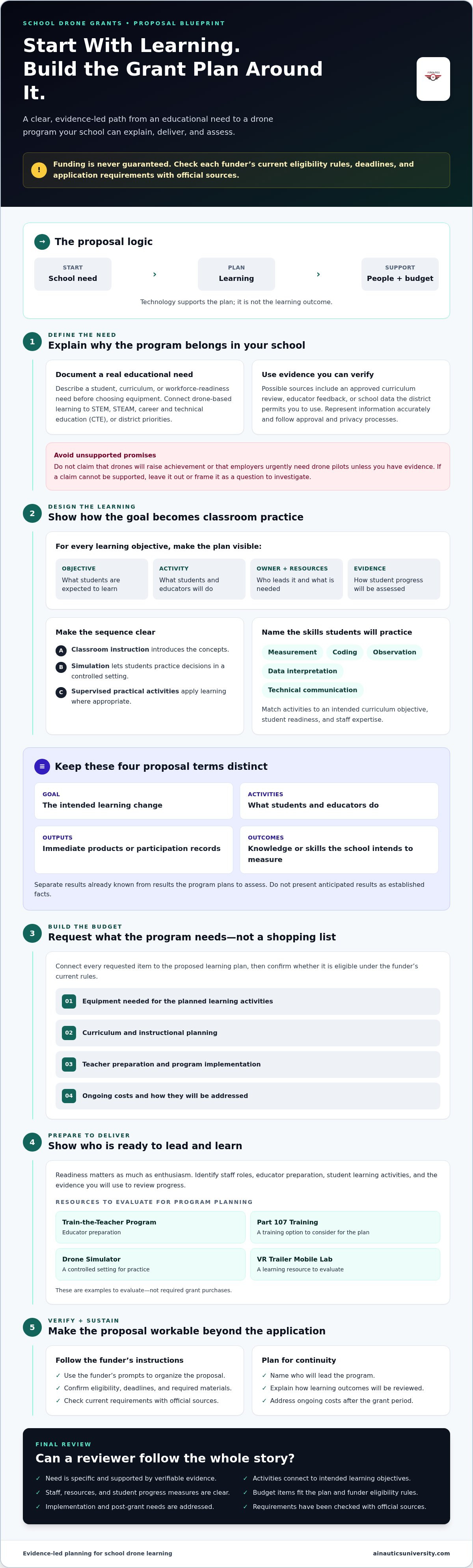
Proposal language to keep the plan clear: “The goal is the intended learning change; activities are what students and educators do; outputs are the immediate products or participation records; outcomes are the knowledge or skills the school intends to measure.” Keeping these terms distinct helps reviewers see the difference between holding a drone activity and demonstrating its educational purpose.
What should a school drone grant proposal demonstrate?
Identify who the program will serve, the learning gap it will address, and what students are expected to gain. Then map that need to planned instruction. For instance, if students have few opportunities to apply classroom concepts through projects, describe a drone-supported activity tied to a specific learning objective. State what you intend to measure, and distinguish information already available from results you plan to assess.
Existing evidence might include an approved curriculum review, educator feedback, or school data the district permits you to use. Planned measures could include student work assessed against a project rubric or records of completed learning activities. Don’t present an anticipated result as an established fact.
How can a school establish a credible need?
Build the case from evidence you can verify and are authorized to share. Review relevant curriculum priorities, ask educators where instruction could benefit from applied learning, and describe student opportunities precisely. If you cite school or district information, represent it accurately and follow applicable approval and privacy processes.
Avoid unsupported claims such as “students are demanding drones,” “the program will raise achievement,” or “local employers urgently need drone pilots.” If you lack evidence for a claim, leave it out or frame it as a question the program will investigate. Once the need is clear, consider whether the school can support delivery. AINautics University’s Train-the-Teacher Program and curriculum alignment resources are examples of educator preparation and planning options to evaluate, not required grant purchases.
Design a school drone program that reviewers can understand and assess
A clear program plan turns an educational goal into work the school can deliver and evaluate. For each learning objective, identify the student activity, the staff member responsible, the resources needed, and the evidence that will show progress. Reviewers can then assess whether the proposal is coherent and realistic, rather than a collection of technology purchases.
For example, if students are learning to interpret data, they might review information gathered during a supervised drone lesson and explain what it shows. Classroom instruction can introduce concepts, simulation can let students practice decisions in a controlled setting, and practical activities can apply the learning where appropriate. Explain the sequence and purpose of each part. A FAA guide to educational drone use can help schools identify relevant federal guidance as they plan activities.
How should schools connect drones to STEM learning objectives?
Name the skills students will practice, such as measurement, coding, observation, data interpretation, or technical communication, and connect each skill to an intended curriculum objective. Choose activities that match students’ readiness and staff expertise. For example, students might use a simulator to practice planning a flight before analyzing a supervised practical exercise. Consult a drone curriculum for educators and adapt activities to local standards and student needs.
Build educator preparation and curriculum alignment into the design from the start. AINautics University’s Train-the-Teacher Program and Drone Simulator are examples of resources a school could evaluate. They are options, not required purchases. Confirm that any proposed expense fits the funder’s rules.
What belongs in an implementation plan?
Assign responsibilities by role. A program lead might coordinate planning, an educator might deliver instruction, designated staff might oversee activities, and a team might review student work. Name the people or roles responsible, and explain how teachers will prepare and receive curriculum support. A VR Trailer Mobile Lab may suit some delivery plans, but include it only if it addresses a defined need.
Use this checklist as a planning aid, not a substitute for an application’s instructions:
- Learning design: Objectives, activities, student group, and evidence of progress.
- Delivery: Staff roles, educator preparation, curriculum alignment, and selected learning resources.
- Oversight: How the school will review activities and consult current FAA guidance.
- Assessment: What the school will examine to understand student learning.
These are useful proposal components, not universal funder requirements. For drone grants for schools, follow each opportunity’s current prompts and eligibility rules. Schools considering educator preparation can review AINautics University’s Train-the-Teacher Program as one possible resource when shaping an implementation plan.
Build a realistic drone grant budget and compare program options
Build the budget from the learning plan, not from a list of attractive purchases. For each proposed expense, explain which activity it supports, who will use it, and how it contributes to the intended learning. Then check the funder’s current guidance. Allowable costs, eligibility, documentation, and budget formats vary by opportunity, so don’t assume that a resource is fundable simply because it fits the program.
Depending on the plan and funder rules, categories to investigate may include instruction, educator preparation, curriculum or other learning resources, implementation, and evaluation. Include only items directly connected to the proposal. Document how each estimate was developed, obtain current estimates before submitting, and distinguish confirmed costs from assumptions. Project Lead The Way’s page on STEM grant opportunities can be a useful starting point as you explore funding resources.
Which budget details should schools investigate?
Check every line item against the funder’s rules before including it. If the plan includes teacher preparation, explain its instructional purpose. If it includes a simulation resource, name the learning activity that will use it. Confirm whether the funder permits each category and what estimates or supporting documents the application requests. These are planning prompts, not universal eligibility requirements.
For drone grants for schools, a responsible budget also makes assumptions visible. Note what the school already has, what it proposes to request, and what still needs a current estimate. Don’t present an unverified figure as a firm cost.
How can schools compare training and learning resources?
Compare options by educational fit, staff capacity, accessibility for intended learners, and whether the resource can be sustained. AINautics University offers a Train-the-Teacher Program, Self-Paced Certification, Drone Simulator, and VR Trailer Mobile Lab. These are different types of educator preparation and learning resources to evaluate against your plan, not grant-approved purchases. Verify eligibility with the funder before budgeting for any of them.
Use these questions as a comparison aid. Costs and eligibility details depend on the funder and should be verified.
Educator training: Does the plan need to prepare teachers to deliver instruction?
Self-paced learning: Would this format fit the learners and the proposed instructional goals?
Simulation: Does practice in a simulated setting support the learning sequence?
Mobile lab: Would this option address a delivery or access need the school has identified?
For a deeper comparison of immersive approaches, look for guidance on immersive drone training technology. Choose resources because they serve the program, not because they sound novel.
Write a step-by-step drone grant proposal and verify every requirement
A strong application connects the need, program activities, budget, and intended results in one clear argument. Follow the funder’s prompts, definitions, format, and submission instructions. Use this workflow to organize the work, then treat the official notice as the final authority.
- Review the opportunity. Confirm that the school and proposed activities fit the stated eligibility criteria, timeline, and intended learners.
- Build the case. Draft the documented need, then connect it to the program plan and the learning outcomes the school intends to assess.
- Develop the budget narrative. Explain how each requested item supports a planned activity. Check the funder’s rules for every cost category.
- Describe evaluation. State what evidence the school will collect and how it will use that evidence to assess progress.
- Complete a compliance review. Ask a reviewer to check required documents, relevant school or district permissions, consistency, formatting, and submission details.
“Check eligibility and allowable costs in the current official notice before preparing or submitting the application.” Requirements can differ between opportunities, so don’t rely on an old application, a general checklist, or another school’s interpretation.
How can a school check proposal consistency?
Use a review table to trace each part of the proposal from the need to the evidence. If a budget item has no matching activity, explain its purpose or reconsider it. If an outcome has no measure, identify suitable evidence or revise the outcome.
| Proposal element | Reviewer’s check |
|---|---|
| Need | Is it specific and supported by available evidence? |
| Activity | Does it address the need and serve the intended learners? |
| Budget item | Does it support an activity and comply with funder guidance? |
| Outcome | Does it describe intended learning or progress? |
| Evidence | Can the school collect it and use it to review progress? |
How can a school avoid common proposal weaknesses?
Replace broad promises with concrete descriptions. Instead of claiming a drone program will improve achievement, explain the learning activity and what student work or other evidence the school plans to review. Don’t claim local workforce demand or student interest without support. Check that every budget item has a clear role, and distinguish proposed outcomes from results already demonstrated.
Before submitting, compare the final application with the funder’s instructions line by line. If educator preparation is part of the plan, explore AINautics University’s Train-the-Teacher Program as a resource to consider for implementation planning.
Plan for implementation and sustain a school drone program after funding
A credible plan looks beyond the grant period. Identify who will lead instruction, support participating teachers, maintain curriculum, and review student learning. Assign these responsibilities to specific roles, such as a program lead, classroom educators, and staff who help assess student work. Explain how they’ll coordinate so the program doesn’t depend on one person’s availability or knowledge.
Separate what the school can continue with existing capacity from what depends on additional resources. A class might retain some classroom lessons or project work, while other activities could rely on training, equipment, or learning resources supported by the grant. State these assumptions openly. Don’t imply that future grants, recurring funds, or program expansion are certain.
How can schools plan for continuity beyond a grant period?
Describe how the school will review and update its curriculum, prepare instructors, and provide students with relevant career and workforce guidance. Identify what will prompt a curriculum review and who will take responsibility. Educators considering certification preparation can explore FAA Part 107 drone training resources alongside the school’s instructional plan. Any certification-related activities should fit the program’s goals and be checked against current requirements.
Plan to revisit learning evidence, too. Student work, project records, or other measures already identified in the proposal can help educators decide which activities to keep, adapt, or discontinue. This makes continuation a reasoned decision based on capacity and learning, not an assumed expansion.
What educational support can help a school move forward?
Choose support that addresses a defined implementation need. AINautics University’s Train-the-Teacher Program may be relevant when educators need preparation; UAS Student Scholars may be worth considering where student support aligns with the school’s plan. The Drone Simulator and VR Trailer Mobile Lab are learning resources, not funding sources. Assess their fit and confirm that any proposed expense is allowed by the funder.
AINautics University describes a 90-day drone-program launch pathway. Treat it as a program implementation pathway, not a grant deadline, funding promise, or guarantee that a school can launch on a particular schedule.
Before finalizing the plan, check that:
- Delivery, teacher support, curriculum updates, and evaluation have assigned owners.
- The school has distinguished activities it can sustain from those requiring new resources.
- Any continuation costs or funding assumptions are clearly identified and verified.
- Proposed learning resources fit the educational need and the funder’s current rules.
Thoughtful planning can help a school make responsible decisions about drone grants for schools, whether or not an application is funded. Educators ready to explore possible learning support can assess AINautics University’s Part 107 Training, Train-the-Teacher Program, Drone Simulator, and other educational resources against their needs.
Turn your proposal into a practical learning plan
A strong case for drone grants for schools starts with a documented educational need, then connects that need to clear learning activities, responsible staff, and evidence of progress. Build your budget around the plan, verify every cost and application requirement with the funder, and show how the school will sustain learning without assuming future funding is guaranteed.
Implementation matters as much as the proposal. Educator preparation, curriculum alignment with state and district standards, CTE pathways, and STEM or STEAM initiatives can help make a program deliverable. Depending on the school’s needs, simulation-based learning or a VR Trailer Mobile Lab may also be worth evaluating as educational resources.
AINautics University offers educator training, UAS Teacher Scholars, simulation, curriculum resources, and other drone education options for schools to assess against their goals. These resources support planning and learning, but do not replace checking funder requirements or guarantee grant funding. Explore AINautics University’s educator training and drone education resources as you shape your next steps. With a clear purpose and a realistic plan, your school can make a confident case for meaningful student learning.
Frequently Asked Questions
Can schools get grants for drone programs?
Schools may find funding opportunities that support STEM or technology education, but availability and eligibility depend on each funder. For drone grants for schools, review the current official guidance and confirm eligible applicants, allowable costs, deadlines, required application materials, and any school or district approvals. Funding is never guaranteed. This article offers general planning guidance, and AINautics University provides educational resources, not grants or funding guarantees.
How do you write a grant proposal for a school drone program?
Start by identifying a documented educational need, then define measurable learning objectives and design activities with clear staff roles. Create a budget that follows the funder’s rules, explain how the school will evaluate progress, and connect each requested resource to a planned learning activity. Before submission, check every prompt, document, format, and deadline against the current official application instructions. Keep the need, program plan, budget, and evaluation approach consistent.
What should a school include in a STEM technology grant budget?
Build the budget from the proposed program and include only expenses that support its activities and intended outcomes. Depending on the funder’s rules, categories to investigate may include instruction, educator preparation, learning resources, implementation, and evaluation. Allowable costs vary by opportunity. Document assumptions, obtain current estimates, and confirm every item against the specific funding notice before requesting funds. Don’t treat a sample budget or another school’s award as proof of eligibility.
Can a school use a grant to buy drones?
Possibly, but equipment eligibility depends on the grant’s purpose and rules. Check the current official funding notice to see whether equipment purchases are allowed, what documentation is required, and whether related or alternative costs are addressed. Don’t assume a drone purchase qualifies simply because the proposal includes STEM activities. Explain how any requested equipment supports a specific learning activity, and confirm the expense is permitted before including it in the budget.
How can schools show that a drone program will benefit students?
Connect the program to a documented educational need, clear learning objectives, planned classroom activities, and a method for reviewing student progress. Use school or district evidence only when it’s accurate and authorized. Avoid promising achievement gains without supporting evidence. Explain how educators will deliver the activities and how the curriculum aligns with relevant school priorities. A practical evaluation plan might identify the student work or other evidence the school will review.
Do teachers need drone training before starting a school program?
Training needs depend on the planned activities, staff roles, and applicable requirements. Identify the knowledge and oversight educators need to deliver the proposed instruction, then verify relevant rules through official sources. Preparation can help teachers lead learning with confidence and connect activities to the curriculum. AINautics University offers a Train-the-Teacher Program and other educational resources schools can assess against their needs. Don’t assume one training approach fits every program.
How can a school sustain its drone program after grant funding ends?
Plan for continuity before applying by identifying who will lead activities, support teachers, maintain curriculum, and review learning outcomes. Separate activities the school can continue with existing capacity from those that depend on additional resources. Consider ongoing curriculum support and educator preparation, and state funding assumptions clearly. Don’t assume another grant or program expansion will follow. A realistic continuation plan shows how the school intends to preserve useful learning while accounting for its capacity.

Article by
AINautics University Team
The team behind AINautics University, dedicated to drone education and FAA Part 107 certification prep, VR flight simulation, and STEM training programs for students and educators.


