
The online drone school vs. in-person choice isn’t simply about where you learn. Online training offers a self-paced schedule, while in-person classes provide direct interaction and a more structured learning environment. Either format can help you prepare for the FAA Part 107 exam.
It makes sense to want flexibility without losing the guidance and structure that keep your studies on track. The right choice depends on how you learn, when you can study, and whether you want live instruction or the freedom to learn on your own schedule.
This guide compares the two formats across scheduling, instructor feedback, accountability, and Part 107 test preparation. You’ll see where self-paced lessons can fit around school, work, or teaching commitments, and when in-person instruction may better support your learning. Use those differences to choose a training path that helps you build confidence with the material and move toward your next step in drone education.
Key Takeaways
- Match your training format to the time and structure you need to study consistently.
- Compare how each format supports instructor feedback and keeps you accountable.
- Use your learning preferences to decide whether self-paced lessons or direct classroom interaction suits you better.
- Choose a Part 107 preparation approach that helps you understand the material, not just review it.
- Consider how a drone simulator can complement your learning as you build toward your next step.
What Is Online Drone Training?
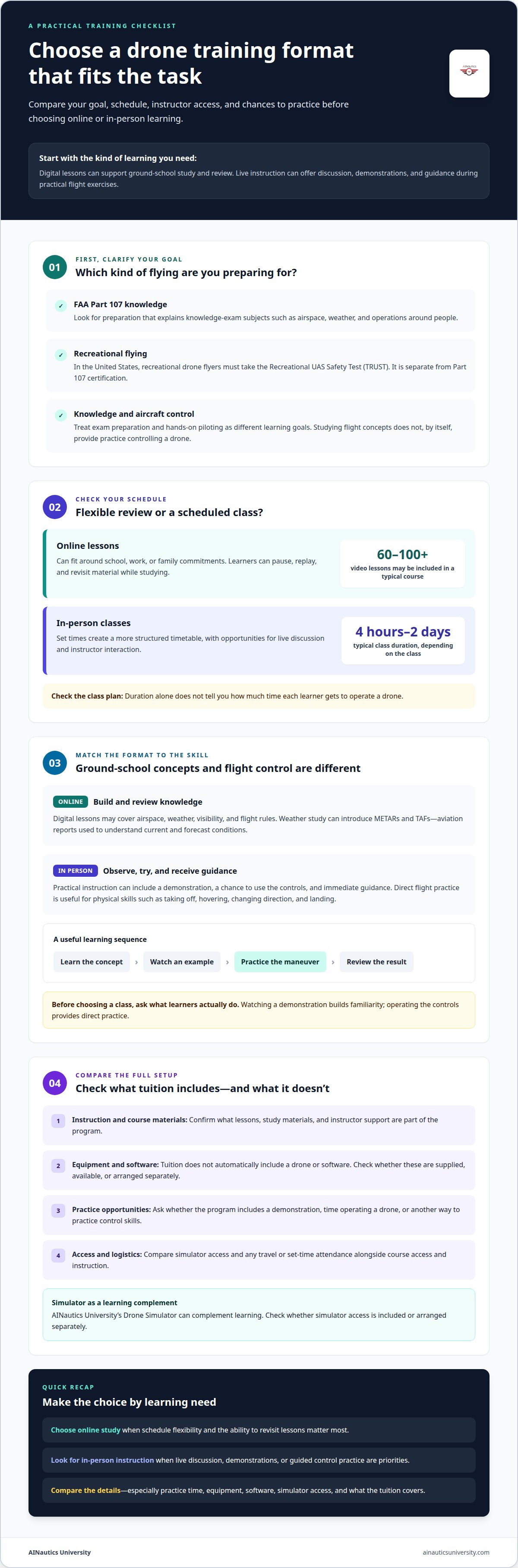
Online drone training teaches ground-school topics through digital lessons, study materials, and practice activities. A typical course includes 60-100 or more video lessons. These may cover airspace, weather, visibility, and flight rules. For example, weather lessons can introduce METARs and TAFs, aviation reports used to understand current and forecast conditions. Learners can pause, replay, or revisit material while studying. That format supports review, but a screen-based lesson is not the same as controlling a drone in person.
In the United States, a pilot must obtain an FAA Part 107 Remote Pilot Certificate to conduct commercial drone work or other non-recreational flying, according to the Federal Aviation Administration. Online courses can help learners prepare for the knowledge exam by explaining its subject areas. They can also help students organize study around school, work, or teaching schedules. However, studying flight concepts and practicing aircraft control are different parts of learning.
Which drone skills require hands-on, in-person training? Skills involving physical control, such as taking off, hovering, changing direction, and landing, benefit from direct flight practice. Videos alone do not make a course hands-on. In-person instruction can combine a demonstration, an opportunity to try the controls, and immediate guidance while operating a drone.
Some in-person drone ground-school sessions include demonstrations with a student’s or instructor’s drone. An instructor might show how control inputs affect movement, then let learners observe the aircraft’s response. The practical value depends on what happens during the session: watching a demonstration builds familiarity, while operating the controls provides direct practice. Find out what learners do in a lesson rather than assuming every classroom course includes flight time.
In-person drone training classes typically take 4 hours to 2 days, depending on the class. That time may combine instruction, demonstrations, and practice. A short session can introduce controls, while a longer class can allow more time to repeat a maneuver and discuss the result. The stated class duration alone does not show how much time each learner spends flying, so look at the planned activities when comparing formats.
Online lessons can explain a flight maneuver, but learners still need a practical way to develop control skills. A useful sequence is to learn the concept, watch an example, practice the maneuver, and review the results. For instance, a learner studying turns can apply the lesson in a supervised flight exercise. This connects classroom knowledge to aircraft movement without confusing exam preparation with flight proficiency.
Choose a course by separating its learning goals. For Part 107 knowledge, review whether it covers topics such as airspace, weather, and operations around people. For flight skills, identify whether instruction includes a drone demonstration or actual control practice. A learner preparing for an exam may prioritize structured study materials; someone new to piloting may also need opportunities to practice with an aircraft.
Online and in-person training can support different parts of preparation. Digital lessons let learners revisit challenging topics, such as reading a weather report. A live demonstration can make aircraft movement easier to observe. Match the format to the skill: use focused lessons to build knowledge, then practical instruction to learn drone control.
Choosing a training format by learning style and schedule
Start with your goal, available study time, and preferred learning style. Online programs can fit around school, work, or family commitments. Classroom sessions provide a fixed timetable and opportunities for live discussion. A student balancing classes, for example, may prefer flexible lessons, while a group learning together may value scheduled instruction.
Recreational flyers have a different learning task from Part 107 exam candidates. The Federal Aviation Administration requires recreational drone flyers in the United States to take the Recreational UAS Safety Test, or TRUST. That test is separate from Part 107 certification. Identify whether your goal is recreational flying, professional knowledge, or both before choosing a course. The online drone school vs in-person training comparison starts with that goal.
What equipment and software are included in drone school tuition? Inclusions depend on the program and its purpose, so tuition does not automatically include a drone or software. When comparing programs, distinguish course access and instruction from physical equipment, simulator access, and other tools.
Enterprise dealer training may cover product demonstrations, operational workflows, or ways to explain equipment to customers. A live demonstration can show how a particular drone responds to controls, while online modules can deliver consistent product learning across locations. Choose demonstrations to observe equipment in action and digital lessons to review information. This distinction can clarify the online drone school vs in-person choice for dealer teams.
Compare more than tuition. Check whether instruction, course materials, equipment use, software, and practical demonstrations are included or arranged separately. An in-person class may require travel and attendance at set times; an online program may leave learners to arrange their own practice equipment. Compare the complete learning setup, not just the course label.
A professional pilot training program should match the work a learner hopes to do. Someone preparing for aerial photography, for example, may need to study flight planning alongside camera workflows. A learner pursuing mapping may need instruction related to data collection and mission planning. These are examples of different goals, not standard course contents.
Use a straightforward decision process: define your goal, identify the topics and practice you need, then choose a schedule that supports steady progress. If you benefit from reviewing material independently, online lessons may suit you. If live explanations and demonstrations help you learn, prioritize scheduled instruction. Educators should also consider how each format supports their preparation and their students’ learning activities.
Differences in instructor feedback and accountability
Online courses support independent study, while instructor-led classes offer scheduled interaction and direct feedback. A course completion record and an FAA Remote Pilot Certificate are different credentials. Employers may consider what each represents alongside a pilot’s relevant skills.
Direct Interaction and Instructor Feedback
In-person instruction gives learners an opportunity to ask questions as a lesson unfolds. An instructor can clarify a mapping concept, respond to a learner’s example, or explain why a planned step needs revision. Check whether a class includes discussion, demonstrations, and feedback on learner work. Learning alongside other students can also make it easier to work through a task together.
The training setting affects the kind of interaction available. A classroom supports group discussion, while a suitable practice area can support instructor-led flight activities. Each setting has a different purpose. A mapping workshop, for example, might guide learners through planning a sample survey and discuss how flight paths relate to the intended data. Check what instruction and practice the class includes.
Online Instructor Access and Self-Discipline
Online drone ground schools may not provide immediate access to instructors. Some courses let learners submit questions or request feedback, but responses may not arrive during a study session. Review how to communicate with instructors and how feedback is delivered. Then set a regular study block and keep a list of questions, such as why a mapping exercise uses a particular route.
Self-paced lessons require discipline because learners take on more responsibility for their progress. Break a course into manageable sessions, record completed topics, and revisit difficult material before moving on. After a mapping lesson, for example, summarize the workflow in your own words and note any unclear steps. Calendar reminders can add structure without requiring classroom attendance.
Instructor-guided drone mapping workshops can provide structure for a specialized learning goal. Learners can follow a defined example, ask about planning choices, and discuss how each step supports the task. Online instruction may cover the same topic through recorded explanations or written activities. Compare the feedback methods, not just the topic titles, to see how much guidance each format provides.
For accountability, look for specific course features, such as scheduled meetings, progress milestones, instructor feedback, or independent assignments. A live class creates a shared timetable. An online course puts more responsibility on learners to plan, even when instructor access is available. Neither format alone shows that a learner can perform a task. Employers may value relevant credentials, practical ability, and training that matches the role.
Choose the format that supports the work you need to learn. If you need to discuss mapping decisions, prioritize instructor interaction. If you study consistently on your own, online lessons may provide useful flexibility. In either format, connect each lesson to a concrete outcome, such as explaining a flight plan or interpreting feedback on an exercise.
Online versus in-person Part 107 test preparation
Online and in-person classes can both organize study for the Part 107 knowledge exam. Online lessons support review on a learner’s schedule, while classroom instruction adds scheduled explanations and discussion. The exam tests aeronautical knowledge, so choose the format that helps you understand and apply the material, not simply complete lessons.
In the United States, pilots must obtain an FAA Part 107 Remote Pilot Certificate to conduct commercial drone work or other non-recreational flying, according to the Federal Aviation Administration. Preparing for certification means learning exam topics, then practicing how to interpret questions accurately. Online preparation can make it easier to revisit a difficult lesson; in-person teaching gives learners a chance to ask questions during class.
The Part 107 exam has 60 multiple-choice questions and a 120-minute time limit. A passing score is 70%. Those figures make timed practice useful: answer questions under a time limit, then review both missed answers and uncertain guesses. Focus on the reasoning behind each answer, especially for topics such as airspace, weather reports, and operating limits.
Build a study plan around focused review and practice exams. Most students need 15-20 total study hours to prepare for online drone training. Divide study time across topics instead of cramming everything into one session. For example, review a weather lesson, complete related practice questions, and note which concepts still need attention. Use a later session to revisit those weak areas.
Practice-test results can help guide your next study step. Instructors commonly recommend scoring at least 85% on practice exams before scheduling the Part 107 exam. Treat that as a preparation target, not the official passing score. If practice results fall short, identify recurring errors, review the related lessons, and retake questions after studying the underlying concept.
Many online training courses include practice question banks with 300-400 or more questions. A large bank gives learners varied examples, but completing questions alone does not prove understanding. Read each explanation, connect it to the relevant topic, and keep a short record of errors. In a classroom, ask the instructor to explain a confusing question; online learners can use available instructor access or revisit the lesson.
Use a simple study cycle: learn a topic, answer practice questions, review mistakes, and repeat. If a practice exam reveals repeated confusion about airspace, revisit that material before taking another full test. In-person classes provide scheduled structure, while online preparation makes targeted review easier to fit around other commitments. Consistent practice supports stronger exam readiness in either format.
According to the Federal Aviation Administration, anyone who fails the Part 107 exam must wait 14 days before retaking it. Use that interval to review missed subject areas rather than repeating the same study routine. A simulator can support learning about flight concepts, but exam preparation still needs focused review of knowledge-test topics.
Benefits of self-paced online lessons
Self-paced lessons let learners choose when to study and how often to review. This flexibility can help fit drone learning around classes, work, or family responsibilities. A learner might study one topic after school, then return to a challenging lesson during a quieter weekend. The online drone school vs in-person choice often comes down to whether flexible scheduling or live structure matters more.
Online training can accommodate different learning speeds. A learner who understands airspace quickly can move on, while someone who needs more time can revisit the topic first. Understanding why a rule applies is more useful than rushing through a course. Use progress markers to track completed topics and identify lessons to review.
Plan a steady routine rather than waiting for a long block of free time. Online drone training usually takes 2-4 weeks of steady study, while some students take 2-3 months to complete it. Those ranges show how schedules can vary. Choose study blocks that fit your actual week, then adjust your pace if school, work, or other commitments change.
Build a practical routine: set a regular study time, focus on one topic, and record anything that needs review. After studying weather, for example, write down a question about interpreting a forecast and return to it in your next session. This gives self-directed learning structure without requiring attendance at a fixed class time.
Digital lessons also make focused review easier. If a practice question exposes confusion about visibility limits, return to the relevant lesson rather than repeating every topic. Then try a new question and explain the reasoning in your own words. This turns a missed answer into a specific study task and supports certification preparation.
Flexibility still takes follow-through. An open-ended course does not set a personal deadline, so add milestones to your calendar and protect study time. If a week gets busy, schedule a shorter review instead of abandoning the plan. Check that the curriculum reflects current FAA rules, which can change, before relying on it for exam preparation.
Self-paced learning can suit students, educators, and aspiring pilots who need control over their study schedule. It may be less suitable for someone who depends on fixed class meetings to stay on track. In the online drone school vs in-person comparison, consider your learning habits, career goals, and need for instructor interaction. For structured independent study, explore self-paced certification learning as a way to organize your next step.
AINautics University: Drone Simulator
AINautics University offers a Drone Simulator for learners who want to add simulated flight practice to their drone education. It can complement Part 107 Training by giving learners another way to engage with flight concepts, alongside focused study for the knowledge exam. Simulation supports learning, but it does not replace instruction with a physical aircraft when hands-on flight practice is needed.
Educators building UAS learning experiences for students can explore the Train-the-Teacher Program and VR Trailer Mobile Lab. Choose the resource that fits your next step, whether you are strengthening your own preparation or supporting drone education in a classroom.
Contact AINautics University to discuss which learning option fits your goals.
Turn Your Training Choice Into a Next Step
Your choice between online drone school and in-person training should support the direction you want to take next. Set a practical goal, such as preparing for Part 107 certification or bringing UAS learning into a classroom, then choose a path that helps you build toward it.
AINautics University offers Part 107 Training for certification preparation, along with a Train-the-Teacher Program and VR Trailer Mobile Lab for educators developing drone learning experiences. Learners can also explore the UAS Student Scholars program as a next step in their UAS journey. These options can help connect your next step to your role as a learner, teacher, or future UAS professional.
Contact AINautics University to discuss your drone education goals. Keep building your knowledge, and take the next step with purpose.
Frequently Asked Questions
How much do online and in-person drone schools cost in the United States?
Costs depend on the format and what the course includes. Compare instruction, study materials, instructor access, equipment use, and any travel or practice expenses. A classroom course with demonstrations may use different resources from online lessons completed independently. Before choosing, list the support you need and compare the complete course setup, not tuition alone. This makes it easier to see how each option fits your training goals.
Do online drone schools prepare students for the FAA Part 107 exam?
Yes, online drone schools can prepare students for the FAA Part 107 exam by teaching its knowledge topics and providing practice questions. Preparation works best when you review explanations, not just answer questions. For example, after missing an airspace question, revisit the related lesson and explain the correct reasoning. A course supports study, but completing it is distinct from earning the FAA Remote Pilot Certificate.
How long do online and in-person drone courses take to complete?
Online training commonly takes 2-4 weeks of steady study, though some learners take 2-3 months. In-person classes typically run from 4 hours to 2 days, depending on the class. These durations describe different formats, so plan around your available time and course structure. A self-paced learner can spread lessons across a longer period, while classroom attendance follows the scheduled session.
What are the pros and cons of online drone training?
Online training offers flexible scheduling and lets learners revisit lessons, which can help when balancing study with school or work. It also calls for self-discipline, since learners need to set their own routine. Instructor feedback may not be immediate, and online lessons alone do not provide physical flight practice. Use digital study for exam topics, then pursue appropriate hands-on instruction if your goals include aircraft control.
How can I find local in-person drone training near me?
Start by identifying the training you need: Part 107 exam preparation, flight practice, or educator-focused instruction. Then look for classes that state their location, schedule, and whether they include demonstrations or hands-on activities. For educators planning UAS learning, AINautics University’s VR Trailer Mobile Lab is an educational resource to consider. Its relevance depends on whether you’re arranging learning for a school or seeking an individual class.

Article by
AINautics University Team
The team behind AINautics University, dedicated to drone education and FAA Part 107 certification prep, VR flight simulation, and STEM training programs for students and educators.


