
What if a drone policy could protect students and give them more room to learn? A practical school district drone policy template can do both by clarifying who may approve flights, how educators supervise them, and where safety and privacy boundaries apply.
Districts need consistent controls while still making space for hands-on learning. The key is to define responsibilities clearly, so teachers are not left to interpret them on their own. A policy should distinguish educational activities from other types of drone operations and direct staff to verify the requirements that apply before flying.
This guide provides an adaptable framework and sample language for authorization, supervision, safety, privacy, educational use, and accountability. It also shows how to connect written rules to educator preparation and student learning. AINautics University’s Train-the-Teacher Program, Part 107 Training, Drone Simulator, and VR Trailer Mobile Lab can support implementation by helping educators build knowledge and practice. Use the outline as a starting point, then align it with district procedures and current requirements.
Key Takeaways
- Use a school district drone policy template to organize decisions about purpose, scope, authorization, operations, privacy, and review.
- Name a responsible role and record a decision in every policy section so expectations are clear across schools.
- Choose an approval model that fits your district, then define who can authorize flights and what each approval covers.
- Draft the policy with adaptable prompts and placeholders, then align it with applicable district procedures and current requirements.
- Connect educator preparation, curriculum, and practice tools to help staff apply policy consistently without confusing training with operational approval.
Why a School District Drone Policy Template Needs More Than Flight Rules
District leaders face a practical balancing act: making room for meaningful drone-based learning while setting clear boundaries for where, when, and by whom flights may be authorized. A school district drone policy template can turn that challenge into shared expectations. Without a district-wide framework, schools may interpret approval, supervision, and accountability differently, leaving educators and families unsure how a program is governed.
A strong policy does more than list flight restrictions. It defines the district activities and locations it covers, identifies who can approve drone use, and sets expectations for staff and students. It also connects learning goals, such as coding, engineering, or data analysis, with practical safeguards and responsibilities.
What a district-wide drone policy should accomplish
Start by defining the scope. For example, decide whether the policy applies to classroom activities, outdoor flights on school grounds, school-sponsored events, or off-campus learning activities. These are district decisions, not assumptions to copy from a generic template. Then establish a consistent foundation for authorization, supervision, safety, and accountability across participating schools and approved users.
Keep the policy distinct from the documents that put it into action. The policy sets district expectations. Operational procedures explain how an approved activity is prepared and conducted, while lesson plans describe what students will learn. Applicable FAA, state, district, and school-board requirements remain separate obligations. The policy should direct staff to current authoritative guidance rather than attempt to replace it.
Who should shape the policy before adoption
Involve the people responsible for governance and implementation in drafting. District leadership, educators, safety personnel, and relevant board stakeholders can identify decision points and practical needs. Include privacy and student-data expertise when reviewing activities that may collect or use images or other information. The appropriate review process depends on district structures and local requirements.
- District leadership: define the policy’s scope and approval structure.
- Educators: identify classroom goals and supervision needs.
- Safety and privacy stakeholders: review operational boundaries and proposed data practices.
- Policy owner: coordinate revisions and communicate approved procedures.
Assign one role to maintain the document, gather feedback, and share updates with affected schools. This keeps the policy usable as programs develop, while making clear that training or a lesson plan does not substitute for district authorization.
Treat the template as a starting framework, not a universal legal document. Adapt it to local governance, review it against current requirements, and involve qualified district reviewers before adoption. The template can organize decisions, but it isn’t legal advice.
What to Include in a School District Drone Policy
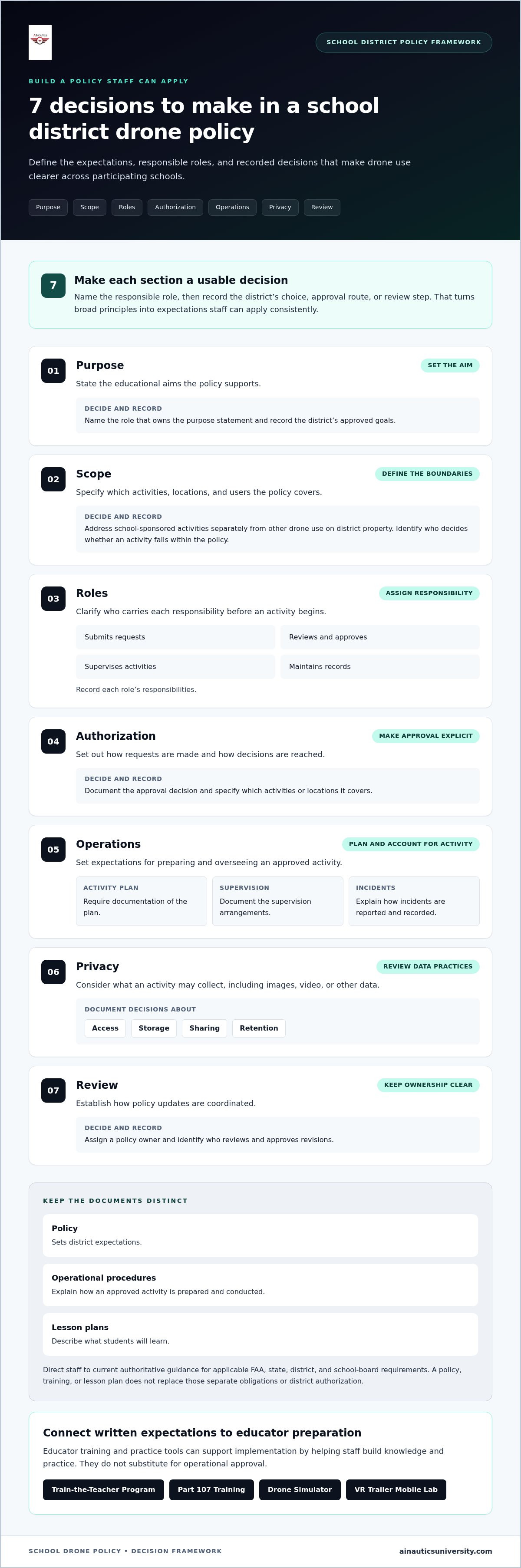
Build the policy around specific decisions, not broad principles. For each section, identify the role responsible and record the district’s choice, approval route, or review step. This turns a school district drone policy template into a governance document staff can apply consistently.
Use these modules as prompts. Adapt them to district procedures, and have appropriate reviewers check relevant FAA, state, school-board, and district requirements. Treat those requirements as items to verify, not legal language to copy into a template.
- Purpose: State the educational aims the policy supports. Name the role that owns this statement and record the district’s approved goals.
- Scope: Define which activities, locations, and users the policy covers. Address school-sponsored activities and other drone use on district property separately, and record who decides whether an activity falls within the policy.
- Roles: Identify who submits requests, reviews and approves them, supervises activities, and maintains records. Record each role’s responsibilities.
- Authorization: Set out the request and decision process, including how approval is documented and which activities or locations it covers.
- Operations: Require responsible staff to document the activity plan, supervision arrangements, and process for reporting and recording incidents.
- Privacy: Require a review of the images, video, or other data an activity may collect. Document decisions about access, storage, sharing, and retention.
- Review: Assign an owner, define how revisions are coordinated, and record who reviews and approves updates.
Authorization, supervision, and operational boundaries
Make the approval path explicit: who submits a request, who evaluates it, who authorizes it, and where the decision is recorded. Set supervision expectations for instructional activities and student participation, including which staff role oversees each activity. Ask program leads to document operational plans and explain how incidents are reported and recorded. These are district design decisions. The template should capture them rather than assume one procedure fits every school.
Include a prompt to verify which FAA requirements apply to the planned activity. The FAA’s rules for educational drone use can help district reviewers distinguish educational use from operations that may fall under Part 107. Have qualified reviewers confirm current applicability before the district adopts language or approves an activity.
Student privacy, data handling, and prohibited uses
Before approving an activity, identify what the drone may capture and why that information is needed. Then document who may access the data, where it will be stored, how it may be shared, and how long it will be retained, following applicable district procedures. Ask privacy and student-data reviewers to assess proposed restrictions or prohibited-use language against current requirements rather than treating generic wording as universally valid.
Educator preparation can help staff apply approved procedures consistently. AINautics University’s Train-the-Teacher Program can connect policy expectations with classroom practice, while district leaders retain responsibility for governance and approval.
How to Adapt a Drone Policy Template to Your District
A strict template isn’t automatically a suitable policy. Districts differ in how they govern schools, organize drone instruction, and approve activities. Use the framework to make local decisions visible, not to impose one approval path on every classroom or campus. The goal is a policy that supports learning while making authority and boundaries clear.
Choose an approval model that matches district governance
Consider who needs to make decisions and how often the program will operate. Centralized approval can support consistent district-wide expectations. Delegated approval can bring decisions closer to schools, provided the district clearly defines the authority and documentation required. Program-specific approval can distinguish recurring instruction from a one-time activity. No model is automatically best. Each needs a named decision-maker, recorded approval, and defined scope.
| Approval model | Potential advantage | Decision to document |
|---|---|---|
| Centralized | Promotes consistent review across schools. | Which district role approves requests, and what does each approval cover? |
| School-level delegated | Places some decisions closer to the activity. | Which role may approve locally, within what limits, and how is the decision recorded? |
| Program-specific | Can distinguish recurring instruction from one-time activities. | What activities, locations, and time period does the program approval cover? |
Whichever model you choose, don’t rely on informal verbal permission. Record who approved the activity, what it covers, and where the record is kept. For an instructional program, clarify whether approval covers a defined recurring activity or must be considered separately for each event. The policy should also explain how staff handle requests outside the approved scope.
Check each proposed policy section against local conditions
Review the draft against district facilities, planned educational activities, and existing approval processes. A school with recurring classroom instruction may need a different workflow from one proposing a single event. Map each decision to a responsible role, then flag questions about state, district, school-board, or student-data requirements for qualified reviewers. The FAA’s FAA guidelines for educational drone use can inform review of educational operations. Confirm current applicability rather than copying a generic rule into district policy.
Before board consideration, ask qualified district reviewers to identify conflicts with existing procedures and resolve them through the appropriate governance process. This makes the school district drone policy template adaptable without weakening shared expectations. Once approved, communicate the selected model and its boundaries so educators know which activities are authorized and how to request a decision for others.
School District Drone Policy Template: A Step-by-Step Drafting Framework
Use a school district drone policy template as a drafting aid, not as a set of universal legal clauses. Keep it modular: fill in district decisions, flag language that needs review, and make every key responsibility explicit. The prompts below provide a practical path from defining the policy to preparing it for adoption.
Draft the policy using fill-in prompts
Work through each stage with the staff who will implement or review the policy. Replace brackets with district-specific decisions, and mark unresolved items for follow-up.
- Purpose and scope: “This policy supports [educational purpose]. It applies to [activities] at [locations] and covers [authorized users].” Define whether school-sponsored activities and other drone use on district property follow separate processes.
- Roles and authorization: “Requests are submitted by [role] to [approver]. Approval is recorded in [district record or system] and covers [activity, location, and scope].” Name the responsible supervisor for instructional and student-participation activities.
- Operational procedures: “Before an approved activity, [role] documents [operational plan and supervision arrangements] in [location]. Incidents are reported to [role] using [district process].” Verify applicable operational requirements with qualified reviewers rather than inserting assumed rules.
- Privacy and prohibited activities: “The activity may collect [images, video, or other data] for [purpose]. Access, storage, sharing, and retention follow [reviewed district procedure].” Add proposed restrictions only after privacy and student-data reviewers assess the wording.
- Review and ownership: “The policy owner is [role]. The next review is scheduled for [date or review cycle], with revisions coordinated through [process].”
Review and approve the completed draft
Before formal consideration, route the draft through the district’s appropriate leadership, safety, privacy, educational, and governance reviewers. Ask them to identify language that depends on current FAA, state, district, student-data, or board requirements. Mark each provision for verification and resolution. Don’t present placeholder language as an authoritative legal requirement. For aviation-specific background, consult the article on FAA drone regulations for schools and school districts alongside current FAA guidance.
After review, record the district’s adoption process, effective date, policy owner, and scheduled review. Keep the approved policy distinct from the operational procedures staff use to carry it out, and tell staff where those procedures are maintained. AINautics University’s Train-the-Teacher Program can help educators translate approved expectations into consistent classroom practices. Explore educator training for drone programs as you plan implementation.
Put the Drone Policy Into Practice With Educator Training
A policy only works when the people leading drone activities understand how to apply it. Staff orientation can turn written expectations into consistent routines: how educators prepare a lesson, confirm approval, supervise student participation, and follow documented operational procedures. Training supports implementation, but it doesn’t replace district authorization or review of legal and regulatory requirements.
Prepare teachers to deliver policy-aligned drone education
Connect educator preparation to the district’s curriculum and operating procedures. AINautics University’s Train-the-Teacher Program can help educators build instructional readiness, while UAS curriculum development can align learning with district standards, CTE pathways, and STEM/STEAM goals. This helps teachers plan meaningful student activities within the district’s approved boundaries.
Practice can reinforce preparation. AINautics University’s Drone Simulator and VR Trailer Mobile Lab provide educational tools for simulation-based learning. Districts can use training and curriculum planning to clarify what students will learn, what educators are expected to supervise, and which activities require separate approval under local procedures.
Move from an approved policy to a sustainable program
After adoption, assign an owner to maintain the policy and coordinate updates. Communicate approved procedures to educators and other relevant school communities, and make the current version easy to find. Build an implementation plan that links the policy to educator preparation, curriculum, activity planning, and ongoing review. These steps help make the school district drone policy part of routine program practice rather than a document that sits unused.
AINautics University’s program implementation support includes a structured 90-day rollout from planning to flight operations, aligned with state and district standards. This can provide a framework for organizing the work while district leadership retains responsibility for governance and approvals. Educators can also explore AINautics University’s drone education programs for curriculum, teacher preparation, and training resources.
Keep the next steps straightforward: review the draft with qualified district stakeholders, prepare educators to apply approved procedures, then plan a structured rollout that reflects local requirements and learning goals. With those pieces in place, districts can support hands-on drone education with clearer expectations for staff and students.
Build a Drone Program That’s Ready to Grow
A strong school district drone policy template gives your district a shared foundation for authorization, safety, privacy, and accountability while leaving room for meaningful student learning. The most useful framework names decision-makers, reflects local requirements, and connects approved activities to clear procedures. Educator preparation then helps turn written expectations into consistent classroom practice.
Move from draft to action: review the policy with appropriate district stakeholders, prepare educators, and plan how the program will take shape. AINautics University’s Train-the-Teacher Program and UAS curriculum development can support educator readiness, and its structured 90-day rollout offers a step-by-step path from planning to flight operations.
Explore AINautics University’s educator training and UAS curriculum resources to support your next steps. With clear governance and prepared educators, your district can build a drone program that helps students learn with confidence and explore future opportunities.
Frequently Asked Questions
What should a school district drone policy include?
A school district drone policy should define its purpose and scope, assign responsibilities, explain how activities are approved, and set expectations for supervision, operations, privacy, incident reporting, and review. It should distinguish school-sponsored activities from other drone use on district property. For each policy area, name the responsible role and document the district’s decision. Treat FAA, state, and district requirements as items for qualified reviewers to verify.
Can students fly drones on school property?
Students may be able to fly drones for approved educational activities on school property, but they need both district authorization and an operating plan that follows applicable FAA requirements. The FAA describes a recreational operating framework for qualifying educational use at accredited institutions, with TRUST completion required. A school policy should identify who supervises student participation, which activities and locations are approved, and how staff confirm the requirements that apply.
Does a school district need FAA approval to use drones?
Not every school drone activity requires the same FAA approval, but districts must determine which rules and permissions apply to each operation. Requirements can depend on the activity and operating conditions, including whether the flight follows recreational or Part 107 rules and whether airspace authorization is needed. Have qualified staff review current FAA guidance before approving a flight. District approval and FAA compliance are separate considerations; one does not replace the other.
Who should approve drone flights at a school?
The district should name an approving role in its policy and explain how requests reach that decision-maker. Depending on district governance, approval may be centralized, delegated to school-level leadership, or tied to a specific program. Each model needs clearly defined authority, scope, and a record of the decision. The policy should also identify who supervises students and who maintains approval and incident records, so responsibilities don’t depend on informal assumptions.
How should a district address student privacy in its drone policy?
Start by identifying what an activity may capture, such as images, video, or other data, and why it is needed. Then document who may access the information, where it will be stored, whether it may be shared, and how retention will be handled under district procedures. Include privacy and student-data expertise in the review. Have qualified district reviewers assess proposed restrictions against applicable requirements before adopting policy language.
Can a school drone policy template be used by any district?
A template can give any district a useful starting structure, but it shouldn’t be adopted unchanged. Districts differ in governance, facilities, educational programs, approval processes, and applicable requirements. Adapt the language to define local roles, covered activities and locations, request records, privacy practices, and review procedures. Before adoption, route the draft through appropriate district reviewers and confirm current FAA, state, school-board, and student-data requirements.

Article by
AINautics University Team
The team behind AINautics University, dedicated to drone education and FAA Part 107 certification prep, VR flight simulation, and STEM training programs for students and educators.


