
The best-paid drone career may depend less on how well you fly and more on what you can measure, map, or inspect. The highest paying drone jobs 2026 span industries with different titles, responsibilities, and skill requirements, so salary figures can be hard to compare at a glance. A pilot role in one field may require very different expertise from a mapping or infrastructure inspection position.
If you’re exploring this career path, start by asking two questions: what work does the role involve, and how is compensation reported? This guide compares drone-related careers, explains why pay can vary, and highlights skills and experience that may strengthen your prospects. A certificate alone may not be enough. Commercial drone work calls for knowledge of applicable FAA Part 107 requirements, practical flying ability, and, in many roles, confidence working with industry-specific data.
Use the role comparisons to identify a realistic next step, whether that’s building your Part 107 knowledge or developing practical skills through AINautics University’s Part 107 Training, Self-Paced Certification, or Drone Simulator. Education can help you prepare, but it can’t guarantee a job or a particular salary.
Key Takeaways
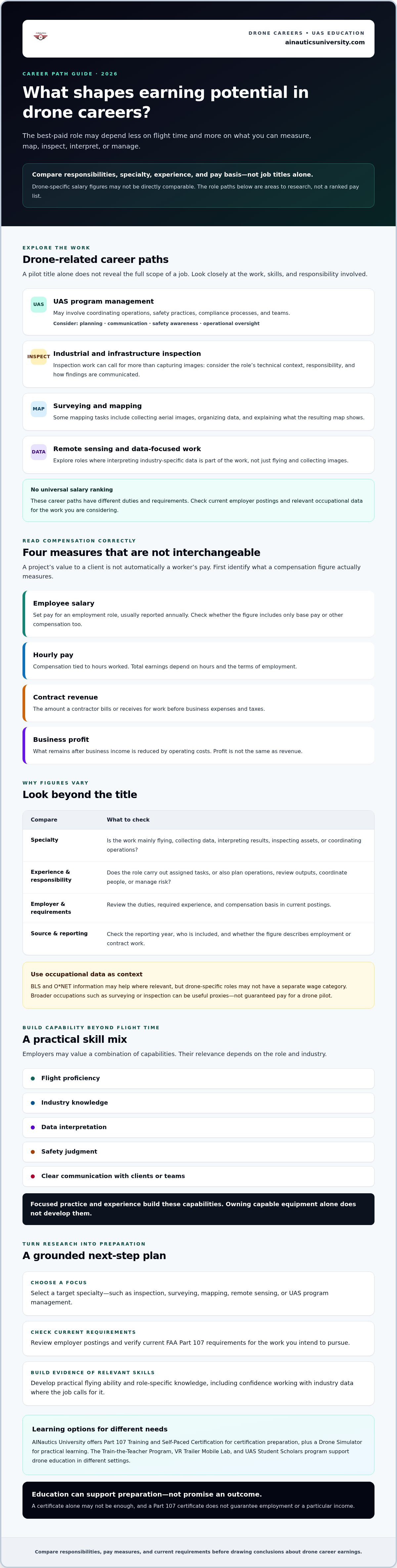
- Compare drone career paths such as UAS program management, industrial inspection, surveying, mapping, and remote sensing without assuming salary figures are directly comparable.
- Assess the highest paying drone jobs 2026 by looking beyond titles to specialty, experience, responsibility, and employer needs.
- Understand why employee salaries, hourly wages, contract revenue, and business profit measure different kinds of earnings.
- Build a practical preparation plan: choose a target specialty, check current employer requirements, and develop evidence of relevant skills.
- Identify a suitable next step for students, career changers, or educators, including training options that support drone learning without promising employment or earnings.
What makes a drone job one of the highest paying in 2026?
A drone job’s earning potential depends on more than flight time. Specialty, employer, experience, responsibility, and work arrangement all shape compensation. Capturing images may involve different expectations from interpreting survey data, inspecting critical assets, or coordinating complex operations. To compare the highest paying drone jobs 2026 fairly, look at what the worker is responsible for and how the pay is measured.
Drone-related compensation is what a worker or business earns for performing a role; the value of drone work is the benefit that work creates for a client or employer. These amounts aren’t interchangeable. An employer may use aerial data to support a project, but the project’s value doesn’t automatically become the pilot’s salary.
- Employee salary is set pay for an employment role, usually reported annually. Check whether a figure includes only base pay or also other compensation.
- Hourly pay is compensation tied to hours worked. The total earned depends on hours and the terms of employment.
- Contract revenue is the amount a contractor bills or receives for work before business expenses and taxes.
- Business profit is what remains after business income is reduced by operating costs. It isn’t the same as revenue.
How to compare drone job salary claims fairly
Start with current Bureau of Labor Statistics (BLS) and O*NET occupational information where relevant, but check how each source classifies the work. Drone-specific roles may not appear as a distinct wage category. A broader occupation, such as surveying or inspection, can provide context, but its figures are proxies, not guaranteed pay for a drone pilot. Before comparing claims, confirm the reporting year, whether the figure describes employment or contract work, and which workers the data includes.
Job titles can hide important differences in scope. Review the duties, required experience, and compensation basis behind a posting rather than relying on its title or a headline salary. To see how varied the work itself can be, explore this overview of commercial drone applications.
What raises earning potential beyond basic piloting
Employers may value a combination of flight proficiency, industry knowledge, data interpretation, safety judgment, and clear communication with clients or teams. For example, a mapping task may involve more than capturing aerial images: the worker may also need to organize the data and explain what the resulting map shows. These capabilities develop through focused practice and experience, not simply by owning capable equipment.
Responsibilities also change with seniority. An entry-level worker may carry out assigned flight or data-collection tasks, while a senior role may involve planning operations, reviewing outputs, coordinating people, or managing risk. Qualifications can support readiness for particular work, but no single certificate determines compensation. A Part 107 certificate doesn’t guarantee employment or a specific income. Verify current FAA requirements for the work you intend to pursue.
Which drone-related careers may offer stronger earning potential?
Rather than treating the highest paying drone jobs 2026 as a definitive salary ranking, compare roles by their responsibilities and the evidence available for compensation. Drone work spans technical, operational, creative, and public-service settings. A pilot title alone doesn’t tell you whether the job involves collecting data, interpreting it, managing a program, or delivering a finished product.
Role and industry matter more than the pilot label alone. The table lists career paths to research, not guaranteed pay levels. Where there is no comparable drone-specific figure, it says so. Use current employer postings and relevant BLS or O*NET occupational data as context, checking whether broader occupation figures match the actual work.
| Career path | Typical work | Relevant skills | Evidence source to check | Verified compensation |
|---|---|---|---|---|
| UAS program management | Coordinate operations, safety practices, compliance processes, and teams. | Planning, communication, safety awareness, operational oversight | Current employer postings; relevant BLS or O*NET occupations as proxies | No comparable drone-specific figure established |
| Industrial inspection | Collect imagery or other information to support asset inspections and reporting. | Careful data capture, reporting, industry knowledge, safety judgment | Employer postings and relevant occupational proxies | No comparable drone-specific figure established |
| Surveying and mapping | Capture aerial data used to create maps or survey products. | Photogrammetry, mapping workflows, data quality, relevant surveying knowledge | BLS or O*NET surveying occupations, plus job postings | Proxy figures require role-by-role verification |
| Remote sensing or geospatial analysis | Interpret location-based data gathered by sensors, sometimes beyond piloting duties. | Geospatial analysis, data interpretation, sensor knowledge | Relevant BLS or O*NET occupations and employer postings | No comparable drone-specific figure established |
| Aerial media, agriculture, or public service | Create visual content, support agricultural tasks, or contribute to public-service operations. | Creative production, task-specific knowledge, communication, safe operations | Sector-specific postings and relevant occupational data | Depends on role and employment arrangement; verify with employers |
Specialized technical and data-focused drone careers
Surveying and mapping roles may pair flight skills with photogrammetry, the process of using overlapping images to build measurements or maps, or LiDAR, which uses laser pulses to capture distance data. Inspection work also extends beyond flying: employers may need organized data collection and clear reports. Remote-sensing and geospatial positions can focus mainly on interpreting data, so check whether piloting is central to the job. Explore high-demand drone skills as a starting point, then verify requirements against current postings.
Operational, creative, and public-service career paths
Program managers coordinate people and processes; aerial media specialists support visual storytelling; agricultural operators work toward sector-specific outcomes. Public agencies may use drones for varied applications, but that doesn’t mean hiring is guaranteed or follows a single pathway. Students and educators can explore preparation through AINautics University’s drone education resources. Compare each target role’s actual duties and qualifications before choosing a learning path.
Why the same drone job can pay very differently
Two people with similar flight skills may earn differently because they work for different employers, take on different responsibilities, or use different work arrangements. A capable drone and a certificate can support readiness, but neither sets a worker’s income. When comparing the highest paying drone jobs 2026, look beyond the equipment and pilot label to the scope of the work and how compensation is reported.
Specialization can shape that scope. A role that combines piloting with mapping, inspection knowledge, or data analysis may involve deliverables beyond collecting images. Experience can also bring broader responsibility, such as planning missions or coordinating a program. These factors may influence an employer’s compensation decisions, but they don’t establish a guaranteed pay increase.
Employee, contractor, or independent operator?
Employment can offer more predictable compensation, while project-based contracting ties revenue to assigned work and contract terms. Independent operators also manage the business side, including finding clients, scheduling, administration, and periods without paid projects. Consider the full arrangement, not just a salary or project quote.
| Work arrangement | Compensation measure | Potential trade-off | Evidence to review |
|---|---|---|---|
| Salaried employee | Salary and any stated additional compensation | More predictable pay, with duties and terms set by the employer | Current job posting or written offer; confirm reporting period and what compensation includes |
| Project contractor | Contract revenue for agreed work | Work and income can vary by project; revenue isn’t personal salary or profit | Contract scope, payment terms, expected deliverables, and responsibility for expenses |
| Self-employed operator | Business revenue, then profit after costs | Must account for expenses, downtime, insurance, taxes, and unpaid administrative work | Business records and project-by-project costs; don’t compare gross revenue directly with employee pay |
Evidence quality differs, too. An employer posting or written offer can clarify compensation for a specific job. A contractor’s quoted fee shows a project price, not what the contractor keeps. A broad salary estimate may combine workers whose duties and employment terms don’t match yours. Check the scope, date, and pay basis before drawing comparisons.
How specialization and experience influence opportunity
Build expertise around the work you want to do. Mapping may call for data processing and interpretation; inspection may require knowledge of what information a client needs and how to report it clearly. Program leadership adds coordination and operational oversight. Review current employer requirements to see which skills or credentials matter for your target role. A qualification can demonstrate relevant preparation, but no single credential guarantees higher compensation.
How to prepare for a higher-value drone career
Turn interest in the highest paying drone jobs 2026 into a focused preparation plan. Start with a target role, identify the skills employers ask for, and build evidence that you can apply them. This helps students, career changers, and educators connect training with real job requirements instead of collecting credentials without a clear goal.
- Choose a specialty. Decide whether you’re drawn to mapping, inspection, aerial media, agriculture, program coordination, or another UAS pathway. Read current job postings in that field and note recurring duties, skills, and qualifications.
- Check the requirements. If your goal involves commercial piloting, verify current FAA Part 107 requirements for the work you intend to do. Employers may also specify role-related knowledge or qualifications, so check postings directly and confirm regulatory details with official FAA sources.
- Build practical ability. Practice mission planning, safe decision-making, and capturing data for a clear purpose. Simulation can help you work through scenarios and consider decisions before applying those skills in real settings.
- Create evidence you can share. Document suitable projects, classwork, or practice exercises. Explain the goal, your approach, safety considerations, tools or methods used, and the final deliverable. Be clear about what you did and what the work demonstrates.
- Review and refine. Compare your portfolio with employer requirements. Identify a skill gap, choose a practical way to address it, and update your examples as your abilities develop.
Match training to the work you want to do
For commercial piloting goals, use current FAA guidance to confirm which requirements apply. AINautics University’s Part 107 Training and Self-Paced Certification are learning options for those preparing to study certification topics. Its Drone Simulator supports scenario-based practice, including decision-making. These resources can support preparation, but they don’t guarantee certification, employment, or earnings. The published Part 107 training guide and beginner drone training guide can also help orient your research.
Build evidence of skills employers can assess
A strong portfolio explains more than the finished image or map. Show how you approached the task, handled information, worked with others, and communicated useful results. For educators building classroom pathways, AINautics University’s Train-the-Teacher Program is a relevant educational resource. Explore AINautics University drone training options to consider structured learning that fits your next step.
Choose your next step toward a drone career
You don’t need to map out an entire career before taking action. Choose one role to investigate, then check what the work involves and what employers currently expect. The highest paying drone jobs 2026 can differ widely in duties and qualifications, so a focused comparison is more useful than pursuing a credential based on a broad salary claim.
A practical checklist for evaluating a drone career
Use this checklist to move from interest to informed research:
- Clarify the work. Identify the setting, day-to-day tasks, and expected outputs. Is the role primarily about flying, collecting data, interpreting results, or coordinating operations?
- Verify requirements. Review current employer postings for qualifications and experience, then check applicable requirements with official sources. For commercial piloting, confirm current FAA guidance for the intended work.
- Compare compensation carefully. Check the reporting period and whether a figure describes employee pay, contract revenue, or something else. Use occupational data as context only when it matches the role.
- Choose relevant learning. Compare courses and practice opportunities with the skills employers actually request. Make a short list of gaps to address rather than assuming one credential fits every path.
Choose a next step that fits your situation
Students can explore UAS Student Scholars and classroom or hands-on learning, then build examples of their skills through suitable projects. Career changers can connect existing strengths, such as technical analysis, communication, or field experience, to a target role and identify what additional preparation it requires. Educators can consider the Train-the-Teacher Program when developing classroom pathways into UAS learning.
For context on where the industry may be heading, continue with the published article on the future of drone careers. Students seeking education support can also consult the UAS scholarship guide and verify its current eligibility details and deadlines.
Where structured drone education can help
For relevant commercial flight goals, AINautics University’s Part 107 Training and Self-Paced Certification are options for preparing to study certification topics. Its Drone Simulator can support scenario-based practice, but simulation doesn’t replace required qualifications or establish job readiness by itself.
Take one practical step: select a role, save a few current postings, and compare their requirements with your experience. If structured learning would help you address a skill gap, explore AINautics University’s drone education options as one possible part of your preparation. Training can support your development, but it can’t promise employment or a particular income.
Build your next step around the work you want to do
The highest paying drone jobs 2026 aren’t defined by flying alone. Compensation depends on the role, industry, responsibility, experience, and whether the work is salaried, contracted, or self-employed. To compare opportunities fairly, check current employer postings and official occupational or regulatory sources, then focus on the skills those roles actually require.
Choose one career path and build toward it with relevant practice and evidence of your abilities. AINautics University offers Part 107 Training and Self-Paced Certification options, scenario-based learning with the AINautics Drone Simulator, and education pathways including UAS Student Scholars and teacher-training programs. These resources can support learning, but they don’t promise employment or a particular income.
Ready to explore a learning option that fits your goals? Explore AINautics University’s drone training options, then take your next step with purpose and confidence.
Frequently Asked Questions
What is the highest paying job you can get with a drone?
There isn’t one verified highest-paying drone job that applies across employers and industries. Specialized roles in defense and aerospace, surveying and mapping, infrastructure inspection, and UAS program management are worth researching for stronger earning potential. Compare actual responsibilities, qualifications, and compensation evidence in current job postings. A broad salary figure for an occupation may not represent drone-specific work, so treat it as context rather than a pay promise.
How much do drone pilots make in 2026?
Reported 2026 estimates vary by source and role. The compensation research reviewed for this article shows entry-level estimates around $40,000 to $60,000 annually, mid-level estimates around $60,000 to $90,000, and senior or specialized estimates from $90,000 to over $153,000. These figures aren’t a single standardized wage measure. Some job-site averages include aerospace or defense positions, so check the source, reporting year, and job scope before comparing.
Do drone pilots make good money?
Some drone professionals earn competitive incomes, particularly when their work combines flying with specialized technical, data, or operational responsibilities. But “good money” depends on the role, employer, location, experience, and employment arrangement. An employee salary isn’t directly comparable with a contractor’s project revenue or a business owner’s gross revenue. To assess a specific opportunity, compare current compensation evidence with the job’s duties and account for expenses if you’re self-employed.
Do you need an FAA Part 107 certificate to get a drone job?
Not for every drone-related job. For many commercial drone-piloting roles in the United States, an FAA Part 107 Remote Pilot Certificate is a key qualification, but requirements depend on the work and operating rules that apply. Some UAS careers focus on data analysis, program coordination, or other responsibilities rather than piloting. Check current FAA guidance and the employer’s requirements for the specific role before choosing a training path.
Can you make a full-time career flying drones?
Yes, full-time careers can involve drone operations, but the work often includes more than piloting. Employees may collect data, inspect assets, plan missions, prepare reports, or coordinate operations. Full-time opportunities depend on employers and industries, while contract and self-employed work can vary with project availability. Review job postings to see whether flying is the main responsibility and what additional skills or experience the role expects.
What drone industry is most profitable?
No single industry is most profitable for every worker or business. Defense and aerospace, surveying and mapping, construction, and infrastructure inspection are among the sectors identified in the 2026 research as offering strong potential for specialized drone work. Individual outcomes still depend on the role, client or employer, expenses, and required expertise. Compare specific job postings or contracts, and distinguish employee compensation from business revenue and profit.
Does a drone certification guarantee a high-paying job?
No. A certificate can demonstrate that you’ve completed relevant training or met a requirement, but it doesn’t guarantee employment or a particular income. Employers may also look for practical experience, industry knowledge, data interpretation, safety judgment, and communication skills. Confirm which qualifications apply to your target role, then build examples of relevant work. AINautics University’s Part 107 Training and Self-Paced Certification are educational preparation options, not job or salary guarantees.
What skills can help a drone pilot earn more?
Build skills that match a specialized role. Depending on the field, employers may value mapping, photogrammetry, LiDAR, inspection knowledge, data analysis, mission planning, safety practices, or program coordination. Clear reporting and communication also help turn collected information into useful results. Review current postings in your target industry to identify recurring requirements, then practice and document relevant skills. A simulator can support scenario-based learning, but it doesn’t replace qualifications required for a job.

Article by
AINautics University Team
The team behind AINautics University, dedicated to drone education and FAA Part 107 certification prep, VR flight simulation, and STEM training programs for students and educators.


