
What if becoming a drone flight instructor doesn’t require a separate FAA teaching license? If you’re researching how to become a drone flight instructor, that distinction matters. The FAA doesn’t issue a dedicated Part 107 instructor certificate. A Remote Pilot Certificate provides the regulatory foundation for certain small UAS operations, but it doesn’t by itself show that you can teach others to fly safely.
It’s understandable to wonder which credentials count, how much flight experience you need, and where to practice teaching. Instructor readiness combines relevant pilot knowledge, sound judgment during operations, and the ability to make complex skills clear to learners.
This guide explains how to check which requirements may apply to the instruction you plan to provide and how to build credible flight, safety, and teaching skills. You’ll explore ways to gain practical experience, choose a teaching context, and document your progress. Resources such as Part 107 Training, the Train-the-Teacher Program, and structured Drone Simulator practice can support different parts of that preparation. They are learning resources, not FAA-issued instructor credentials.
Key Takeaways
- Understand how to become a drone flight instructor by building both credible pilot skills and the ability to teach them.
- Separate FAA pilot certification from teaching preparation, and check current requirements for the type of instruction you plan to provide.
- Compare self-study, formal pilot training, educator development, and supervised practice to identify gaps in your readiness.
- Use a step-by-step plan to choose a teaching context, strengthen your skills, and document your experience.
- Explore AINautics University resources, including Part 107 Training, the Train-the-Teacher Program, and the Drone Simulator, as learning tools rather than FAA instructor credentials.
How to Become a Drone Flight Instructor: What the Role Actually Involves
Your goal as a drone flight instructor is to help people become safe, capable operators, not simply to show them how to make a drone fly. That means teaching judgment alongside controls. Learners need to know how to prepare for a flight, recognize risks, and make responsible decisions when conditions or plans change.
A drone flight instructor is an educator who teaches unmanned aircraft systems (UAS) knowledge and practical skills. The role varies with the employer, course, learners, and planned flight activities. An educator leading an introductory school lesson may focus on basic controls and safety habits. A trainer preparing adults for commercial UAS work may also cover mission planning and skills related to a specific type of work. There isn’t one universal instructor role or teaching approach for every setting.
What does a drone flight instructor teach?
Instruction often combines foundational flight concepts, safety habits, mission planning, and responsible decision-making. To build context, instructors should be comfortable with core drone terminology, including the broader category described in this Unmanned aerial vehicle (UAV) overview. The knowledge and skills learners need beyond that depend on their goals and the activities they’ll practice.
Classroom lessons, simulator exercises, and supervised practice serve different purposes. A classroom lesson can explain a concept before a flight. A simulator lets learners rehearse a scenario in a structured setting, while supervised practice helps them apply skills with an instructor present. AINautics University’s Drone Simulator can support scenario-based learning, but it complements rather than replaces hands-on instruction.
Hobbyist instruction may center on basic operation and responsible flying. Commercial preparation has a different emphasis: learners may need to connect flight skills with work-related tasks and the requirements that apply to their planned operations. Before teaching a live-flight activity, check current FAA guidance for that specific operation.
Who can pursue this career path?
Current pilots can build on their flight experience by learning how to explain procedures, spot common errors, and give useful feedback. Educators and workforce trainers may bring lesson-planning and classroom-management skills. Career changers can explore the field by developing aviation knowledge and practical ability step by step.
Teaching experience helps, but it doesn’t replace understanding UAS operations. Likewise, confidence at the controls doesn’t automatically make someone an effective instructor. Strong preparation connects subject knowledge with clear explanations and well-planned practice. If you’re considering where instruction could fit within the broader industry, explore this future of drone careers guide for more context on possible career directions.
Drone Instructor Credentials: Separate FAA Pilot Certification from Teaching Preparation
A pilot certificate and the ability to teach are different qualifications. The FAA’s Part 107 rules establish requirements for certain small unmanned aircraft operations, but a Remote Pilot Certificate demonstrates pilot knowledge, not teaching skill. Based on current FAA information, there is no separate FAA-issued instructor certificate or rating under Part 107. Private organizations may offer instructor training, but that preparation is not an FAA credential.
What does Part 107 establish for an aspiring instructor?
Part 107 is relevant when instruction involves small UAS operations covered by that rule. The certificate applies to the person conducting the operation, so consider who will control the aircraft during a lesson and what kind of flight is planned. A classroom discussion or simulator activity differs from a live flight. Don’t assume one credential automatically covers every teaching situation.
Review the FAA’s Remote Pilot Certificate guidance for current eligibility and steps. For a closer look at preparing for the knowledge test and commercial operations, consult this professional Part 107 training guide. AINautics University’s Part 107 Training can support learners building relevant pilot knowledge. Review current course details to understand its scope.
For anyone asking how to become a drone flight instructor, the practical takeaway is to treat pilot certification and instructor preparation as separate parts of readiness. A certificate doesn’t prove that you can explain concepts clearly, give useful feedback, or guide a learner through practice. Teaching experience alone doesn’t establish that you meet the operating requirements for a flight, either.
Which requirements must you verify before teaching?
Before leading instruction, identify the exact activity and setting. Then verify the current FAA rules that apply to the aircraft operation, airspace, and training scenario. Requirements can depend on what the aircraft is doing and how the flight is conducted, so avoid relying on general assumptions or outdated summaries.
- Check operating rules: Confirm which FAA requirements apply to the planned flight and who will operate the aircraft.
- Check the setting: Review the relevant airspace and any conditions that could affect the training activity.
- Check non-FAA criteria: Employers, schools, and training programs may set their own hiring or instructor-readiness standards. Treat these as organizational criteria, not FAA credentials.
If a rule or activity is unclear, confirm it through current FAA guidance before flying or teaching. You can also explore AINautics University’s Part 107 Training as a learning resource, not as a substitute for verifying requirements or an FAA instructor credential.
Compare Drone Instructor Preparation Routes: Pilot Experience, Teaching Skills, and Practice
There isn’t one preparation route that fits every aspiring instructor. An experienced pilot may need to focus on teaching methods, while a classroom educator may need to deepen flight knowledge and practical judgment. Beginners often benefit from building both foundations in sequence. These routes can work together, but none automatically grants an FAA instructor credential.
| Preparation route | Purpose and strengths | Limitations | Evidence of readiness |
|---|---|---|---|
| Self-study | Builds knowledge of UAS concepts and relevant FAA materials at your own pace. | Reading alone doesn’t demonstrate flight skill or teaching ability. | Organized notes, accurate explanations, and a clear plan for addressing knowledge gaps. |
| Formal pilot training | Provides structured preparation for pilot knowledge and intended operations. The FAA’s Remote Pilot Certificate guidance is a reference for applicable Part 107 certification steps. | Pilot training isn’t the same as educator development, and its relevance depends on the operations you plan to teach. | Current qualifications where required, plus the ability to explain procedures and safety decisions. |
| Educator development | Strengthens lesson planning, demonstrations, learner assessment, and feedback. | Teaching methods don’t replace UAS knowledge or relevant flight proficiency. | Lessons with clear objectives, practice activities, and safety-focused feedback. |
| Supervised practical experience | Helps connect concepts with flight decisions and gives aspiring instructors practice guiding learners. | Experience should match the intended teaching context; it doesn’t automatically establish legal authority or qualification. | Documented practice, thoughtful debriefs, and demonstrated ability to coach safely. |
Build flight knowledge and sound judgment
Study the topics and operating requirements relevant to the instruction you expect to provide. Then rehearse decision-making with scenarios before guiding learners through related maneuvers. A Drone Simulator can provide structured practice, while supervised real-world experience helps develop practical judgment. Beginners can start with this drone training for beginners guide and build from core concepts.
Develop instructional confidence
Practice turning a skill into a teachable sequence: set a lesson objective, explain and demonstrate the task, observe the learner, then give specific, safety-focused feedback. For example, after a simulated exercise, ask the learner to describe the decisions they made and what they would reconsider. AINautics University’s Train-the-Teacher Program is an educator-development resource, not an FAA-issued instructor qualification. Educators may also find the drone curriculum for educators guide useful for planning learning activities. Keep evidence of what you can explain, demonstrate, and coach.
How to Become a Drone Flight Instructor: A Step-by-Step Readiness Plan
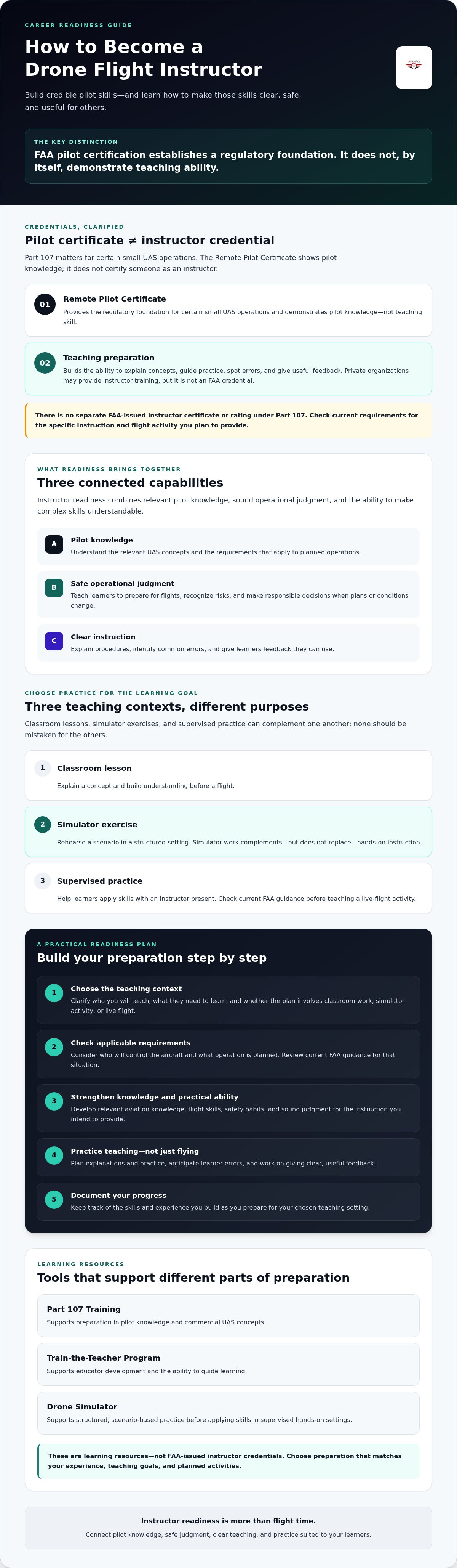
A practical plan turns your existing skills into evidence that you can guide learners responsibly. If you’re deciding how to become a drone flight instructor, start with the teaching situation you want to prepare for, then build and document the knowledge, flight practice, and instructional skills it requires. There’s no fixed timeline. Seek mentorship or supervised practice where available, and progress at a pace that supports safe, effective teaching.
- 1. Define your teaching context. Choose the learner group and setting you’re preparing for, such as a school, workforce program, community course, or employer. The audience shapes your lessons. Beginners may need clear introductions to controls and safety, while workforce learners may need instruction connected to their planned UAS tasks.
- 2. Identify activities and verify requirements. List the flight activities learners may perform, including whether instruction will involve simulator scenarios, live flights, or both. Before leading any flight activity, confirm current FAA requirements for the aircraft operation, airspace, and training scenario. Don’t treat a classroom lesson and a live operation as automatically subject to identical requirements.
- 3. Set learning outcomes and practice teaching. Write down what learners should know, demonstrate, and do safely by the end of each lesson. Create short lesson plans that pair a clear explanation with a demonstration, practice, and a knowledge check. Prepare a safety briefing for each relevant activity, and use scenario exercises to help learners explain how they would respond to changing conditions or decisions.
- 4. Gather feedback and document progress. Use a Drone Simulator to rehearse teaching scenarios and prompt discussion about decision-making before practice in an applicable flight setting. Ask a mentor or learner what was clear and where more guidance was needed. Keep an accurate record of your relevant training and experience, lesson plans, safety briefings, scenario exercises, and feedback. Review those materials regularly to identify what to strengthen next.
Your documentation should show more than participation. It should help you explain what you can teach, how you prepare learners, and how you respond when someone needs additional support. If you’re working in a school or structured program, check whether its curriculum needs to align with local learning standards or internal expectations.
AINautics University’s Part 107 Training, Train-the-Teacher Program, and Drone Simulator may support different parts of this preparation. They are learning resources, not guarantees of an FAA-issued instructor credential. Explore AINautics University’s drone education resources as you plan your next learning steps.
Prepare to Teach with AINautics University’s Drone Education Resources
Choosing a learning resource is part of preparing to teach, not a shortcut to an instructor credential. For anyone exploring how to become a drone flight instructor, the useful question is which skill to strengthen next. You might need to build pilot knowledge, plan lessons for students, or give learners more opportunities to practice applying what they’ve learned.
Which AINautics resources may fit your goals?
Educators developing UAS instruction can explore AINautics University’s Train-the-Teacher Program as an education resource. It may support instructional preparation, but it isn’t an FAA-issued instructor qualification. If you’re building relevant pilot knowledge, review Part 107 Training and Self-Paced Certification. Students exploring UAS education can also look into the UAS Student Scholars program. Check current program descriptions to understand their scope and outcomes.
Applied learning can connect instruction with practice. The Drone Simulator can support scenario-based exercises, while the VR Trailer Mobile Lab offers another educational resource to consider. Check current availability and scope before planning lessons around either. Neither replaces checking the requirements that apply to a planned flight activity.
Match resources to your audience and goals. An educator preparing a classroom unit may prioritize lesson structure and curriculum alignment. Someone supporting workforce learning may want to connect UAS knowledge with practical scenarios. Students have different learning needs, too, so review the UAS Student Scholars program details to determine whether it fits their goals.
What should you do next?
Before choosing a pathway, make a short inventory of your starting point:
- Pilot knowledge: What UAS topics and flight activities can you explain confidently? Which areas need further study?
- Teaching experience: Have you planned lessons, demonstrated a skill, assessed learning, or given constructive feedback?
- Intended learners: Are you preparing students, educators, career changers, or workforce learners, and what should they be able to do?
Compare your needs with current program descriptions. Confirm the course content, format, availability, and stated outcomes before enrolling. Don’t assume completion provides an FAA credential unless current materials explicitly say so. Pair the learning resource that fits your needs with practice and relevant experience to keep building your foundation.
When you’re ready to compare options, explore AINautics University programs and identify the resource that best matches your next learning goal.
Build Your Next Step Toward Drone Instruction
Becoming a capable instructor takes more than confidence at the controls. The path to becoming a drone flight instructor combines relevant pilot knowledge, practical flight judgment, and the ability to help learners build safe habits. A Remote Pilot Certificate and teaching preparation serve different purposes, so verify the requirements for your planned instruction and flight activities.
Start by identifying your learner group and the skills you want to teach. Then strengthen the areas where you need more practice, whether that’s Part 107 knowledge, lesson planning, or guiding learners through scenarios. AINautics University offers Part 107 and workforce-ready drone training, Train-the-Teacher models, self-paced certification options, scenario-based simulator training, and a VR Trailer Mobile Lab. These resources can support learning and preparation, but they aren’t FAA-issued instructor credentials.
Choose the pathway that matches your goals and confirm course details and outcomes before enrolling. Explore AINautics University’s drone education programs to identify your next learning step.
Frequently Asked Questions
Do you need an FAA instructor certificate to teach drone flying?
No. The FAA doesn’t issue a separate drone flight instructor certificate or rating under Part 107. That doesn’t mean every teaching activity has identical requirements. Rules can depend on the operation, aircraft, and setting. Before leading a live flight, check current FAA guidance for that specific scenario. An employer, school, or training provider may also set its own instructor qualifications, separate from FAA requirements.
Does a Part 107 certificate qualify you to be a drone flight instructor?
Not by itself. A Remote Pilot Certificate establishes pilot knowledge for applicable small UAS operations under Part 107, but it doesn’t demonstrate teaching ability or automatically qualify you for every instructor role. Employers and educational programs may look for additional flight experience, subject expertise, and instructional skills. Review the current requirements for the operations you’ll teach, then compare them with the role’s hiring or program criteria.
Can you become a drone instructor without teaching experience?
Yes, you can work toward an instructor role without a formal teaching background, but you’ll need to develop the skills to explain concepts, demonstrate procedures, and respond constructively to learner mistakes. Start by practicing short lessons with a mentor or in a supervised setting, where available. Ask for specific feedback on clarity, pacing, and safety. Teaching experience can strengthen your preparation, but it doesn’t replace UAS knowledge.
How do you gain experience teaching drone flight?
Look for opportunities to assist an experienced instructor, practice explaining a lesson to peers, or support a school or workforce learning activity. Use a Drone Simulator to rehearse scenarios and teach decision-making before any relevant live-flight practice. Keep sample lesson plans, safety briefings, learner feedback, and an accurate record of your experience. If you’re figuring out how to become a drone flight instructor, build evidence of both flight judgment and teaching skill.
What skills should a drone flight instructor have?
A capable instructor needs relevant UAS knowledge, sound safety judgment, and practical skill matched to the activities being taught. Clear communication matters too: break procedures into manageable steps, demonstrate them accurately, and check that learners understand. Strong instructors also plan lessons, notice when a learner needs help, and give specific, safety-focused feedback. The right skill mix depends on the audience and whether the course covers introductory flying or job-related operations.
Can teachers become drone flight instructors?
Yes. Teachers can bring valuable strengths in lesson planning, classroom management, and assessing student learning. They’ll also need to build the UAS knowledge and practical experience appropriate to their intended instruction. AINautics University’s Train-the-Teacher Program may support educators developing drone instruction, while Part 107 Training and the Drone Simulator support other areas of learning. Check current program details and FAA guidance. Course participation shouldn’t be assumed to grant an FAA instructor credential.

Article by
AINautics University Team
The team behind AINautics University, dedicated to drone education and FAA Part 107 certification prep, VR flight simulation, and STEM training programs for students and educators.


