
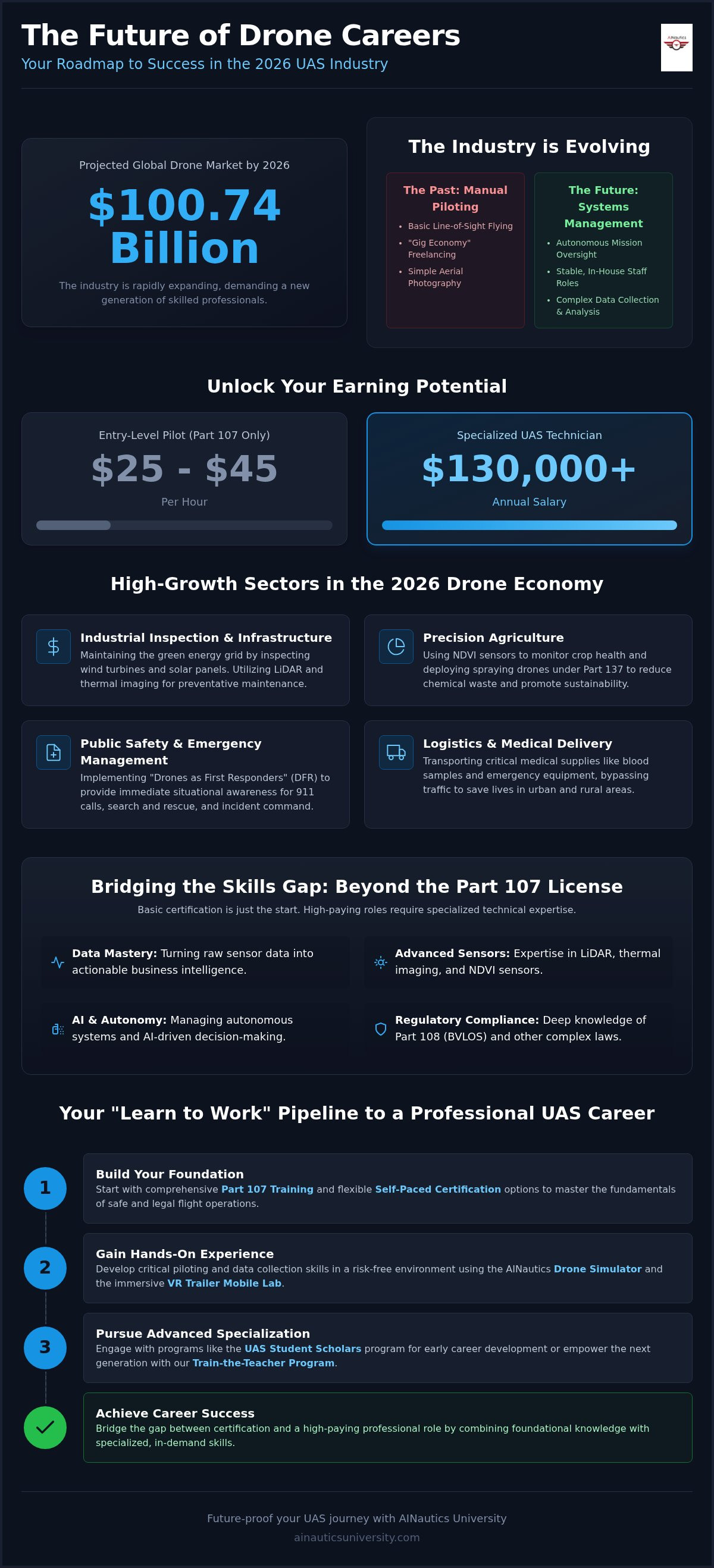
By the end of 2026, the global drone market is projected to reach a staggering $100.74 billion. However, if you're holding a basic Part 107 certificate and wondering why the high-paying jobs haven't arrived, you aren't alone. The future of drone careers is no longer about just flying. It's about mastering the data and autonomy that drive industries like energy and infrastructure.
You probably feel the pressure of a saturated market and the confusion of evolving FAA regulations like the Part 108 framework for BVLOS operations. It's difficult to know if investing in LiDAR, thermal imaging, or AI oversight will actually pay off. We understand that you want a clear path to professional success rather than just a hobbyist's credential.
This article provides a roadmap to help you future-proof your skills and stand out. You'll learn about high-paying niches and how to leverage advanced resources like the AINautics Drone Simulator and the UAS Student Scholars program. We'll explore the shift from manual piloting to autonomous systems management, ensuring you have the competitive edge needed for the 2026 landscape.
Key Takeaways
- Understand the shift from manual flight to autonomous systems management and why 2026 is the industry's critical tipping point.
- Identify high-growth sectors like infrastructure inspection and precision agriculture where specialized technical skills are in highest demand.
- Learn why data mastery and advanced sensor knowledge are now more critical for the future of drone careers than basic flight skills.
- Explore educational pathways that use the AINautics Drone Simulator and UAS Student Scholars program to build early career foundations for students.
- Follow a structured "Learn to Work" pipeline to bridge the gap between initial certification and securing a high-paying professional role.
The Landscape of Drone Careers in 2026
The future of drone careers is no longer defined by manual control or basic line-of-sight flying. By 2026, the industry has reached a tipping point where an Unmanned Aerial Vehicle (UAV) is a sophisticated data collection node rather than a simple flying camera. We've moved decisively toward autonomous systems management. Today's UAS professional oversees complex missions where the aircraft makes real-time decisions based on AI inputs. This shift requires a deeper understanding of software, data workflows, and regulatory compliance than ever before.
The Shift from Gig Economy to Staff Roles
Major corporations are moving away from the inconsistency of hiring freelancers. Instead, they're building dedicated internal flight departments to handle ongoing infrastructure needs. This transition is creating stable, high-paying staff positions for those with specialized technical skills. While an entry-level pilot might earn between $25 and $45 per hour, specialized UAS technicians in fields like LiDAR mapping can command annual salaries exceeding $130,000. AINautics University helps you bridge this gap. Using our Drone Simulator and VR Trailer Mobile Lab, students gain the immersive experience required for these high-stakes corporate roles. We're also seeing a rise in "Drone-First Entrepreneurs" who specialize in niche areas like wildlife-aware inspections, which require both technical mastery and environmental knowledge.
Regulatory Milestones Shaping the Workforce
The proposed Part 108 framework is the engine driving the 2026 landscape. It standardizes Beyond Visual Line of Sight (BVLOS) operations, moving the industry away from a cumbersome waiver-based system. This change creates thousands of new roles in remote monitoring and fleet oversight. Compliance isn't just about flight mechanics; it's about understanding complex laws like the Migratory Bird Treaty Act during vertical infrastructure inspections to protect nesting sites. With Remote ID now a standard requirement, every professional flight is a matter of record.
Our Part 107 Training and Self-Paced Certification options ensure you don't just pass the exam; you understand the legal environment you'll be operating in. For younger learners, the UAS Student Scholars program introduces these complex regulatory concepts early. Simultaneously, our Train-the-Teacher Program empowers educators to bring these professional standards into the classroom, ensuring the next generation is ready for the workforce. This comprehensive approach transforms certification from a simple permit into a foundation for a long-term career.
High-Growth Sectors Dominating the 2026 Drone Economy
While low-barrier niches like real estate photography were once the industry standard, they've become commoditized. The future of drone careers now rests in high-stakes industrial applications. Large-scale utility providers and government agencies are no longer looking for "pilots" but for UAS technicians who can deliver actionable data. It's a shift toward technical specialization. Companies want professionals who can manage autonomous fleets rather than just fly a single aircraft.
Industrial Inspection and Infrastructure
Maintaining the green energy grid is a massive growth driver. Technicians use drones to inspect wind turbine blades and solar panels for micro-cracks that are invisible to the naked eye. Integrating LiDAR and thermal imaging allows for structural health reports that save companies millions in preventative maintenance. This work often requires specialized wildlife-aware inspection protocols to protect local ecosystems, a skill set that separates professional operators from hobbyists. Mastery of these sensors is what defines a top-tier UAS professional in 2026.
Precision agriculture is another pillar of the 2026 economy. Operators use NDVI (Normalized Difference Vegetation Index) sensors to monitor crop health and deploy spraying drones under Part 137 regulations. This targeted approach reduces chemical waste and promotes sustainable farming. In logistics, medical delivery is now a reality in both urban and rural settings. Drones transport blood samples and emergency supplies, bypassing traffic to save lives.
Public Safety and Emergency Management
Public safety agencies have shifted to "Drones as First Responders" (DFR) models. In this setup, drones launch automatically when a 911 call is placed, often arriving on the scene before ground units. This provides incident commanders with immediate situational awareness. Career opportunities in this sector include:
- Search and Rescue (SAR) coordinators using thermal sensors to find missing persons.
- Disaster assessment specialists who map flood zones or fire perimeters.
- Medical logistics pilots managing fleet delivery in emergency corridors.
To enter these fields, you must hold an FAA Part 107 License. However, the license is just the baseline. High-growth sectors demand mastery of specific sensors and flight environments. Utilizing a Drone Simulator or enrolling in Self-Paced Certification programs can help you build the technical depth these roles require. If you're ready to specialize, exploring comprehensive UAS training can help you master these high-growth sectors.
The Essential Skills Gap: Beyond the Part 107 License
An FAA Part 107 certificate is essentially the "driver's permit" of the drone world. It proves you know the rules of the sky, but it doesn't prove you can execute a complex industrial mission. The future of drone careers depends on bridging the gap between basic legal compliance and technical mastery. While manual stick-and-rudder skills remain a necessary baseline, the 2026 professional focuses on autonomous flight software and high-level mission planning. Leading drone industry organizations emphasize that soft skills, such as risk assessment and client communication, are now just as critical as total flight time. Employers aren't just looking for someone who can fly; they want a professional who can manage a project from the initial safety brief to the final data delivery.
Immersive Training: The Role of Simulators and VR
Hands-on experience is vital, but high-stakes industrial environments don't allow for beginner mistakes. This is where the AINautics Drone Simulator becomes a career-defining tool. It allows pilots to practice scenario-based missions in a controlled, virtual environment before ever stepping onto a job site. Top tier employers increasingly prioritize candidates with documented simulator hours because it proves they've handled emergencies and complex maneuvers safely. By integrating the VR Trailer Mobile Lab into our training, we provide a level of immersion that traditional classroom settings can't match. This Immersive drone training technology is shaping how the next generation of pilots prepares for the workforce. It builds the muscle memory and decision-making skills required for complex enterprise operations.
Advanced Data Mastery and AI Integration
Education as the Catalyst: Building Your Career Path
The future of drone careers depends on a structured, deliberate pipeline. We define this journey through the "Learn → Train → Certify → Fly → Work" model. It's a roadmap that transforms a curious student into a high-earning professional. Education serves as the engine for this entire process. While many try to skip steps by purchasing hardware first, true success comes from a foundation in theory and safety. For K-12 students, the UAS Student Scholars program builds these STEM foundations early, introducing flight physics and data analysis before they even reach high school. We also use the VR Trailer Mobile Lab to bring this high-tech exposure to underserved areas, ensuring that geography doesn't limit a student's professional potential.
Train-the-Teacher: Scaling the UAS Workforce
Educator certification is the most scalable way to build a robust drone workforce. When we empower a single instructor through our Train-the-Teacher Program, we're effectively reaching hundreds of students every year. This multiplier effect is vital for meeting the industry's growing talent demands. School districts don't have to wait years to see results. With our structured 90-day program launch, schools can implement a full UAS department quickly. This includes everything from safety protocols to hands-on flight labs. Educators looking for a starting point can explore this Drone curriculum for educators to see how these programs integrate into existing STEM tracks.
Self-Paced vs. Immersive Learning Models
Choosing the right educational model depends on your specific goals and schedule. For working professionals or busy students, Self-Paced Certification options provide the flexibility needed to master the material without sacrificing current responsibilities. It allows for deep dives into complex regulatory topics at a personal speed. However, workforce readiness often requires the intensity of mission-driven instruction. Using the Drone Simulator provides a safe environment to practice high-stakes maneuvers that manual flight can't replicate without risk. Both models are essential tools for different Drone pilot career paths. Whether you're a career changer or a first-time student, the right training environment makes all the difference in your long-term success.
If you're ready to start your journey, you can explore our comprehensive UAS training programs to find the path that fits your career goals.
Future-Proofing Your UAS Journey with AINautics University
AINautics University provides more than just a course; it offers a comprehensive ecosystem for professional growth. The future of drone careers demands a partner that evolves alongside the technology. We act as a bridge between your current curiosity and the technological demands of a $100.74 billion industry. By integrating specialized training with practical application, we ensure our community is always one step ahead of the curve. Our mission is to empower individuals through specialized knowledge, turning potential into professional mastery.
The AINautics Advantage: Mission-Driven Instruction
Our Part 107 Training is designed with commercial application in mind. We don't just teach you how to pass a test; we teach you how to operate as a professional within an enterprise environment. The VR Trailer Mobile Lab plays a critical role here, providing hands-on skill acquisition that replicates real-world challenges. For younger learners, this immersion is often the spark that ignites a lifelong interest in STEM. High schoolers can further their ambitions by applying for a UAS scholarship for high school students, which provides a clear pathway into this competitive field. This scholarship helps students move from the classroom to the flight line without financial barriers.
Your 2026 Action Plan
To secure your place in the future of drone careers, you need a methodical approach to skill development. Follow these three steps to build a resilient professional profile:
- Step 1: Obtain your Remote Pilot Certificate through our Self-Paced Certification or instructor-led Part 107 Training. This is your legal foundation.
- Step 2: Master complex maneuvers and emergency procedures using the AINautics Drone Simulator. Documenting these hours proves your competence to future employers.
- Step 3: Specialize in a high-growth niche such as LiDAR mapping, thermal imaging, or autonomous fleet oversight. This technical depth is what commands higher salaries.
Once you're certified and trained, platforms like the iFlyDrone marketplace help bridge the gap between education and high-paying employment. This connection ensures that your specialized knowledge translates directly into professional opportunities. It's about moving beyond the license to achieve long-term career stability.
Taking the first step can feel daunting, especially with rapidly changing regulations. However, you don't have to navigate this landscape alone. Whether you're a student exploring the UAS Student Scholars program or an educator utilizing our Train-the-Teacher Program, we provide the tools and support needed for success. The drone industry is moving fast, and the window to become an early leader in autonomous systems is now. Start your journey today to ensure you're ready for the opportunities of 2026 and beyond. We're here to guide you through every regulatory update and technical milestone.
Securing Your Place in the Autonomous Workforce
The 2026 landscape offers unprecedented opportunities for those ready to move beyond basic certification. Success in the future of drone careers hinges on your ability to master specialized data workflows and autonomous systems. By leveraging immersive tools like our Drone Simulator and VR Trailer Mobile Lab, you gain the technical depth required by major industrial employers. These resources transform a standard pilot into a high-value UAS professional ready for the demands of the green energy and infrastructure sectors.
As an AUVSI member and Service-Disabled Veteran-Owned Small Business, we're committed to providing the professional standards needed for this evolution. Whether you're a student in the UAS Student Scholars program or an educator scaling the workforce through Train-the-Teacher, the path to success is structured and accessible. Once you've mastered these skills, our nationwide pilot marketplace access helps bridge the final gap to meaningful employment.
Explore AINautics University Drone Training Programs and start building your technical edge today. The industry is moving quickly, and your professional journey starts with a single, informed step. We're excited to support your growth in this dynamic and rewarding field.
Frequently Asked Questions
What is the highest-paying drone career in 2026?
Specialized technicians in LiDAR mapping and infrastructure inspection are the highest earners in 2026. These professionals can earn from $70,000 to over $130,000 annually. Success requires more than basic flight skills; it demands mastery of advanced sensors and data processing. Our Self-Paced Certification options help you build this expertise on your own schedule. High-paying roles focus on delivering actionable data for energy and utility companies.
Do I need a college degree to start a career in drones?
You don't need a four-year college degree to build a successful career in the drone industry. Most employers prioritize FAA certification and documented technical proficiency over traditional academic credentials. Professional Part 107 Training combined with specialized skills in mapping or AI oversight provides a faster, more direct path to employment. We focus on workforce readiness, ensuring you have the practical knowledge needed to excel in enterprise environments.
How will FAA Part 108 change drone pilot jobs?
FAA Part 108 will revolutionize drone pilot jobs by standardizing Beyond Visual Line of Sight (BVLOS) operations. This shift moves the industry away from a complex waiver system, allowing for large-scale automated flights. It creates new professional roles in remote mission supervision and autonomous fleet management. Staying informed about these regulatory changes is a core part of our curriculum, helping you prepare for the next phase of commercial aviation.
Is the drone pilot market saturated in 2026?
The market is only saturated for basic pilots who lack specialized technical skills. There is actually a structural talent shortage for advanced roles in the future of drone careers. Employers are searching for professionals who understand thermal imaging, LiDAR, and AI-driven data analysis. Using the Drone Simulator to document your experience in complex scenarios helps you stand out from the crowd and secure high-demand positions.
Can I start a drone career while still in high school?
You can absolutely begin your drone career while still in high school. Students as young as 16 can take the FAA Part 107 exam to become certified commercial pilots. Our UAS Student Scholars program is specifically designed to help young learners build STEM foundations and gain early industry exposure. Starting early allows you to enter the workforce or higher education with a professional credential already in hand.
What is the difference between a Part 107 license and a UAS certification?
An FAA Part 107 license is the legal permit required to fly commercially, while a UAS certification represents professional mastery of specific tasks. Think of the license as the baseline and the certification as your competitive edge. Our Self-Paced Certification programs focus on industry-specific skills like infrastructure inspection or precision agriculture. Combining both ensures you are legally compliant and technically prepared for high-level professional responsibilities.
How do simulators help in getting a drone job?
Simulators help you gain critical experience in high-risk scenarios without the danger of crashing expensive hardware. Employers increasingly prioritize candidates who can show documented hours on a professional Drone Simulator. This proof of practice demonstrates your commitment to safety and your ability to handle complex maneuvers. It builds the muscle memory and decision-making skills necessary for managing autonomous systems in real-world industrial environments.
What industries will hire the most drone pilots in the next five years?
Energy, construction, agriculture, and public safety will hire the most drone professionals over the next five years. These sectors need technicians for power line monitoring, site mapping, and crop health analysis. Our VR Trailer Mobile Lab and Train-the-Teacher Program help schools prepare students for these specific high-growth fields. As industries move toward sustainable practices and automated inspections, the demand for skilled UAS operators will continue to expand.

Article by
AINautics University Team
The team behind AINautics University, dedicated to drone education and FAA Part 107 certification prep, VR flight simulation, and STEM training programs for students and educators.


