
Could a single $175 investment be the catalyst that transforms your curiosity about drones into a high-growth career by 2026? If you've spent any time researching FAA Part 107 requirements, you probably feel overwhelmed by the technical jargon and the fear of facing steep fines for simple mistakes. It's common to feel stuck between wanting to launch a professional career and feeling confused by the complex differences between recreational and commercial rules.
We believe that mastering these regulations is the foundational standard for a future-ready workforce. This guide provides a clear roadmap to help you navigate eligibility, understand the latest Remote ID mandates, and prepare for the upcoming Part 108 Beyond Visual Line of Sight (BVLOS) shifts. You'll gain the confidence to fly legally and the knowledge to excel in the UAS industry. We'll explore everything from initial testing to how our Part 107 Training, Drone Simulator, and UAS Student Scholars program help you bridge the gap from student to professional pilot.
Key Takeaways
- Identify the core eligibility criteria for the Remote Pilot Certificate, the industry's gold standard for professional drone operations.
- Navigate the mandatory Part 107 requirements for 2026, including the step-by-step process for securing your FAA Tracking Number and passing the knowledge test.
- Differentiate between recreational and commercial flight rules to avoid costly fines and ensure your operations are fully legal.
- Learn to manage institutional drone programs by aligning certification with state STEM standards and professional workforce development.
- Gain a clear understanding of operational limits, such as altitude caps and visual line of sight, to maintain safety in complex airspaces.
Essential FAA Part 107 Eligibility Requirements
To operate a drone for business, the FAA Remote Pilot Certificate is your non-negotiable credential. It represents the industry's gold standard for safety and professional competence. Meeting the basic Part 107 requirements ensures you're prepared for the complexities of the national airspace. This certification isn't just a legal necessity; it's a badge of professionalism that signals your commitment to excellence in the Unmanned Aircraft Systems (UAS) industry.
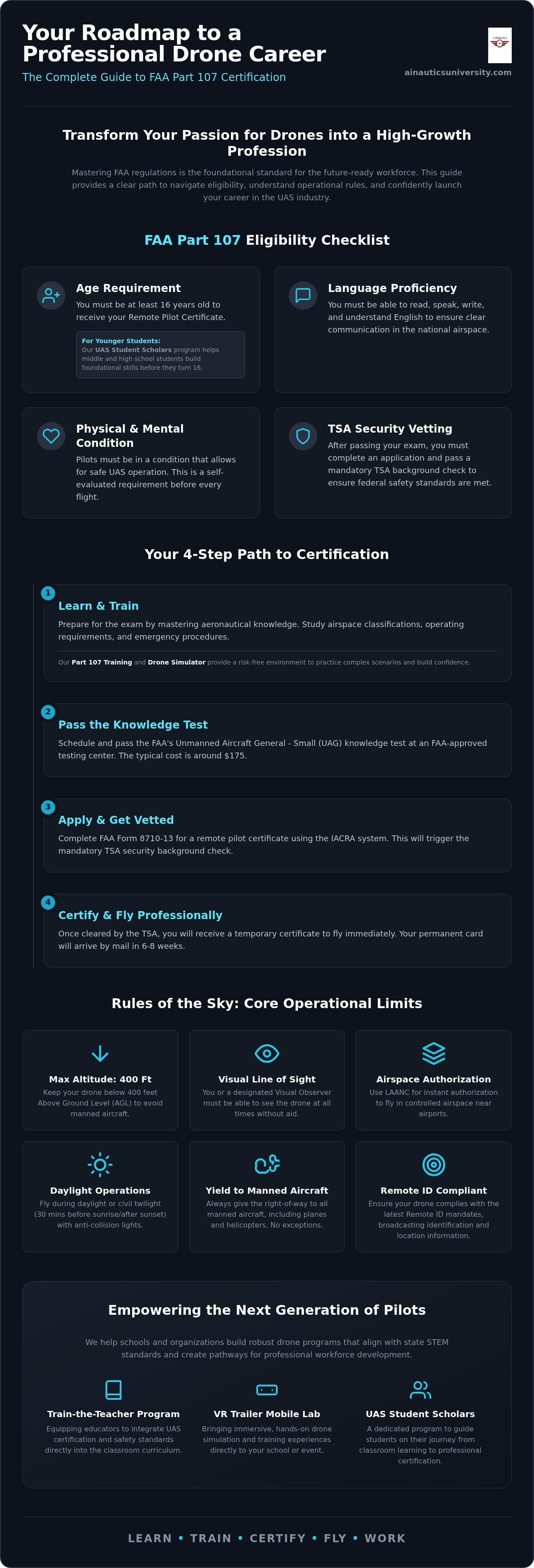
The FAA establishes clear criteria to ensure every pilot is capable of safe flight. You must be at least 16 years old to hold the certificate. Additionally, the FAA mandates that you must be in a physical and mental condition that allows for the safe operation of a UAS. While a formal medical certificate is not required, you are responsible for self-evaluating your fitness before every flight to prevent accidents caused by fatigue, illness, or impairment. Managing these Part 107 requirements effectively is the first step in our "Learn, Train, Certify, Fly, Work" pipeline.
Age and Language Standards for Students
Students in middle and high school can begin their journey toward certification well before their 16th birthday. Early exposure through our UAS Student Scholars program builds the technical proficiency required for future careers. We use the VR Trailer Mobile Lab and high-fidelity Drone Simulator to create immersive environments where students practice complex scenarios safely. The FAA's English language standard for aviation safety requires every applicant to demonstrate the ability to read, speak, write, and understand English. This requirement ensures clear communication with air traffic control and other pilots. Educators using our Train-the-Teacher Program learn to embed these standards directly into their STEM curriculum, making the certification process a natural extension of the classroom experience.
The TSA Security Vetting Process
Your journey toward professional flight doesn't end when you finish the exam. After you pass the Unmanned Aircraft General, Small (UAG) test, you must complete an application in the Integrated Airman Certification and Rating Application (IACRA) system. This triggers a mandatory background check by the Transportation Security Administration (TSA). This vetting is a core component of U.S. Drone Regulations to ensure all commercial operators meet federal safety standards. Once the TSA clears your application, the FAA issues a temporary digital certificate. You can expect to receive your permanent, credit-card-sized Remote Pilot Certificate in the mail within approximately 6 to 8 weeks. Our Self-Paced Certification options and specialized Part 107 Training guide you through each administrative hurdle, ensuring your transition from student to certified pilot is seamless and professional.
Key Operational Rules and Airspace Regulations
Operating a drone professionally requires more than just technical skill; it demands a deep understanding of the rules that keep the sky safe. The most fundamental of the Part 107 requirements is the altitude limit. Pilots must keep their aircraft below 400 feet above ground level (AGL). This ceiling minimizes the risk of interference with manned aircraft, which typically fly much higher. Maintaining a Visual Line of Sight (VLOS) is equally critical. You must be able to see your drone at all times without the aid of binoculars or telescopes. If a mission requires you to look away, a Visual Observer (VO) can assist, provided they maintain constant communication with the pilot.
Safety extends to how you interact with other pilots. Drones must always yield the right-of-way to manned aircraft, such as planes and helicopters. There are no exceptions to this rule. Additionally, while standard operations occur during daylight, you can fly during civil twilight if your drone is equipped with anti-collision lighting visible for at least three statute miles. We use our Drone Simulator to help students practice these maneuvers in a risk-free environment before they ever take to the sky.
Navigating Controlled and Uncontrolled Airspace
Airspace is categorized into different classes, and knowing where you are is vital for compliance. Controlled airspace, including Class B, C, D, and E, usually surrounds airports and requires prior authorization. Fortunately, the Low Altitude Authorization and Notification Capability (LAANC) system is now live at over 530 FAA air traffic control facilities, covering more than 726 airports. This allows for near-instant digital approval. Our Professional FAA Part 107 Drone Training Guide provides the tools needed to master sectional charts and identify these boundaries accurately. Conversely, Class G airspace is uncontrolled, allowing for more flexibility, though pilots must still adhere to all standard safety regulations.
Remote ID Compliance in 2026
As of 2026, every drone requiring registration must comply with Remote ID regulations to operate legally. The FAA mandates that drones must act as a digital license plate, broadcasting identification and location information to ensure accountability and safety. You can achieve compliance in three ways: using a drone with built-in Standard Remote ID, attaching a broadcast module to older hardware, or flying within a recognized FAA-Recognized Identification Area (FRIA). While current rules focus on visual operations, the upcoming Part 108 framework will soon streamline Beyond Visual Line of Sight (BVLOS) flights. Our Self-Paced Certification options ensure you stay ahead of these technological shifts while remaining fully compliant with today's standards.
Part 107 vs. TRUST: Choosing Your Legal Framework
One of the most common points of confusion in the drone industry is determining which legal framework applies to a specific flight. Many believe that if they aren't getting paid, they're flying recreationally. This is a risky misconception. The FAA defines commercial flight as any operation that isn't strictly for hobby or personal enjoyment. If you're flying for a school, a non-profit, or even to promote a personal brand, you must follow Part 107 requirements. The intent of the flight, not the exchange of money, is what dictates the rules you must follow.
The TRUST (The Recreational UAS Safety Test) is a free, entry-level safety quiz designed for hobbyists. It ensures basic airspace awareness but offers no legal protection for professional or educational activities. In contrast, the Part 107 certificate is a federal aviation license that permits you to operate for work or business. For school districts deciding which path to take, this FAA TRUST Test vs. Part 107 comparison provides a detailed breakdown of the legal stakes involved. Choosing the right framework is the difference between a safe, compliant program and one that risks federal enforcement.
Why Educators Need Part 107 Certification
Teachers often operate in a grey area, but holding a commercial certificate provides essential legal protections for the school. When an educator is certified, the school's UAS program moves from a simple club to a professional-grade curriculum. Our Train-the-Teacher Program is specifically designed to help educators establish school-wide compliance. This transition ensures that every flight, whether it's a classroom demonstration or a campus mapping project, adheres to federal safety standards. It also allows teachers to model the professional behavior expected in the industry. By moving beyond a hobbyist mindset, educators can build sustainable programs that meet rigorous state STEM standards.
Student Pathways to Professionalism
For students, the jump from recreational flying to professional certification can be life-changing. The UAS Student Scholars program prepares teens for the rigors of the Part 107 exam by combining theory with hands-on practice. Graduating high school with a federal aviation license gives students a significant competitive edge in the job market. They aren't just hobbyists; they're certified pilots ready for high-paying roles in utility inspection, public safety, or cinematography. To help manage the costs of this professional journey, students can explore various UAS scholarship opportunities. These resources ensure that meeting the Part 107 requirements is an accessible goal for every aspiring aviator, regardless of their financial background.
The Step-by-Step Path to Your Remote Pilot Certificate
Launching your professional career starts with a clear, administrative sequence. You must first create an account on the Integrated Airman Certification and Rating Application (IACRA) website to obtain an FAA Tracking Number (FTN). This unique ID stays with you throughout your entire aviation journey. Once you have your FTN, you'll schedule the Unmanned Aircraft General, Small (UAG) knowledge test at an authorized PSI testing center. The current fee for this exam is $175, which you'll pay directly to the testing facility.
After passing the exam with a score of 70% or higher, return to the IACRA portal to complete FAA Form 8710-13. This is the formal application for your certificate. The FAA then coordinates with the TSA for background vetting to ensure you meet all security standards. You'll typically receive a temporary digital certificate within a few days. This allows you to begin commercial operations immediately while you wait for your permanent hard-copy card to arrive by mail. If you're ready to begin this process, our Part 107 Training provides the expert guidance needed to move through these steps with confidence.
Preparing for the Knowledge Test
The exam covers critical aviation topics like weather patterns, aircraft loading, flight performance, and airport operations. While memorizing facts is part of the process, true mastery involves practical application. We recommend using our Drone Simulator to visualize complex regulatory scenarios before your test date. For busy professionals or students balancing schoolwork, our Self-Paced Certification options provide the flexibility to study on your own schedule without sacrificing depth. These tools ensure you don't just pass the test but actually understand how to apply the rules in the field.
Maintaining Your Certification
Earning your license is just the beginning of your professional development. To keep your certificate current, you must complete free recurrent training every 24 calendar months through the FAA’s online portal. This ensures you stay informed about evolving Part 107 requirements and safety protocols without additional testing fees. Staying current also means looking ahead at future drone career trends to identify new opportunities in the autonomous systems sector. This proactive approach ensures your skills remain relevant as the industry expands into new sectors like package delivery and long-range infrastructure inspection.
Scaling Success: Part 107 for Schools and Professional Teams
Transitioning from an individual hobbyist to managing an institutional UAS program requires a strategic shift in perspective. For school districts and professional organizations, success isn't just about one person passing a test. It's about building a scalable infrastructure that ensures long term compliance and safety. Our 90 day drone program launch model simplifies this transition for educators. It provides a structured framework that aligns Part 107 requirements with state and district STEM standards. This approach transforms a simple elective into a robust career and technical education (CTE) pathway. By integrating mission planning and operational safety into the daily classroom routine, schools create an environment where students don't just learn to fly; they learn to lead in a professional aviation culture.
Immersive Learning and Regulatory Mastery
Modern training technology allows us to bring abstract regulations to life. The VR Trailer Mobile Lab provides a unique space where students can experience complex scenarios without physical risk. Before ever entering the national airspace, pilots use our Drone Simulator to practice emergency procedures such as lost link events or battery failures. This immersive preparation ensures that when a pilot encounters a real world challenge, their response is instinctive and safe. This level of mastery is essential for maintaining a clean safety record and ensuring ongoing compliance with all Part 107 requirements.
Workforce Readiness and Career Pathways
A Remote Pilot Certificate is a powerful tool for career advancement in industries like infrastructure inspection, precision agriculture, and cinema. Professionalism in these fields requires knowledge that goes beyond the FAA exam. For example, pilots must understand wildlife aware procedures and federal protections like the Migratory Bird Treaty Act (MBTA) to avoid disturbing nesting habitats during operations. Looking ahead, the industry is shifting toward Beyond Visual Line of Sight (BVLOS) operations under the upcoming Part 108 framework. Our Self-Paced Certification options keep you updated on these autonomous system trends. We ensure you're ready for the future of flight, whether that involves package delivery or long range environmental monitoring.
Secure Your Future in the Skies
Mastering the Part 107 requirements is your first step toward a high-growth career in the autonomous systems industry. You now have a clear roadmap. From understanding age and language eligibility to navigating complex airspace with LAANC, you're ready to transition from a hobbyist to a professional pilot. This certification is the gold standard that opens doors in utility inspection, public safety, and cinematography. It's more than a license; it's a foundation for lifelong professional development.
At AINautics University, a Service-Disabled Veteran-Owned Small Business, we provide the specialized tools you need to succeed. Our STEM-aligned curriculum and immersive training with the VR Trailer Mobile Lab and Drone Simulator ensure you're prepared for real-world missions. Whether you're a student building a career or an educator launching a school program, we're here to guide you through every regulatory hurdle. The sky is no longer the limit; it's your new workplace.
Start Your Journey to Part 107 Mastery with AINautics University
Frequently Asked Questions
What are the physical requirements for a Part 107 license?
You don't need a formal medical certificate or a doctor's exam to meet the physical Part 107 requirements. Instead, the FAA requires you to self-certify that you're in a physical and mental condition that allows for the safe operation of a drone. This means ensuring you aren't suffering from fatigue, illness, or any impairment that could compromise safety. Our Drone Simulator training helps you practice maintaining focus during long missions to ensure you're always fit for flight.
Can I fly a drone for school projects without a Part 107 certificate?
No, you generally cannot fly for school projects under recreational rules because the FAA considers institutional or educational use to be commercial in nature. To stay compliant, students and educators should obtain their Remote Pilot Certificate. Our UAS Student Scholars program is designed specifically to help high schoolers bridge this gap. By earning your license early, you ensure that every classroom project or campus mapping mission remains fully legal and professional.
How much does the FAA Part 107 exam cost in 2026?
The initial aeronautical knowledge test costs $175 per attempt in 2026. This fee is paid directly to an FAA-approved testing center when you schedule your exam through the PSI portal. While this is the primary out-of-pocket cost for the license itself, investing in quality preparation is key to passing on your first try. Our Self-Paced Certification courses and Part 107 Training are structured to ensure you're fully prepared for the exam's technical and regulatory challenges.
What happens if I fail the Part 107 knowledge test?
If you don't pass the exam on your first attempt, you must wait 14 calendar days before you can retake it. You'll also need to pay the $175 testing fee again for the new appointment. To avoid this delay and extra cost, we recommend using our Drone Simulator and comprehensive study guides. These tools help you master the material and build the confidence needed to succeed during your very first testing session without the frustration of a retake.
Do I need to register my drone if I have a Part 107 license?
Yes, every drone operated under Part 107 must be registered with the FAA, regardless of its weight. The registration fee is $5 per aircraft and is valid for three years. Once registered, you must mark your drone with its unique registration number. Additionally, as of 2026, your drone must be Remote ID compliant to fly legally in the national airspace. Our Part 107 Training covers these administrative steps to ensure your entire fleet stays within federal guidelines.
How long is the FAA drone license valid?
Your Remote Pilot Certificate never technically expires, but your flight privileges are only valid if you complete recurrent training every 24 calendar months. This free online training is available through the FAASTeam website and keeps you updated on the latest Part 107 requirements. Staying current ensures you're always ready for professional opportunities. We encourage our UAS Student Scholars to track their renewal dates carefully to maintain their status as active, legal pilots in a rapidly changing industry.
Is there a background check for the Remote Pilot Certificate?
Yes, every applicant undergoes a mandatory security background check performed by the Transportation Security Administration (TSA). This process begins automatically once you pass your knowledge test and submit your application through the IACRA portal. The TSA verifies your identity and ensures you don't pose a security risk to the national airspace. While you wait for this vetting to finish, you'll receive a temporary certificate to begin flying professionally as soon as your digital application is processed.
Can non-U.S. citizens get a Part 107 certificate?
Yes, non-U.S. citizens can obtain a Part 107 certificate provided they meet the age and English language proficiency standards. You must be able to read, speak, write, and understand English to communicate safely in the aviation environment. The TSA background check still applies to all applicants regardless of citizenship. Our Train-the-Teacher Program often helps educators support diverse student populations in navigating these federal requirements, ensuring that career pathways in UAS are accessible to every aspiring pilot.

Article by
AINautics University Team
The team behind AINautics University, dedicated to drone education and FAA Part 107 certification prep, VR flight simulation, and STEM training programs for students and educators.


