
If you think flying your drone for a monetized YouTube channel or a school fundraiser is purely recreational, you might be risking a civil fine of up to $27,500. The FAA is increasingly clear that any flight benefitting a business or organization requires professional certification. Understanding the FAA TRUST test vs Part 107 requirements is no longer optional for serious pilots. It is a legal necessity in 2026. You don't want to let regulatory confusion ground your ambitions or lead to costly penalties that could have been easily avoided.
We understand that the shift from hobbyist to professional can feel daunting. That's why we've built this guide to give you total clarity on the certification process and the new Part 108 regulations for beyond visual line of sight operations. You'll discover the exact differences between these two pathways and learn how to follow a step-by-step roadmap to your FAA license. We will explore everything from the 60-question exam to using our Drone Simulator for risk-free practice. This ensures you are fully prepared to launch a successful career in the evolving UAS industry with confidence and mastery.
Key Takeaways
- Distinguish between recreational and professional flight by understanding the core differences between the FAA TRUST test vs Part 107 certifications.
- Identify why commercial use includes unpaid activities like school marketing or research, requiring a Remote Pilot Certificate to maintain legal compliance.
- Follow a clear, five-step roadmap to licensure, starting with your FAA Tracking Number and moving through specialized self-paced certification.
- Master flight skills in a risk-free environment using a Drone Simulator to build confidence before the official FAA-proctored exam.
- Discover how the UAS Student Scholars program and Train-the-Teacher model provide a direct path to high-demand careers in the 2026 drone economy.
Understanding the FAA Regulatory Landscape: TRUST vs. Part 107
The FAA classifies drone operations into two rigid categories based on the pilot's purpose. For those flying purely for fun, The Recreational UAS Safety Test (TRUST) serves as the legal baseline. For those looking to build a career or support an organization, the Part 107 Remote Pilot Certificate remains the professional gold standard. Understanding the FAA TRUST test vs Part 107 requirements is the first step toward mastery in the skies. By 2026, the FAA has streamlined enforcement, making it mandatory for all pilots to produce digital or physical proof of their certification upon request during any routine inspection.
The core legal distinction rests on the intent of the flight, not whether money changes hands. If your flight provides a benefit to a business, a school, or a non-profit, the FAA views it as a commercial operation. This is a critical point for students in our UAS Student Scholars program to grasp early. You can't fly a drone to take photos for a school website under a recreational exception. These nuances are central to FAA drone regulations, which prioritize safety and accountability in shared airspace. Deciding between the FAA TRUST test vs Part 107 depends entirely on your ultimate goal for the flight.
Who is a Recreational Flyer?
A recreational flyer is someone operating a drone exclusively for personal enjoyment. They fly under a limited statutory exception that exempts them from the rigorous testing required for commercial pilots. However, this doesn't mean there are no rules. You must complete the TRUST test, which is a free online safety training provided by FAA-approved administrators. You're also required to carry your TRUST certificate at all times during flight. If you're practicing maneuvers specifically to prepare for a future job, you've already crossed the line into professional territory.
Who is a Commercial Remote Pilot?
Commercial pilots fly for the "furtherance of a business" or any non-recreational purpose. This includes high-stakes industries like real estate, infrastructure inspections, and emergency response. In 2026, the definition is broad and strictly enforced. Commercial intent is defined as any flight activity that supports a professional objective, regardless of compensation or the pilot's employment status. Educators using drones for classroom research or district marketing must also hold a Part 107 certificate. Our Train-the-Teacher Program prepares staff to meet these exact legal standards, ensuring schools remain compliant while training the next generation of pilots. Using a Drone Simulator or opting for Self-Paced Certification training is the most efficient way to bridge the gap between hobbyist and professional status.
Side-by-Side Comparison: Requirements, Costs, and Scope
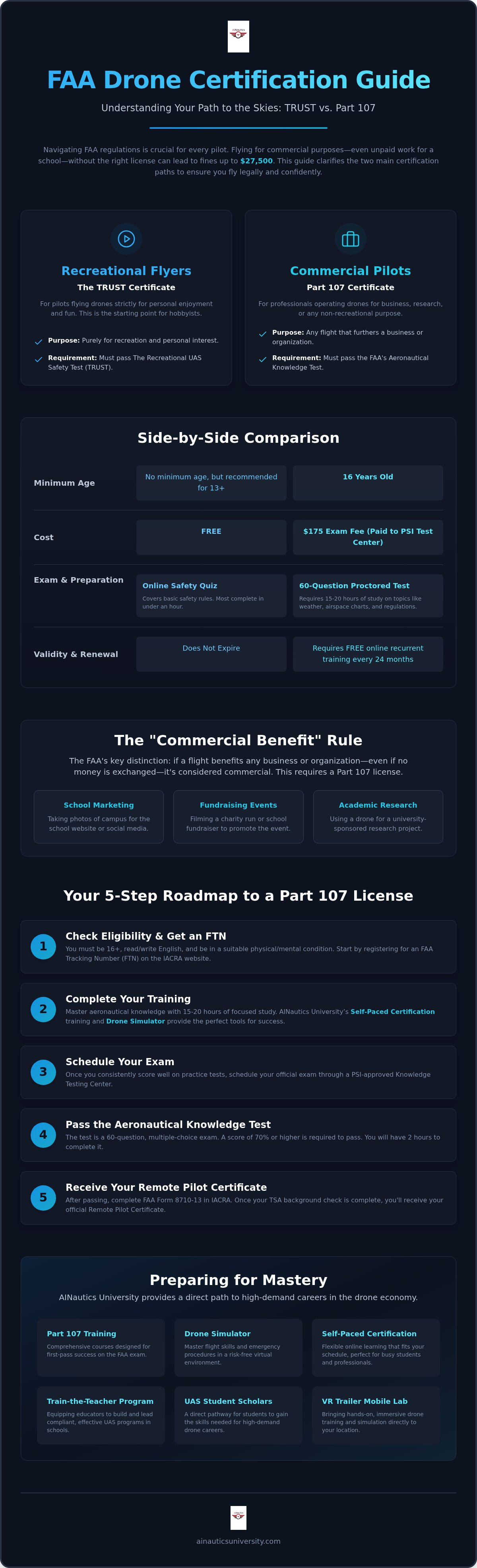
Choosing between the FAA TRUST test vs Part 107 involves assessing your age, budget, and long-term goals. For students as young as 13, the TRUST test offers an immediate path to the sky with zero financial barrier. It is a free, online safety quiz designed to ensure hobbyists understand basic airspace rules. In contrast, the Part 107 Remote Pilot Certificate is available to those 16 and older. It requires a $175 fee paid to a PSI testing center. While the TRUST certificate never expires, professional pilots must complete free online recurrent training every 24 months to maintain their currency. This ensures every commercial operator stays updated on evolving safety standards and airspace designations.
Exam Content and Preparation Time
The preparation gap between these two certifications is significant. The TRUST quiz focuses on fundamental safety, such as yielding to manned aircraft and identifying no-fly zones. Most students complete it in under an hour. Earning a professional license requires a deeper commitment. You must master aeronautical topics like sectional charts, weather theory, and radio communications. We typically recommend 15 to 20 hours of focused study to ensure a first-pass success on the 60-question exam. Utilizing a Drone Simulator during this phase helps bridge the gap between theoretical knowledge and practical flight mastery.
Operational Privileges and Limitations
Your certification level dictates exactly where and when you can fly. Recreational flyers are limited to daylight operations and must maintain a direct line of sight at all times. They are also prohibited from flying over people or moving vehicles. Professional pilots enjoy much broader authority. With a Part 107 license, you can operate at night and request access to controlled airspace through the LAANC system. Understanding these Part 107 rules and regulations is essential for anyone conducting advanced missions or educational research. If you're ready to move beyond basic hobby flight, our UAS Student Scholars program provides the structured environment needed to handle these expanded privileges safely.
The 'Commercial Benefit' Rule: Why Schools Often Need Part 107
A common myth persists in school hallways: if you aren't getting a paycheck for a flight, you don't need a license. This misunderstanding often leads to legal trouble. The FAA focuses on whether the flight benefits an organization or "furthers a business." If you're capturing footage for a district football game or conducting environmental research for a science fair, you've crossed into commercial territory. Navigating the FAA TRUST test vs Part 107 debate requires looking at the intent behind the propeller spin. Even unpaid volunteers for a non-profit must hold a professional certificate if the flight supports the organization's mission.
Schools operating drones without certified pilots face significant liability risks. Civil penalties for flying an unregistered drone or operating without a license can reach up to $27,500. Beyond fines, there is the risk of insurance claims being denied if an uncertified student or teacher causes property damage. This creates a dangerous gap in school safety protocols. To solve this, we developed the UAS Student Scholars program. It ensures students and schools meet every legal requirement while building professional-grade skills. This program creates a clear, safe, and compliant environment for future innovators.
Drones in the STEM Classroom
Teachers serve as the primary guides for students entering this high-tech field. Leading by example means obtaining a Remote Pilot Certificate before launching a classroom program. By integrating a specialized drone curriculum for educators, schools can transform simple hobbies into robust Career and Technical Education (CTE) pathways. This approach prepares students for the 2026 workforce, moving them beyond basic flight toward technical mastery. It is about teaching them to manage complex systems and analyze data, not just pilot a device for fun. Our Train-the-Teacher Program empowers educators to build these internal UAS programs with confidence.
UAS Career Paths for Certified Pilots
The demand for skilled operators in 2026 is surging across several key sectors. Agriculture, public safety, and infrastructure inspection now rely heavily on autonomous systems for efficiency and safety. A Part 107 license is more than a legal requirement; it is a professional credential that sets a resume apart. When employers see this certification, they recognize a pilot who understands the nuances of the FAA TRUST test vs Part 107 and has committed to safety. Research indicates that most commercial drone pilots in these sectors earn between $50 and $150 per hour. This earning potential makes the transition from a recreational flyer to a certified professional a highly rewarding career move.
How to Get Your FAA Drone License: A 5-Step Professional Roadmap
Securing a professional license requires a methodical approach that goes far beyond the simplicity of the FAA TRUST test vs Part 107 baseline. While the TRUST test is a quick safety check, the Remote Pilot Certificate is a formal aviation credential. Follow this five-step roadmap to ensure you meet every federal requirement while building the technical skills needed for the 2026 UAS industry.
- Step 1: Obtain your FAA Tracking Number (FTN). Visit the Integrated Airman Certification and Rating Application (IACRA) website to create a profile. This unique number stays with you for your entire aviation career.
- Step 2: Engage in self-paced drone certification training and simulator practice. Use this time to master the complex regulations and flight physics that hobbyist tests ignore.
- Step 3: Schedule and pass the Aeronautical Knowledge Test. You must book your exam at an FAA-approved PSI testing center. The current fee for 2026 is $175, and you need a score of at least 70% to pass.
- Step 4: Complete FAA Form 8710-13. Once you pass the exam, log back into IACRA to apply for your permanent certificate using your test ID.
- Step 5: Receive your Remote Pilot Certificate and maintain currency. Your permanent card will arrive by mail. Remember to complete the free online recurrent training every 24 months to keep your license active.
Mastering the Knowledge Test
The exam covers 60 multiple-choice questions that challenge your understanding of airspace classifications and weather briefings. You'll need to interpret METAR reports and identify restricted areas on sectional charts. Using the AINautics Drone Simulator allows you to visualize these complex flight scenarios in a 3D environment before you ever step into the testing center. Mock exams are vital for passing on the first attempt because they familiarize you with the FAA's specific phrasing and technical expectations. Don't leave your success to chance when professional tools are available.
Leveraging Immersive Technology
Modern flight training has moved beyond textbooks. The benefits of immersive drone training technology include building deep muscle memory without the risk of equipment damage. VR labs and simulators reduce the cost of flight training by allowing you to repeat difficult maneuvers until they become second nature. Transitioning from digital simulation to real-world mission planning becomes seamless when you've already mastered the controls in a high-fidelity environment. If you want to accelerate your progress, consider starting with our Self-Paced Certification options to master the skies on your own schedule.
Preparing for Mastery: How AINautics University Bridges the Gap
Understanding the core differences between the FAA TRUST test vs Part 107 is the starting point, but true mastery requires a structured ecosystem. AINautics University provides this through a comprehensive suite of tools designed for the 2026 workforce. Our Part 107 Training program isn't just a test prep course; it's a career-launching platform for both students and educators. By focusing on professional standards, we help you move beyond the hobbyist baseline into high-value industry applications. We emphasize growth and future-readiness, ensuring you don't just pass an exam but actually master the technology.
One of our most impactful initiatives is the Train-the-Teacher Program. This model empowers schools to build internal UAS programs by giving educators the credentials and confidence they need to lead. Instead of relying on outside contractors, districts can develop their own sustainable CTE pathways. This is supported by our VR Trailer Mobile Lab, which brings hands-on, site-based learning directly to your campus. It's an immersive experience that traditional online-only schools cannot match. For high school students, the UAS Student Scholars program offers advanced career mentorship. It connects young pilots with industry experts to navigate the complexities of autonomous systems. This community-driven approach ensures every participant understands the safety-conscious culture required for commercial flight.
A Supportive Learning Environment
We offer both Self-Paced Certification and guided learning tracks to fit your specific schedule. Whether you're a busy educator or a student balancing coursework, our platform adapts to your needs. You gain direct access to expert instructors who provide mission planning support and real-world insights. This isn't just about passing a test. It's about building a community of safety-conscious remote pilots who are ready for the technological demands of the future. Our status as a Service-Disabled Veteran-Owned Small Business and a member of AUVSI ensures that our training meets the highest industry standards.
Launch Your Drone Program in 90 Days
We provide a step-by-step school implementation plan for districts ready to integrate drone technology. Our team helps align your curriculum with state and district standards, ensuring your CTE program is both academically rigorous and industry-relevant. Most schools move from initial planning to a fully operational drone lab within 90 days. We focus on practical application and professional standards to make the transition seamless for your staff and students. It's time to bridge the gap between current skill sets and future career demands. Start your professional journey with AINautics University today.
Secure Your Future in the 2026 Drone Economy
The evolution of the UAS industry requires more than just basic flight skills. It demands a deep understanding of the FAA TRUST test vs Part 107 framework to ensure every mission remains legal and safe. You've learned that the "commercial benefit" rule applies to almost all professional and educational activities. This makes the Remote Pilot Certificate an essential credential for the modern workforce. By following our five-step roadmap, you can transition from a hobbyist to a certified pilot ready for high-demand sectors like public safety and infrastructure inspection.
Success in this field relies on specialized knowledge and hands-on practice. As a Service-Disabled Veteran-Owned Small Business, we offer a comprehensive STEM-aligned curriculum that prepares you for real-world challenges. Our advanced VR and Simulator technology provides a risk-free environment to build muscle memory before your official exam. Take the first step toward a high-earning career today. Enroll in AINautics University Part 107 Training to join a community of elite UAS professionals. The sky is no longer the limit; it's your new office. We're ready to help you take flight.
Frequently Asked Questions
Can I fly a drone for a school project with just a TRUST certificate?
No, you cannot fly for a school project under a TRUST certificate if the flight provides any benefit to an organization. When comparing the FAA TRUST test vs Part 107, the FAA classifies flight supporting a school club or research project as a commercial operation. Our Train-the-Teacher Program helps educators understand these legal boundaries to keep their students compliant and safe while they build their technical skills.
How much does the FAA Part 107 exam cost in 2026?
The FAA Part 107 knowledge test fee is $175 per attempt in 2026. This payment is made directly to the PSI testing center where you sit for the proctored exam. To avoid the cost of retakes, we recommend using our Drone Simulator and Self-Paced Certification modules. These tools ensure you have the mastery needed to pass the 60-question test on your first try.
Do I need to register my drone if I only have a TRUST certificate?
You must register your drone if it weighs 0.55 pounds or more, regardless of your certification level. Registration costs $5 for three years and covers all your drones for recreational use. For those navigating the FAA TRUST test vs Part 107 requirements, remember that commercial operators must register each drone individually for $5 each to maintain legal standing with the FAA and avoid potential fines.
What happens if I fly commercially without a Part 107 license?
Flying commercially without a license carries severe legal penalties, including civil fines of up to $27,500 per violation. Criminal penalties can reach $250,000 and up to three years in prison for unauthorized operations. Our UAS Student Scholars program emphasizes strict legal compliance to protect young pilots from these life-altering consequences while they pursue high-tech career paths in the evolving drone economy.
Is the FAA TRUST test free to take?
Yes, the FAA TRUST test is free to take through any FAA-approved administrator online. It serves as a baseline safety quiz for hobbyists flying drones purely for personal enjoyment. While this is a great starting point for beginners, most ambitious students eventually choose the professional path to unlock career opportunities and higher earning potential. Our Part 107 Training provides the bridge to these advanced roles.
How long is the FAA Part 107 Remote Pilot Certificate valid?
Your Remote Pilot Certificate remains valid for 24 months from the date of issuance. To maintain your currency, you must complete a free online recurrent training course every two years. This process has been simplified in 2026, allowing pilots to renew their credentials without visiting a testing center. Staying current ensures you are always ready for missions involving our VR Trailer Mobile Lab or real-world operations.
What is the minimum age to get a professional FAA drone license?
The minimum age to earn a professional Remote Pilot Certificate is 16 years old. Students as young as 13 can take the TRUST test for recreational flight, but they must wait until their 16th birthday to sit for the Part 107 exam. We encourage younger students to start early by mastering flight skills in our Drone Simulator to prepare for their future certification and career success.
Can I take the Part 107 exam online from home?
No, you cannot take the initial Part 107 knowledge test online from home. The FAA requires all applicants to visit an authorized PSI testing center for a proctored, in-person exam. However, once you are licensed, all future recurrent training is handled through a free online portal. This makes it easier to maintain your professional status while you continue your education through our Self-Paced Certification options.

Article by
AINautics University Team
The team behind AINautics University, dedicated to drone education and FAA Part 107 certification prep, VR flight simulation, and STEM training programs for students and educators.


