
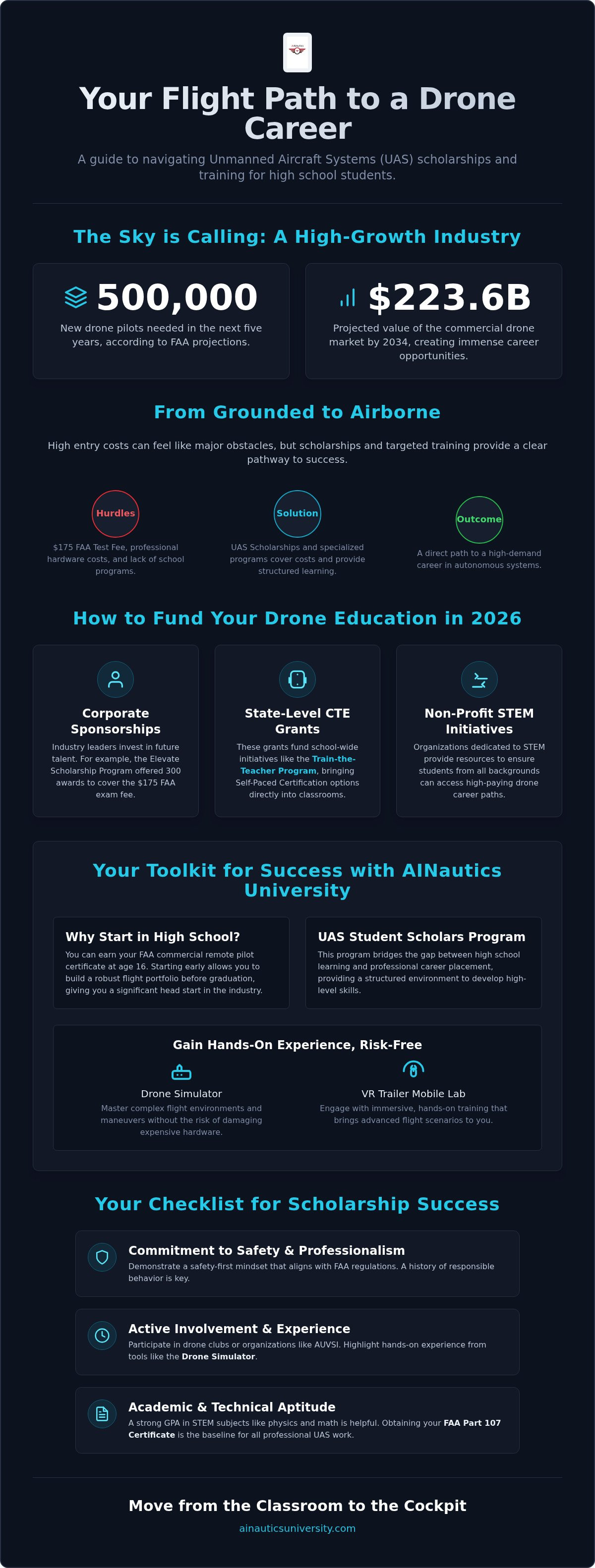
The FAA projects a demand for nearly half a million new drone pilots over the next five years. For many, finding a UAS scholarship for high school students is the most effective way to enter this high-growth industry without the burden of high startup costs. While the $175 FAA Part 107 Knowledge Test fee and the price of professional hardware can feel like major obstacles, these hurdles shouldn't stop your progress. You might feel overwhelmed by FAA age requirements or frustrated by a lack of structured drone programs in your local school district.
We believe that specialized knowledge should be accessible to every aspiring pilot. This guide shows you how to secure funding and elite training for a career in autonomous systems. You'll learn how to navigate the certification process and find programs that integrate with your high school curriculum. We will highlight specific 2026 opportunities and show how the AINautics University UAS Student Scholars program uses tools like our Drone Simulator and VR Trailer Mobile Lab to prepare you for the workforce. It's time to move from the classroom to the cockpit.
Key Takeaways
- Identify the specific types of UAS scholarship for high school students available in 2026 to cover FAA exam fees and training costs.
- Master the eligibility requirements by focusing on STEM coursework and active involvement in drone-related extracurriculars.
- Explore how the UAS Student Scholars program bridges the gap between high school learning and professional career placement.
- Learn the steps to leverage FAA Part 107 certification for immediate entry into the commercial drone workforce.
- Discover how hands-on tools like the VR Trailer Mobile Lab and Drone Simulator accelerate your path to flight mastery.
Funding the Future: Navigating UAS Scholarships for High School Students
When we talk about UAS, we aren't referring to a specific university campus in Alaska. We are talking about Unmanned Aircraft Systems, the technology powering a global industrial revolution. A UAS scholarship for high school students is a targeted financial award designed to remove the barriers to entry for this high-tech field. These programs don't just cover general tuition; they fund the specific path to becoming a certified professional. An Unmanned Aerial Vehicle (UAV) operator needs more than a textbook. They need flight hours, regulatory knowledge, and hands-on experience with sophisticated hardware.
It's vital to distinguish between traditional academic scholarships and industry-specific workforce grants. Traditional aid often supports broad degrees that take years to complete. In contrast, drone scholarships focus on immediate mastery of autonomous systems. Organizations like AUVSI and various industry partners sponsor these awards to build a pipeline of skilled pilots. In 2026, this need is critical. The commercial drone market is projected to reach $223.66 billion by 2034. Industry leaders are investing in students now to ensure they have the talent needed for future inspection, logistics, and public safety missions.
Types of Drone Education Funding in 2026
Funding comes from several distinct channels. Corporate sponsorships, such as the Elevate Scholarship Program, are leading the way. In June 2026, this program opened applications for 300 scholarships specifically to cover the $175 FAA Part 107 exam fee. Beyond individual awards, state-level Career and Technical Education (CTE) grants are expanding rapidly. These grants often fund school-wide initiatives like the Train-the-Teacher Program. This allows schools to unlock sustainable funding and bring Self-Paced Certification options directly into the classroom. Non-profit STEM initiatives also provide resources to ensure that students from all backgrounds can access these high-paying career paths.
Why High School is the Ideal Time to Start
The timing for high schoolers is perfect because of the FAA's age requirements. You can earn your commercial remote pilot certificate at age 16. Starting early allows you to build a robust flight portfolio before you even walk across the graduation stage. Students who participate in the UAS Student Scholars program gain a significant head start. They use tools like the Drone Simulator and VR Trailer Mobile Lab to gain flight experience without the risk of damaging expensive equipment. This early certification doesn't just look good on a college application. It positions you for specialized roles in industries that are desperate for certified, experienced operators who understand the complexities of the national airspace.
Eligibility and Requirements: How to Qualify for Drone Education Funding
Securing a UAS scholarship for high school students requires more than just high grades. While a strong GPA in STEM subjects like physics and mathematics is helpful, scholarship boards look for students who demonstrate a specific commitment to aviation safety and technical precision. They want to see a clean paper trail. This means showing a history of responsible behavior and a safety-first mindset that aligns with FAA regulations. Participation in drone clubs or organizations like AUVSI can set you apart. These groups prove you aren't just a hobbyist; you're a professional in training.
Technical aptitude is another critical factor. If you've spent time on a Drone Simulator or engaged with hands-on training in a VR Trailer Mobile Lab, you should highlight these experiences in your application. Demonstrating that you can handle complex flight environments, even in a simulated setting, reduces the perceived risk for organizations offering funding. They are investing in your potential to become a reliable commercial pilot. If you're looking for a way to stand out, our UAS Student Scholars program provides the structured environment needed to develop these high-level skills.
The Role of Part 107 Certification in Scholarship Selection
Obtaining your Remote Pilot Certificate is the baseline for all professional UAS work. Programs like the Elevate Scholarship Program often prioritize applicants who have already shown the initiative to study for the FAA exam. Having this certification makes you a low-risk investment because you've already cleared the industry's primary regulatory hurdle. Our Part 107 Training is designed to take students through this process step-by-step. It ensures you're ready for the test and the professional responsibilities that follow.
Building a UAS Student Portfolio
A strong application includes a portfolio that showcases your practical skills. You should document every flight through detailed mission planning and flight logs. Whether you are capturing aerial media for a school project or gathering inspection data, these records prove your competence. Using Self-Paced Certification options allows you to work through these requirements on your own schedule. This demonstrates the self-discipline that industry leaders value. A well-organized portfolio tells a story of growth, from your first simulated flight to your first successful data capture mission.
Case Study: The Impact of the UAS Student Scholar Program on Career Readiness
The UAS Student Scholars program at AINautics University serves as a premier example of how specialized training transforms student potential into professional readiness. This program isn't just a curriculum; it's a "Learn to Work" model that bridges the gap between a high school classroom and a professional cockpit. Schools can implement this scholarship-worthy track in as little as 90 days, providing students with immediate access to a high-growth career path. By focusing on workforce readiness, we ensure that every student who earns a UAS scholarship for high school students has a clear roadmap to employment.
Real-world application is the heart of this journey. Students don't just read about flight; they perform missions. They move from basic maneuvers on a screen to simulating complex vertical-structure inspections. This rapid progression is supported by federal initiatives like FAA Aviation Workforce Development Grants, which help fund the infrastructure needed for these advanced programs. When students see the direct connection between their studies and a high-paying career, their engagement levels skyrocket.
From Simulator to Sky: A Student Journey
The path to mastery is broken down into three distinct phases. First, students achieve technical proficiency using the Drone Simulator. This environment allows them to crash, learn, and reset without any financial or safety consequences. Second, they transition to the VR Trailer Mobile Lab. This immersive experience simulates field conditions, teaching students how to manage sensors and navigate obstacles in a 360-degree environment. Finally, they complete their Part 107 Training and obtain their remote pilot certificate. This structured pipeline ensures that by the time they reach the sky, they are already seasoned operators ready for the demands of the commercial sector.
Quantifiable Outcomes for Graduates
The results of this integrated ecosystem are measurable. In 2026, certified high school graduates are entering a market where the FAA projects a demand for nearly half a million new drone pilots. These graduates aren't just finding jobs; they're starting careers in drone-media, engineering, and logistics. While entry-level salaries vary by region and industry, the specialized nature of autonomous systems work often commands a premium compared to traditional high school jobs. You can explore more about these shifts in our guide on Drone Technology Education: 2026 Trends. By using Self-Paced Certification and expert-led instruction, our scholars are consistently placed at the forefront of the industry.
Maximizing Your Scholarship: From Part 107 Certification to Workforce Entry
A UAS scholarship for high school students is the fuel, but your professional execution is the engine that drives a successful career. Once you've secured funding and completed your Part 107 Training, the focus shifts to monetization and career growth. You shouldn't wait until graduation to start your professional journey. Use your scholarship-funded credentials to access the iFlyDrone marketplace. This platform allows you to find student-friendly flight missions that build your resume while you're still in school. These early missions provide the real-world flight hours that major employers demand.
As you gain experience, look toward the next regulatory horizon. While Part 107 is the current standard for commercial work, the industry is rapidly moving toward Part 108, which governs Beyond Visual Line of Sight (BVLOS) operations. Staying ahead of these changes ensures you remain a competitive candidate for high-tier roles in logistics and infrastructure. Maintaining this edge requires a commitment to operational safety and compliance. Industry trust is built on a pilot's ability to follow strict flight protocols and document every mission accurately. If you're ready to take the first step, explore our UAS Student Scholars program to see how we help you bridge the gap between certification and your first paycheck.
The Professional Pilot Toolkit
Modern drone pilots do more than just fly; they manage data. To maximize the value of your training, you must master essential software tools like Geographic Information Systems (GIS) and Computer-Aided Mass Appraisal (CAMA) systems. These tools allow you to turn raw aerial images into actionable asset-management reports. Networking is equally vital. Join local drone organizations and engage with the AUVSI community to find mentors and job leads. For a detailed roadmap on maintaining your professional standing, review our Drone Compliance Training Checklist. This resource ensures you never miss a critical step in your operational workflow.
Transitioning to Higher Education
Your scholarship training doesn't have to end at high school graduation. Many UAS Student Scholar credits are designed to transfer directly to university aviation programs, saving you time and tuition costs. By stacking certifications, such as advanced aerial media or thermal inspection, you create a specialized niche for yourself. Our Train-the-Teacher Program plays a crucial role here, as it helps your local educators stay updated on these advanced pathways. This ensures your school remains a hub for Self-Paced Certification and long-term career support. Whether you choose immediate workforce entry or a four-year degree, your early scholarship success provides a solid foundation for any path in the autonomous systems industry.
Join the Next Generation of Pilots with AINautics University
The 2026 autonomous economy is no longer a distant vision; it's a present reality. High school is the perfect time to position yourself at the center of this technological shift. AINautics University provides a comprehensive ecosystem that transforms curious students into certified commercial pilots. Our mission-driven instruction focuses on more than just passing a test. We prioritize real-world commercial success by teaching you how to handle complex data, manage advanced sensors, and maintain rigorous safety standards. Securing a UAS scholarship for high school students is the catalyst that sets this entire professional journey in motion.
We believe in a "Learn to Work" philosophy. This means every hour you spend in our program has a direct application in the workforce. Whether you are practicing maneuvers on our Drone Simulator or preparing for the FAA exam through our Part 107 Training, you are building a career foundation. Your future in autonomous systems starts with a single decision to pursue specialized knowledge. We are here to guide you from your first simulated flight to your first professional mission. The sky is no longer the limit; it's your new office.
Resources for Schools and Educators
We make it easy for schools to bring this technology to their students. Our team can help your district launch a fully compliant drone program in as little as 90 days. We align our curriculum with state and district STEM standards to ensure academic rigor and eligibility for CTE funding. Through our Train-the-Teacher Program, we empower educators to become local experts who can sustain these programs for years to come. If you're an administrator looking to innovate, review our Drone Curriculum for Educators Guide to see how we simplify classroom integration.
Take the First Step: Enrollment and Inquiry
Ready to begin? The path is clear and accessible. You can start today by exploring our Self-Paced Certification modules, which allow you to learn at a speed that fits your busy high school schedule. For those who want an immersive, hands-on experience, you can schedule a visit from our VR Trailer Mobile Lab. This mobile facility brings elite training technology directly to your campus. We encourage students, parents, and educators to reach out to Taz Little and the AINautics leadership team to discuss the UAS Student Scholars track. We're ready to help you navigate the complexities of certification and find the right scholarship opportunities to fund your professional ascent.
Secure Your Future in the National Airspace
The window of opportunity in the drone industry is wider than ever. By identifying a UAS scholarship for high school students, you remove the financial barriers to elite training and professional certification. You've seen how early mastery of autonomous systems leads to high-tier roles in inspection and logistics. It's not just about flying; it's about becoming a vital part of the 2026 workforce. Early certification at age 16 provides a massive head start in a market projected to demand nearly half a million pilots.
AINautics University stands as a bridge between your current skills and the technological demands of the future. As a Service-Disabled Veteran-Owned Small Business and AUVSI Member Institution, we offer a proven ecosystem for success. We help schools achieve a 90-day fast-track implementation and provide students with the tools they need to excel. Don't wait for the future to happen to you. Take control of your career path today.
Apply for the UAS Student Scholar Program and Launch Your Career. Your journey into the cockpit starts here.
Frequently Asked Questions
How do I find a UAS scholarship for high school students in 2026?
You can find a UAS scholarship for high school students by monitoring industry-specific portals like AUVSI and aviation news sites like UASweekly. Many corporate programs, such as the Elevate Scholarship Program, open applications in early June. It's also effective to check with your school's guidance counselor about state-level Career and Technical Education (CTE) grants that fund specialized training tracks.
Can high school students get FAA Part 107 certified through a scholarship?
Yes, many scholarship programs are specifically designed to cover the costs associated with becoming a professional drone pilot. These awards often pay for the mandatory $175 FAA Knowledge Test fee and provide the necessary Part 107 Training. Programs like the UAS Student Scholars track ensure you're fully prepared to pass the exam and move directly into the workforce upon graduation.
What are the eligibility requirements for the UAS Student Scholar program?
The UAS Student Scholar program focuses on students who are at least 16 years old and demonstrate a strong interest in STEM or aviation. Applicants should maintain a solid academic record and show a commitment to operational safety and professional conduct. Schools can implement this program through a 90-day launch process that aligns with existing district standards and state requirements.
Are there drone scholarships specifically for minority or underrepresented students?
Many organizations offer scholarships to increase diversity within the autonomous systems industry. Groups like Women in Drones and various STEM-focused non-profits provide funding specifically for underrepresented groups to ensure equitable access to high-tech careers. These programs often cover everything from initial ground school to advanced mission training using a Drone Simulator.
How much does it cost to get a drone license without a scholarship?
Obtaining a commercial drone license without financial aid requires paying the mandatory $175 FAA Part 107 Knowledge Test fee to a testing center. Beyond the exam fee, students often face additional costs for study materials, flight training, and hardware. A UAS scholarship for high school students is designed to eliminate these out-of-pocket expenses for the learner.
Do drone scholarships cover the cost of the drone hardware?
Most scholarships focus on funding certification and training rather than individual hardware sales. However, students in the UAS Student Scholars program gain hands-on experience with professional equipment through tools like the VR Trailer Mobile Lab. This provides access to high-end drone technology without the student needing to invest thousands of dollars in their own professional-grade aircraft.
Can I use a UAS scholarship for online or self-paced drone training?
You can use many industry scholarships to fund Self-Paced Certification modules that fit your high school schedule. These online options allow you to master the material at your own speed while still receiving expert-led instruction. This flexibility is ideal for students who are balancing academic requirements with their professional pilot training goals.
What careers can I start after completing a high school drone scholarship program?
Completing a scholarship program prepares you for immediate entry into high-growth fields like infrastructure inspection, public safety, and aerial media. Certified graduates find roles conducting vertical-structure inspections or working in logistics and engineering firms. The specialized skills you gain allow you to enter the 2026 autonomous economy with a significant competitive advantage over uncertified peers.

Article by
AINautics University Team
The team behind AINautics University, dedicated to drone education and FAA Part 107 certification prep, VR flight simulation, and STEM training programs for students and educators.


