
By 2026, simply knowing how to fly a drone will be as basic as knowing how to type. The real professional value now lies in the sophisticated data you extract and the complex regulations you master. It's natural to feel uncertain about shifting FAA rules or worry that your STEM curriculum isn't keeping pace with the field. You're likely looking for a path that avoids outdated hardware and focuses on actual career utility. Modern drone technology education has moved beyond basic flight to a high-fidelity, simulation-first pipeline that prioritizes workforce readiness.
In this article, we'll explore the 2026 landscape and show you how immersive training bridges the gap between the classroom and high-stakes industry careers. You'll find a clear roadmap for your Part 107 Training and identify the specializations that command the highest value. Whether you're a student in our UAS Student Scholars program or an educator using the Train-the-Teacher Program to launch a flight lab, the goal is mastery. We'll examine how tools like the Drone Simulator, Self-Paced Certification, and the VR Trailer Mobile Lab are setting the gold standard for professional preparation. Get ready to turn your interest in flight into a future-proof career.
Key Takeaways
- Discover how drone technology education has evolved from basic piloting to a high-level discipline combining data science and autonomous systems mastery.
- Learn why FAA Part 107 certification is the foundational requirement for careers in data-heavy fields like GIS and asset management.
- Understand how tools like the Drone Simulator and VR Trailer Mobile Lab build expert pilot judgment while reducing hardware costs.
- Identify the professional pipeline that connects learners to high-growth roles in vertical inspections and public works.
- Explore how schools can launch professional UAS programs in just 90 days using the Train-the-Teacher model and a structured implementation framework.
The 2026 Landscape of Drone Technology Education
By 2026, drone technology education has matured into a high-level discipline that integrates aviation, data science, and advanced robotics. The industry has moved past the era of manual joysticks. Today, the primary focus is on autonomous systems mastery. Modern programs don't just teach you how to fly; they teach you how to manage complex aerial data and AI-driven platforms. This evolution is driven by the urgent need for skilled professionals in critical sectors. Whether it's inspecting a bridge or monitoring crop health, the drone is simply the tool. The real value lies in the pilot's ability to interpret data and maintain safety standards in a professional environment.
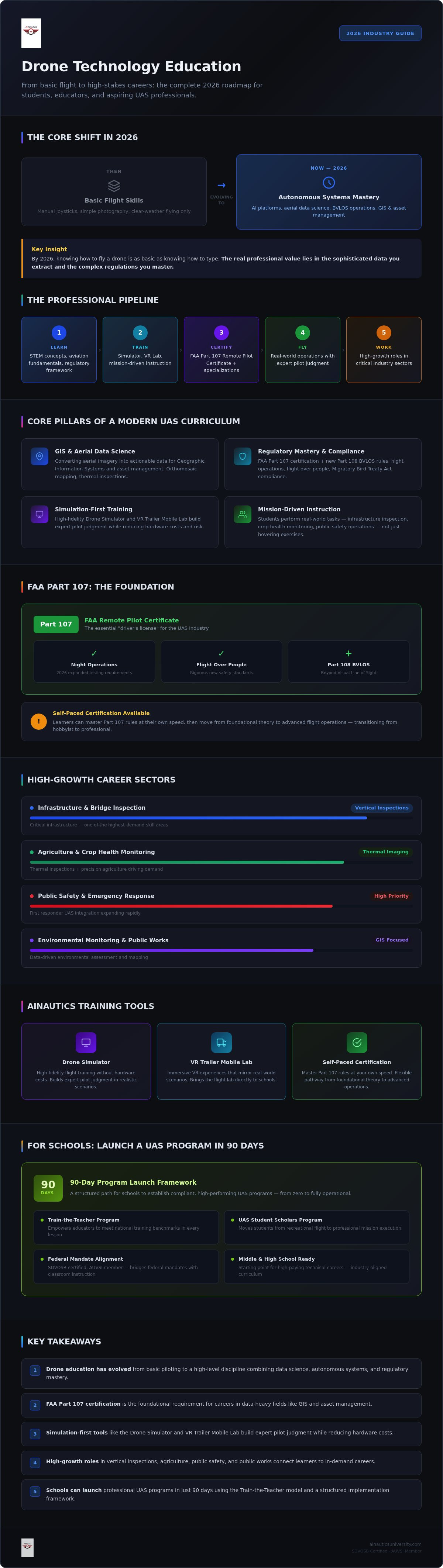
Industry-aligned curriculum is rapidly replacing the generic "flight school" models of the past. Companies no longer want pilots who can only fly in clear weather. They need technicians who understand the "Learn → Train → Certify → Fly → Work" pipeline. This means moving beyond basic maneuvers and focusing on the role drones play in critical infrastructure, public safety, and environmental monitoring. Mastery in 2026 requires a deep understanding of how these machines interact with the world and the data they produce.
From STEM Interest to Workforce Readiness
Middle and high school classrooms are now the starting point for high-paying technical careers. The UAS Student Scholars program illustrates this shift by moving away from recreational flight and toward professional mission execution. Mission-driven instruction is the new standard. Students don't just hover; they perform orthomosaic mapping and execute thermal inspections. These are the specific skills that industry leaders demand. By integrating high-fidelity tools like the Drone Simulator and the VR Trailer Mobile Lab, educators can provide immersive experiences that mirror real-world scenarios. This ensures that every hour spent in the classroom translates directly into workforce competency.
National Standards and the 2026 Regulatory Environment
The regulatory landscape has expanded significantly with the introduction of Part 108 rules for Beyond Visual Line of Sight (BVLOS) operations. Mastery of the foundational FAA Part 107 Training is still essential, but it's now just the beginning of a professional journey. Schools and institutions must prioritize drone compliance training to navigate this complex legal framework. As an SDVOSB and a member of AUVSI, AINautics University bridges the gap between federal mandates and classroom instruction. Our 90-Day Program Launch framework provides a structured path for schools to establish compliant, high-performing UAS programs. We empower educators through the Train-the-Teacher Program to ensure that national training benchmarks are met in every lesson. Compliance isn't just a hurdle; it's the foundation of a professional career.
Core Pillars of a Modern UAS Curriculum
A robust drone technology education program relies on more than just flight hours. It demands a curriculum built on technical mastery and regulatory precision. In 2026, the industry has moved beyond simple photography. We now focus on turning aerial imagery into actionable data for Geographic Information Systems (GIS) and asset management. Pilots must also master operational safety and meticulous mission planning. This includes ethical considerations like wildlife awareness. For example, professional inspections now require compliance with the Migratory Bird Treaty Act. This ensures that commercial operations don't disrupt local ecosystems while performing critical infrastructure checks. Comprehensive drone technology education must bridge the gap between basic flight and these complex industrial requirements.
The Part 107 Certification Pathway
The FAA Remote Pilot Certificate remains the essential "driver's license" for the UAS industry. Obtaining Part 107 drone training is a powerful resume-builder for students entering the workforce. In 2026, the requirements have evolved to include more rigorous testing on night operations and flight over people. Our Self-Paced Certification options allow learners to master these rules at their own speed. Once certified, students can move from foundational theory to advanced flight operations. This transition is critical for moving from a hobbyist mindset to a professional career path.
Specialized Skillsets: Beyond the Camera
Modern pilots need specialized skills to remain competitive. This includes training for vertical structure inspections and cell-tower maintenance. These high-stakes environments require precision and a deep understanding of safety protocols. There's also a growing demand for "Wildlife-Aware" pilots who can conduct environmental regulatory assessments. AINautics University prepares students for real-world mission execution support through our UAS Student Scholars program. We focus on the specific needs of high-growth industries to ensure our graduates are ready for day-one operations. If you're ready to start building these skills, you can explore our current training modules to find your specialization.
The Shift Toward Immersive and Simulation-Based Learning
Modern drone technology education has moved beyond the textbook and into high-fidelity virtual environments. In 2026, high-fidelity simulators are no longer optional accessories; they're essential tools for reducing hardware costs and ensuring operational safety. You can't expect a student to master a complex commercial platform by practicing on a toy. High-stakes industries require pilots who have already faced equipment failures, sudden weather shifts, and signal loss in a risk-free setting. By using the AINautics Drone Simulator, learners achieve rapid skill acquisition without the financial risk of crashing expensive equipment. This approach allows for limitless practice in complex scenarios like night operations and Beyond Visual Line of Sight (BVLOS) missions that are often difficult to replicate in live initial training.
The real power of simulation lies in Scenario-Based Training (SBT). Instead of simple flight patterns, students are dropped into realistic missions that require expert-level pilot judgment. They learn to make split-second decisions based on live sensor data and environmental cues. This immersive tech builds the "muscle memory" of decision-making, ensuring that when they transition to live flight, their responses are instinctive and professional. It's about developing a mindset that prioritizes safety and mission success over basic flight mechanics.
The VR Trailer Mobile Lab: Education on the Move
Reaching every student is a priority for a truly national workforce. Our VR Trailer Mobile Lab brings a high-tech learning atmosphere directly to underserved or rural school districts. This mobile environment does more than just transport equipment; it creates an engaging, focused space that increases student retention. VR bridges the gap between classroom theory and the psychological stress of live flight. When a student puts on the headset, they aren't just in a classroom; they're on a cell tower or over a search-and-rescue site. This exposure helps desensitize them to the pressure of high-stakes missions before they ever touch a real controller.
Simulator-First Pedagogy
A "simulator-first" approach allows students to master emergency procedures in a completely risk-free virtual environment. If a motor fails in the simulator, the only cost is a reset button. This freedom to fail is where the deepest learning happens. Educators can also use these tools to track student progress with precise data analytics, identifying specific areas where a pilot might need more practice. This data-driven feedback is a core component of a modern drone curriculum for educators. By integrating simulator hours into the broader drone technology education framework, schools ensure that every student is fully prepared for the UAS Student Scholars program and their eventual Part 107 certification.
Future-Proofing Careers via Specialized Drone Certifications
A degree or certificate is only as valuable as the career it enables. In 2026, drone technology education has shifted from academic theory to a direct workforce pipeline. We call this the "Learn → Train → Certify → Fly → Work" model. This structured approach ensures that students don't just graduate with a piece of paper; they graduate with a professional identity. High-growth industries like economic development, public works, and vertical inspections are actively seeking pilots who possess specialized certifications. These sectors require a level of precision that general flight training cannot provide. By focusing on specialized certifications, you ensure your skills remain relevant as the industry continues to automate and expand into new municipal and industrial applications.
The 2026 landscape demands more than a basic pilot license. It requires a mastery of specific data workflows and mission protocols. Whether you're a student looking for your first role or an educator building a program, the focus must stay on the end goal: employment. Specialization isn't just a bonus; it's the standard for those who want to command higher salaries and work on high-stakes projects.
UAS Student Scholars: Building Excellence
The UAS Student Scholars program offers a tiered certification system that tracks student mastery from basic flight to advanced data processing. This isn't just about passing a test. It's about building a professional portfolio while still in a training environment. Students prepare for "Tier 2" finished media and economic development storytelling. They learn to capture and process high-quality imagery that helps cities attract new businesses and showcase infrastructure. This hands-on experience allows students to demonstrate their value to potential employers long before they enter the job market. It turns a classroom project into a real-world asset that proves competence to hiring managers.
Industry-Specific Specializations
Success in the UAS industry often depends on finding a niche. Public safety agencies are increasingly using drones for fire, police, and EMS applications. These roles require specialized training in tactical flight and thermal sensors. In municipal management, drones are now standard tools for tax assessment and asset management. However, the highest demand often lies in vertical inspections. Monitoring cell towers and critical infrastructure requires a unique blend of flight precision and technical analysis. To help bridge the gap between training and employment, the iFlyDrone marketplace connects certified students with real-world municipal data projects. This platform provides a space where your drone technology education meets actual market demand. If you're ready to start your journey, join the UAS Student Scholars program today to begin building your professional future.
Scaling Your Drone Program with AINautics University
Building a sustainable UAS program requires more than just buying hardware. It needs a structured framework that moves from initial planning to live flight operations efficiently. Our 90-Day Program Launch provides exactly that. It's a roadmap designed for schools and municipalities to integrate drone technology education into their existing infrastructure without the typical growing pains. This framework ensures that your program aligns with state and district standards for Career and Technical Education (CTE) pathways. By focusing on a turnkey approach, we help you transition from interest to operational excellence in a single semester.
A successful program also needs to provide value beyond the classroom. For municipalities, this means having a workforce ready to handle real-world data collection and infrastructure management. AINautics University bridges this gap by providing the tools and training necessary to turn a school program into a community asset. When students can participate in municipal data projects, the return on investment for the district becomes clear and immediate.
Train-the-Teacher: Ensuring Program Sustainability
The biggest hurdle for most schools is the "qualified instructor" gap. You might have the budget for drones, but finding someone certified to teach the material is a challenge. Our Train-the-Teacher Program, also known as the UAS Teacher Scholars model, solves this by certifying your existing faculty. We don't just help them pass the Part 107 exam; we provide them with the pedagogical tools to manage a flight lab. This includes ongoing curriculum updates to keep pace with 2026 technology and instructor support that lasts long after the initial training. Integrating drones into STEM and STEAM initiatives becomes seamless when your teachers feel like the experts they are.
Why AINautics University is the 2026 Industry Choice
Choosing a training partner is a strategic decision. As a Service-Disabled Veteran-Owned Small Business (SDVOSB), AINautics University brings a level of discipline and professional standards that is unmatched in the industry. We are active members of AUVSI and remain deeply rooted in the latest regulatory and technological shifts. When you partner with us, you gain access to a national network of Part 107-certified pilots and workforce guidance that helps your students find their path.
Success in 2026 is about mastery, specialization, and future-readiness. Whether you are using the VR Trailer Mobile Lab to reach rural students or the Drone Simulator to perfect emergency procedures, the goal remains the same: workforce excellence. Don't wait for the future of aviation to pass you by. Take the first step toward UAS mastery and ensure your community is ready for the high-stakes careers of tomorrow. Your journey toward professional certification and industry leadership starts with the right foundation.
Mastering the Skies of the Future
The shift toward autonomous systems and high-stakes data collection has redefined the requirements for professional success. Mastery of drone technology education is no longer just about flight hours. It's about your ability to execute complex missions and manage specialized data in a regulated environment. By prioritizing immersive tools like our Professional Drone Simulator and the VR Mobile Lab, you build the expert judgment needed for high-demand roles in public safety and infrastructure inspection.
Scaling these programs effectively requires a proven roadmap. As a National AUVSI Member, AINautics University provides the 90-Day Program Launch Framework to help schools and municipalities transition quickly into operational excellence. Whether you're a student seeking certification or an educator building a lasting legacy, the path to mastery is clear. Don't let the technical demands of the future leave you behind. Take control of your career path and join a community dedicated to professional advancement.
Explore AINautics University's Drone Education Programs and start your journey toward UAS mastery today. The sky is no longer the limit; it's your new professional frontier.
Frequently Asked Questions
What is drone technology education and why is it important in 2026?
Drone technology education is a specialized field that combines aviation, data science, and autonomous systems to prepare students for professional careers. In 2026, it's vital because industries rely on precise aerial data for critical infrastructure and safety. This training moves beyond hobbyist flight, focusing on mastery and workforce readiness in high-stakes environments.
How do I start a drone program in my school or district?
You can start a program by following the 90-Day Program Launch framework provided by AINautics University. This structured approach moves your district from initial planning to live flight operations while ensuring alignment with state CTE standards. We help you integrate tools like the VR Trailer Mobile Lab to create a professional atmosphere that engages students immediately.
Is an FAA Part 107 license required for students in a drone technology program?
Yes, an FAA Part 107 license is the essential legal requirement for any student or professional performing commercial drone operations. It acts as the foundational "driver's license" for the industry. Our Part 107 Training and Self-Paced Certification options ensure students master the regulations and safety protocols needed to pass the exam and build a professional resume.
What are the career prospects for drone technology graduates in 2026?
Career prospects are diverse and high-paying, ranging from vertical infrastructure inspections to public safety and municipal management. Graduates often find roles in search and rescue, tax assessment, or cell tower maintenance. Our iFlyDrone marketplace further supports graduates by connecting certified pilots with real-world municipal data projects to kickstart their professional journeys.
How does VR and simulator training improve drone pilot skills?
VR and simulator training allow pilots to master complex emergency procedures and high-stakes scenarios in a completely risk-free virtual environment. Using the Drone Simulator builds necessary muscle memory and decision-making skills before students ever touch a live controller. This "simulator-first" approach reduces hardware costs and significantly increases operational safety during initial learning phases.
What is the UAS Student Scholar program and how do I join?
The UAS Student Scholars program is a tiered certification system that tracks student mastery from basic flight to advanced data processing. It helps students build a professional portfolio by executing missions like economic development storytelling. You can join the program through AINautics University to begin your journey toward industry-recognized excellence and workforce readiness.
Can educators without aviation experience teach drone technology?
Absolutely, educators can successfully lead these programs by participating in our Train-the-Teacher Program. We provide existing faculty with the aviation knowledge, pedagogical tools, and technical support needed to manage a flight lab. This model ensures program sustainability by empowering local teachers to become the primary experts for their students.
How long does it take to launch a comprehensive drone program in a school?
It typically takes approximately 90 days to establish a fully operational program when using our structured implementation framework. This timeline covers everything from curriculum alignment and teacher certification to the arrival of mobile labs. Our goal is to move schools from the conceptual phase of drone technology education to live student flight within a single academic semester.

Article by
AINautics University Team
The team behind AINautics University, dedicated to drone education and FAA Part 107 certification prep, VR flight simulation, and STEM training programs for students and educators.


