
Did you know that while the FAA Part 107 certificate is a legal requirement for commercial flight, it doesn't actually test your ability to fly a drone? It's a startling reality for many new pilots who realize that passing a written exam is very different from maneuvering a high-value aircraft through a complex industrial site. This gap is exactly why hands-on UAS training has become the gold standard for anyone serious about a career in the skies. You've done the hard work of studying regulations, but now you're facing the very real fear of crashing expensive hardware or failing a mission because the theory doesn't match the real world.
We understand that transition can feel overwhelming, but professional mastery is within your reach. This guide will show you how to move from basic certification to expert execution using immersive tools like our Drone Simulator and the cutting-edge VR Trailer Mobile Lab. You'll discover how programs like the UAS Student Scholars and our specialized Part 107 Training provide the structured environment you need to build muscle memory. We'll explore how to leverage Self-Paced Certification and the Train-the-Teacher Program to build a future-ready career path that turns you into a confident, data-driven UAS professional.
Key Takeaways
- Understand why the FAA Part 107 certificate is only the legal baseline and how to transition into mission-oriented commercial operations.
- Learn how to eliminate hardware risk by building muscle memory through a Drone Simulator and immersive tools like the VR Trailer Mobile Lab.
- Master the shift from basic hovering to complex data collection by utilizing structured hands-on UAS training and standardized mission checklists.
- Discover the critical criteria for evaluating professional programs, including instructor-to-student ratios and industry-aligned career paths.
- Explore how schools can overcome barriers to entry and launch high-tech drone programs using the Train-the-Teacher Program and UAS Student Scholars initiative.
Defining Hands-On UAS Training: Beyond the Part 107 Certificate
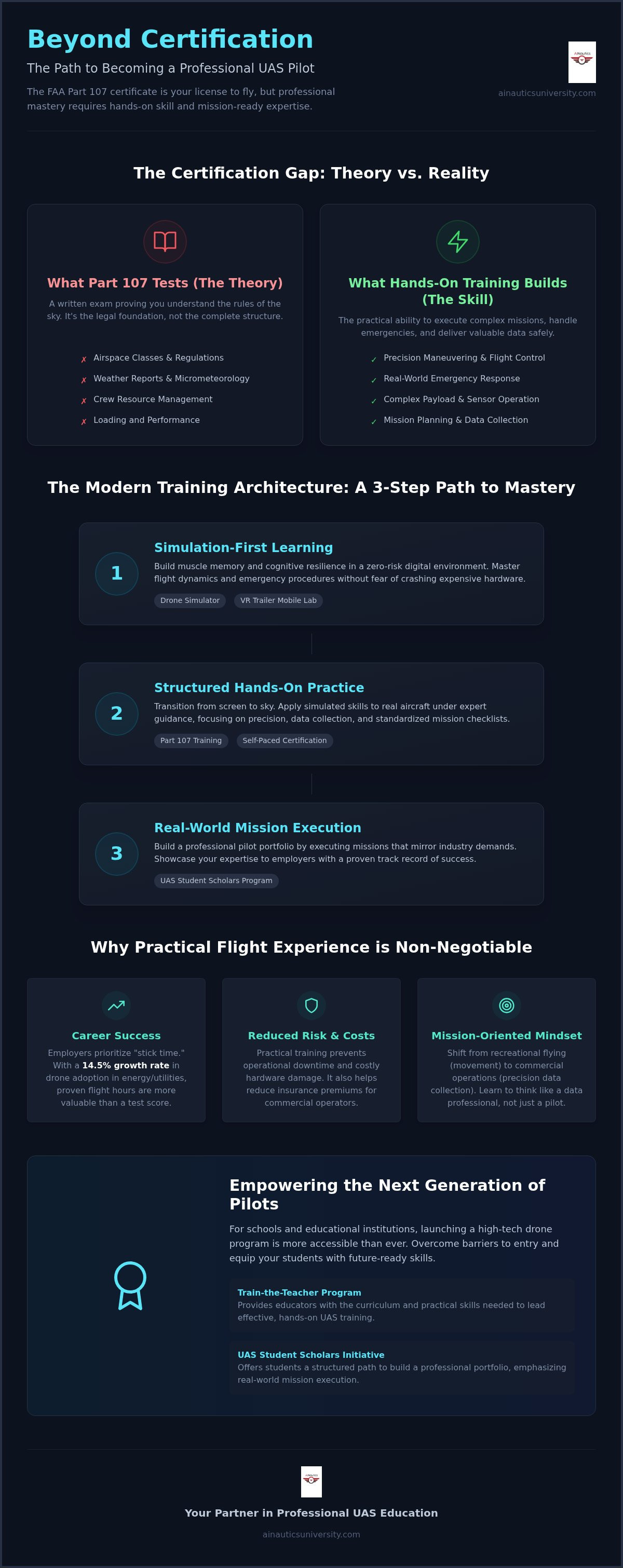
Obtaining your FAA Remote Pilot Certificate is a significant milestone, but it's only the first step in a professional journey. Think of our Part 107 Training as the legal foundation. It proves you understand airspace classes and weather reports, but it doesn't guarantee you can maneuver a thermal camera around a power line in 15-knot winds. In 2026, the gap between a licensed pilot and a professional operator is defined by specialized expertise. While Self-Paced Certification options help you master the theory, true mastery requires moving beyond the screen.
Transitioning from recreational flying to mission-oriented operations requires a shift in mindset. Recreational flights are about the joy of movement; commercial missions are about the precision of data collection. Professional hands-on UAS training bridges this gap by focusing on mission success rather than just staying airborne. This practical experience is vital for reducing insurance premiums and preventing operational downtime. Companies prioritize pilots who demonstrate they can handle high-pressure environments without risking expensive hardware. Before taking to the skies, many professionals utilize UAS simulation training to master the basics of flight dynamics without the risk of equipment damage.
Why Practical Flight Experience Matters for Career Success
Employers in the energy and utilities sectors, which are seeing a 14.5% growth rate in drone adoption, look for "stick time" above all else. Developing spatial awareness and emergency response protocols isn't something you can learn from a textbook. Our UAS Student Scholars program emphasizes this by building a professional pilot portfolio that showcases real-world mission execution. Having 50 hours of flight time in complex environments is worth more to a hiring manager than a perfect score on a written exam. It shows you've faced real-world variables and maintained control.
Essential Skills Developed Through Physical Flight Time
Modern industry standards in 2026 demand more than simple line-of-sight flying. Pilots must master precision maneuvering in high-interference environments where GPS might be unreliable. This involves simultaneously managing the aircraft and complex sensor payloads. Tools like our Drone Simulator and the VR Trailer Mobile Lab allow students to practice these multi-tasking skills in a controlled setting. For educators, our Train-the-Teacher Program ensures that instructors can pass on these practical skills, from understanding wind shear to mastering gimbal controls, ensuring the next generation is ready for the high-tech demands of the UAS industry.
The Modern Training Architecture: Combining Simulators and VR
Mastery in the cockpit doesn't begin on the flight line. In 2026, the most effective path to flight proficiency utilizes a "Simulation-First" methodology. This approach prioritizes zero-risk learning, allowing pilots to push the limits of their aircraft in a digital environment before ever powering up a physical drone. The psychological benefit is immense. When you fail in a virtual space, you aren't just saving thousands of dollars in hardware. You're building the cognitive resilience needed for high-stress missions. Integrating VR technology into hands-on UAS training ensures that pilots are prepared for the sensory overload of real-world missions. It removes the fear of the first crash and replaces it with a focus on technical excellence.
Organizations like DRONERESPONDERS hands-on UAS training emphasize scenario-based preparation for public safety, a philosophy we mirror through our digital tools. In 2026, Remote ID compliance and complex airspace regulations make this digital preparation even more critical. Pilots can test their compliance workflows and emergency procedures in a safe, repeatable environment. This architecture ensures that every student who transitions to live flight is already a seasoned operator in the virtual world. The transition becomes a formality rather than a gamble.
Building Muscle Memory with Drone Simulators
Practicing in GPS-denied flight modes is a cornerstone of advanced hands-on UAS training. Our Drone Simulator recreates these challenging environments, forcing pilots to rely on manual stick inputs and visual cues. This repetition turns complex maneuvers into subconscious actions. You'll learn to handle sensor failures or signal interference without panic. Pilots also use simulators to master software interfaces and Head-Up Displays (HUDs) before touching a field controller. This ensures focus remains on the mission, not the controls.
Immersive Learning via the VR Trailer Mobile Lab
Education shouldn't be tethered to a traditional classroom. The VR Trailer Mobile Lab brings high-tech, immersive learning directly to you. This mobile asset uses virtual reality to provide a 360-degree perspective on complex structures like cell towers or wind turbines. It creates a collaborative environment where teams observe and critique virtual flights in real-time. This shared experience accelerates the learning curve. Students explore high-risk environments safely, gaining an understanding of structural nuances impossible to see from the ground. If you want to start building these future-ready skills, explore our UAS workforce development programs today.
Real-World Mission Scenarios: How to Execute Professional Flights
Mastering the sticks in a simulator is a vital first step, but the true test of a pilot occurs in the field. Professional flight execution is about more than just staying airborne; it's about delivering high-value data under real-world conditions. Transitioning from basic hovering to complex, mission-driven operations requires a disciplined approach to every flight. Real-world hands-on UAS training transforms a pilot from a hobbyist into a professional operator who can manage environmental distractions, communication link challenges, and technical failures without compromising safety. Structured programs like the KYTC UAS Pilot Training Course illustrate how state-level agencies combine certification with real-world application to ensure mission success.
In 2026, professional scenarios have evolved far beyond simple photography. Pilots now conduct detailed cell tower inspections, bridge assessments, and wildlife-aware surveys. Our UAS Student Scholars learn to treat every takeoff as a professional mission, utilizing the same standardized checklists used by major industrial firms. This structure ensures that even when distractions arise, the pilot remains focused on the objective. Whether you are navigating the complexities of our Part 107 Training or advancing through Self-Paced Certification, the goal remains the same: professional flight mastery through repetition and discipline.
Mastering Pre-Flight Inspections and Risk Mitigation
Success begins on the ground. A professional mission requires thorough hardware assessments and firmware verification, especially with 2026 Remote ID requirements. Pilots must evaluate site-specific hazards, such as electromagnetic interference near power lines or transient obstacles like cranes. During our hands-on UAS training, students apply Part 107 rules to these actual field conditions in real-time. We move beyond theory to ensure you can secure airspace authorizations and mitigate risks before the rotors even spin.
Executing Data Collection and Aerial Media Missions
The value of a UAS pilot is often measured in the quality of the data they collect. Professional cinematography requires balancing creative capture with strict flight safety. For industrial applications, pilots must master techniques for capturing high-quality orthomosaic mapping data, ensuring consistent overlap and sharp imagery. 2026 standards also demand wildlife-aware procedures. This includes flying in compliance with the Migratory Bird Treaty Act to avoid disturbing nesting sites during inspections. By utilizing tools like the VR Trailer Mobile Lab and our Drone Simulator, students practice these specialized missions until they can execute them flawlessly in the physical world. For educators, the Train-the-Teacher Program provides the framework to teach these mission-critical skills to the next generation of pilots.
How to Evaluate a Hands-On UAS Training Program
Choosing the right educational partner determines your trajectory in the $100 billion drone market of 2026. A quality program offers more than just flight hours; it provides a structured environment where you can fail safely and succeed professionally. When you evaluate hands-on UAS training, start with the instructor-to-student ratio. Personalized feedback is the only way to correct subtle bad habits before they become expensive mistakes. Seek out institutions that align with AUVSI and STEM standards, ensuring your education meets recognized industry benchmarks.
Hardware diversity is equally important. A professional shouldn't be limited to a single platform. Learning the nuances of different flight controllers and airframes prepares you for the varied demands of the workforce. Look for programs that emphasize the following criteria:
- Instructor-to-student ratios that allow for personalized coaching.
- Access to diverse hardware platforms, including enterprise and custom UAS.
- Curriculum alignment with AUVSI and STEM educational standards.
- Direct pipelines to workforce opportunities and industry networks.
Instructor Credentials and Equipment Standards
Real-world commercial experience is the most valuable asset an instructor brings to the table. You need mentors who have managed real missions, handled signal interference, and navigated complex regulatory hurdles. Their insights into enterprise-grade sensors and thermal cameras turn a basic pilot into a specialist. Our Drone Simulator and VR Trailer Mobile Lab ensure you're training on equipment that mirrors the 2026 technological landscape. Don't settle for outdated hardware. Your career depends on being future-ready.
Curriculum Alignment and Workforce Readiness
Does the program offer a clear path to Professional FAA Part 107 Drone Training? This is your entry point, but your choice between Self-Paced Certification and instructor-led cohorts should align with your learning style. While self-paced options offer flexibility, cohorts provide networking opportunities that are vital in the UAS industry.
Programs like our UAS Student Scholars initiative go beyond the classroom. They connect you directly to the broader UAS workforce marketplace. This bridge between education and employment defines a successful training experience. If you're ready to elevate your skills, explore our UAS career pathways to find the right fit for your professional goals.
Implementing UAS Training for Schools and Professionals
Integrating Unmanned Aircraft Systems into a curriculum or professional workflow is a strategic investment in the future. With the global drone market projected to reach $210.26 billion by 2034, the demand for skilled operators is skyrocketing. However, many schools and organizations hesitate because of perceived barriers like high equipment costs, insurance complexities, and a lack of internal expertise. We address these hurdles by providing a structured roadmap that turns technological potential into a functional classroom or department. By integrating hands-on UAS training into the weekly schedule, schools transform theoretical STEM concepts into tangible career skills that students can use immediately upon graduation.
A sustainable program requires more than just hardware; it needs a foundation of expert leadership. Our Train-the-Teacher Program is designed to solve the expertise gap by empowering educators to become confident UAS leads. This ensures that the knowledge stays within the institution, creating a long-term resource for students. When combined with our VR Trailer Mobile Lab, schools can offer high-tech experiences without the need for permanent, expensive onsite facilities. This mobile asset provides the immersive environment necessary for mastery while keeping the program flexible and scalable.
Launch a Drone Program in 90 Days
Speed to implementation is critical for maintaining student engagement and district support. Our 90-Day Program Launch framework provides a step-by-step rollout that moves from initial planning to live flight operations with efficiency. A major part of this success is aligning drone curriculum for educators with state standards. This alignment makes it easier to secure district-level buy-in, as administrators can see the direct connection between autonomous systems education and workforce readiness goals. We handle the complexities of safety protocols and equipment selection so you can focus on teaching.
Advanced Certification Pathways for Student Scholars
The transition from a student enthusiast to a workforce-ready pilot is a journey of increasing specialization. Our UAS Student Scholars program serves as the gold standard for this progression. It encourages youth to build professional resumes through documented flight logs and specialized certifications. Students utilize our Drone Simulator to perfect their skills before moving to Part 107 Training and eventually Self-Paced Certification for advanced missions. Professional hands-on UAS training ensures these students enter the workforce with the confidence to manage real-world missions. They don't just graduate with a diploma; they graduate with a career path in one of the world's fastest-growing industries.
Secure Your Future in the Evolving UAS Industry
The sky is no longer a limit but a professional workspace filled with opportunity. Transitioning from a certified pilot to a mission-ready expert requires more than passing a written test; it demands deliberate practice and exposure to real-world complexities. By integrating hands-on UAS training with immersive simulation, you build the muscle memory and technical confidence needed to excel in the competitive 2026 landscape. Whether you're an educator launching a district-wide program or a student scholar aiming for an enterprise career, the tools for success are ready and accessible.
As a SDVOSB certified institution and proud AUVSI member, we provide 100% FAA compliant training designed for the modern workforce. Take the next step toward professional flight mastery today. Explore Hands-On UAS Training Programs at AINautics University and start your journey toward specialized industry leadership. Your path to the professional cockpit is clear, and the future of flight is yours to command. We're here to help you navigate every step of that journey with confidence.
Frequently Asked Questions
Do I need my own drone to participate in hands-on UAS training?
You don't need to own a drone to participate in our training programs. We provide all the necessary professional-grade hardware for our students, ensuring you learn on the same equipment used by industry leaders. This approach removes the financial burden of purchasing expensive gear before you've mastered the basics. Our VR Trailer Mobile Lab and Drone Simulator also offer high-tech environments to build skills without requiring personal hardware.
How many flight hours are typically required to become proficient for commercial work?
Proficiency usually requires 10 to 20 hours of mission-specific flight time beyond basic hovering. Simple flight hours aren't as valuable as structured, goal-oriented training that targets specific industrial tasks. Our UAS Student Scholars program focuses on high-quality "stick time" that builds the muscle memory needed for commercial success. We prioritize quality over quantity to ensure you're ready for the rigorous demands of real-world industrial missions.
Can hands-on training help me pass the FAA Part 107 exam?
Practical training significantly improves your understanding of Part 107 theory by providing real-world context for FAA regulations. Seeing how airspace rules and weather conditions affect a physical flight makes the academic material easier to retain. Whether you choose our instructor-led Part 107 Training or Self-Paced Certification, adding a physical component helps bridge the gap between the book and the sky. It turns abstract concepts into actionable professional knowledge.
What is the difference between a drone simulator and a VR training lab?
A Drone Simulator uses a monitor and controller to replicate flight physics in a digital space. In contrast, our VR Trailer Mobile Lab provides a 360-degree immersive environment where you feel like you're physically on-site at a cell tower or wind turbine. Both tools are essential for hands-on UAS training, allowing you to practice high-risk maneuvers without endangering physical aircraft. This combination ensures a comprehensive understanding of both controls and spatial awareness.
Is hands-on UAS training available for K-12 teachers without prior flight experience?
Yes, we offer specialized training for K-12 educators through our Train-the-Teacher Program. You don't need any prior flight experience to join. We guide you through the basics of drone technology, safety protocols, and classroom curriculum integration. This program empowers you to lead your own school drone lab and inspire students to explore future-ready career paths in the rapidly growing UAS industry. It is a perfect entry point for educators at any skill level.
What industries currently have the highest demand for hands-on trained UAS pilots?
The energy and utilities sectors currently show the highest demand for pilots with hands-on UAS training. These industries require precise inspections of critical infrastructure like power lines and solar farms. Construction and agriculture also rely heavily on skilled pilots for mapping and crop monitoring. Mastering these specialized data collection techniques ensures you're prepared for high-growth career opportunities in 2026, where workforce readiness is a top priority for major employers.
How does AINautics University incorporate wildlife-aware procedures into flight training?
We integrate wildlife-aware procedures by teaching pilots to recognize and avoid nesting areas in compliance with the Migratory Bird Treaty Act. Our curriculum includes pre-flight site assessments that identify local environmental risks before you take off. By practicing these scenarios in our Drone Simulator, you learn how to maintain mission objectives while respecting local ecosystems and following all federal environmental regulations. This ensures your commercial operations are both legal and ethically responsible.
What happens if I crash a drone during a hands-on training session?
Crashing is a natural part of the learning curve, which is why we emphasize a "Simulation-First" approach. If you crash in our Drone Simulator or VR environment, there's no cost or hardware damage. During live flight sessions, our instructors use "buddy box" systems to take control if a mistake occurs. We provide a safe, structured environment where you can learn from errors without the fear of breaking expensive equipment or facing financial stress.

Article by
AINautics University Team
The team behind AINautics University, dedicated to drone education and FAA Part 107 certification prep, VR flight simulation, and STEM training programs for students and educators.


