
By 2026, the most successful professionals in the sky won't be defined by how well they move a joystick, but by how they manage autonomous data systems. If you feel overwhelmed by shifting FAA regulations or uncertain about long-term job stability, you're not alone. Many aspiring pilots struggle to find a clear roadmap from their initial certification to a high-paying role. Understanding the diverse drone pilot career paths available today is the first step toward securing your place in a global commercial market projected to reach up to $116.81 billion this year.
You deserve a career that offers more than just a view from above. This guide promises to help you identify lucrative niches like utility inspection and BVLOS operations, which are expanding rapidly under the new Part 108 framework. You'll learn about the educational foundation required to excel, including how to leverage tools like the AINautics University Drone Simulator or our Self-Paced Certification options. Whether you're a student in the UAS Student Scholars program or an educator using our Train-the-Teacher curriculum, we provide a structured path to workforce readiness. Let's explore the specializations that turn a Part 107 certificate into a future-proof career.
Key Takeaways
- Understand the critical shift from manual hobbyist flight to the data-driven autonomous systems operations that define the 2026 market.
- Learn why autonomous systems education, including AI software management, is the essential foundation for any professional UAS mission.
- Discover the specialized requirements for drone pilot career paths across the public safety, private industry, and educational sectors.
- Follow a structured roadmap to move from initial FAA Part 107 certification to a specialized, workforce-ready skill set.
- Explore how programs like UAS Student Scholars and Self-Paced Certification options provide a direct route to professional employment.
Navigating the Drone Pilot Career Landscape in 2026
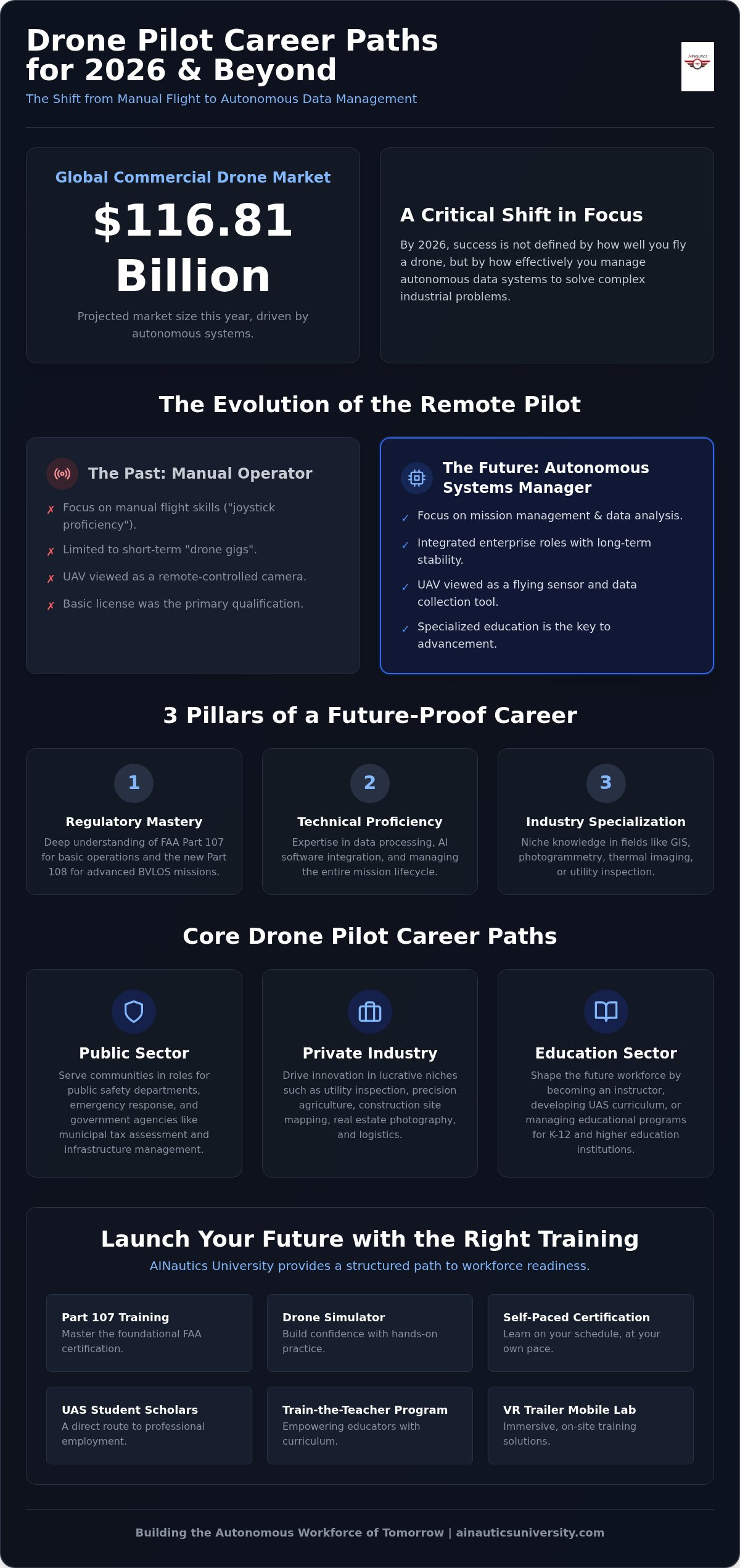
A drone pilot career path is a structured professional trajectory within the UAS industry that prioritizes mission outcomes over manual flight skills. In 2026, we're seeing a definitive shift. The era of the hobbyist "drone gig" has ended. It's been replaced by a data-driven workforce where pilots manage autonomous systems to solve complex industrial problems. This evolution is fueled by the finalization of FAA Part 108 regulations, which has normalized Beyond Visual Line of Sight (BVLOS) operations across the country.
Modern professionals view an Unmanned Aerial Vehicle (UAV) as a flying sensor rather than a toy. This change in perspective is critical for anyone looking to enter a global commercial market estimated to reach $116.81 billion this year. Mastery of these systems requires more than just a basic license; it demands a commitment to specialized education and professional standards. Success in this field is now driven by three main factors:
- Regulatory mastery of Part 107 and the new Part 108 standards.
- Technical proficiency in data processing and AI software integration.
- Industry-specific knowledge, such as GIS, photogrammetry, or thermal imaging.
The Evolution of the Remote Pilot
Professional remote pilots have transitioned into integrated enterprise roles. Companies no longer look for someone who can simply fly. They hire specialists who can execute complex missions and analyze the resulting data. Credibility in this space is often built through AUVSI membership and adherence to strict safety protocols. We're even seeing the rise of highly specialized roles, such as environmental inspectors who must navigate the legalities of the Migratory Bird Treaty Act during wildlife-aware inspections. These niche drone pilot career paths require a blend of technical skill and regulatory knowledge that goes far beyond the basics of flight.
Key Economic Drivers in the UAS Sector
The economic impact of the autonomous systems workforce is visible across several sectors. Government agencies and public safety departments are driving massive demand for aerial data. For example, municipal Tax Assessor offices are increasingly adopting drones for efficient property mapping and assessment. This surge in utility has made workforce development the #1 priority for UAS firms. They're looking for pilots who are ready to work on day one.
AINautics University serves as the bridge to these opportunities. Through our UAS Student Scholars program and Self-Paced Certification options, we prepare the next generation for these high-stakes roles. Whether you're an educator using our Train-the-Teacher Program or a student practicing on our Drone Simulator, the goal is the same: workforce readiness. The industry is moving fast. The right training ensures you aren't just watching the future happen, but leading it.
The Foundation: Why Autonomous Systems Education Matters
Autonomous systems education represents a shift from mechanical control to intelligent mission management. It encompasses the study of unmanned hardware and the complex AI software that drives it. While many beginners focus on manual flight, professional drone pilot career paths require the ability to oversee an entire mission lifecycle. This means understanding how sensors, software, and hardware interact in real-world industrial environments.
Mission-driven instruction moves beyond simple test-prep. It focuses on how to solve problems using aerial data. STEM-aligned training prepares you for these high-tech roles by teaching the "why" behind the "how." It's the difference between being a hobbyist and being a workforce-ready professional who can manage autonomous fleets. This deep understanding is what allows a pilot to transition from basic flight to complex data analysis.
Workforce Readiness vs. Basic Certification
Obtaining your license is a vital first step, but it's only the beginning. Meeting the FAA Part 107 certification requirements serves as your entry ticket to the industry. However, a certificate alone doesn't guarantee a long-term career. True workforce readiness comes from a comprehensive curriculum that links autonomous systems education to specific industrial needs.
Career longevity depends on your ability to adapt to new technologies. As AI continues to automate basic flight, the value of a pilot shifts toward data integration and mission planning. Educators and students who prioritize this deeper understanding are better positioned for high-level roles in utilities, agriculture, and public safety. It's about building a skill set that remains relevant as the technology evolves.
The Role of Simulation in Professional Training
Professional training shouldn't start in the field where mistakes are costly. Using the AINautics Drone Simulator allows students to build muscle memory safely. This tool provides a controlled environment to practice complex maneuvers without the risk of damaging expensive equipment. It's an essential step in moving from theory to practical application.
Scenario-based training is where simulation truly shines. It allows pilots to experience emergency management or industrial inspections in a virtual space. You can practice responding to sensor failures or high-wind conditions repeatedly until the response becomes second nature. This approach significantly reduces the cost of entry for aspiring pilots while increasing safety. If you're ready to start your journey, explore our professional training programs to build your foundation today.
Core Drone Pilot Career Paths: Public, Private, and Educational
The UAS industry has matured into three distinct professional pillars: public safety, private enterprise, and education. Each sector offers unique drone pilot career paths that demand specialized training and a deep understanding of regulatory compliance. Successfully navigating these tracks requires more than basic flight skills. It requires the ability to deliver actionable data within a specific professional vertical. Whether you're interested in government service or high-tech industrial inspection, your success depends on mastering the tools specific to that field.
Industrial inspections, for instance, have evolved far beyond simple aerial photography. Modern enterprise roles require pilots to operate thermal sensors, LiDAR, and high-zoom cameras to detect structural fatigue or gas leaks. This work is technical and high-stakes. It often involves integrating aerial data into complex Geographic Information Systems (GIS). Choosing one of these drone pilot career paths means committing to a life of continuous learning as hardware and software capabilities expand.
Public Safety and Government Operations
Public safety agencies are among the fastest adopters of UAS technology. Fire departments use drones for thermal hotspot detection, while police departments deploy them for search and rescue or accident reconstruction. Beyond emergency response, municipal government roles are expanding. Tax Assessor offices now utilize drones for infrastructure management and property assessment. These positions are compliance-heavy. They require pilots who are experts in FAA waivers and night-operation protocols. Professionals in this sector often use our Self-Paced Certification options to stay current with shifting government regulations.
Industrial Inspection and Enterprise Data
Private sector opportunities are booming in telecommunications and energy. Cell tower and vertical structure inspections are now standard practice for major firms. These roles often include environmental responsibilities. Pilots must follow wildlife-aware procedures when inspecting structures that house protected bird nests. This sector prioritizes data integration. The goal isn't just to see a tower, but to create a digital twin that fits into an asset-management system. Our Drone Simulator provides the high-fidelity environment needed to practice these precise, close-proximity maneuvers safely.
UAS Education and Curriculum Development
A significant gap exists in the market for qualified UAS instructors. School districts across the country are searching for specialists who can lead STEM programs. This has created a lucrative path for those who complete a Train-the-Teacher Program. Educators are now building careers by developing curriculum and managing a mobile drone lab for schools. Programs like UAS Student Scholars help bridge the gap between classroom learning and industry needs. By utilizing our VR Trailer Mobile Lab, educators can bring high-tech training directly to their students, preparing the next generation for the autonomous workforce.
How to Build a Workforce-Ready Skill Set
Building a career in the UAS industry requires a deliberate roadmap. You can't rely on manual flight skills alone. Success in modern drone pilot career paths depends on your ability to plan missions and integrate complex data sets. Employers in 2026 look for pilots who understand the entire operational lifecycle. This includes pre-flight risk assessment, regulatory compliance, and post-flight data processing. Mastery of these areas ensures you aren't just a pilot, but a valuable asset to any enterprise team.
Maintaining a "clean paper trail" is another non-negotiable skill. Insurers and regulators require meticulous documentation of flight hours, maintenance logs, and safety protocols. This professional discipline protects your career and builds trust with high-level clients. Utilizing Self-Paced Certification options allows you to stay ahead of these requirements without pausing your current professional life. It's about constant refinement of your craft. It's about showing you're ready for the responsibility of the sky.
Mastering the FAA Part 107 and Beyond
Every professional journey begins with the basics. Securing Part 107 drone training is your first major milestone. However, the job market in 2026 has been transformed by the implementation of Part 108. This new framework for Beyond Visual Line of Sight (BVLOS) operations has opened doors that didn't exist just two years ago. Understanding these advanced regulations is now a core competency. Professionals who can navigate the complexities of Part 108 are commanding higher salaries and more stable roles. They're the ones leading the charge into long-range delivery and large-scale infrastructure inspection.
Immersive Technology and Hands-On Experience
Theory only takes you so far. You need hands-on experience that mirrors real-world challenges. Our VR Trailer Mobile Lab provides immersive flight scenarios that prepare you for the unexpected. These sessions allow you to build a portfolio based on actual mission objectives, such as tower inspections or search and rescue drills. A collection of random photos won't get you hired. A portfolio of mission-based data products will. It proves you can handle the equipment and the data it produces.
Once you've built your skills, you need a way to reach the market. Joining a nationwide pilot marketplace like iFlyDrone helps bridge the gap between training and employment. It connects certified pilots with organizations that need their specific expertise. To ensure you're ready for these opportunities, start your journey with our comprehensive workforce training programs today. Preparing now means you'll be the first choice for the high-demand roles of tomorrow. Don't just fly; lead the mission.
Launching Your Future with AINautics University
AINautics University serves as the essential bridge between foundational education and professional employment. We don't just teach you how to pass an exam. We prepare you for the specific demands of the 2026 workforce. Our mission-driven instruction ensures you understand how to manage complex data and autonomous systems. This focus on practical application separates successful professionals from those who struggle to find their place. By aligning our curriculum with industry needs, we help you secure your future in various drone pilot career paths.
For educators, we offer a streamlined "Launch a Drone Program in 90 Days" model. This framework allows schools to implement a full UAS curriculum quickly and effectively. It includes everything from teacher training to hardware integration. By empowering teachers through our Train-the-Teacher Program, we ensure students receive high-quality instruction. This systemic approach builds a sustainable talent pipeline for the entire industry. It turns the classroom into a launchpad for the next generation of aviators.
A Seamless Path from Learner to Professional
Our proprietary "Learn → Train → Certify → Fly → Work" pipeline provides a clear roadmap for every student. It isn't a fragmented learning experience. It's a cohesive journey designed to build confidence and competence. As a Service-Disabled Veteran-Owned Small Business (SDVOSB) with active AUVSI membership, we bring industry-leading credibility to your training. You'll have access to ongoing curriculum updates that reflect the latest FAA changes, including Part 108 BVLOS standards. This ensures your skills remain relevant as the technology evolves.
Final Steps to Your Drone Career
The final phase of your preparation involves choosing the learning environment that fits your needs. You can opt for our Self-Paced Certification for maximum flexibility. Or, join us in our VR Trailer Mobile Lab for immersive, in-person training. Both paths lead to the same goal: a workforce-ready resume. When crafting your resume, focus on your mastery of autonomous systems and mission management. Highlight your experience with our Drone Simulator and any specialized projects completed during your training.
These details prove to employers you're ready for high-stakes roles. If you're a student looking to gain a competitive edge, explore the UAS Student Scholar program to start your journey today. Your career in the sky is waiting. We provide the tools, the tech, and the roadmap to help you reach it.
Secure Your Place in the Future of Flight
The UAS industry in 2026 offers more than just a job; it provides a gateway to becoming an essential part of the modern technological workforce. Success in the sky today depends on your ability to move beyond basic flight and master the data systems that drive enterprise operations. By choosing specialized drone pilot career paths in sectors like public safety or industrial inspection, you're investing in a future that values technical expertise and regulatory mastery.
AINautics University is here to support that investment. As a Service-Disabled Veteran-Owned Small Business, we provide a STEM-aligned curriculum that bridges the gap between certification and employment. Whether you're training on our Drone Simulator or connecting with clients through the nationwide iFlyDrone pilot marketplace, we offer the tools you need to excel. Don't wait for the industry to evolve around you. Take the lead and define your professional trajectory with expert guidance.
Start your professional UAS journey with AINautics University today and build the skills required for the autonomous workforce. The horizon is wide open, and your journey to mastery begins with a single, decisive step.
Frequently Asked Questions
Is a drone pilot career path stable in 2026?
Yes, drone pilot career paths are highly stable in 2026 as the global commercial market has expanded to an estimated $116.81 billion. Industries like telecommunications, agriculture, and public safety now rely on UAS for daily operations. This shift from experimental use to essential infrastructure ensures long-term demand for certified professionals who can manage autonomous fleets. The finalization of BVLOS regulations has further solidified this stability across the country.
What is the average salary for a professional UAS pilot?
The average annual salary for a drone pilot in the United States currently ranges from $50,000 to $95,000. Entry-level pilots with less than one year of experience can expect to earn between $42,000 and $50,000 annually. Those with over five years of experience or specialized skills in data processing often command salaries exceeding $88,000. Top earners in high-demand technical niches can reach upwards of $120,000.
Do I need a college degree to become a drone pilot?
You don't need a four-year college degree to start a career in the UAS industry. The primary legal requirement is the FAA Part 107 remote pilot certificate. However, employers increasingly prioritize candidates with specialized training. Programs like UAS Student Scholars provide the technical foundation and mission-based experience that often carry more weight in the workforce than a general academic degree alone.
What is autonomous systems education and why do I need it?
Autonomous systems education is the combined study of unmanned hardware and the AI software that controls it. You need this knowledge because modern industry is moving away from manual joystick control toward automated mission management. Understanding how to oversee these intelligent systems is what allows you to transition from a basic operator to a high-level UAS strategist. It's the essential foundation for long-term career growth.
How long does it take to go from beginner to workforce-ready?
You can obtain your initial certification in a few weeks, but becoming workforce-ready typically takes several months of dedicated training. While Self-Paced Certification options allow you to learn the theory quickly, mastering mission planning requires hands-on experience. Utilizing a Drone Simulator and participating in immersive sessions in a VR Trailer Mobile Lab ensures you have the muscle memory and technical skills required for high-level professional roles.
Can I start a drone program in my high school as a career path?
Yes, educators can implement a professional-grade drone program using our 90-day launch framework. By utilizing the Train-the-Teacher Program, schools can provide students with a direct path to FAA certification and career readiness. This approach turns the classroom into a vocational hub, preparing students for immediate entry into the autonomous systems workforce upon graduation. It's an excellent way to provide students with high-demand 21st-century skills.
What are the most in-demand drone pilot skills in 2026?
The most in-demand skills in 2026 include data processing, AI software integration, and Beyond Visual Line of Sight (BVLOS) mission planning. Employers are no longer just looking for pilots; they need specialists who can deliver finished data products like 3D maps or thermal reports. Mastery of these technical areas, combined with strict regulatory compliance, defines the most successful drone pilot career paths in the current market.
What is the difference between Part 107 and Part 108?
Part 107 is the standard FAA regulation for small commercial drone operations within the pilot's line of sight. Part 108 is the newer framework designed specifically for Beyond Visual Line of Sight (BVLOS) operations. While Part 107 covers most local commercial tasks, Part 108 allows for long-range missions like large-scale utility inspections and delivery services without requiring individual waivers. Understanding both is critical for modern enterprise roles.

Article by
AINautics University Team
The team behind AINautics University, dedicated to drone education and FAA Part 107 certification prep, VR flight simulation, and STEM training programs for students and educators.


