
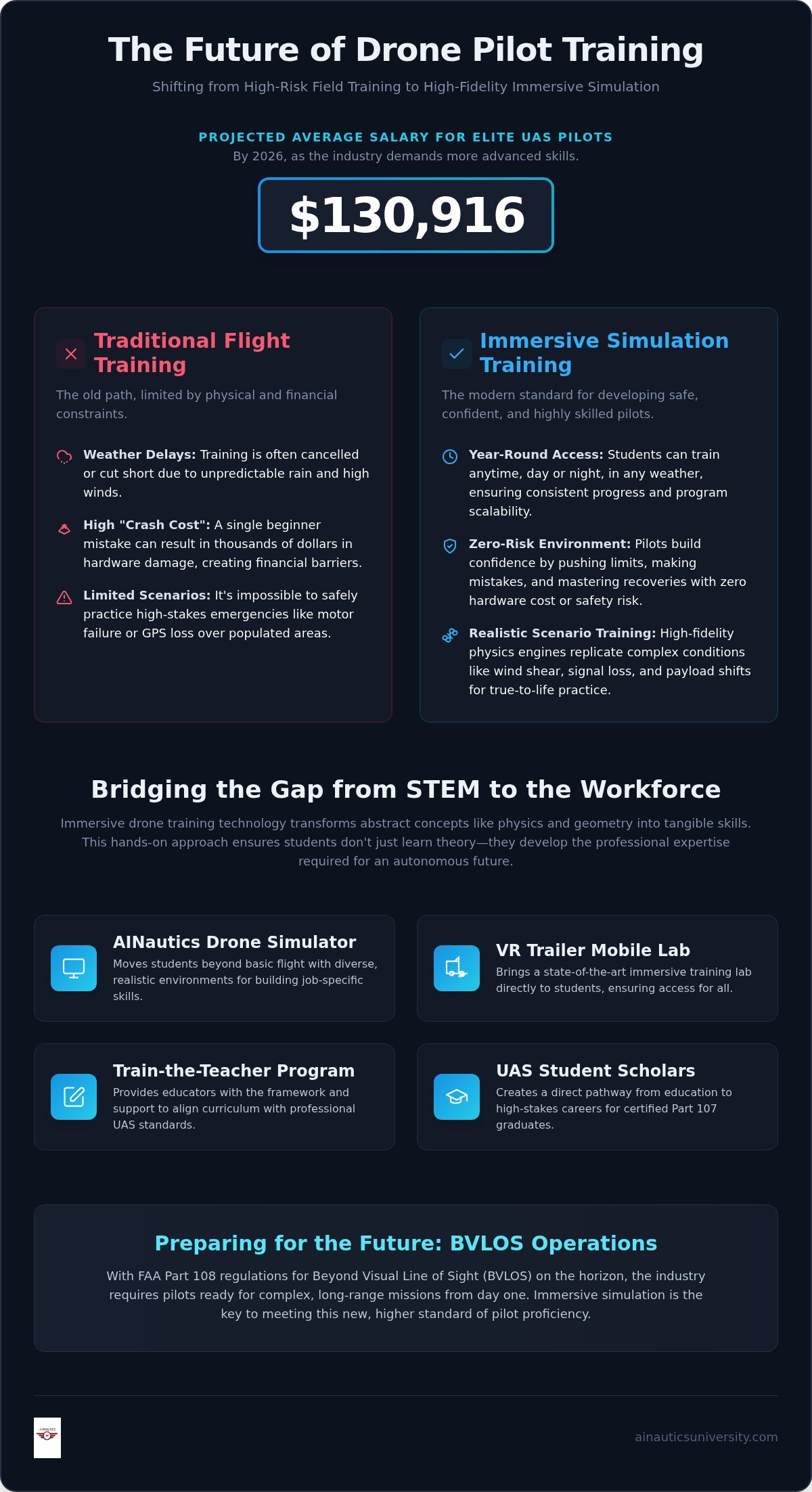
With the average drone pilot salary reaching $130,916 in 2026, the competition for elite UAS roles is fiercer than ever. You likely recognize that traditional flight training is often stalled by unpredictable weather or the looming fear of a costly hardware crash. Adopting immersive drone training technology allows schools to bypass these barriers, ensuring the path to FAA Part 107 certification is no longer slow or risky for students and educators. It's a common frustration to see learners held back by the limitations of physical equipment, but the industry is shifting toward a simulation-first approach to ensure safety and mastery.
This article reveals how these digital tools are dismantling traditional obstacles by creating a safe, year-round environment for professional growth. You'll discover how high-fidelity tools like the AINautics Drone Simulator and the VR Trailer Mobile Lab are transforming classroom STEM concepts into professional expertise. We'll explore how these innovations, alongside our self-paced certification options, UAS Student Scholars program, and Train-the-Teacher framework, create direct pathways to high-paying careers while making drone education scalable and accessible for everyone.
Key Takeaways
- Understand how immersive drone training technology integrates VR and high-fidelity physics to move training beyond simple screens into realistic, 360-degree environments.
- Learn how tools like the Drone Simulator and VR Trailer Mobile Lab accelerate student readiness and improve retention rates compared to traditional methods.
- Gain a clear roadmap for aligning your curriculum with STEM standards and supporting faculty through the Train-the-Teacher Program.
- Discover how immersive labs prepare the next wave of UAS Student Scholars for high-stakes career paths and upcoming BVLOS regulatory changes.
- Identify how to implement scalable, year-round training solutions using self-paced certification to reach larger groups without the risk of hardware damage.
The Evolution of Immersive Drone Training Technology
Immersive drone training technology has evolved from a supplemental tool into the backbone of modern aviation education. It combines Virtual Reality (VR), Augmented Reality (AR), and high-fidelity physics engines to replicate the exact conditions of flight. In the past, students relied on flat screens and basic gamepads. Today, they step into 360-degree digital environments that mimic real-world turbulence, signal interference, and emergency scenarios. This shift is critical as we reach a tipping point in 2026. With the FAA finalizing Part 108 regulations for Beyond Visual Line of Sight (BVLOS) operations, the industry needs pilots who are ready for complex missions on day one. For educational institutions, adopting immersive drone training technology is the only way to scale programs effectively while meeting these new standards.
The primary drivers for this evolution are safety, cost-reduction, and the necessity for complex scenario-based training. Real-world training makes it difficult to safely simulate a motor failure over a crowded area or a sudden loss of GPS. In a digital environment, these scenarios are programmed with precision. Foundational principles of UAS simulation training have paved the way for these high-fidelity environments, allowing for a safer transition to commercial flight. This ensures that when a pilot faces a real emergency, their reaction is instinctive rather than panicked.
Why Traditional Flight Training Isn't Enough Anymore
Traditional flight training faces constant interruptions. Rain, high winds, and limited battery life often cut lessons short. There is also the "crash cost" factor. A single mistake by a beginner can result in thousands of dollars in hardware damage. Simulators remove this financial barrier. They provide a fail-safe space where students can crash, learn, and reset instantly. This builds confidence. It allows learners to push their limits without the stress of destroying equipment. Educators use the VR Trailer Mobile Lab to bring this experience directly to students, ensuring that training continues regardless of the weather or location.
Bridging the Gap Between STEM and the Workforce
This technology also bridges the gap between classroom theory and the workforce. Abstract concepts like lift, drag, and geometric flight paths become tangible. Students don't just read about physics; they feel its impact on their controls. As part of our autonomous systems training, we help students prepare for a high-tech economy where data management is as important as piloting. Programs like the UAS Student Scholars utilize these tools to ensure graduates are ready for an autonomous future. By making STEM concepts interactive, we turn students into specialists who can handle the demands of the 2026 drone market.
Key Components of Modern Immersive UAS Labs
A professional UAS lab requires more than just a computer and a screen. It demands hardware that replicates the sensory experience of flight. High-fidelity VR headsets provide the depth perception needed for precision landing, while high-torque controllers offer the physical resistance found in professional-grade remote pilots' stations. These components are powered by high-end processing units that eliminate latency. When a student moves a control stick, the reaction in the virtual world must be instantaneous. This level of immersive drone training technology ensures that the transition from digital practice to physical flight is seamless and intuitive.
The software driving these labs must be built on accurate physics engines. If a digital drone doesn't react to wind shear, battery drain, or payload weight, it remains a game rather than a training tool. High-quality simulators align with the spirit of the FAA National Simulator Program, which sets the standard for how flight simulation training devices should prepare pilots for real-world certification. By using software that mirrors reality, students develop the situational awareness required for safe commercial operations.
High-Fidelity Drone Simulators
The AINautics Drone Simulator is designed to move students beyond basic hovering. It features diverse environments, including busy urban construction sites and complex search and rescue zones. This variety is essential for building the specialized skills needed for the modern workforce. Drone simulator training ensures that every movement becomes second nature, translating digital hours directly into the muscle memory required for high-stakes missions. This prepares students for the practical realities of the FAA Part 107 exam without the risk of damaging expensive hardware.
VR Trailer Mobile Labs: Training on the Move
Mobility is the newest frontier in UAS education. The VR Trailer Mobile Lab serves as a turnkey solution for school districts that lack dedicated classroom space for a permanent lab. It brings immersive drone training technology directly to the school parking lot, removing the logistical barriers to entry. This setup is built for scalability. It allows instructors to train 20 or more students simultaneously in a synchronized virtual environment. This mobile approach ensures that every student, regardless of their school's location, has access to the same high-level career preparation.
Modern labs also integrate sophisticated data analytics to track student proficiency. Instructors can monitor flight paths, reaction times, and obstacle avoidance metrics in real time. This data-driven feedback loop allows for personalized coaching, ensuring that every learner meets industry standards before they ever touch a physical drone. To begin your journey toward a professional career, you can explore our UAS certification pathways and see how our immersive tools support your growth.
Traditional Flight Training vs. Immersive Simulation
Traditional UAS education often relies on passive classroom lectures followed by high-stakes field sessions. This model is frequently inefficient. Students often struggle to retain complex aerodynamic principles when they are only presented in a slideshow. In contrast, immersive drone training technology places the learner in an active role from the first minute. Retention rates are notably higher in immersive environments because the brain processes the experience as a real event rather than a theoretical one. This shift from "watching" to "doing" ensures that students don't just memorize facts for a test; they develop the instinctive responses required for professional flight.
The "Time to Solo" metric highlights the most significant difference between these methods. In traditional settings, instructors spend hours on basic orientation before a student can safely touch the controls. Simulators accelerate this readiness. By the time a student enters the field, they have already logged dozens of "flights" in a risk-free environment. This preparation allows them to maximize their actual stick time, focusing on advanced maneuvers rather than basic hovering. Additionally, simulation offers a zero-carbon training solution. Schools can log thousands of training hours without consuming a single lithium battery or generating electronic waste from hardware crashes.
Simulation also allows for the practice of rare but critical emergencies. You cannot safely replicate a motor failure, a bird strike, or a mid-air collision during a field lesson. These events are too dangerous and expensive to practice with physical hardware. In a digital twin environment, students face these scenarios repeatedly until their recovery actions are flawless. This level of preparation is impossible to achieve through traditional field training alone.
Cost-Benefit Analysis for Schools
For educational institutions, the financial argument for simulation is clear. While the initial investment in a Drone Simulator or a VR Trailer Mobile Lab is a factor, the long-term savings are substantial. Schools eliminate the recurring costs of prop replacements, motor repairs, and frame swaps that inevitably follow beginner mistakes. Instructors can maximize the "flight hours" per student without needing to maintain a massive physical fleet. Furthermore, detailed simulator logs provide a transparent record of a student's safety commitment, which is a valuable asset when discussing insurance considerations with providers.
Safety and Compliance Advantages
Safety is the foundation of any successful UAS program. Immersive technology allows students to practice FAA Part 107 procedures in a digital twin of their local airspace. They learn to manage complex functions like "lost link" and "return to home" (RTH) before they ever launch a physical aircraft. This ensures that their first real-world flight is boring, exactly as a professional flight should be. Integrating Part 107 drone training into a virtual curriculum creates a seamless bridge between regulatory knowledge and practical skill. This approach ensures that UAS Student Scholars are not just certified, but truly competent and ready for the workforce.
Implementing Immersive Tech: A Guide for Educators
Adopting new technology in the classroom requires more than just unboxing equipment. For a program to be sustainable, it must align with state STEM and Career and Technical Education (CTE) standards. This alignment ensures that the time students spend with immersive drone training technology counts toward their graduation requirements and future career goals. Successful implementation begins with a clear roadmap. We recommend a structured 90-day framework that handles everything from initial setup to the first student flight. This timeline allows districts to integrate Self-Paced Certification options with high-impact sessions in the VR Trailer Mobile Lab, creating a balanced and scalable learning environment.
Choosing the right mix of resources is essential. While the Drone Simulator provides the foundation for flight mastery, students also need a clear path to their FAA Part 107 certificate. By combining digital simulation with structured study, educators can ensure that their students are prepared for both the written exam and the physical demands of commercial piloting. This dual approach maximizes the value of the investment while providing students with a comprehensive education that goes beyond basic hobbyist skills.
Empowering Teachers with the Train-the-Teacher Program
Educator confidence is the single most important predictor of a drone program's success. Many teachers feel intimidated by the technical aspects of UAS, which can stall progress. Our Train-the-Teacher Program removes this barrier by focusing on "how to teach" rather than just "how to fly." We provide instructors with the pedagogical tools and technical support they need to lead with authority. For those looking for long-term sustainability, our drone curriculum for educators offers a deep dive into classroom integration, ensuring that the curriculum remains relevant as the industry evolves.
The UAS Student Scholars Model
A specialized scholar program creates a sense of community and excellence that drives student engagement. The UAS Student Scholars model uses healthy competition and clear milestones to incentivize mastery. Students can use simulator high scores and certification progress as badges of honor, pushing each other to improve. This model doesn't just produce pilots; it identifies future leaders who are ready for mission planning and real-world execution. Top-performing scholars often receive direct support for their career journeys, bridging the gap between high school graduation and high-paying UAS roles. If you are ready to bring these opportunities to your district, you can launch your drone program in 90 days with our expert guidance.
The Future of UAS Workforce Development
The UAS industry is no longer just about flying a small craft within your sight. By mid-2026, the finalization of FAA Part 108 and Part 146 regulations has fundamentally changed the career landscape. Professional roles have evolved from simple "pilots" to "Operations Supervisors" and "Flight Coordinators" who manage multiple autonomous units simultaneously. This shift toward Beyond Visual Line of Sight (BVLOS) operations requires a sophisticated understanding of automated data systems. Immersive drone training technology is the primary tool for mastering these complex environments. It allows students to practice managing traffic through Automated Data Service Providers (ADSPs) without the risk of real-world airspace violations.
Artificial Intelligence is also playing a larger role in modern simulators. AI-driven coaching now provides automated skill assessment, giving students real-time feedback that mirrors a human flight instructor. These systems can identify specific weaknesses in a student's flight path or emergency response and adjust the difficulty of the scenario accordingly. This personalized approach ensures that every UAS Student Scholar reaches a high level of proficiency before entering the workforce. By the time they graduate, they aren't just pilots; they are systems managers ready for a global drone market projected to reach $223.66 billion by 2034.
Emerging Career Paths in Autonomous Systems
The demand for certified specialists is surging across diverse sectors. Beyond traditional photography, new career paths in utility inspections, public safety response, and economic development media offer stable, high-paying opportunities. Professional work in 2026 also requires a deep commitment to federal compliance and environmental stewardship. This includes mastering "Wildlife-Aware" procedures to ensure that commercial operations don't disrupt local ecosystems. To help our graduates succeed, we utilize the iFlyDrone marketplace. This platform connects our certified students directly with a nationwide network of employers, ensuring a seamless transition from the classroom to a commercial career.
Taking the Next Step with AINautics University
Your journey into the future of aviation begins with the right foundation. Whether you are a student exploring new horizons or an educator looking to empower your classroom, AINautics University provides the tools you need. We invite you to visit our campus or schedule a visit from our VR Trailer Mobile Lab for a live demonstration of our immersive drone training technology. For those who need flexibility, our Self-Paced Certification options allow you to master Part 107 Training on your own schedule while still benefiting from our expert-led curriculum. The opportunities in the UAS industry are vast and growing every day. Don't wait for the future to arrive. Start your immersive journey and secure your place in the autonomous economy today.
Mastering the Skies of Tomorrow
The shift toward immersive drone training technology is a necessity for anyone serious about a career in the 2026 UAS market. By integrating high-fidelity simulators and mobile labs, schools eliminate the financial risk of hardware damage while preparing students for complex BVLOS operations. These tools don't just teach basic flight; they build the muscle memory and situational awareness required for high-stakes commercial missions. As a Service-Disabled Veteran-Owned Small Business, AINautics University provides a comprehensive STEM-aligned curriculum that bridges the gap between the classroom and the workforce.
Through our integrated iFlyDrone marketplace, we connect certified students with a nationwide network of professional opportunities. Whether you are an educator building a new department or a student seeking a high-paying career, the path forward is clear. You can launch your school's drone program in 90 days with AINautics University and join a community dedicated to excellence. The future of aviation is autonomous, and the right training is your most valuable asset. Take the lead and start your professional journey today.
Frequently Asked Questions
What is immersive drone training technology?
Immersive drone training technology is a sophisticated blend of Virtual Reality (VR), Augmented Reality (AR), and high-fidelity physics engines designed to replicate real-world flight conditions. It moves beyond traditional screen-based practice by placing the student in a 360-degree digital environment where they can feel the impact of wind, battery drain, and signal interference. This approach ensures that learners develop deep situational awareness and muscle memory before ever touching a physical aircraft.
Can I really learn to fly a drone using a simulator?
Yes, you can develop professional-level flight skills using the Drone Simulator. Modern simulation tools use advanced physics engines to mirror the exact flight characteristics of commercial aircraft. This allows you to practice complex maneuvers and emergency procedures repeatedly in a risk-free environment. By the time you transition to a physical drone, your responses are instinctive and your confidence is high.
Is immersive training enough to pass the FAA Part 107 exam?
Immersive training is a powerful tool, but it should be paired with a structured study program to ensure success on the FAA Part 107 exam. While simulators build practical skill, the certification test focuses heavily on regulatory knowledge, airspace classifications, and weather charts. Combining our Drone Simulator with Part 107 Training and Self-Paced Certification options provides the most comprehensive preparation for both the written test and real-world operations.
What are the benefits of a VR drone lab compared to flying outside?
A VR drone lab offers a controlled, year-round learning environment that is completely independent of weather conditions or airspace restrictions. Unlike outdoor flight, where a single mistake can lead to costly hardware damage, immersive drone training technology allows students to fail safely and learn from their errors instantly. Tools like the VR Trailer Mobile Lab enable schools to provide high-quality training to large groups simultaneously without the logistical hurdles of outdoor field sessions.
How much does it cost to start a drone program in a school?
The cost of starting a drone program varies depending on the size of the student body and the specific tools required. Instead of a one-size-fits-all price, we focus on a structured "Launch a Drone Program in 90 Days" framework to help schools maximize their existing resources. By utilizing scalable solutions like the VR Trailer Mobile Lab and self-paced modules, districts can build professional-grade programs that align with their specific budget and STEM goals.
Are AINautics programs aligned with state education standards?
Yes, our programs are specifically designed to align with state STEM and Career and Technical Education (CTE) standards. This ensures that the curriculum meets rigorous academic requirements and provides students with credits that count toward their graduation and future career paths. We focus on transforming technical skills into high-value workforce credentials that prepare UAS Student Scholars for the high-tech, autonomous economy of 2026.
Do I need prior experience to start drone training?
You don't need any prior aviation or technical experience to begin your journey. Our programs are designed to guide learners from basic orientation to advanced commercial mastery. Whether you are a student starting from scratch or a professional in transition, our self-paced certification and immersive tools provide a supportive environment. We focus on building your skills step-by-step, ensuring you feel empowered at every stage of your learning.
What is the Train-the-Teacher program?
The Train-the-Teacher Program is a specialized professional development framework designed to give educators the confidence and technical skill to lead a drone program. It moves beyond basic flight instruction to focus on pedagogical strategies for the classroom. We provide teachers with a comprehensive, STEM-aligned curriculum and ongoing support, ensuring they can mentor their students effectively as they navigate the complexities of UAS certification and career development.

Article by
AINautics University Team
The team behind AINautics University, dedicated to drone education and FAA Part 107 certification prep, VR flight simulation, and STEM training programs for students and educators.


