
Did you know that there are now over 855,000 drones registered with the FAA, yet many operators still struggle to keep up with the rapid pace of regulatory change? As we move through 2026, staying ahead of the curve requires more than just basic flight skills. It demands a rigorous approach to drone compliance training. You likely feel the pressure of integrating these complex technologies into your curriculum while fearing the legal fallout of a simple oversight. It's a common challenge to balance the excitement of new Part 108 BVLOS operations with the technical demands of Remote ID and safety protocols.
You deserve a clear path toward mastery that eliminates confusion and builds professional confidence. This article provides a comprehensive roadmap for educators and professionals to navigate the latest FAA standards and operational safety requirements. We'll explore the essential steps for successful Part 107 certification and the strategies needed to build a safe, scalable drone program. From leveraging immersive tools like a Drone Simulator to implementing the Train-the-Teacher model, you'll find the actionable guidance necessary to prepare students for a high-growth workforce.
Key Takeaways
- Master the essentials of FAA Part 107 certification to establish a professional regulatory baseline for all UAS operations.
- Implement a robust operational safety checklist that includes pre-flight logging and LAANC protocols to mitigate legal and financial risks.
- Scale your institution’s program using drone compliance training that integrates seamlessly with existing STEM curricula and district standards.
- Reduce hardware risk and enhance student mastery by incorporating immersive tools like the AINautics Drone Simulator and VR Trailer Mobile Lab.
- Empower educators through the Train-the-Teacher Program to build sustainable, workforce-ready drone initiatives for the next generation of pilots.
Why Drone Compliance Training is the Core of UAS Professionalism
True professionalism in the Unmanned Aircraft Systems (UAS) industry begins with a mindset of accountability. Many new pilots view compliance as a hurdle or a box to check. In reality, a robust foundation in drone compliance training is what separates a hobbyist from a career-ready professional. Compliance involves a deep understanding of U.S. Drone Regulations, which govern everything from where you can fly to how you record your flight data. It is the framework that allows innovation to happen safely.
Operating without specialized training carries heavy risks. Financial penalties from the FAA can be significant, but the legal liabilities following an equipment failure or airspace violation are even more damaging. For educational institutions, a lack of compliance can lead to the immediate suspension of programs and the loss of grant funding. AINautics University simplifies these complex regulatory landscapes by providing structured pathways like the UAS Student Scholars program. This ensures that every flight conducted by a student or educator meets the highest standards of safety and legality.
The Shift from Recreational to Professional Standards
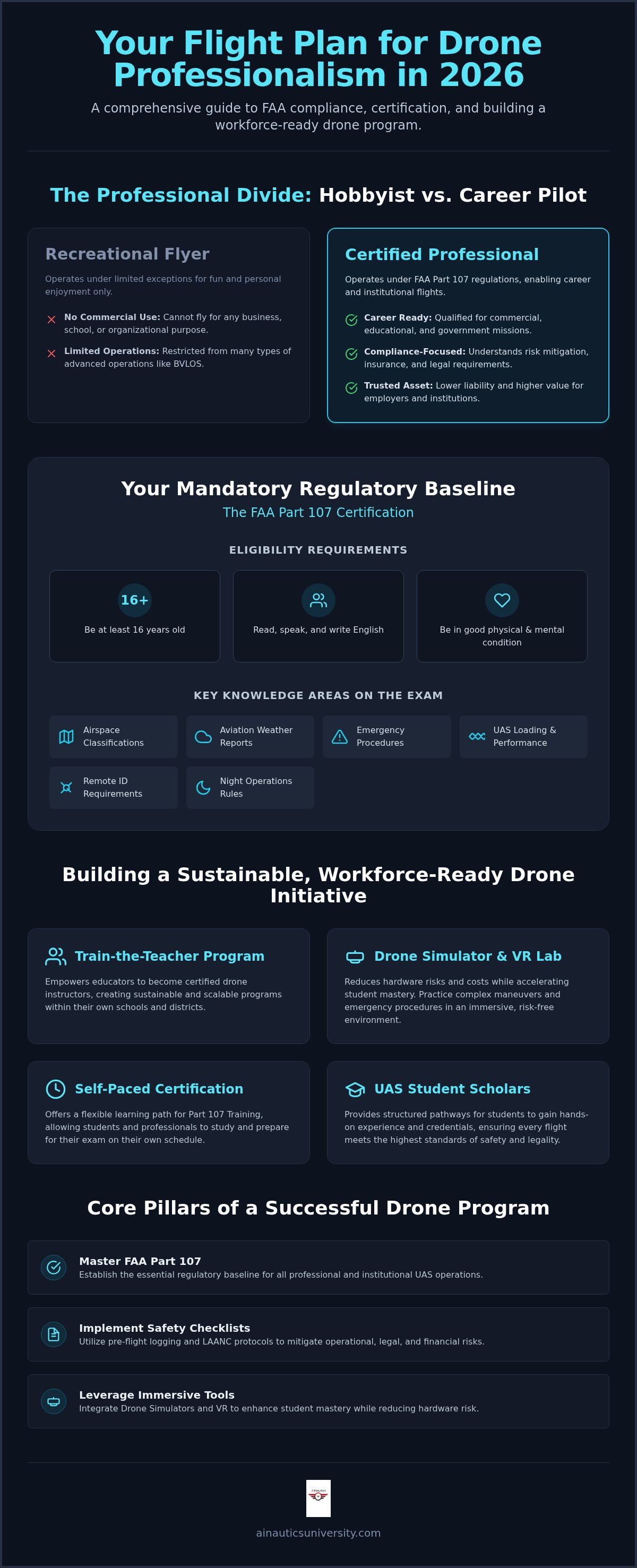
The line between flying for fun and flying for a career is clearly defined by intent and regulation. Hobbyists operate under limited statutory exceptions, but any flight that supports an organization, school, or business falls under professional rules. Even if a student is capturing footage for a school yearbook, they must adhere to strict FAA standards. The Remote Pilot Certificate serves as the essential legal entry point for any individual seeking to operate drones for commercial or institutional purposes. Moving beyond the "educational use" myth is vital for program longevity. By using the AINautics Drone Simulator, students can practice these professional standards in a risk-free environment before ever taking to the skies.
Compliance as a Career Differentiator
Employers in the 2026 drone market aren't just looking for people who can move joysticks. They want pilots who understand risk mitigation and insurance requirements. A pilot with documented drone compliance training is a lower liability and a higher asset. This specialized knowledge is often a prerequisite for insurance eligibility, which is mandatory for high-stakes missions like infrastructure inspection or emergency response. Integrating AINautics’ Self-Paced Certification into a professional portfolio demonstrates a commitment to industry standards. It shows that you aren't just a pilot; you're a disciplined operator ready for the demands of the modern workforce. This level of preparation turns a simple license into a powerful career differentiator.
The FAA Part 107 Certification: Your Mandatory Regulatory Baseline
Professionalism in the skies begins with legal authorization. To operate a drone for any commercial, institutional, or educational purpose, you must obtain FAA Part 107 Certification. The eligibility requirements are straightforward: you must be at least 16 years old, demonstrate English proficiency, and be in a physical and mental condition that allows for safe flight. This certificate is not just a piece of paper; it represents a pilot's mastery of the National Airspace System. It proves you understand how to navigate complex environments without endangering other aircraft or people on the ground.
The knowledge required for this certification covers several critical pillars. You'll need to master airspace classifications, interpret aviation weather reports, and execute emergency procedures with precision. As we move through 2026, drone compliance training must also account for newer mandates like Remote ID, which became mandatory for most drones on March 16, 2024. Additionally, rules for night operations now require specific anti-collision lighting visible for three statute miles. Our Part 107 Training at AINautics University is designed to accelerate this learning process, condensing technical jargon into actionable skills that help you pass the exam on your first attempt.
Navigating the Testing Process
The journey to becoming a certified pilot starts with the FAA’s Integrated Airman Certification and Rating Application (IACRA) system. After registering for an FAA Tracking Number, you can schedule your 60-question knowledge test at a certified testing center. The mandatory fee to sit for this exam is $175, paid directly to the testing provider. Preparation is the key to success. You'll need to practice reading sectional charts and calculating drone performance based on atmospheric conditions. For a structured approach to these topics, we recommend reviewing our Professional FAA Part 107 Drone Training: The Ultimate 2026 Certification Guide. Combining self-study with practice exams ensures you're ready for the pressure of the testing center.
Maintaining Currency and Recurrent Training
Your responsibility to the FAA doesn't end once you receive your certificate. Part 107 pilots must maintain their currency every 24 months. This recurrent drone compliance training is vital because regulations evolve quickly. For example, the finalization of Part 108 in 2026 is set to change how we handle Beyond Visual Line of Sight (BVLOS) operations. Staying current ensures you're always flying within the latest legal framework. Institutional programs should use a centralized system to document flight hours and maintenance logs for compliance audits. Our Self-Paced Certification options make it easy for busy students and educators to stay updated without disrupting their schedules. If you're ready to build a foundation for your career, explore our Part 107 Training to get started today.
Operational Safety and Mission Planning: A Practical Checklist
Compliance is more than a one-time exam; it is a daily operational culture. While your license grants you the right to fly, your mission planning determines your professional longevity. A comprehensive drone compliance training program teaches you to treat every flight with the same rigor as a manned aircraft mission. This begins with a meticulous pre-flight equipment inspection. You must check for hairline fractures in propellers, verify battery cycle counts, and ensure all firmware is updated to support Remote ID broadcasting. Logging these maintenance actions isn't just good practice. It provides a legal paper trail that protects your organization during an audit.
Mission planning also requires a deep understanding of the environment. You must identify potential obstacles, such as power lines or temporary structures, and assess the risk to non-involved people in the area. Environmental compliance is equally critical. For instance, the Migratory Bird Treaty Act protects over 1,000 species of birds, and disturbing nesting sites with a drone can lead to federal penalties. Before you arrive on-site, verify your airspace through the Low Altitude Authorization and Notification Capability (LAANC). This system provides near-instant authorization to fly in controlled airspace, which is a fundamental skill for anyone holding an FAA Part 107 Certification.
Standard Operating Procedures (SOPs)
Every professional UAS organization needs a standardized flight manual. This document outlines exactly how missions are conducted, from the initial site survey to the final post-flight debrief. SOPs must include clear emergency response plans for scenarios like a lost link or battery failure. Practicing these maneuvers in the real world can be risky for expensive hardware. This is where the AINautics Drone Simulator becomes invaluable. It allows students to master emergency recoveries in a high-fidelity virtual environment. Building these skills through consistent drone compliance training ensures that when a real-world emergency happens, the pilot's response is instinctive and safe.
Data Privacy and Ethical Compliance
As drones become more integrated into our communities, data privacy has become a top priority for regulators. You must navigate a patchwork of local and state laws regarding aerial media. Professionalism means respecting "reasonable expectations of privacy" and securing all collected data. This is especially true during vertical structure or infrastructure inspections where sensitive information might be captured. Best practices include using encrypted storage and establishing clear data retention policies. Programs like the UAS Student Scholars focus on these ethical foundations, ensuring that the next generation of pilots understands that technical skill must always be paired with professional integrity.
Institutional Compliance: Drone Programs in Schools and Districts
Building a drone program at the district level requires more than just purchasing hardware. It demands a structured approach to institutional safety and regulatory adherence. Schools must align their UAS education with state and district STEM standards to ensure academic validity and long-term funding. This involves creating a culture where drone compliance training is integrated into the daily curriculum. Managing a fleet of aircraft within a school environment safely means establishing clear boundaries for where and when students can fly. By implementing the UAS Student Scholars program, educators can incentivize excellence and hold students to the same professional standards found in the commercial workforce.
Program longevity often hinges on having qualified staff in-house. The AINautics Train-the-Teacher Program is designed to bridge this gap. It empowers educators to become the experts, reducing reliance on external contractors and ensuring the program remains sustainable year after year. This model turns teachers into certified flight instructors who understand both the pedagogy and the technical requirements of the FAA. It creates a self-sustaining ecosystem where knowledge is passed down through established institutional channels.
Launching a Drone Program in 90 Days
Starting from scratch can feel overwhelming for administrators. We use a 90-day program launch framework to move schools from the initial planning phase to live flight operations. The first phase focuses on site assessment and risk mitigation. The second involves equipment procurement and establishing maintenance logs. Finally, the third phase centers on student enrollment and safety briefings. Successful programs often leverage grant writing and federal funding strategies to cover initial costs. For a deeper look at integrating these tools into your lesson plans, see our Drone Curriculum for Educators: A Comprehensive Guide to Classroom Integration. Following a proven timeline prevents common implementation errors and ensures student safety from day one.
Teacher Certification and Liability
Liability is a major concern for school boards. Ensuring that all instructors are Part 107 certified is the first step in mitigating institutional risk. Districts must also navigate specific insurance requirements for youth flight, which often differ from standard commercial policies. Professional development pathways for autonomous systems educators should be ongoing. This ensures that staff remain updated on the latest 2026 regulations, such as Remote ID and BVLOS protocols. Consistent drone compliance training for staff protects the school and provides students with accurate, workforce-ready information. If your school is ready to lead in technology education, our Train-the-Teacher Program provides the roadmap you need to launch with confidence.
Advanced Compliance: Simulation, VR, and Workforce Readiness
The final stage of mastery involves moving beyond basic flight into high-stakes, professional scenarios. Immersive technology is the key to this transition. By using the AINautics Drone Simulator, students can practice complex maneuvers without the risk of damaging expensive aircraft. This is essential for modern drone compliance training. As operations become more autonomous and complex in 2026, simulation provides a safe space to fail and learn. The VR Trailer Mobile Lab takes this a step further by bringing high-fidelity training directly to schools and communities. It offers a unique way to experience emergency protocols in a controlled, immersive environment that mirrors real-world pressure.
As the industry prepares for the full implementation of FAA Part 108, training must evolve to meet new standards. Part 108 will standardize Beyond Visual Line of Sight (BVLOS) operations, moving the industry away from the old, slow waiver system. This shift requires pilots who are not just licensed, but truly proficient in advanced systems. Transitioning from the classroom to the commercial workforce means being ready for these automated workflows. It's about being prepared for a market where Walmart has already surpassed 1 million drone deliveries as of May 2026. Professionalism now means mastering the technology that makes these milestones possible.
The Safety Benefits of Virtual Flight
Virtual flight is the gold standard for high-risk mission planning. It allows pilots to build muscle memory and test their limits in a space where failure has no financial cost. We recommend documenting simulator hours as a formal part of a pilot's proficiency log. This data proves to insurers and employers that a pilot has handled hundreds of hours of simulated emergencies before ever touching a live controller. Consistent practice in a simulator reduces hardware risk and ensures that every live flight is conducted with precision. It's a foundational step that turns a student into a reliable professional.
The Future of Autonomous Systems Training
The next generation of drone pilots will work alongside AI-integrated systems. These systems handle navigation and data processing, but the human pilot remains the ultimate authority for safety. The path from a UAS Student Scholar to a certified professional is paved with specialized knowledge. Total compliance requires a disciplined approach to every mission. Use this 10-point summary to ensure your operations meet the highest standards:
- Current FAA Part 107 Certificate: Ensure all pilots are legally authorized.
- Remote ID Compliance: Verify the drone is broadcasting identification data.
- Pre-flight Inspection Log: Document the physical health of the aircraft.
- LAANC Authorization: Secure digital permission for controlled airspace.
- Weather Briefing: Review wind, visibility, and atmospheric conditions.
- Emergency Protocols: Rehearse lost-link and battery failure procedures.
- Data Privacy Plan: Establish rules for secure media handling.
- Battery Health Check: Verify cycle counts and voltage stability.
- Obstacle Survey: Identify power lines, trees, and structures.
- Risk Assessment: Complete a final safety sign-off before takeoff.
By following this checklist and utilizing advanced drone compliance training tools, you position yourself at the forefront of the UAS industry. The future of flight is autonomous, safe, and professional.
Leading the Future of Professional Flight
The evolution of the UAS industry in 2026 demands more than just basic flight skills. It requires a deep commitment to safety, data privacy, and the evolving standards of Part 108. By mastering drone compliance training, you aren't just following rules; you're building the infrastructure for a successful career or a sustainable school program. We've explored how a robust checklist, from pre-flight inspections to immersive simulation, transforms regulatory hurdles into competitive advantages for students and educators alike.
AINautics University is here to bridge the gap between learning to fly and flying for work. As a Service-Disabled Veteran-Owned Small Business, we provide mission-driven instruction led by our Chief Pilot, Taz Little. Whether you're an educator utilizing our 90-day program launch framework or a student seeking workforce-ready skills, our tools are designed to empower your journey. We invite you to launch your compliant drone program with AINautics University today. The skies are open for those who are prepared to lead with excellence and integrity.
Frequently Asked Questions
What is drone compliance training exactly?
Drone compliance training is a structured educational framework that ensures operators understand and follow all federal, state, and local regulations. It encompasses everything from FAA Part 107 rules to advanced mission planning and data privacy standards. By focusing on these requirements, you protect your organization from legal liability and ensure a safe operating environment. Programs like our UAS Student Scholars emphasize these standards to prepare students for the expectations of the professional workforce.
Is Part 107 certification required for high school students?
Yes, Part 107 certification is mandatory for any student aged 16 or older who flies for educational or institutional purposes. While hobbyists have certain exceptions, school-related activities are generally classified as commercial or professional operations. Our Part 107 Training provides students with the specific knowledge needed to pass the FAA exam. This certification is the first step toward building a career-ready portfolio in the growing drone industry.
How often do I need to renew my drone compliance training?
You must renew your regulatory knowledge every 24 calendar months to remain a current and legal pilot. The FAA requires this recurrent training to ensure you are aware of new rules, such as the 2026 updates regarding BVLOS and Remote ID. AINautics offers Self-Paced Certification options that simplify this renewal process. Staying current is vital for maintaining insurance eligibility and ensuring your institutional program remains in good standing with federal regulators.
Does my school need special insurance to fly drones?
Most general liability policies for schools exclude aviation activities, making specialized UAS insurance a necessity. This coverage protects the district from financial loss due to equipment failure or accidental property damage. When launching a program through our Train-the-Teacher Program, we provide guidance on navigating these administrative hurdles. Having the right insurance is a key component of institutional compliance and protects both the educators and the students during flight operations.
What happens if I fly a drone commercially without compliance training?
Operating without the proper certification and training can result in significant federal fines and the suspension of your pilot privileges. The FAA has increased enforcement efforts, using Remote ID technology to identify and track non-compliant aircraft in real time. Beyond legal trouble, a lack of drone compliance training can lead to costly accidents that are not covered by insurance. Professional training is the only way to mitigate these risks and ensure long-term operational success.
Can I do drone compliance training online?
Yes, you can complete the majority of your compliance curriculum through flexible online platforms. AINautics provides Self-Paced Certification courses that allow students and educators to master the technical material at their own speed. While hands-on flight practice is important, the regulatory and theoretical foundations are perfectly suited for digital learning. For those who prefer hands-on experience, our VR Trailer Mobile Lab can bring immersive, practical training directly to your school to complement your online studies.
What is the Migratory Bird Treaty Act and why does it matter for drones?
The Migratory Bird Treaty Act is a federal law that prohibits the disturbance of protected bird species and their nesting sites. Drone operators must be aware of this because aircraft can be perceived as threats by wildlife, leading to aggressive behavior or nest abandonment. Understanding these environmental protections is a critical part of comprehensive drone compliance training. Responsible pilots conduct site surveys to ensure their missions don't interfere with local ecosystems or violate federal wildlife protections.
How does a drone simulator help with FAA compliance?
A simulator allows you to practice high-risk emergency maneuvers, such as lost-link procedures and battery failures, without risking expensive hardware. The FAA requires pilots to be proficient in these areas to maintain safe operations in the national airspace. Using the AINautics Drone Simulator helps you build the muscle memory needed to respond correctly during real-world equipment malfunctions. This virtual practice is a proven way to increase pilot confidence while maintaining the highest levels of safety and compliance.

Article by
AINautics University Team
The team behind AINautics University, dedicated to drone education and FAA Part 107 certification prep, VR flight simulation, and STEM training programs for students and educators.


