
Would you gamble $175 on a sixty-question test if you weren't 100% sure of the outcome? For many students and educators, the fear of failing the FAA exam is real, especially when faced with complex sectional charts and the cryptic language of METARs or TAFs, which are specialized aviation weather reports. Finding a high-quality Part 107 practice exam free of charge is the first step toward building the confidence you need to succeed.
We agree that the jump from hobbyist to professional remote pilot can feel overwhelming. You shouldn't have to decipher technical regulations alone. This guide provides a comprehensive roadmap to passing the FAA Aeronautical Knowledge Test on your first try; it ensures you understand real-world airspace safety rather than just memorizing answers.
We'll preview how to leverage free tools alongside specialized resources like our Self-Paced Certification and immersive Drone Simulator to bridge the gap between student and professional. You'll discover how to master the 2026 standards and launch your career with the authority of a visionary leader.
Key Takeaways
- Identify your baseline knowledge by using a Part 107 practice exam free of charge to pinpoint weak areas before the real test.
- Master complex National Airspace System classifications and weather codes to navigate the 120-minute exam with confidence.
- Implement a strategic review process for every incorrect answer to ensure you understand the logic behind FAA regulations.
- Enhance your study plan with the AINautics Drone Simulator to practice emergency procedures in a risk-free, immersive environment.
- Build a professional foundation for your drone career through self-paced certification and the UAS Student Scholars program.
Why a Part 107 Practice Exam is Essential for 2026 Success
The FAA Remote Pilot Knowledge Test is a high-stakes gatekeeper for your professional aspirations. Every attempt requires a $175 testing fee paid to an FAA-approved center. Failing doesn't just hurt your wallet; it stalls your career momentum. A Part 107 practice exam free tool allows you to fail safely in a controlled environment. You can make mistakes now so you don't make them when the clock is ticking at a proctored PSI testing center. This diagnostic approach is a cornerstone of professional Part 107 drone training, ensuring you don't walk into the exam room with blind spots.
Many students fall into the "memorization trap." They try to learn the answers without understanding the underlying concepts. The FAA is increasingly sophisticated. They update question banks frequently to ensure pilots actually understand FAA pilot certification standards. If you only know the "what," a slightly rephrased question about weather minimums or night operations will trip you up. You must master the "why" to handle the 60 multiple-choice questions effectively. Practice exams simulate the 120-minute pressure, helping you manage your pace and reduce anxiety.
The Reality of the FAA Remote Pilot Exam
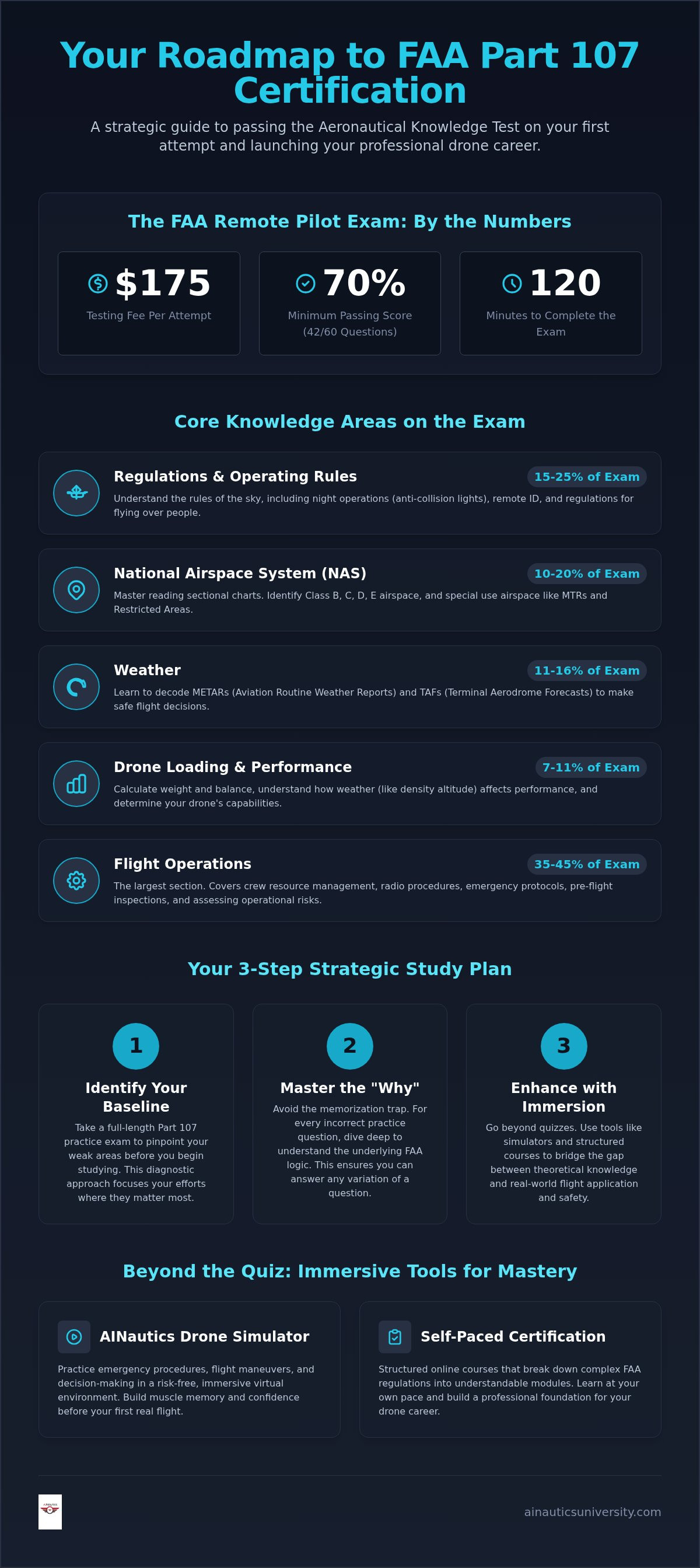
To earn your license, you must achieve a score of 70%. This means you can only miss 18 questions out of 60. While two hours sounds generous, the complexity of reading sectional charts and interpreting METAR reports can consume time rapidly. The testing center environment is strict and formal. Preparing through our Self-Paced Certification options helps you familiarize yourself with the question formats and the level of precision required by the FAA. It's about building the stamina to stay focused for the duration of the test.
Bridging the Gap Between Theory and Flight
Knowledge on a screen is fundamentally different from knowledge in the cockpit. Practice questions should build your situational awareness, not just your test-taking skills. When you study the National Airspace System (NAS), you're learning how to keep your aircraft and the public safe. Using your practice results helps you map out a clear drone career path by identifying which sectors of the industry interest you most. Programs like the UAS Student Scholars leverage these insights to transition learners from students to specialized remote pilots who are ready for the workforce.
Core Knowledge Areas Tested on the Free Practice Exam
Mastering the FAA Part 107 exam requires more than a passing familiarity with drones. It demands a deep understanding of the five core knowledge areas established by the Federal Aviation Administration. When you utilize a Part 107 practice exam free resource, you're essentially auditing your readiness across these specific domains. These include regulations, the National Airspace System (NAS), weather, loading and performance, and operations. To truly Become a Certificated Remote Pilot, you must prove your competency in each area during the 60-question test.
Regulations and Operating Rules make up a significant portion of the test, often ranging from 15% to 25% of the total questions. You'll need to know the specifics of night operations, including the requirement for anti-collision lighting visible for at least three statute miles. Additionally, understanding the categories for flying over people is critical for 2026 operations. Our Part 107 Training breaks these complex rules into actionable steps. We ensure you don't just memorize the law but learn how to apply it safely in the field.
Mastering Sectional Charts and Airspace
Sectional charts are often the most intimidating part of the exam. You must distinguish between Mean Sea Level (MSL) and Above Ground Level (AGL) altitudes without hesitation. Identifying Class B, C, D, and E airspace is vital for maintaining safety in the NAS. Many students struggle with Military Training Routes (MTRs) and identifying Restricted or Prohibited areas. Using a Part 107 practice exam free module helps you practice these visual identifications repeatedly until they become second nature. This visual literacy is a foundational skill for any professional pilot.
Weather Reports and Aircraft Loading
Weather accounts for roughly 11% to 16% of the exam. You'll be required to decode Aviation Routine Weather Reports (METARs) and Terminal Aerodrome Forecasts (TAFs). Beyond just reading the code, you must understand how density altitude, humidity, and temperature impact drone battery life and motor efficiency. High temperatures can significantly degrade performance by making the air less dense. Loading is equally important. You'll learn how the Center of Gravity (CG) affects stability and why exceeding the maximum takeoff weight of 55 pounds is a regulatory violation.
Operations and procedures cover everything from radio communications to airport markings. You need to know how to communicate your intentions at non-towered airports using the Common Traffic Advisory Frequency (CTAF). If you want to move beyond the theory, practicing these scenarios in our Drone Simulator provides a safe way to build muscle memory. This practical experience is a key component of the UAS Student Scholars program. If you're an educator looking to bring these skills to your classroom, consider exploring our Train-the-Teacher Program to empower the next generation of aviators.
How to Use Practice Questions to Execute Your Study Plan
A quiz is only as good as the strategy behind it. Taking a Part 107 practice exam free tool and clicking through answers won't guarantee success on the actual FAA knowledge test. Instead, use your first attempt as a baseline diagnostic. This initial score reveals exactly where your understanding of the National Airspace System or weather theory falters. By identifying these weak domains early, you can stop wasting time on topics you've already mastered and focus your energy where it counts most.
Expert study strategies involve more than just seeing if you got a question right. For every incorrect answer, write a one-sentence explanation of why the correct choice is actually right. This forces your brain to process the logic rather than just memorizing a letter. Focus your efforts on "The Big Three": Airspace, Weather, and Regulations. According to the FAA topic distribution, these categories represent the vast majority of the exam, with Regulations and Airspace each accounting for up to 25% of the total questions. Official resources for Commercial Drone Operators confirm that a score of 70%, or 42 correct answers, is required to pass, but you should aim higher during your preparation.
Analyzing Your Mistakes
Not all errors are equal. Categorize your mistakes to determine if you suffered from a lack of knowledge or if you were tripped up by a trick question. We recommend the "Rule of Three." If you miss a specific topic, like Class G airspace requirements, three times, return to your primary study materials immediately. Use flashcards for rote facts that require zero interpretation. This includes the 0.04% blood alcohol limit or the specific 10-degree increments used for night scanning. These are the "easy points" you can't afford to lose.
Setting a 2026 Certification Timeline
Consistency beats intensity every time. For full-time students or working professionals, the "14-Day Sprint" model is highly effective. Dedicate one hour each evening to a specific FAA domain and take a full-length practice test every third day. You must simulate real exam conditions: no phone, no distractions, and a strict 2-hour timer for all 60 questions. Once you hit a consistent 90% score on your Part 107 practice exam free attempts, you're ready to transition to self-paced certification. Don't wait until you feel perfect to book your FAA exam date; once you're comfortably in the 90s, your momentum is at its peak.
Beyond the Quiz: Immersive Tools for Mastery
Static quizzes are excellent for passing the written test, but they often fail to teach the "muscle memory" required for aeronautical decision-making. You need to understand how to react when a situation changes in seconds. A Part 107 practice exam free resource is just the starting point of your journey. To truly excel, you must transition from identifying Class D airspace on a page to navigating it in a three-dimensional environment. Our Drone Simulator provides this bridge, allowing you to experience high-stress scenarios without risking expensive hardware.
Visualizing the National Airspace System is another significant hurdle for many aspiring pilots. Traditional 2D sectional charts can be confusing when you're first starting out. VR technology makes these charts come to life, allowing you to "see" the invisible boundaries of restricted and prohibited areas. Our VR Trailer Mobile Lab brings this high-tech autonomous systems training directly to schools and districts. It transforms a standard parking lot into a cutting-edge learning environment where students engage with the future of aviation through hands-on experience.
The Power of Flight Simulators
Mastery of stick movements and GPS-denied flight is essential before you ever launch a real aircraft. Simulators allow you to practice for bird strikes, signal loss, and sudden weather shifts in a risk-free setting. We've seen that students who supplement their study with simulator hours show significantly higher Part 107 pass rates due to increased situational awareness. This immersive approach ensures that when you face a real-world emergency, your response is instinctive rather than hesitant. It builds a level of professional confidence that a standard quiz simply cannot replicate.
Educational Innovation for Schools
Integrating these advanced tools into the classroom requires a structured and professional approach. Our drone curriculum for educators provides a comprehensive guide for STEM classroom integration. By using simulators and mobile labs, teachers can significantly boost student engagement and workforce readiness. This hands-on experience is a core part of the UAS Student Scholars program, which prepares the next generation for high-paying careers in the drone industry. We also offer a Train-the-Teacher Program to ensure educators are fully equipped to lead these specialized courses.
If you're ready to move beyond the screen and start your professional journey with expert guidance, explore our comprehensive UAS training programs today.
Launch Your Drone Career with AINautics University
Transitioning from a student to a certified remote pilot requires a clear vision and the right tools. While a Part 107 practice exam free resource provides the necessary starting point, AINautics University serves as the professional bridge to a high-paying drone career. We offer more than just test preparation; we provide a comprehensive "Learn-Train-Certify-Fly" pipeline designed to turn beginners into workforce-ready experts. Our Part 107 Training focuses on the practical application of aviation standards, ensuring you're prepared for real-world commercial missions from day one.
Our Self-Paced Certification options are built for flexibility. Whether you're a full-time student or a working professional, you can access high-quality modules that fit your unique schedule. This isn't just about memorizing facts to avoid the $175 FAA fee; it's about mastering the technology that is currently reshaping industries like agriculture, construction, and public safety. As a Service-Disabled Veteran-Owned Small Business (SDVOSB) and a proud AUVSI member, we maintain the highest industry standards in every course we offer.
Workforce-Ready Certification
True career success in the UAS industry comes from specialization. By moving beyond a Part 107 practice exam free tool and engaging with our Drone Simulator and VR Trailer Mobile Lab, you develop the technical proficiency employers demand. We don't just teach you how to pass; we teach you how to fly with precision and authority. Our graduates enter the workforce with a deep understanding of crew resource management and risk-based decision-making, which are the hallmarks of a professional aviator. This specialized knowledge ensures you're ready for the technological demands of the future.
Support for Educators and Districts
We recognize that educators face unique challenges when launching new technology programs. Our Train-the-Teacher Program empowers instructors to lead the autonomous revolution with confidence. We help schools implement a fully functional drone program in as little as 90 days, providing expert guidance every step of the way. These programs align with state and district STEM standards, ensuring that UAS education is both rigorous and relevant for the modern classroom.
The UAS Student Scholars program is specifically designed to build excellence in flight for K-12 students and beyond. It creates a pathway for young learners to move from curiosity to certification, preparing them for high-growth career paths. We believe that by supporting both the student and the teacher, we foster a robust ecosystem for aviation innovation. If you're ready to take the next step in your professional or educational journey, start your journey with AINautics University today.
Secure Your Future in the National Airspace System
Your journey toward becoming a certified remote pilot starts with a single step. While using a Part 107 practice exam free tool helps you identify your baseline knowledge, true mastery requires a deeper commitment to professional standards. You've learned how to decode complex weather reports and navigate the intricacies of the National Airspace System. Now it's time to transition from theory to flight. Success in this industry belongs to those who move beyond rote memorization to embrace immersive, scenario-based learning.
AINautics University is more than a training provider; we're a bridge to your professional future. As a Service-Disabled Veteran-Owned Small Business and a proud AUVSI member, we deliver a mission-driven, STEM-aligned curriculum that prepares you for the high-stakes demands of the 2026 drone industry. Whether you're a student seeking a new career or an educator building a classroom program, our resources ensure you lead with confidence and authority.
Don't just pass the test; master the mission. Enroll in AINautics Part 107 Professional Training and join a community of innovators dedicated to excellence. The sky isn't the limit; it's your new workplace. We're ready to help you take flight.
Frequently Asked Questions
Is the FAA Part 107 practice exam free forever?
Yes, several reputable online resources provide access to a Part 107 practice exam free of charge to help students gauge their readiness. While these free tools are excellent for identifying your baseline knowledge, they often lack the depth of a professional curriculum. We recommend using free quizzes as a starting point before advancing to our comprehensive Part 107 Training to ensure you master the complex situational reasoning required for the 2026 standards.
How many questions are on the actual 2026 FAA drone exam?
The official FAA Remote Pilot certificate exam consists of 60 multiple-choice questions. You're given a total of 120 minutes to complete the test at a proctored PSI testing center. Each question has three possible answers, and there's no penalty for guessing. To pass, you must achieve a minimum score of 70%, which means correctly answering at least 42 of the questions provided on your specific test version.
What is the best way to study for the Part 107 exam if I'm a beginner?
Beginners should start with a structured study guide that explains the "why" behind aviation regulations rather than just memorizing facts. Utilizing a Part 107 practice exam free module helps you identify weak areas like weather theory or airspace classifications early on. Supplementing your reading with our Drone Simulator is highly effective for building the visual and spatial awareness needed to interpret complex sectional charts and airport operations correctly.
Can I take the Part 107 exam online from home?
No, the initial FAA Aeronautical Knowledge Test must be taken in person at an FAA-approved knowledge testing center. You must schedule your appointment through the PSI website and bring a valid government issued photo ID. While the initial certification requires a physical presence at a testing center, recurrent training for existing pilots can often be completed through the FAA’s online portal to maintain your currency every 24 months.
How much does it cost to get a Part 107 drone license in 2026?
The primary cost is the $175 FAA testing fee, which is paid directly to the testing center at the time of registration. Additionally, you must pay a $5 fee to register your drone for a three year period. To avoid the financial burden of paying the $175 retake fee, many students invest in Self-Paced Certification programs. These professional resources ensure you're fully prepared to pass the exam on your first attempt.
What happens if I fail the Part 107 exam?
If you don't achieve the required 70% passing score, you must wait 14 calendar days before you're eligible to retake the exam. You'll also be required to pay the $175 testing fee again for each subsequent attempt. The FAA provides a Knowledge Test Report that lists specific codes for the questions you missed. Use these codes to focus your study efforts before booking your next appointment at the testing center.
Do I need to be a pilot to get a Part 107 certificate?
You don't need any prior experience with manned aircraft to become a certified remote pilot. The Part 107 certificate is designed for individuals who want to operate drones commercially and is accessible to anyone at least 16 years old who can read, speak, and write English. Programs like our UAS Student Scholars initiative help students and educators navigate these requirements to launch successful careers in the growing unmanned systems industry.
How often do I need to renew my Part 107 drone license?
Your Remote Pilot Certificate doesn't expire, but you must maintain your aeronautical knowledge currency every 24 months. Currently, this is accomplished by completing a free online recurrent training course provided by the FAA. Staying engaged with the latest technology through our Train-the-Teacher Program or immersive VR Trailer Mobile Lab experiences is a great way to ensure your skills remain sharp and your operations stay compliant with evolving safety standards.

Article by
AINautics University Team
The team behind AINautics University, dedicated to drone education and FAA Part 107 certification prep, VR flight simulation, and STEM training programs for students and educators.


