
What if the biggest hurdle to launching your drone career isn't the complexity of the FAA exam, but the fragmented way you're trying to learn the material? Many aspiring pilots and educators feel buried under dense aviation jargon and the looming fear of a costly retest fee. It's exhausting to piece together a study plan from inconsistent online videos while wondering if you're actually prepared for the 2026 testing standards. You want more than just a passing score; you want the professional confidence to operate safely in the national airspace.
The best way to study for Part 107 involves a structured, multi-modal strategy that replaces confusion with mastery. In this guide, we'll show you how to streamline your preparation by moving beyond simple rote memorization. We'll explore how tools like AINautics University's Self-Paced Certification and high-fidelity Drone Simulator bridge the gap between reading a manual and commanding a flight. Whether you're a student in our UAS Student Scholars program or an educator in the Train-the-Teacher Program, you'll discover a clear roadmap to secure your remote pilot credential and advance your career with certainty.
Key Takeaways
- Understand why the best way to study for Part 107 involves a multi-modal approach that prioritizes long-term mastery over short-term cramming.
- Learn how to decode complex FAA topics like airspace classifications and METAR weather reports using practical, real-world examples.
- Discover how immersive tools like the Drone Simulator and VR Trailer Mobile Lab build operational confidence before you even sit for the exam.
- Follow a structured 4-week study plan designed to guide you through foundational regulations and sectional chart interpretation with ease.
- See how specialized programs like UAS Student Scholars and the Train-the-Teacher Program turn a basic certification into a long-term professional career path.
Why Your Part 107 Study Strategy Matters in 2026
To operate unmanned aerial vehicles (UAVs) for any commercial purpose, you must hold an FAA Part 107 Remote Pilot Certificate. This isn't just a suggestion; it's the federal law. In 2026, the sky is more crowded with autonomous systems than ever before. This means the best way to study for Part 107 isn't finding a shortcut. It's about building a professional foundation. "Cramming" facts for a 60-question test might help you pass, but it won't prepare you for a real-world mission where you're responsible for expensive equipment and public safety.
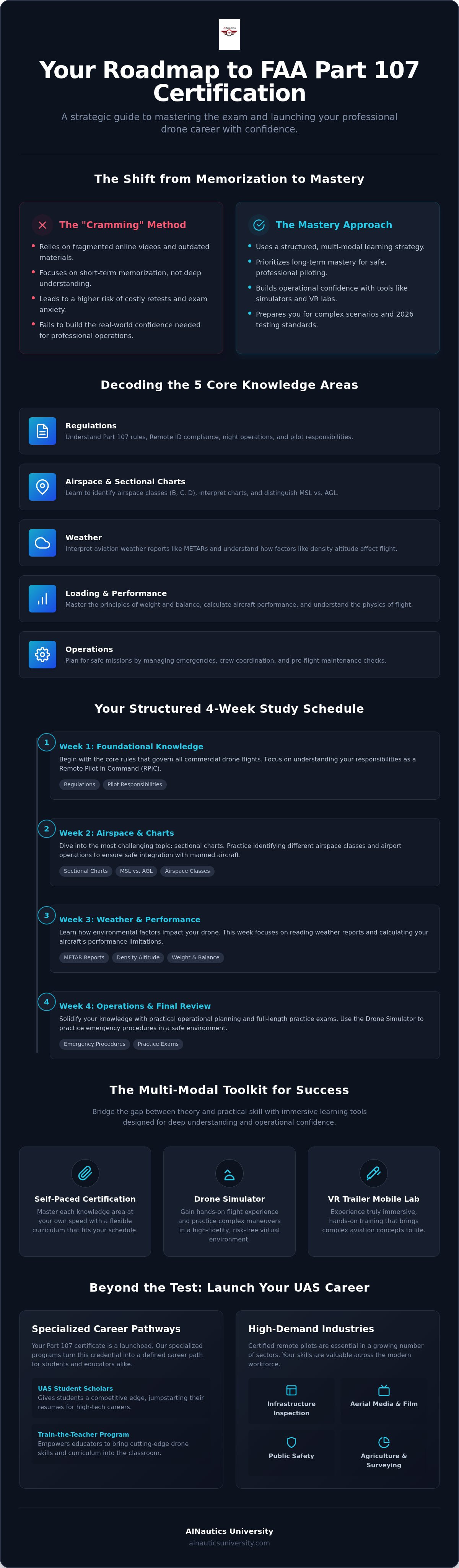
The FAA requires mastery in five core knowledge areas to ensure safe integration into the national airspace:
- Regulations: Understanding the specific rules of Part 107 and pilot responsibilities.
- Airspace: Knowing where you can and cannot fly, including Class B, C, and D zones.
- Weather: Interpreting aviation reports and understanding how density altitude affects flight.
- Loading and Performance: Calculating weight, balance, and the physics of flight.
- Operations: Managing emergencies, maintenance, and crew coordination.
The Shift from Memorization to Mastery
The testing environment has evolved. Modern FAA exams focus heavily on operational decision-making. You'll face complex scenarios involving Remote ID compliance and night operations. Relying on outdated YouTube videos often leads to confusion. The best way to study for Part 107 in this environment is through a structured program. Using Part 107 drone training provides the depth needed for these new standards. AINautics University utilizes immersive tools like our VR Trailer Mobile Lab and Drone Simulator to turn theory into practical skill. We don't just want you to pass; we want you to lead.
Career Opportunities for Certified Remote Pilots
The economic value of this license is significant in the 2026 workforce. Industries such as infrastructure inspection, aerial media, and public safety are scaling their drone programs rapidly. Holding a certification is the first step toward insurance eligibility and earning client trust. For educators, our Train-the-Teacher Program empowers you to bring these skills to the classroom. Students can leverage the UAS Student Scholars program to jumpstart their resumes. By choosing our Self-Paced Certification, you gain the flexibility to master these concepts while preparing for a high-tech career.
Decoding the Core Knowledge Areas: What to Focus On
Mastering the technical content is the next logical step in your journey. The best way to study for Part 107 is to break the massive FAA curriculum into digestible blocks. You need to align your study sessions with the official FAA Part 107 Remote Pilot certification requirements to ensure you aren't wasting time on irrelevant data. Focus your energy on the areas that carry the most weight: airspace, weather, and regulations.
Airspace classification represents the most significant challenge for many new pilots. You must distinguish between controlled and uncontrolled environments. Class B (think "Big"), Class C ("Crowded"), and Class D ("Dialogue") each have specific entry requirements. Understanding these boundaries on a flat sectional chart is a skill that requires consistent practice. Additionally, you'll need to grasp airport operations. This includes monitoring Common Traffic Advisory Frequencies (CTAF) and understanding standard traffic patterns to avoid manned aircraft. It's about safety, not just passing a test.
Regulations have also evolved. You should be familiar with the latest rules regarding operations over people and night flying. You no longer need specific waivers for night missions if you have the correct anti-collision lighting. However, you must still respect the 400-foot altitude limit. If you're feeling overwhelmed by these technical details, exploring our Self-Paced Certification options can help you master each knowledge area at your own speed.
Visualizing Airspace with Sectional Charts
Identifying the difference between Mean Sea Level (MSL) and Above Ground Level (AGL) is vital. MSL tells you how high you are relative to the ocean; AGL tells you how high you are above the ground. Charts use both, so look for numbers in parentheses to find AGL. To truly grasp these concepts, using the AINautics Drone Simulator allows you to visualize these invisible boundaries in a 3D environment. This spatial awareness is often the missing link for students who struggle with 2D maps.
Weather and Loading: The Science of Flight
Weather isn't just about rain; it's about performance. High density altitude (hot, high, or humid air) makes your drone's motors work harder and reduces lift. You must be able to read coded reports quickly. A METAR provides a concise report of current weather observations at a specific airport, whereas a TAF offers a detailed forecast of expected conditions over a 24 or 30 hour period. Beyond weather, you'll need to calculate the load factor. Steep turns increase the effective weight of your aircraft. This can lead to a stall if you aren't careful with your center of gravity and weight distribution.
The Multi-Modal Study Method: Tools and Resources
Static learning is no longer sufficient for the modern aviation environment. Relying solely on a traditional textbook is often the least efficient path to success. Because FAA regulations and testing standards evolve quickly, the best way to study for Part 107 in 2026 is through a multi-modal approach. This method combines visual, auditory, and tactile learning to ensure you don't just memorize facts, but actually understand the mechanics of flight. Interactive platforms provide the agility needed to stay current with the latest Remote ID requirements and night-ops protocols that static manuals often miss.
Practice exams are another critical component of this strategy. They shouldn't be used as a shortcut to memorize specific questions. Instead, treat them as a diagnostic tool to identify knowledge gaps. If you consistently struggle with sectional chart interpretation or weather report decoding, you know exactly where to focus your energy. This targeted study prevents wasted time and builds the specific technical confidence required for the testing center. For those leading a classroom, the Train-the-Teacher Program offers a structured way to bridge the gap between individual mastery and educational leadership.
Leveraging Immersive Technology
Immersive technology transforms abstract concepts into tangible skills. Using our Drone Simulator allows you to practice emergency procedures, such as lost link scenarios or motor failures, in a risk-free digital environment. This builds muscle memory that a book simply cannot provide. For K-12 districts, our VR Trailer Mobile Lab brings this high-tech experience directly to the students, making complex UAS education accessible and engaging. These tools are essential components of a modern drone curriculum for educators looking to inspire the next generation of pilots.
Choosing a Self-Paced Certification Course
Flexibility is vital for busy professionals and students alike. A high-quality Self-Paced Certification course offers modular learning that fits into any schedule. When selecting a program, look for instructor access and content that is updated in real-time. AINautics University structures its certification modules for maximum retention, using short, punchy lessons that prevent cognitive overload. This structure ensures that you progress steadily toward your goals without feeling overwhelmed by the technical depth of the material. By integrating these resources, you move beyond the "cramming" phase and into true professional readiness.
This focus on structured, high-retention learning is a hallmark of modern professional preparation across various industries. For example, students in the healthcare sector can discover PharmEDU to access a comprehensive pharmacology review guide designed with these same principles of mastery and career readiness in mind.
Your 4-Week Part 107 Study Schedule
A structured timeline removes the guesswork from your preparation and ensures you cover every required knowledge area. While some attempt to rush the process, a deliberate four-week approach is the best way to study for Part 107 to ensure long-term retention. This schedule balances technical reading with practical application, allowing you to move from a beginner to a confident pilot. By breaking the material into weekly goals, you avoid the burnout associated with last-minute cramming and build a professional foundation that lasts beyond the testing center.
Your first week focuses on the foundational FAA "rules of the road." You'll spend this time learning the specific regulations that govern small unmanned aircraft. In week two, you'll transition into the most challenging part of the exam: airspace classification and sectional chart interpretation. This is where you learn to read the maps that keep the national airspace safe. Week three is dedicated to weather reports, aircraft loading, and emergency procedures. Finally, week four is for mastery. You'll use this time for final reviews and practice tests to ensure you're ready for the actual exam.
Phase 1: Building the Foundation
During your first seven days, prioritize learning the Operating Rules found in Part 107.15 through 107.51. These sections cover everything from pilot responsibilities to speed and altitude limits. Start the initial modules in our Self-Paced Certification course to see how these rules apply to real missions. Use flashcards to drill essential acronyms like NOTAM (Notice to Air Missions) and TFR (Temporary Flight Restriction). Understanding these terms by heart will save you valuable time during the test.
Phase 2: Simulation and Testing
The best way to study for Part 107 involves moving beyond the page and into a flight environment. Spend at least five hours in our Drone Simulator to visualize how airspace boundaries and flight maneuvers work in a 3D space. Once you feel comfortable, take at least three full-length practice exams. Don't just settle for a passing mark; aim for a consistent score of 85% or higher. When you miss a question, don't just move on. Review the incorrect answer by referencing the FAA Pilot's Handbook of Aeronautical Knowledge to understand the underlying concept. This rigorous review process ensures you won't make the same mistake twice.
Ready to start your journey toward a professional drone career? Enroll in our Self-Paced Certification today and gain access to the tools you need for first-time success.
Beyond the Test: Launching Your UAS Career
Passing the FAA exam is a significant milestone, but it's only the first step in your journey. To succeed in the autonomous systems workforce, you must transition from a remote pilot to a workforce professional. The best way to study for Part 107 involves looking past the test questions and focusing on the operational standards required in the field. Professionalism in the UAS industry is defined by your commitment to mission planning and safety compliance. Employers aren't just looking for a license; they're looking for pilots who can manage risk and deliver high-quality data.
AINautics University bridges the gap between certification and employment by providing the practical tools you need to build a career. We encourage our graduates to begin building a professional portfolio immediately. Document your missions, save your flight logs, and showcase your ability to handle complex scenarios. This real-world evidence is what separates a certified hobbyist from a professional ready for a high-tech career. Whether you used our Self-Paced Certification or trained in our VR Trailer Mobile Lab, your goal is to demonstrate mastery in every flight.
Specialization and Workforce Training
The drone industry is vast, so identifying a niche early is essential. You might focus on high-growth areas like thermal mapping, vertical structure inspection, or aerial storytelling for media. Because AINautics is a Service-Disabled Veteran-Owned Small Business (SDVOSB), our training provides a unique advantage for those seeking government or public safety contracts. If you're a student, participating in the UAS Student Scholars program offers early-career networking opportunities that are often unavailable elsewhere. Specialization is the best way to study for Part 107 if your goal is long-term career stability.
Implementation for Schools and Districts
Educators face the unique challenge of preparing students for a rapidly changing job market. We've simplified this process with our methodology to help you launch a drone program in 90 days. Our curriculum aligns directly with state STEM and Career and Technical Education (CTE) standards, ensuring your program meets academic requirements while providing job-ready skills. Through the Train-the-Teacher program, we provide continuous professional development to keep your staff at the cutting edge of UAS technology. By integrating tools like the Drone Simulator, you create an immersive learning environment that inspires the next generation of aviators.
Take Command of Your Future in Flight
The path to becoming a certified remote pilot is about more than just checking a box. It's about developing the technical mastery and operational confidence required for a safe and successful career. By following a structured four-week schedule and utilizing immersive tools, you've seen why a multi-modal approach is the best way to study for Part 107 in 2026. This method ensures you aren't just memorizing definitions but truly understanding the mechanics of the national airspace.
Whether you're a student exploring the UAS Student Scholars program or an educator looking to implement a STEM-aligned curriculum, the right resources make all the difference. You'll learn from industry experts like Chief Pilot Taz Little and gain hands-on experience through the AINautics Drone Simulator. Don't let the technical jargon or the fear of the exam hold you back from a high-tech career in autonomous systems. Your journey toward specialization starts with a single, purposeful step.
Enroll in AINautics University's Part 107 Training and Start Your Career Today. We're here to bridge the gap between your current skills and your professional future. The sky is open for those who prepare with purpose.
Frequently Asked Questions
How much does it cost to take the Part 107 exam in 2026?
You'll pay a fixed testing fee directly to an FAA-authorized testing center when you schedule your aeronautical knowledge exam. This cost is separate from any training courses or study materials you choose to purchase. It's important to budget for this fee as it's required every time you sit for the exam. You'll use the official PSI portal to find a location and secure your testing date.
What is the passing score for the FAA Part 107 test?
You must achieve a score of 70% or higher to pass the FAA Part 107 exam. The test consists of 60 multiple-choice questions, which means you need to answer at least 42 of them correctly. Using our Drone Simulator helps you move beyond memorization and truly understand the concepts, making it easier to reach this goal. Most students find that focusing on airspace and regulations is the key to success.
How long should I study for the Part 107 exam?
Most successful candidates dedicate 15 to 20 hours of study time over a period of two to four weeks. This structured timeline is often the best way to study for Part 107 because it prevents burnout while ensuring you retain complex information. Spreading your learning across several weeks allows you to master technical topics like weather reports and sectional charts. Consistency in your daily routine is more effective than cramming.
Can I take the Part 107 test online?
You cannot take the initial Part 107 aeronautical knowledge test online; you must attend an in-person session at an FAA-approved Knowledge Testing Center. These centers maintain strict proctoring standards to ensure the integrity of your certification. However, the recurrent training required every 24 months to keep your license active is available through an online portal. Our Part 107 Training focuses on preparing you for the specific environment of the physical testing center.
What happens if I fail the Part 107 exam?
If you don't pass the exam, you're required to wait 14 days before you can take it again. You'll also need to pay the testing center fee again for your second attempt. Your initial test report will list specific subject matter codes for the questions you missed. Use this time to revisit your Self-Paced Certification modules in those specific areas to ensure you're fully prepared for your next attempt.
Do I need to own a drone to study for the Part 107?
You don't need to own a drone to study for or pass the FAA exam. The test focuses on your knowledge of the national airspace, regulations, and safety procedures rather than your flight skills. Many students in our UAS Student Scholars program use our Drone Simulator to gain flight experience without the need for expensive hardware. This approach allows you to focus on the theory before you begin your commercial operations.
How often do I need to renew my Part 107 certification?
You must complete recurrent training every 24 calendar months to keep your remote pilot privileges active. This renewal process is currently available online and ensures you stay up to date with any new FAA regulations or safety protocols. Educators in our Train-the-Teacher Program find that this biennial update is a great way to stay current with the latest industry standards. Keeping your certification active is essential for maintaining your professional standing.
Is the Part 107 exam difficult for people without aviation experience?
The exam is challenging but very achievable for beginners if they use a structured, multi-modal learning plan. Many people entering the drone industry have no prior aviation background and succeed by following a clear roadmap. We believe that using a combination of theory and simulation is the best way to study for Part 107 if you're starting from scratch. Our supportive instructors help you turn complex jargon into actionable professional knowledge.

Article by
AINautics University Team
The team behind AINautics University, dedicated to drone education and FAA Part 107 certification prep, VR flight simulation, and STEM training programs for students and educators.


