
In 2025, over 12,000 aspiring pilots walked away from their testing centers without a passing score. If you're currently staring at a "fail" notification, it's natural to feel frustrated by the lost $175 fee and the delay in your career launch. You might feel overwhelmed by FAA Knowledge Statement Codes or anxious about facing the same difficult questions again. However, a single setback doesn't define your future in the UAS industry. Knowing exactly what to do if you fail the part 107 test is the first step toward turning that score report into a Remote Pilot Certificate.
We understand that self-study is difficult when you're deciphering complex aviation regulations alone. This guide provides a clear, actionable recovery checklist to get you back on track. You'll learn the mandatory FAA retake rules and identify the common mistakes that trip up many testers. We'll also show you how specialized resources like AINautics Part 107 Training and our Drone Simulator can help you visualize hard-to-grasp airspace concepts. You'll leave with a structured study plan designed to bridge the gap between your current score and professional mastery.
Key Takeaways
- Understand the FAA's mandatory 14-day waiting period and fee requirements to schedule your retake with confidence.
- Discover exactly what to do if you fail the part 107 test by decoding Learning Statement Codes to pinpoint your specific weak areas.
- Identify common exam pitfalls, including misinterpreting sectional charts and confusing airspace class boundaries.
- Develop a 2026 study plan that uses active recall and the AINautics Drone Simulator to master complex 3D airspace concepts.
- Explore how structured AINautics Part 107 Training and self-paced certification options offer the specialized support needed for a successful second attempt.
Immediate Next Steps: FAA Retake Rules and Regulations
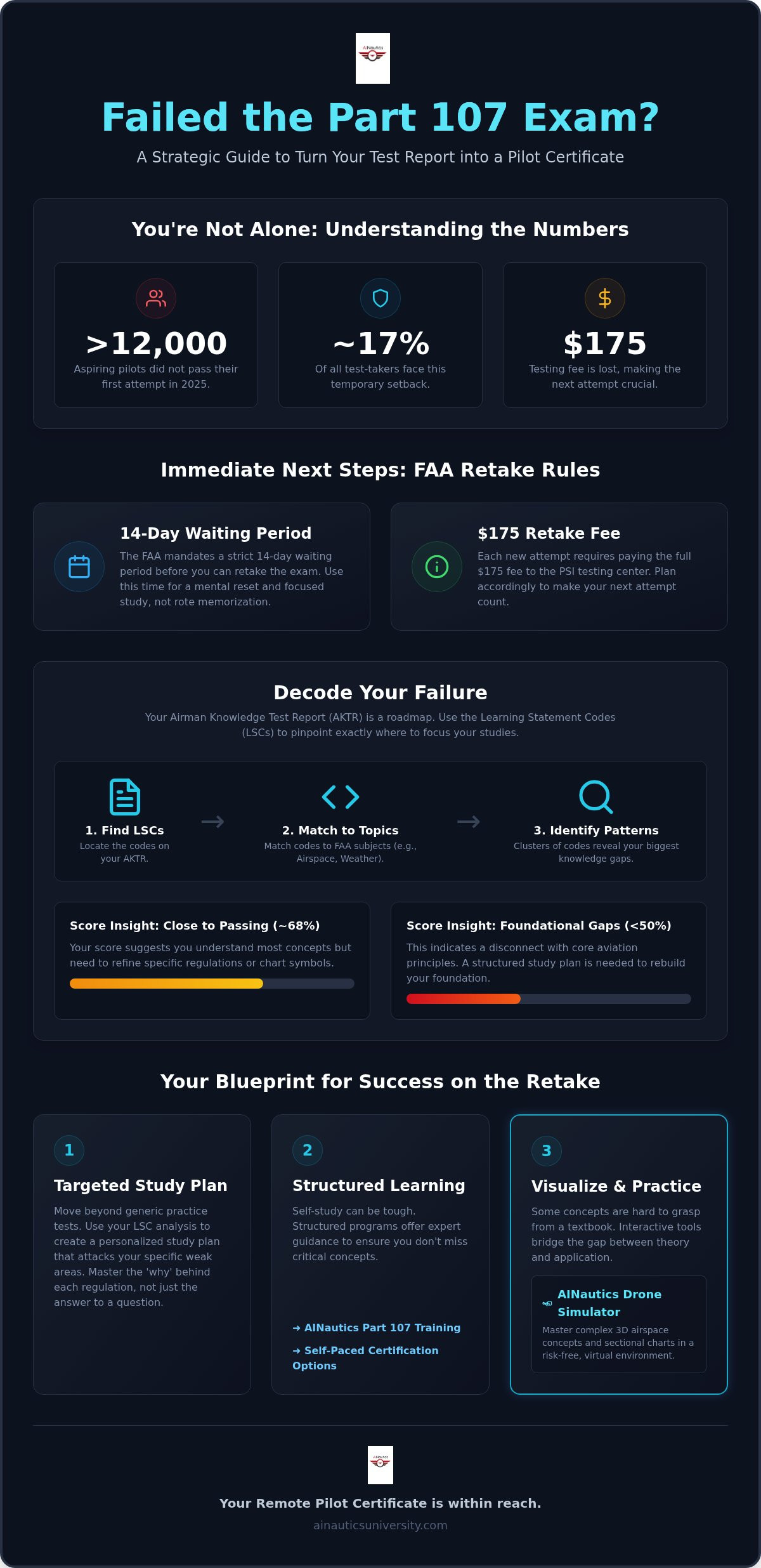
Failing the aeronautical knowledge exam is a temporary setback, not a career-ending event. In 2025, over 12,000 people did not pass their first attempt. This means nearly 17% of all test-takers find themselves exactly where you are today. The path forward requires a clear understanding of the FAA's Part 107 regulations regarding retesting. Knowing exactly what to do if you fail the part 107 test will help you manage your timeline and your budget effectively.
Your recovery begins with your Airman Knowledge Test Report (AKTR). This document is more than just a score sheet; it is a diagnostic tool. It lists specific Learning Statement Codes that identify every question you missed. Keep this document safe. You will need it to guide your study and, in some cases, you may need to present it at the testing center for your second attempt. You must also ensure your FAA IACRA account remains active and updated, as this profile tracks your progress toward your eventual Remote Pilot Certificate.
The 14-Day Waiting Period Explained
The FAA mandates a 14-day waiting period before you can retake the exam. This is a strict calendar-day requirement. If you failed on the 1st of the month, you cannot test again until the 16th. This interval serves as a "cooling-off" period to prevent applicants from simply memorizing questions through rapid repetition. It forces a deeper engagement with the material.
There are no shortcuts here. You cannot bypass this wait with a flight instructor's endorsement or a waiver. Use the first 48 hours for a complete emotional reset. Step away from the manuals and the charts. Once your mind is clear, you can dive back into a structured study plan. This is the perfect time to explore Self-Paced Certification options that allow you to shore up your knowledge without the pressure of a looming deadline.
Registration and Fees for the Second Attempt
Financial planning is a key part of your recovery. Each attempt at the Part 107 exam requires a new testing fee, which is currently $175. This fee is paid directly to the testing center through the PSI registration portal. Because this is a significant investment, you want to ensure your second attempt is your final one.
To register for your retake, log back into your PSI account. The system will recognize your previous attempt and enforce the 14-day window. When you arrive for your second appointment, bring a government-issued photo ID. While many centers access your records digitally, keep a digital or physical copy of your original failed AKTR just in case. If you struggled with the self-study approach the first time, consider transitioning to a formal Part 107 Training program to ensure your next $175 investment results in a passing grade.
Decoding Your Failure: Analyzing the Knowledge Test Report
Your Airman Knowledge Test Report (AKTR) is the most valuable document you possess right now. It provides a precise diagnostic of your performance. Instead of guessing what went wrong, you can use Learning Statement Codes (LSCs) to see exactly where your knowledge gaps lie. These codes provide the data needed to understand what to do if you fail the part 107 test because they remove the guesswork from your second attempt.
How to Read Your AKTR Codes
Look at the bottom of your report for a list of alphanumeric codes. These Learning Statement Codes (LSCs) correspond to specific topics within the Remote Pilot Airman Certification Standards. Match these to the master list on the FAA website to prioritize your study. If a code appears multiple times, it signals a systemic misunderstanding in that subject area that requires immediate attention.
Identify "clusters" of failure. If your codes are concentrated in Weather or Airspace, you have a focused problem. If they are scattered across every chapter, you likely need a full conceptual reset. A 68% score suggests you are close and need to refine specific regulations or chart symbols. A 40% indicates a fundamental disconnect with aviation concepts. In this case, simply retaking practice tests won't help; you need a structured approach like Self-Paced Certification to rebuild your foundation. This is a critical step in determining what to do if you fail the part 107 test with a low score.
The Difference Between 'Wrong Answer' and 'Misunderstood Concept'
Did you choose the wrong answer because the wording was tricky, or because you lacked fundamental knowledge? Many students fail by memorizing practice questions instead of learning the "why" behind the answer. Use the 14-day FAA retake policy to move beyond rote memorization. LSCs act as a diagnostic prescription for your next attempt by highlighting the exact technical areas where your knowledge failed to meet FAA standards. If these codes feel like a foreign language, Part 107 drone training provides the expert guidance needed to translate technical gaps into professional mastery.
Checklist: Common Mistakes on the Part 107 Test
Identifying technical gaps is a vital part of what to do if you fail the part 107 test. Most candidates who struggle don't fail because of a lack of effort. They fail because of specific, recurring logic errors in complex subject areas. With the 2025 pass rate sitting at approximately 83%, nearly 12,000 testers were tripped up by these exact pitfalls. By reviewing this checklist, you can ensure your 14-day study window is targeted and effective.
Many students struggle with the loading and performance section. Calculating the center of gravity or reading a load factor chart requires precision. A single math error can lead to a wrong answer. Similarly, operational rules regarding night flight, moving vehicles, and flight over people have become more nuanced in recent years. Forgetting the specific requirements for anti-collision lighting or the categories for flying over people is a common reason for lost points. If you found these regulatory details confusing, our Part 107 Training provides the structured clarity needed to master these rules.
Sectional Chart Pitfalls
Sectional charts are the primary source of confusion for new pilots. A frequent mistake is mistaking the color of an airport symbol for its controlled status. Blue symbols indicate towered airports, while magenta symbols indicate non-towered ones. Students also fail to identify the differences between restricted areas, prohibited areas, and Military Operations Areas (MOAs), each of which has different entry requirements.
Calculating the radius and vertical boundaries of multi-layered Class C airspace is another high-fail topic. Visualizing these 3D airspace "upside-down wedding cakes" is difficult on a flat piece of paper. Our Drone Simulator allows you to see these invisible ceilings and floors in a virtual environment. This immersive experience makes 2D sectional chart symbols much easier to interpret when you sit for your retake.
Weather and Regulatory Logic Errors
Weather reports like METARs and TAFs use coded abbreviations that can be overwhelming under testing pressure. Students often confuse the characteristics of stable versus unstable air. You must remember that stable air typically brings poor visibility and steady precipitation, while unstable air results in good visibility but showery precipitation and turbulence.
- The 30-Day Rule: Many forget that you must notify the FAA of an address change within 30 days to maintain your certificate's validity.
- Accident Reporting: Misunderstanding the timeline and damage thresholds (over $500) for reporting a UAS accident to the FAA.
- Visual Line of Sight (VLOS): Overlooking the rule that you must maintain sight with the naked eye. Using binoculars to "extend" your range is a regulatory violation often tested on the exam.
If you are an educator helping students through these complexities, our Train-the-Teacher Program offers the pedagogical tools to explain these logic errors effectively. Whether you are a student or an instructor, shifting to Self-Paced Certification can provide the extra time needed to turn these common mistakes into areas of professional strength.
Retake Strategy: Building a 2026 Study Plan
Passive reading is the enemy of retention. If your first attempt involved simply highlighting a textbook, your second attempt requires a shift toward active recall and scenario-based learning. This transition is a core component of what to do if you fail the part 107 test. You must move from recognizing information to retrieving it under pressure. Demand more from your study materials by simulating the high-stakes environment of the testing center.
Start by taking proctored practice exams that mirror the actual 60-question FAA environment. Time yourself. Use only the tools allowed in the room. When you sit for the retake, you are given a piece of blank scratch paper. Use the first two minutes of your testing time to perform a "brain dump." Write down the formulas for load factor, the coded abbreviations for weather, and the specific altitudes for different airspace classes. This "cheat sheet" acts as a reliable reference when fatigue sets in during the final twenty questions.
Visualizing Airspace with Immersive Tools
Many students struggle because they cannot translate a flat, 2D sectional chart into a 3D sky. This is where immersive drone training technology changes the dynamic of your preparation. Instead of squinting at symbols, you can use the Drone Simulator to fly through virtual representations of Class B or Class C airspace. You can see the "ceilings" and "floors" in real-time.
Simulators allow you to practice "lost link" procedures and emergency maneuvers without the risk of a real-world crash. This practical application bridges the gap between theory and flight. If you are part of a school program, the VR Trailer Mobile Lab provides a similar high-tech environment to internalize complex chart data. Shifting your focus to these modern tools ensures that you aren't just memorizing answers; you are building the spatial awareness required for professional mastery.
Mastering the FAA Supplement Book
You must study with the actual "Airman Knowledge Testing Supplement" that is provided in the test center. This physical book is your only resource during the exam. Practice finding Legend 1 and identifying specific tower heights quickly. Many questions are designed to test your ability to navigate this book efficiently rather than just your memory of the rules.
- Use the Figures: Practice answering multiple related questions using a single figure from the supplement.
- Analyze the Legend: Ensure you can quickly find frequency legends and obstruction symbols in the front of the book.
- Verify Scales: Pay attention to the scale of different charts; some are zoomed in more than others.
If you need a more structured environment to master these technical skills, our Self-Paced Certification options allow you to focus on the supplement at your own speed. For those who want to join a community of high achievers, the UAS Student Scholars program provides additional support and networking. Explore our Part 107 Training programs to find the right path for your recovery.
Professional Solutions: Why AINautics Part 107 Training is the Answer
A single failed attempt often highlights the limitations of fragmented, self-guided study. While free YouTube videos offer surface-level tips, they lack the logical progression required for true aviation mastery. Deciding what to do if you fail the part 107 test involves more than just finding new practice questions. It requires a shift toward a comprehensive Part 107 drone training program that addresses the root causes of your confusion. Our Self-Paced Certification options allow you to break down complex topics into manageable segments. You can learn at your own speed without the pressure of a classroom schedule. This methodical approach ensures you aren't just memorizing facts to pass; you are building a foundation for a long-term career.
Structured Learning vs. Fragmented Study
AINautics University provides a curriculum designed by FAA-certified pilots and professional educators. We focus on workforce readiness rather than simple test preparation. Our modules go beyond the basics to include specialized knowledge on the Migratory Bird Treaty Act and vertical inspections. This depth of information prepares you for the realities of commercial flight operations. Because our curriculum is STEM-aligned, it provides a logical argument for the value of the training provided, moving you quickly from interest to professional decision-making.
Our Train-the-Teacher Program philosophy ensures that even absolute beginners can grasp complex UAS concepts. We believe that if a concept is taught well, it remains clear even under testing stress. If you are an educator or a student looking for a peer network, joining the UAS Student Scholars community provides the mentorship and support needed to overcome previous setbacks. This community acts as a bridge between your current skill set and the technological demands of the future.
Final Preparations for Your Remote Pilot Certificate
Before you head back to the testing center, you need a "Ready to Test" guarantee. This means achieving consistent high scores on our simulated exams that mimic the FAA's difficulty level. Once you pass your retake, your journey is just beginning. You will move from certification into real-world applications where safety and precision are paramount. Our VR Trailer Mobile Lab and Drone Simulator technology remain available to you as you transition into active flight operations.
Don't leave your second attempt to chance. Transition from a "student who failed" to a "pilot in training" with a structured roadmap. The investment in professional guidance pays off in the confidence you feel when you open that supplement book for the final time. Don't guess your way through the retake; enroll in our Professional FAA Part 107 Drone Training today.
Take Command of Your Aviation Career
Failing an aeronautical exam is a diagnostic event that clarifies your path to mastery. You now have a comprehensive roadmap for what to do if you fail the part 107 test, starting with a strategic analysis of your score report and a shift toward immersive, active learning. By replacing fragmented study habits with structured preparation and tools like the Drone Simulator, you turn a temporary setback into a professional advantage. Mastery isn't about avoiding failure; it's about the precision of your recovery.
AINautics University is a Service-Disabled Veteran-Owned Small Business led by FAA-certified pilot instructors. We are committed to your success, as evidenced by our 90-Day Program Launch success rate. We provide the expertise and technology needed to bridge the gap between technical regulations and commercial flight operations. Don't let a single score report stall your progress in this rapidly growing industry.
Master the FAA Part 107 with AINautics University Training and secure your future as a certified remote pilot. Your career in the skies is waiting for your next move. Let's get back to flight.
Frequently Asked Questions
How many times can you fail the Part 107 test?
There is no maximum limit on how many times you can take the Part 107 knowledge test. However, the FAA mandates a 14-day waiting period between every failed attempt. This rule ensures you have sufficient time to review your Airman Knowledge Test Report and remediate your weak areas before spending more money on a retake. Each attempt requires a fresh perspective and a new study strategy.
Do I have to pay the $175 fee every time I retake the drone exam?
Yes, you must pay the $175 testing fee for every individual attempt at the exam. This fee is paid to the testing center and is not refundable if you fail. Because the financial stakes are high, many students choose to transition from self-study to a structured program like our Part 107 Training to ensure they pass on their second try and avoid recurring costs.
What is the passing score for the FAA Part 107 test in 2026?
The passing score for the Part 107 test remains 70% in 2026. This means you must answer at least 42 out of 60 questions correctly to earn your certificate. In 2025, the average score was 79.31%, showing that while most pass, many are close to the threshold. Our Self-Paced Certification courses help you aim for a much higher margin of safety by mastering the underlying concepts.
Can I see which specific questions I got wrong on the Part 107 exam?
You cannot see the exact questions you missed, but you do receive Learning Statement Codes on your score report. These codes identify the specific subject areas, such as weather or regulations, where you struggled. Analyzing these codes is the most important part of what to do if you fail the part 107 test because it allows you to focus your study on the right technical chapters.
Is the second attempt at the Part 107 test harder than the first?
The second attempt is not intentionally harder, but it will feature a different set of randomized questions from the FAA pool. You won't see the exact same test twice. If you use the Drone Simulator to visualize airspace concepts you missed the first time, the second attempt often feels much more manageable because your conceptual understanding has replaced simple memorization of practice answers.
How long should I study before retaking the FAA drone test?
You should study for at least the full 14-day waiting period before attempting a retake. This timeframe is ideal for moving from passive reading to active recall. If your first score was significantly below the passing mark, you may need additional time to complete a structured course. Our UAS Student Scholars program often helps students rebuild their confidence and technical knowledge during this interval.
What happens if I fail the Part 107 test three times in a row?
The FAA does not penalize you for failing three times, but the financial and time costs continue to mount. Each failure requires another $175 fee and a 14-day wait. If you reach this point, it's a clear signal that your current study method isn't working. Shifting to a professional solution like our Train-the-Teacher Program or immersive labs can break the cycle of failure and frustration.
Can I take the Part 107 retake exam online?
No, the initial Part 107 certification test and any subsequent retakes for failure must be taken in person at an FAA-approved testing center. While recurrent training for current pilots is available for free online, the first-time knowledge test requires a proctored, physical environment. You can use the PSI portal to locate the nearest center for your second attempt and schedule your appointment once the waiting period ends.

Article by
AINautics University Team
The team behind AINautics University, dedicated to drone education and FAA Part 107 certification prep, VR flight simulation, and STEM training programs for students and educators.


