
With the U.S. commercial drone market projected to reach $31.3 billion by 2034, is your current skill set ready for the next decade of flight? You know that keeping your Remote Pilot Certificate current is a legal requirement, but finding the right Part 107 renewal course often feels like a choice between a boring check-box and actual professional growth. It's frustrating when basic recurrent training ignores the complex realities of modern missions like BVLOS operations or AI-driven data analysis.
You deserve a training path that respects your time and your professional goals. We'll show you how to navigate the FAA's 24-month currency update while moving beyond simple compliance toward specialized UAS mastery. This guide breaks down the latest 2026 regulatory shifts and explains how immersive tools, such as AINautics University's Self-Paced Certification and proprietary Drone Simulator, can transform your renewal period into a launchpad for career advancement. From understanding free FAA recurrent modules to exploring advanced Part 107 Training, you'll gain the clarity needed to stay legal and stay ahead.
Key Takeaways
- Understand the 2026 shift from proctored exams to free online recurrent training to maintain your 24-month aeronautical knowledge currency.
- Learn how to select a Part 107 renewal course that moves beyond basic regulatory compliance to build real-world, mission-ready expertise.
- Discover why institutional credentials like SDVOSB status and AUVSI membership are critical when choosing a professional training partner.
- Identify the essential administrative steps for a successful online renewal and how to maintain a digital paper trail for professional insurance.
- Explore how immersive tools like the AINautics Drone Simulator and Self-Paced Certification options can accelerate your path to specialized UAS careers.
The 2026 Guide to FAA Part 107 Recurrent Training
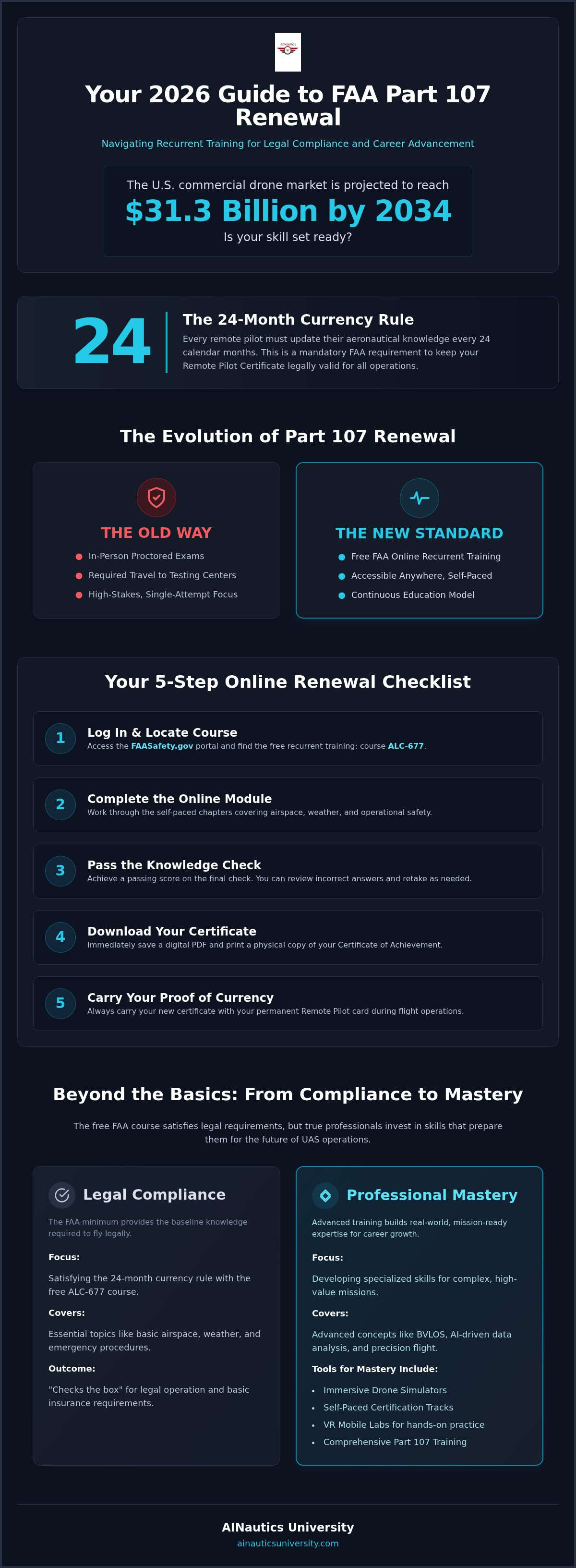
The FAA requires every remote pilot to update their aeronautical knowledge every 24 calendar months. This isn't just a suggestion; it's a hard requirement for maintaining the validity of your Remote Pilot Certificate. In 2026, the process is streamlined. You no longer need to schedule a proctored exam at a testing center for your update. Instead, the FAA has shifted to a "recurrent training" model. This change reflects the evolving nature of FAA regulations for commercial drone operators, moving away from high-stakes testing toward continuous education. Staying current is vital for commercial liability. If you operate for a business or a public agency, an expired certificate can void your insurance coverage and lead to significant federal fines.
Who Needs to Complete Recurrent Training?
This requirement applies to everyone flying under Part 107. Whether you're a commercial pilot, a public safety officer, or an educator in a Train-the-Teacher Program, the clock is always ticking. The 24-month window is a rolling period. If you passed your initial exam in October 2024, you must complete your recurrent training by the end of October 2026. You can verify your status by checking the date on your permanent certificate or your last training completion certificate. While some look for a Part 107 renewal course solely to check a box, professional pilots use this time to sharpen their operational edge. Flying with an expired status is a risk you can't afford. It compromises your professional standing and halts your participation in advanced programs like UAS Student Scholars.
The Legal Baseline: What the FAA Requires
The FAA provides a free online course, specifically "Part 107 Small UAS Recurrent (ALC-677)," which covers essential topics like emergency procedures, weather, and airspace. This online-only shift became permanent following regulatory updates in 2021. While this satisfies the law, many professionals find the FAA's basic module too narrow for high-stakes missions. It's a "minimum viable knowledge" check. For those seeking true mastery, a comprehensive Part 107 renewal course or Self-Paced Certification through AINautics University offers a deeper dive. We use tools like our Drone Simulator and VR Trailer Mobile Lab to ensure you aren't just clicking through slides. You're preparing for the technological demands of the future. Our Part 107 Training bridges the gap between basic compliance and workforce-ready expertise.
How to Renew Your Part 107 License Online
Renewing your license in 2026 is a digital-first process that requires administrative precision. You don't just need to know the rules; you must prove you've reviewed them. Maintaining a clean digital paper trail is essential for professional insurance coverage and federal compliance. Most commercial policies require proof of currency before they'll cover a claim. If you can't produce a training certificate during a ramp check or after an incident, your physical Remote Pilot Certificate won't protect you from liability. You must manage two primary accounts: your IACRA profile and your FAASafety.gov login.
Navigating the FAASafety.gov Portal
The first step is logging into the official FAA safety site. If you haven't accessed the portal since your last 24-month cycle, take a moment to verify your contact information is current. Once logged in, navigate to the "Activities, Courses & Seminars" tab and select "Online Courses." You are looking for the free FAA Part 107 recurrent training, specifically course ALC-677. This module is designed to be self-paced. You'll move through several chapters covering airspace, weather, and operational safety. At the end, you must pass a knowledge check. Unlike the initial proctored exam, the online system allows you to review incorrect answers and retake the check until you achieve a passing score.
Post-Completion Requirements
Passing the course is only half the battle. You must immediately download and print your Certificate of Achievement. Don't rely on the website to store it forever. Keep a digital PDF in a secure cloud folder and a physical copy in your flight kit. In 2026, you're required to carry this certificate alongside your permanent plastic card whenever you operate. It serves as your legal proof of "recency of experience." You should also update your IACRA records if you're managing active waivers or authorizations, as these systems don't always sync instantly. Recording your completion date in a professional flight log is a best practice that demonstrates a "mission-ready" mindset to potential clients.
While the FAA portal covers the legal basics, a professional Part 107 renewal course provides the depth needed for complex commercial work. If you want to move beyond simple compliance, our Self-Paced Certification programs offer advanced training that the free government modules often skip. We focus on workforce-ready skills that help you transition from a legal pilot to a specialized industry expert.
Legal Compliance vs. Professional Mastery
Compliance doesn't equal competence. While the FAA's official Part 107 renewal requirements ensure you know the latest rules, they don't guarantee you can handle a high-wind landing during a critical infrastructure inspection. A standard Part 107 renewal course provided by the government is a "minimum viable knowledge" check. It's designed to keep you legal, not necessarily to keep you sharp. Professional pilots recognize that legal currency is the floor, not the ceiling, of their career.
Many pilots struggle with "skill rot." This happens when you fly only occasionally or rely too heavily on automated flight modes. Without consistent, challenging practice, your ability to manually recover from a hardware failure or navigate complex airspace degrades. Transitioning from a "test-taking" mindset to a "mission-ready" mindset is what separates a hobbyist from a professional. True mastery requires ongoing engagement with the technology and the evolving operational landscape.
The Limitations of the Free FAA Course
The FAA's recurrent module is an excellent tool for regulatory updates, but it has clear boundaries. It lacks any requirement for flight proficiency. You can pass the course without ever picking up a controller. It also ignores industry-specific software, advanced mission planning, and high-end sensor management. For pilots looking to enter specialized fields like LiDAR mapping or thermal analysis, these gaps represent a significant barrier to entry. The free course offers no networking or workforce placement support, leaving you to navigate a competitive job market without guidance.
Why a Professional UAV Training School is Different
A professional institution like AINautics University bridges the gap between theory and the field. We focus on workforce-ready skills that employers actually value. Access to expert mentors and professional FAA Part 107 drone training ensures you're prepared for more than just a multiple-choice quiz. We use scenario-based learning to simulate real-world emergencies, forcing you to make split-second decisions that protect your equipment and your reputation.
Our Drone Simulator and VR Trailer Mobile Lab provide the immersive environment needed to combat skill rot effectively. We believe that hands-on UAS training is the only way to maintain the high safety standards required for commercial operations. Whether you are an educator in our Train-the-Teacher Program or a student in the UAS Student Scholars initiative, the goal is the same: professional excellence that far exceeds the legal minimum. Investing in a comprehensive Part 107 renewal course through a dedicated school provides the specialized certifications that drive career advancement.
What to Look for in a 2026 UAV Training School
Choosing a training partner is a strategic decision for your career or your classroom. In 2026, the market is flooded with generic "test prep" sites that offer little beyond a basic Part 107 renewal course. To find a school that actually prepares you for the field, you must look for institutional credibility. Verify if the school holds Service-Disabled Veteran-Owned Small Business (SDVOSB) status or is an AUVSI member. These credentials signify a commitment to professional standards and federal compliance that fly-by-night websites lack. You need a partner that offers a clear pipeline from learning to employment.
Institutional quality also shows in the flexibility of the learning model. A professional school should offer Self-Paced Certification options that respect your schedule while maintaining rigorous standards. Whether you are a parent helping a student or an educator looking for a reliable Part 107 renewal course, the focus must remain on workforce-ready skills. Look for programs that emphasize mission-driven instruction over simple memorization.
Curriculum and Instructor Quality
Professional training must be more than a series of slides. It should provide a specialized drone curriculum for educators and teachers who are building the next generation of pilots. Ask if the instructors are active commercial pilots. Real-world experience in infrastructure or public safety is non-negotiable. At AINautics University, our Train-the-Teacher Program ensures that school leaders are as mission-ready as their students. Our instruction is STEM-aligned, making it a perfect fit for K-12 and higher-education environments looking to launch a 90-Day Program.
Technology and Learning Tools
Modern education relies on immersive drone training technology to bridge the gap between theory and flight. A school that invests in a proprietary Drone Simulator offers a much safer learning curve for new pilots. It allows you to practice emergency maneuvers without risking expensive hardware. Additionally, look for schools that bring the training to you. Our VR Trailer Mobile Lab provides hands-on, on-site professional development that is unmatched in the industry. These tools are essential for students participating in the UAS Student Scholars initiative.
If you are ready to move beyond a simple check-box and want a training partner that prioritizes your long-term success, explore our Part 107 Training options today. We don't just teach the rules; we build the workforce.
Elevate Your Career with AINautics University
AINautics University acts as a professional bridge between your current license and the technological demands of a $31.3 billion U.S. drone market. While a standard Part 107 renewal course keeps you legally current, our mission is to make you workforce-ready. We specialize in STEM-aligned, mission-driven instruction that transforms a simple certification into a lifelong career path. Whether you're a veteran pilot or a student just starting out, we provide the tools to master the skies. We don't just teach the rules; we build the future of the UAS industry.
Self-Paced Certifications for Busy Professionals
Modern pilots need flexibility without sacrificing depth. Our Self-Paced Certification model allows you to advance your skills on your own schedule. These courses build directly upon the foundational knowledge of your initial Part 107 Training. We align our curriculum with national Career and Technical Education (CTE) pathways and STEM initiatives. This ensures that every hour you spend learning translates into recognized industry value. For educators, our Train-the-Teacher Program provides the specific expertise needed to manage complex school drone labs with confidence.
Students aren't left behind in this ecosystem. The UAS Student Scholars program offers a direct route into high-tech career paths. We believe that professional relevance requires more than just reading a manual. It requires a commitment to continuous growth through specialized knowledge. By choosing a Part 107 renewal course that integrates with a broader educational framework, you ensure your skills remain sharp as the industry evolves toward AI and autonomous flight. You'll move from basic compliance to operational mastery.
Immersive Learning: Simulators and VR
Theory only goes so far in aviation. The AINautics Drone Simulator bridges the critical gap between classroom concepts and live flight operations. It provides a safe, controlled environment to master complex maneuvers and emergency responses. You can fail in the simulator so you don't fail in the field. This approach significantly reduces the risk to expensive hardware and increases pilot confidence. It's a level of preparation that the free FAA recurrent modules simply cannot match. We prioritize the human element of technological advancement by ensuring every pilot is truly ready for the flight line.
Our reach extends beyond the digital classroom. The VR Trailer Mobile Lab brings this advanced training directly to school districts and enterprises. This mobile facility allows for hands-on, on-site professional development that is both immersive and actionable. It's a bold innovation designed to meet learners where they are. Contact AINautics University today to launch your professional drone program or to take your personal career to the next level. We're ready to help you navigate the complexities of 2026 and beyond.
Master the Future of Professional Flight
The 24-month currency update is your opportunity to do more than just click through slides. While the FAA ensures you stay legal, professional mastery requires a commitment to immersive, mission-driven instruction. You've learned that navigating the online portal is just the first step. To truly thrive in an expanding market, you need a training partner that offers specialized paths for educators, students, and working pilots.
Choosing a high-quality Part 107 renewal course means looking for institutional credibility. As a Service-Disabled Veteran-Owned Small Business and proud AUVSI member, AINautics University provides the authoritative guidance needed to bridge the gap between theory and the field. Our proprietary Drone Simulator technology and VR Trailer Mobile Lab ensure you're prepared for real-world missions, not just a multiple-choice quiz.
Don't let your skills stagnate during your renewal cycle. Take the next step toward a specialized career in the UAS industry today and empower your professional journey. Explore Professional UAS Training at AINautics University
Frequently Asked Questions
Is the Part 107 renewal test still free in 2026?
Yes, the mandatory FAA recurrent training remains free for all remote pilots. You can access this training directly through the FAASafety.gov portal. While the government provides the legal minimum at no cost, many professionals invest in a paid Part 107 renewal course through AINautics University to gain deeper operational mastery and specialized certifications that the basic module doesn't cover.
How long does the Part 107 recurrent training take to complete?
Most pilots complete the official FAA online recurrent module in approximately two hours. The training is self-paced, allowing you to review chapters on airspace, weather, and emergency procedures at your own speed. If you choose to enhance your skills through our Self-Paced Certification, the duration will vary based on the specific technical modules and mission-driven scenarios you select.
Do I need to go to a testing center for my Part 107 renewal?
No, you don't need to visit a physical testing center for your 24-month currency update. The FAA transitioned the renewal process to an online-only format in 2021. You can complete the entire recurrent training from your home or office. You only need a valid FAASafety.gov account and a reliable internet connection to fulfill your legal requirements.
What happens if I let my Part 107 currency lapse?
You lose your legal authority to fly for commercial purposes the moment your 24-month window expires. Operating with a lapsed certificate can result in federal fines and will likely void your professional liability insurance. To regain your currency, you simply need to complete the free online recurrent training. Your original certificate number won't change, but you must have the new completion certificate before flying again.
Can I fly commercially immediately after passing the online recurrent course?
Yes, you can resume commercial operations as soon as you pass the online knowledge check and receive your certificate. You must download and print your Certificate of Achievement immediately. In 2026, you're required to carry both your permanent Remote Pilot Certificate and your current training certificate whenever you operate. This ensures you can prove your recency of experience during any ramp check.
Does AINautics University offer a specialized course for educators?
Yes, we provide a robust Train-the-Teacher Program specifically for educators managing school drone labs. This program goes far beyond a basic Part 107 renewal course by focusing on classroom safety and curriculum integration. It's an essential resource for teachers leading the UAS Student Scholars program or those implementing our 90-Day Program Launch in their school districts.
How does a drone simulator help with recurrent training?
A Drone Simulator allows you to practice emergency procedures and complex maneuvers without risking expensive hardware. While the FAA's recurrent training is entirely theoretical, using a simulator builds the manual flight skills needed for real-world missions. It's the most effective way to combat "skill rot" between renewal cycles and ensures you're ready for hardware failures or high-pressure environments.
Is a Part 107 renewal course different from the initial certification?
Yes, the recurrent training is shorter and focuses on regulatory updates rather than teaching the fundamentals from scratch. The initial certification requires a proctored, in-person exam at an FAA-approved testing center. The renewal process is an online experience designed to ensure you understand current rules, such as Remote ID requirements and the latest airspace classifications, without the need for a new physical test.

Article by
AINautics University Team
The team behind AINautics University, dedicated to drone education and FAA Part 107 certification prep, VR flight simulation, and STEM training programs for students and educators.


