
Does a "No Drone Zone" sign on a neighbor's fence actually carry the weight of the law? For many pilots, the act of flying drones over private property feels like walking a legal tightrope. You want to capture the perfect shot or complete a professional inspection, but the fear of a privacy complaint or a heated confrontation often keeps your drone grounded. It's frustrating when you've put in the work to understand FAA rules, yet local signs and state-level privacy laws create a maze of conflicting information.
We're here to help you move past the confusion and fly with total confidence. This guide breaks down the 2026 legal landscape, using our Part 107 Training as the baseline for your legal knowledge. You'll get a clear framework to determine when you have the right of way and when you need to pivot. Whether you're a student in our UAS Student Scholars program or a professional practicing maneuvers on a Drone Simulator, mastering these nuances is essential for your career. You'll gain actionable steps for handling property owner disputes and learn how to stay fully compliant while capturing high-quality media. Let's ensure your flight operations are as professional as they are legal.
Key Takeaways
- Identify the critical boundaries between FAA airspace authority and land ownership to understand the legal reality of flying drones over private property.
- Navigate the "reasonable expectation of privacy" standard to stay compliant with state laws and local ordinances when operating in residential areas.
- Master professional de-escalation strategies and transparency protocols to manage property owner interactions with confidence and authority.
- Utilize tools like a Drone Simulator and Part 107 Training to build the technical precision and legal knowledge required for community-aware flight.
Understanding FAA Airspace Authority vs. Property Rights
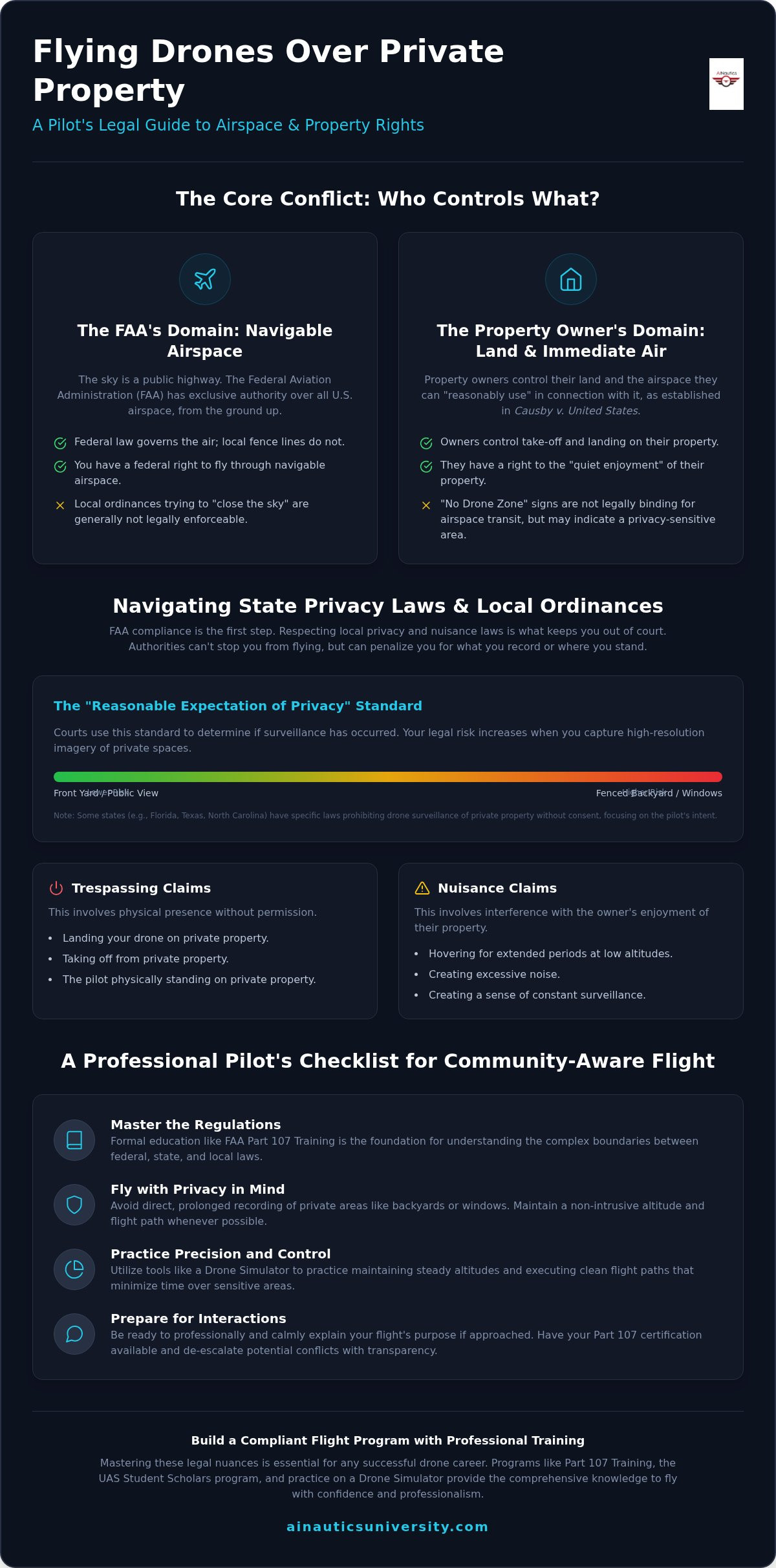
The Federal Aviation Administration (FAA) holds the keys to the sky. They maintain exclusive authority over all U.S. navigable airspace, meaning that federal law dictates what happens above the soil. When you're flying drones over private property, you're operating in a public highway governed by federal standards, not local fence lines. Legally, property owners don't own the air above their land to an infinite height. This distinction is the foundation of every professional pilot's career.
The Concept of Navigable Airspace
In the context of Unmanned Aircraft Systems (UAS), the FAA defines navigable airspace as extending from the ground up. This is a critical point for 2026 pilots to master. While a city or a homeowner might try to "close" the sky, federal authority typically overrides these local attempts. You must, however, distinguish between the air and the land. You have a federal right to fly through the airspace, but you don't necessarily have the right to take off or land on someone else's driveway without permission. Modern drone regulations clarify that while the sky is open, land use remains a local matter. This is why our Part 107 Training emphasizes the difference between airspace access and ground trespass. Understanding this boundary ensures you remain compliant while executing complex missions.
Property Owner Rights and Air Rights
The legal foundation for modern flight dates back to the Supreme Court case Causby v. United States. This ruling established that property owners only own as much of the air above their land as they can reasonably use in connection with the land itself. Beyond that height, the air becomes a public resource. Because of this, "No Drone Zone" signs posted on private fences are often not legally binding for the airspace itself. A homeowner can't stop you from passing through at a safe altitude; however, they do have a right to the "quiet enjoyment" of their property. If your flight interferes with their use of the land, you could face nuisance claims even if you aren't technically trespassing.
Balancing these competing rights requires more than just a drone. It requires specialized knowledge and professional preparation. Before you take to the skies in a sensitive residential area, use our Drone Simulator to practice maintaining steady, non-intrusive altitudes. This helps you respect privacy while staying firmly within your legal rights. Mastery of these nuances is what we teach in our UAS Student Scholars program, preparing the next generation to be community-aware leaders in the industry. Knowing the law is your best defense against ground-level confusion.
Navigating State Privacy Laws and Local Ordinances
While the FAA governs the sky, state and local authorities govern how you behave. This is a critical distinction for any pilot. You can be in legal airspace but still violate a state privacy law. Many municipalities have passed ordinances that prohibit drone take-offs and landings from city parks or specific public lands. If you're flying drones over private property, you must understand that your conduct on the ground and the way you use your camera are subject to local jurisdiction. Authorities cannot stop you from flying, but they can certainly penalize you for where you stand or what you record.
Privacy, Peeping Tom, and Surveillance Laws
Courts often look at the "reasonable expectation of privacy" to settle disputes. A person in their front yard generally has a lower expectation of privacy than someone in a fenced backyard or a second-story bedroom. Capturing high-resolution photos or video of these private spaces significantly increases your legal risk. This is why Part 107 drone training is so vital. It teaches you how to navigate these gray areas before you launch. Following FAA drone rules is the first step, but respecting local privacy is what keeps you out of court. States like Florida, Texas, and North Carolina have already enacted specific laws that prohibit using drones for surveillance of private property without consent. These laws target the intent of the pilot, not just the flight path.
Trespassing vs. Nuisance Claims
Physical trespassing is straightforward; don't land your drone on a neighbor's roof or take off from their driveway without a permit. Aerial trespassing and nuisance claims are more complex. Nuisance laws often target drones that hover for extended periods, creating noise or a sense of constant surveillance. A quick transit flight across a property is rarely an issue. However, a stationary hover over a pool or window can trigger harassment or stalking statutes.
Pilots in our UAS Student Scholars program learn to plan flight paths that minimize time over sensitive residential areas. If you're unsure about a specific route, practicing in a Drone Simulator can help you refine your path to be as non-intrusive as possible. Building these habits early is a hallmark of a professional pilot. If you want to ensure your operations meet the highest legal standards, consider exploring our Self-Paced Certification options to master these local complexities at your own speed. Staying informed is your best defense against local legal challenges.
How to Fly Responsibly Near Residential Areas
Professionalism in the drone industry isn't just about following the letter of the law; it's about building community trust. When flying drones over private property, your presence can trigger anxiety if your intentions aren't clear. By 2026, the standard for accountability is the Remote ID mandate. This technology acts as a digital license plate, broadcasting your location and identity to prove you're a registered, accountable pilot. Utilizing this tool effectively reduces neighbor suspicion and demonstrates that you aren't a hobbyist "creeper," but a trained professional. Trust is earned through transparency and technical precision.
Maintaining a consistent buffer zone is one of the most effective ways to minimize visual and noise intrusion. We recommend a minimum altitude of 150 to 200 feet when transiting over homes. At this height, the drone's noise profile blends into the background, and the visual profile is less threatening to those on the ground. Professionalism starts with hands-on UAS training that emphasizes ethical flight. If you're unsure how your flight path looks from below, use our Drone Simulator to practice maintaining steady, non-intrusive trajectories before you ever arrive on site.
The Residential Pre-Flight Checklist
A structured approach to community-aware flight prevents legal and social friction. Before you launch, follow these steps to ensure a compliant mission:
- Step 1: Check for local land use restrictions. While you can fly in the air, you must ensure your take-off and landing zones are permitted by local ordinances.
- Step 2: Identify sensitive areas. Scan your flight path for schools, daycares, or high-density backyards where people have a higher expectation of privacy.
- Step 3: Set a minimum altitude. Aim for 150 to 200 feet to significantly reduce the drone's noise footprint.
- Step 4: Verify Remote ID. Ensure your broadcast is active and verifiable to provide peace of mind to anyone checking the FAA Drone FAQs regarding drone identification.
Ethical Media Capture Best Practices
Capturing media while flying drones over private property requires a high degree of situational awareness. Avoid pointing your gimbal directly into windows, enclosed yards, or balcony spaces. If your mission is commercial or educational, consider notifying immediate neighbors with a simple door hanger or a quick conversation. This proactive transparency often stops complaints before they start. Use wide-angle shots for your primary data collection; this minimizes the appearance of "spying" on specific residences. Our UAS Student Scholars learn that the best pilots are the ones who are never noticed, or if they are, they are seen as helpful professionals rather than intruders.
Managing Privacy Concerns and Property Owner Interactions
Your ground game matters just as much as your flight path. When flying drones over private property, you are often visible to the community, and your presence can be a magnet for questions or concerns. De-escalation is the most important skill for a pilot on the ground. A professional posture, a high-visibility vest, and a calm demeanor can prevent a minor inquiry from becoming a major legal headache. If a property owner approaches you, stay focused on your flight safety first. Be prepared to engage with transparency once the aircraft is stable or landed.
Always have your credentials ready for inspection. This includes your FAA registration and your Part 107 certificate if you are flying for commercial or educational purposes. Showing these documents immediately establishes you as a legitimate operator rather than a casual hobbyist. If the situation feels tense or the property owner is becoming aggressive, know when to land. It is better to cut a mission short and move to a different location than to risk a physical confrontation or a call to law enforcement that could have been avoided with a bit of professional humility.
The 'Elevator Pitch' for Concerned Neighbors
Prepare a 30-second explanation of your mission before you ever launch. A simple, honest statement like, "I am currently practicing flight maneuvers for a professional certification," or "I am mapping the local infrastructure for a school project," goes a long way. If the neighbor is worried about privacy, offer to show them your "live view" screen. Seeing the wide-angle perspective often reassures them that you aren't looking into their windows or focused on their backyard. You can even mention that you've logged dozens of hours on the AINautics Drone Simulator to ensure you can operate safely and precisely around residential obstacles. This demonstrates a level of preparation that commands respect.
Dealing with Interference or Threats
Conflict sometimes escalates despite your best efforts. It is vital to remember that drones are considered aircraft under federal law. Any property owner attempting to "shoot down," jam, or physically interfere with your drone is committing a federal crime. If you face a direct threat, do not engage in a shouting match. Document the interaction using a ground-based camera or a body cam for your legal protection. If someone attempts to seize your equipment or threatens your safety, involve law enforcement immediately. Having a clear record of your compliant flight path and your professional credentials will be your best defense. To build the confidence needed to handle these high-pressure situations, we recommend starting with our Part 107 Training to master both the law and the soft skills of professional piloting.
Building a Compliant Flight Program with Professional Training
Professional certification acts as your strongest defense when flying drones over private property. It transforms your status from a casual hobbyist to a certified professional in the eyes of both the law and the community. This distinction provides a critical layer of protection against accusations of reckless flight or "spying." When you can prove you have mastered FAA safety protocols through our Part 107 Training, you demonstrate a commitment to community safety that carries significant weight in any legal or social dispute. Mastery of the rules is the only way to operate with true authority.
Institutional flight programs require even higher standards of accountability. Educational institutions must align with state standards and FAA safety protocols to protect their students, their equipment, and their reputation. Implementing a "Train-the-Teacher" model ensures that every school-based flight is legally sound and professionally managed. This top-down approach to compliance prevents the types of oversight that lead to neighbor complaints or municipal fines. A well-structured program doesn't just teach students how to fly; it teaches them how to be community leaders in a high-tech industry.
Why Certification Matters for Residential Flights
Navigating the complex intersection of federal airspace and local privacy requires constant vigilance and up-to-date knowledge. Regulations evolve quickly as technology advances. This is why a Part 107 renewal course is essential for staying current on 2026 standards. Your certificate serves as a "trust badge" during field operations. Municipal clients and skeptical neighbors are far more likely to cooperate when they see you have undergone rigorous professional training. It proves you understand the "reasonable expectation of privacy" and have the skills to maintain a safe buffer zone at all times.
Integrating Compliance into the STEM Classroom
Schools face unique challenges when operating drone labs near residential zones. By using a specialized drone curriculum for educators, schools can establish "Legal Flight Zones" that respect property rights while maximizing learning opportunities. This curriculum teaches students the ethics of flying drones over private property before they ever touch a controller. We also utilize our VR Trailer Mobile Lab to bring immersive, compliant training directly to the school site, ensuring students practice in a controlled, professional environment.
We encourage students in our UAS Student Scholars program to lead community outreach efforts for their school projects. When students explain their mapping or science missions to neighbors, it builds a culture of respect and transparency. Practicing these interactions on a Drone Simulator helps them refine their communication and flight precision. This comprehensive approach ensures that every mission is a masterclass in professional responsibility and community-aware flight. Your journey toward becoming a respected pilot starts with the right educational foundation.
Secure Your Future in the Evolving UAS Landscape
Success in flying drones over private property requires more than just technical skill; it demands a deep understanding of the 2026 regulatory environment. You've learned that while the FAA governs the airspace, your professional conduct and respect for local privacy laws are what truly protect your career. By prioritizing transparency, utilizing Remote ID, and maintaining a buffer zone, you transform from a casual operator into a community-aware leader. Certification is your most powerful tool, serving as a trust badge that proves your commitment to safety and excellence.
As a Service-Disabled Veteran-Owned Small Business, AINautics University is dedicated to your professional growth. Our FAA Part 107 Expert Instructors and STEM-aligned curriculum for schools provide the authoritative knowledge needed to navigate this complex industry with confidence. Whether you're a student, parent, or educator, you don't have to navigate these rules alone. Start your professional drone journey with AINautics University today! The sky is open for those who fly with purpose, precision, and professional integrity.
Frequently Asked Questions
Is it illegal to fly a drone over someone's backyard?
It is generally legal under federal law because the FAA maintains authority over all navigable airspace. However, state privacy laws often prohibit using a drone to conduct surveillance or capture media where there's a "reasonable expectation of privacy." Our UAS Student Scholars learn to prioritize community respect by avoiding low hovers over sensitive areas like fenced backyards or pools. While you have the right to fly, you don't have the right to invade a neighbor's privacy.
How low can a drone fly over my private property?
The FAA doesn't set a specific minimum altitude for drones, but property owners legally own the immediate air they can "reasonably use" in connection with their land. Most professionals maintain a buffer of at least 150 to 200 feet to avoid nuisance claims. Flying lower than this can be interpreted as aerial trespassing or a disturbance of quiet enjoyment. Practicing these altitudes on a Drone Simulator helps pilots develop the precision needed to stay clear of residential obstacles.
Can a property owner shoot down a drone flying over their land?
No, shooting down a drone is a federal crime because drones are legally classified as aircraft. Under 18 U.S.C. 32, destroying an aircraft can lead to felony charges and significant prison time. Property owners must use legal channels, such as reporting the pilot to the FAA or local police, to resolve disputes. Pilots should always maintain a professional demeanor and have their Part 107 Training credentials ready to show law enforcement if a confrontation occurs.
Do I need permission to fly a drone over a farm or ranch?
You don't need permission to fly through the airspace, but you do need it to take off, land, or stand on the owner's soil. Many states have specific statutes protecting agricultural operations from unauthorized surveillance. It's always a best practice to notify owners of large tracts of land before beginning a mission. This transparency reduces suspicion and builds the professional relationships necessary for a successful career in the UAS industry.
What should I do if a neighbor complains about my drone?
Land your aircraft safely and engage in a calm, professional conversation to de-escalate the situation. Explain your mission clearly and show your FAA registration or Part 107 certificate to establish your legitimacy. If the neighbor remains aggressive, document the interaction and leave the area to avoid further conflict. Our Self-Paced Certification options include modules on soft skills and conflict resolution to help you handle these high-pressure ground interactions with confidence.
Does the FAA protect my right to fly over private property?
Yes, the FAA's exclusive authority over U.S. airspace protects your right to be flying drones over private property for legitimate purposes. This federal oversight prevents local governments from "closing" the sky to drone traffic. While the FAA protects your flight path, it doesn't protect you from state-level privacy or harassment charges. Understanding this balance is a core component of our Part 107 Training, ensuring you stay compliant with both federal and local standards.
Can police fly drones over private property without a warrant?
Police drone use is governed by a mix of the Fourth Amendment and specific state laws. In many jurisdictions, law enforcement can fly drones for emergency responses or "Plain View" observations without a warrant. However, states like Florida and Texas have enacted stricter rules requiring a warrant for targeted surveillance of private residences. Educators in our Train-the-Teacher Program stay updated on these evolving standards to ensure their students understand the legal boundaries of public safety flight.
How does Remote ID affect my privacy as a drone pilot?
Remote ID broadcasts your drone's identification and location to ensure accountability when flying drones over private property, but it doesn't share your personal name or address with the public. Only the FAA and law enforcement can link that ID to your registration data. This system protects your identity from casual observers while providing the transparency needed to fly in complex residential areas. It acts as a digital license plate that proves you're a registered, professional pilot.

Article by
AINautics University Team
The team behind AINautics University, dedicated to drone education and FAA Part 107 certification prep, VR flight simulation, and STEM training programs for students and educators.


