
What if the $175 you spend on your FAA exam fee only buys you a piece of paper, but leaves you terrified to actually launch a drone in a complex environment? Most students and educators feel stuck between dry, academic slide decks and the overwhelming pressure of the Part 107 test. It's frustrating to invest time in a self-paced drone certification that teaches you how to memorize answers instead of how to build genuine muscle memory. You deserve a training path that aligns with high STEM standards and prepares you for the reality of a global industry projected to reach $116.81 billion this year.
We understand that earning your FAA Remote Pilot Certificate is just the first step toward a professional career. This guide compares the leading UAS training methodologies to help you find a path that builds true flight mastery. We'll explore how modern tools like the AINautics Drone Simulator and the UAS Student Scholars program are redefining what it means to be workforce-ready. You'll learn how to choose a program that ensures you pass your exam on the first attempt while developing the specialized skills required for a sustainable career in aviation.
Key Takeaways
- Learn how to transition from basic Part 107 knowledge to operational mastery in high-demand sectors like precision mapping and infrastructure inspection.
- Discover how a self-paced drone certification offers the essential flexibility for students and working professionals to build future-ready skills on their own terms.
- Understand the importance of choosing a curriculum backed by industry standards and veteran-led authority to ensure your credentials carry weight in the 2026 workforce.
- Gain access to a strategic framework for launching sustainable UAS programs in schools using turnkey solutions like the Train-the-Teacher Program.
- Explore how immersive tools like the Drone Simulator and VR Trailer Mobile Lab bridge the gap between digital learning and real-world flight confidence.
Navigating the UAS Certification Landscape in 2026
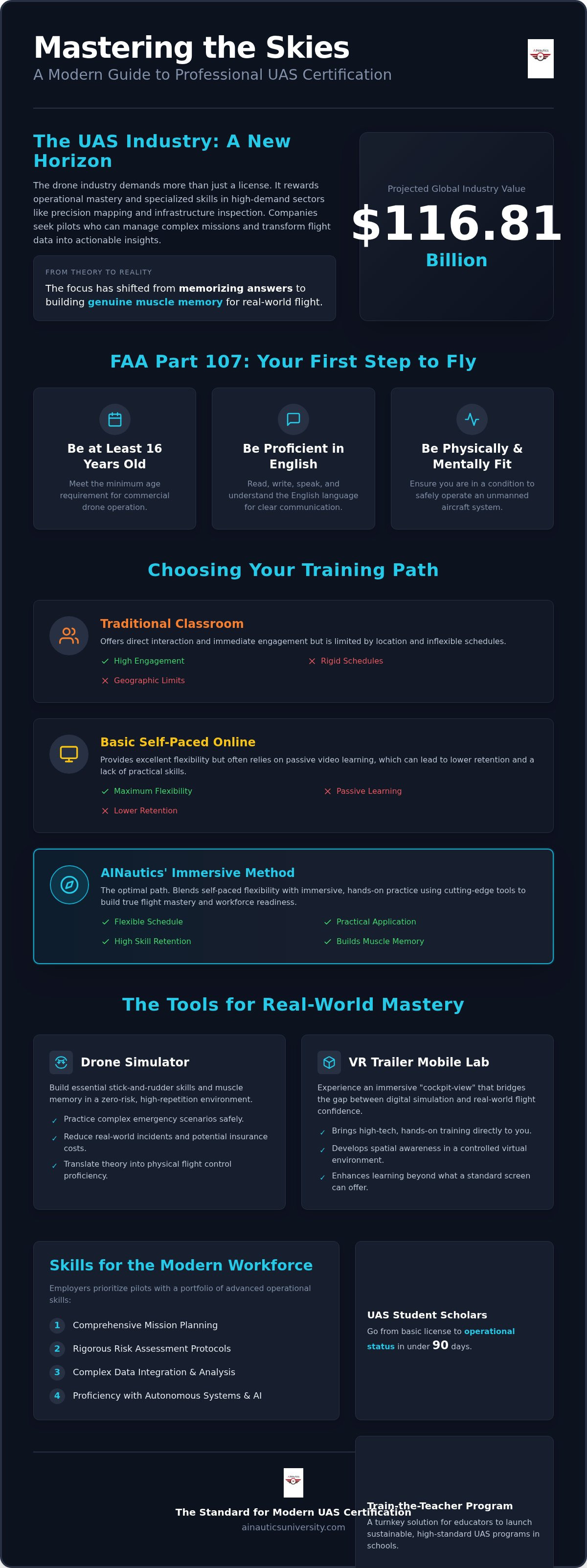
The UAS industry in 2026 demands more than a basic understanding of flight rules. While the Remote Pilot Certificate remains the entry point, the market now rewards operational mastery over simple test-taking ability. Companies no longer look for someone who can simply hover; they need specialists who can manage complex missions in infrastructure inspection, precision mapping, and high-end media production. This evolution means your choice of a self-paced drone certification must bridge the gap between regulatory theory and real-world execution. Modern standards require pilots to be comfortable with autonomous systems and AI integration, as these technologies now handle the bulk of data collection and flight path optimization.
The FAA Part 107 Foundation
Every commercial career starts with the legal framework provided by the FAA. To operate an Unmanned aerial vehicle (UAV) for profit in the United States, you must hold a Remote Pilot Certificate. The eligibility criteria are straightforward: you must be at least 16 years old, proficient in English, and in a physical and mental condition that allows for safe flight. However, simply meeting these requirements isn't enough to thrive in a competitive field. Comprehensive Part 107 drone training acts as your professional bedrock. It ensures you understand airspace classes, weather patterns, and emergency procedures before you ever launch a mission. AINautics University structures its self-paced drone certification to turn these regulations into actionable safety protocols rather than just facts to memorize for an exam.
Beyond the License: Workforce Readiness
In 2026, the "licensed" tag is just the beginning of your journey. Employers prioritize pilots who demonstrate proficiency in mission planning, rigorous risk assessment, and complex data integration. They want to see that you can translate raw flight data into actionable insights for a client. We address this by aligning our curriculum with these specific workforce demands. Programs like the UAS Student Scholars initiative allow learners to move from a basic license to operational status in under 90 days. By utilizing specialized tools like the Drone Simulator, you build the muscle memory needed for complex maneuvers without the risk of equipment damage. This approach ensures that when you step onto a job site, you aren't just a certificate holder; you're a professional ready to contribute to a sustainable UAS program.
Comparing Training Formats: Self-Paced vs. Immersive vs. Traditional
Traditional classroom settings offer high immediate engagement, yet they often fall short for busy professionals due to rigid schedules and geographic limitations. If you can't be in a specific room at a set time, you miss out on the curriculum. A self-paced drone certification solves this scheduling conflict, providing maximum flexibility for students and educators who need to balance training with other responsibilities. However, the quality of these programs varies wildly across the industry. Many rely on passive video learning, which often leads to lower retention rates compared to active, hands-on practice. To truly master flight, you need a format that blends the convenience of online modules with immersive, practical application.
The Power of the Drone Simulator
Building stick-and-rudder skills requires constant repetition. A high-quality Drone Simulator allows you to build muscle memory in a zero-risk environment before you ever touch expensive hardware. You can practice complex scenario-based training, such as emergency motor failures or bird-awareness protocols, without the fear of a costly crash. Extensive simulator time translates directly to reduced field incidents and significantly lower insurance costs for commercial operations. This active engagement ensures you don't just know the theory of FAA drone pilot certification; you possess the physical skills to handle a real aircraft in a high-pressure environment. It's the difference between reading about a flight and actually controlling one.
Mobile Labs and VR Integration
Immersive technology takes training a step further by providing a "cockpit-view" experience that a traditional computer screen cannot match. The AINautics VR Trailer Mobile Lab brings this high-tech environment directly to school districts and businesses, making elite training accessible to any location. This approach is particularly effective for Gen Z learners who thrive in interactive, gamified settings. Utilizing immersive drone training technology bridges the gap between digital theory and physical flight. If you're looking for a path that respects your time while building real mastery, consider exploring the Self-Paced Certification options designed for the modern workforce. By combining online flexibility with VR-enhanced modules, you can achieve a level of readiness that traditional textbooks simply cannot provide.
Evaluating UAS Curriculum: Industry Alignment and Safety Standards
Choosing a self-paced drone certification requires looking past the marketing fluff to see if the curriculum aligns with actual industry demands. In 2026, credibility comes from standardization. Programs backed by organizations like AUVSI or led by veteran-led authorities (SDVOSB) provide a level of trust that generic courses can't match. You need a curriculum that dives deep into advanced topics like Beyond Visual Line of Sight (BVLOS) operations under Part 108 and complex airspace authorizations. While theory is vital for obtaining your FAA Remote Pilot Certificate, true competency only comes from hands-on UAS training. This practical experience bridges the gap between passing a test and managing a high-stakes infrastructure project.
STEM and CTE Alignment for Schools
Educators face the unique challenge of finding a drone curriculum for educators that meets strict state standards. It isn't enough to fly drones in the gym; the program must integrate into Career and Technical Education (CTE) pathways. We solve this through our Train-the-Teacher Program, which empowers districts to launch sustainable drone programs in under 90 days. By focusing on workforce-ready skills, programs like the UAS Student Scholars initiative prepare students for high-paying roles right out of high school. This strategic alignment ensures that drone education isn't just a hobby but a viable career launchpad.
Safety Protocols and Wildlife Awareness
Safety in 2026 involves more than just obstacle avoidance. Professional pilots must understand federal regulations like the Migratory Bird Treaty Act. If you're conducting a vertical structure inspection near a protected nest, you need to know the legal and ethical boundaries. A robust self-paced drone certification teaches you how to document these safety protocols to build a clean paper trail for insurers and regulators. This level of detail protects you from liability and establishes you as a high-level professional. Our training uses the Drone Simulator to run these specific scenarios, allowing you to practice complex inspections without disturbing actual wildlife or risking equipment. Building this documentation habit early is what separates a hobbyist from a career pilot.
Choosing Your Path: A Career-Oriented Decision Framework
Selecting the right self-paced drone certification requires a clear understanding of your specific career or educational goals. For students, the focus should be on building a foundational pathway that leads to immediate employment or higher education. We encourage young pilots to explore the UAS scholarship for high school students to offset costs and gain access to elite mentorship. Educators, on the other hand, need turnkey solutions that provide teacher certification alongside student curriculum. A sustainable program shouldn't rely on a single enthusiast; it requires a structural framework that can survive personnel changes. For professionals, the priority is rapid Part 107 preparation combined with specialized workforce modules, such as cell tower or power line inspections.
Evaluating the return on investment (ROI) is critical when comparing training formats. While a basic study guide might cost less upfront, it often fails to provide the operational confidence needed for high-stakes missions. Investing in premium immersive training that includes the Drone Simulator and VR modules pays off through reduced equipment damage and faster placement in the workforce. The flexibility of a self-paced drone certification allows professionals to upskill without pausing their current careers, making it the most efficient route to specialization in the 2026 market.
The 90-Day Implementation Roadmap
Schools can transition from zero to live flight operations in a single semester by following a structured implementation plan. This roadmap starts with identifying funding sources, such as CTE grants, district allocations, or federal STEM funding. Our Train-the-Teacher Program ensures that staff members are fully certified and comfortable with the technology before students ever touch a controller. By designating UAS Teacher Scholars, districts create a community of practice that maintains program longevity and ensures consistent safety standards across all grade levels. This approach turns a complex technological rollout into a manageable, step-by-step process for any district.
Maintaining Your Certification
Your journey doesn't end once you receive your initial certificate. The FAA requires a renewal every 24 calendar months to keep your privileges current. Choosing a professional Part 107 renewal course ensures you stay updated on the latest regulatory changes, including Remote ID requirements and the evolving Part 108 rules for flight beyond visual line of sight. Beyond the technicalities, you must stay sharp on the legal aspects of operations, such as the specific rules for flying drones over private property. Continuous learning is the hallmark of a professional pilot who values safety and compliance. Ready to start your journey? Select the training path that fits your future today.
Why AINautics University is the Standard for Modern UAS Certification
Choosing a provider for your self-paced drone certification is a decision that impacts your entire career trajectory. AINautics University stands apart by offering an integrated ecosystem that moves beyond the classroom. We don't just provide lessons; we provide a bridge to the industry through the iFlyDrone marketplace. This platform allows our graduates to enter the workforce with a direct connection to commercial opportunities, ensuring that your training leads to tangible results. Our leadership team, spearheaded by Chief Pilot Taz Little, brings a wealth of veteran-led experience to every module. This authority ensures that our curriculum remains grounded in the rigorous standards required for high-level UAS compliance. As a Service-Disabled Veteran-Owned Small Business, we prioritize the discipline and precision necessary for professional aviation.
Our national reach allows us to offer scalable solutions for districts and enterprises across the United States. Whether you are a solo entrepreneur or a large school system, our resources are designed to adapt to your specific needs. By combining proprietary technology with expert-led instruction, we've created a standard that competitors cannot match. We focus on the human element of technology, ensuring that every pilot we train is not just licensed, but truly prepared for the responsibilities of command.
The UAS Student Scholars Advantage
The UAS Student Scholars program represents the pinnacle of our mission-driven instruction. We prepare the next generation for high-paying careers in autonomous systems by replicating real-world commercial work in a controlled environment. Students engage in missions that mirror actual industry tasks, from infrastructure mapping to precision agricultural data collection. AINautics bridges the gap between 'passing a test' and 'performing a job' by ensuring every learner possesses the operational confidence to lead a flight crew. This hands-on approach builds the specialization needed to thrive in a global market projected to reach $116.81 billion this year. By focusing on these high-demand skills, we ensure our scholars are ready for immediate placement in the workforce.
Get Started with AINautics University
Launching your career or a school-wide program is a streamlined process with our scalable tools. You can enroll in our self-paced drone certification or instructor-led courses today to begin building your professional portfolio. For districts looking to spark immediate engagement, booking the VR Trailer Mobile Lab provides a high-tech center for immersive training that travels directly to your location. This mobile solution is designed to scale, offering districts and enterprises across the country access to elite technology without the need for permanent infrastructure. If you need a custom consultation on starting a sustainable drone program, our team is ready to help you navigate the technical and regulatory requirements. We provide the expertise and the technology to ensure your success in the evolving world of Unmanned Aircraft Systems.
Take Command of Your UAS Career in 2026
The path to becoming a professional pilot in 2026 requires more than just a license. It demands operational mastery and the ability to navigate complex regulatory environments with confidence. We've explored how a self-paced drone certification provides the necessary flexibility for your schedule while ensuring you build real-world skills through simulation and immersive technology. Choosing a curriculum aligned with modern industry standards is the most efficient way to secure your place in a workforce that values specialized expertise over simple test-taking.
AINautics University is a Service-Disabled Veteran-Owned Small Business and a committed AUVSI Industry Member. We provide the expert leadership and turnkey "Launch in 90 Days" program support needed to transform your career or school district. Whether you're a student exploring foundational pathways or an educator building a sustainable program, our integrated ecosystem is designed to help you succeed. Explore UAS Certification Programs at AINautics University and take the first step toward professional mastery. The future of aviation is autonomous, and it's time for you to lead the way.
Frequently Asked Questions
What is the best self-paced drone certification for beginners in 2026?
AINautics University provides the premier self-paced drone certification for beginners by blending FAA Part 107 prep with immersive simulation. Our program ensures you don't just memorize answers but actually understand the physics and regulations of flight. This workforce-ready approach is specifically designed to transition new learners into professional roles within 90 days. It offers the support of a veteran-led team to guide you through every complex concept.
How long does it take to complete a self-paced UAS certification program?
Most learners complete a comprehensive self-paced drone certification within 20 to 40 hours of study. This timeframe depends on your prior knowledge of aviation and how much time you dedicate to the Drone Simulator. The flexibility of the format allows busy students and working professionals to progress at their own speed. You can master the material in a single week or spread it out over a full semester.
Can I take UAS certification training entirely online or is in-person required?
You can complete all your preparatory training entirely online through our digital platform. This includes video lessons, interactive quizzes, and simulation modules that you can access from any location. However, the FAA requires you to sit for the actual Remote Pilot Certificate exam at a physical, approved testing center. We help you locate the nearest facility and ensure you're fully prepared for that in-person appointment.
Is a drone simulator necessary to pass the FAA Part 107 exam?
While the FAA Part 107 exam is a written test that doesn't strictly require flight skills, using a Drone Simulator is vital for career success. It allows you to build the muscle memory and stick-and-rudder skills needed to protect your equipment and reputation. Passing the test gets you the license, but the simulator gives you the confidence to execute commercial missions without the fear of a crash.
What is the cost of UAS certification training for a school district?
School districts typically fund UAS programs through CTE allocations, STEM grants, or federal workforce development funds. The total investment depends on whether you opt for the standard curriculum or include immersive tools like the VR Trailer Mobile Lab. We provide a turnkey 90-day launch support package to help administrators maximize their budget. This ensures the program is sustainable and meets all state educational standards.
How do I become a certified UAS teacher for my high school?
Educators can become certified by completing our Train-the-Teacher Program, which is specifically designed for classroom integration. This track provides the technical knowledge to pass the FAA exam and the pedagogical tools to manage a student flight crew. We guide you through the setup of a legal and safe school flight program. This path ensures you're recognized as a qualified UAS instructor within your district.
Does self-paced drone training include hands-on flight time?
Standard self-paced modules focus on the aeronautical knowledge required by the FAA, but we integrate hands-on experience through virtual flight. By using our proprietary Drone Simulator, you gain digital flight hours that translate directly to real-world competency. For districts, the VR Trailer Mobile Lab provides a physical space where students can practice high-stakes maneuvers under expert supervision. This combination ensures a well-rounded educational experience.
What is the difference between Part 107 and a UAS Student Scholar certification?
The FAA Part 107 certificate is the legal baseline required to operate a drone for any non-recreational purpose. In contrast, the UAS Student Scholars program is an advanced workforce credential that focuses on specialized industry applications. While Part 107 proves you know the rules, becoming a scholar proves you have the technical mastery to perform complex jobs like thermal inspections or 3D mapping.

Article by
AINautics University Team
The team behind AINautics University, dedicated to drone education and FAA Part 107 certification prep, VR flight simulation, and STEM training programs for students and educators.


