
What if your school's most advanced STEM facility didn't require a single brick or a permanent renovation? For many administrators, the vision of a high-tech aviation program often stalls due to a lack of dedicated flight space or the high cost of maintaining specialized hardware. You likely agree that students deserve access to future-ready careers, yet the logistics of FAA compliance and teacher training can feel like an impossible hurdle.
A mobile drone lab for schools changes that equation by bringing the technology directly to your campus. This guide explores how to transform your curriculum into a professional career pathway that leads students toward FAA Part 107 certification without the need for fixed infrastructure. You will learn how turnkey solutions, such as the AINautics University VR Trailer Mobile Lab and the Train-the-Teacher program, bridge the gap between classroom theory and industry-standard flight skills. We will break down the 2026 resource landscape, from using a Drone Simulator for safe practice to aligning your program with state STEM standards for a seamless, high-impact launch.
Key Takeaways
- Understand how a mobile drone lab for schools bypasses the need for expensive classroom renovations by providing a portable, self-contained learning environment.
- Discover how to use professional-grade Drone Simulators and VR stations to provide safe, immersive flight training that builds student confidence before they take to the sky.
- Learn about the 90-day launch framework that aligns your curriculum with state STEM standards and prepares educators through the Train-the-Teacher program.
- Explore the pathway to FAA Part 107 certification, turning a standard STEM elective into a legitimate workforce-readiness hub for future UAS pilots.
What is a Mobile Drone Lab and Why Does Your School Need One?
A mobile drone lab for schools is a self-contained, portable learning environment specifically engineered to deliver high-tech education without the need for permanent facility modifications. Unlike static classroom kits, which often gather dust in storage closets, these labs are fully equipped hubs featuring professional-grade Unmanned Aerial Vehicle (UAV) technology, flight simulators, and immersive VR tools. It’s a classroom on wheels that brings the industry to the student.
Many administrators face a common hurdle: the "infrastructure gap." Traditional buildings weren't designed for indoor flight training, and outdoor space is often restricted by local regulations or weather. A mobile lab eliminates these barriers. It provides a secure, climate-controlled space where students can master flight maneuvers and sensor operation. By utilizing an autonomous systems training framework, schools can prepare students for specialized careers in a rapidly evolving market.
Overcoming Space and Budget Constraints
Setting up a permanent lab in every school within a district is often financially impossible. A single mobile unit, like the AINautics VR Trailer Mobile Lab, can serve multiple campuses on a rotating schedule. This shared resource model maximizes the impact of federal and state STEM grant funding. Instead of renovating a room that sits empty half the day, schools invest in a high-utilization asset. It allows for rapid deployment. This means a school can go from zero drone presence to a full-scale aviation program in weeks rather than years.
Meeting 2026 Workforce Demands
The demand for skilled drone pilots is no longer limited to aerial photography. In 2026, industries like precision agriculture, infrastructure inspection, and public safety rely on UAS professionals. A mobile lab bridges the gap between a casual hobby and a high-paying career. Students don't just "play" with drones; they engage in immersive training that mirrors real-world scenarios. Through programs like the Train-the-Teacher Program and the use of a professional Drone Simulator, educators can provide the technical foundation students need to transition directly into the workforce. This approach ensures that learners are not just consuming technology, but mastering the tools that define modern industry standards.
Key Components of a High-Impact Mobile Drone Experience
A high-impact mobile drone lab for schools functions as a concentrated workforce development center. It houses specific technologies designed to take a student from a novice enthusiast to a certified remote pilot. Beyond just carrying hardware, these labs provide a structured environment where students engage with professional-grade tools. Key components include dedicated workstations for FAA Part 107 preparation and mission-specific software that replicates commercial workflows in industries like agriculture and construction.
Simulators: The Foundation of Flight Mastery
Safe and effective drone simulator training is the backbone of any serious UAS program. It allows students to crash a virtual aircraft a thousand times without costing the school a single dollar in hardware repairs. These platforms provide a consequence-free environment to develop essential muscle memory and hand-eye coordination. Digital tracking systems within the lab allow instructors to verify flight hours and proficiency levels accurately. This ensures that every learner meets a high standard of mastery before they ever handle a physical drone in the field. Volume pricing for a Drone Simulator license makes this a scalable solution for entire cohorts of students.
VR and Immersive Learning Environments
The integration of immersive drone training technology takes education a step further by placing students directly in the pilot's seat. VR stations enable learners to experience First Person View (FPV) flight, which is critical for complex inspections and high-speed navigation. By simulating environments like active cell towers or vertical structures, students learn to manage spatial awareness in a controlled setting. This level of immersion significantly increases information retention compared to traditional classroom lectures. It also creates a "wow factor" that drives STEM enrollment and keeps students engaged in their career journey.
To ensure long-term success, these labs must adhere to the latest FAA guidelines for educational drone use. In 2026, this includes understanding Remote ID mandates and maintaining strict safety protocols during every flight session. Curriculum-aligned mission scenarios ensure that students aren't just flying for fun; they are performing tasks that mimic real-world commercial work. Educators can leverage the UAS Student Scholars program to provide students with a structured path toward industry recognition and professional readiness. This comprehensive tech stack transforms a simple trailer into a high-tech gateway for the next generation of aviators.
Evaluating Mobile Labs vs. Static Classroom Setups
Choosing between a static classroom and a mobile solution is a strategic decision for any district. A static lab often involves months of architectural planning and expensive HVAC or electrical renovations. In contrast, a mobile drone lab for schools offers immediate delivery and deployment. It bypasses the bureaucracy of construction while providing a state-of-the-art facility from day one. This speed allows schools to capitalize on student interest and grant deadlines without waiting for a building permit.
These units aren't just for daily classes; they act as powerful recruitment tools. You can move the lab to community events, local festivals, or middle school orientations to spark interest in high school STEM pathways. This mobility is essential for Revolutionizing STEM Education across an entire region. It turns a stationary curriculum into a visible, community-wide asset that showcases your school's commitment to modern technology.
Cost-Benefit Analysis for School Districts
When you analyze the per-student cost, the mobile model often wins. A static room serves approximately 30 students at a time in one specific building. A single VR Trailer Mobile Lab can rotate between five different high schools, serving hundreds of students annually. Maintenance is also simplified. Instead of securing expensive hardware across multiple classrooms, you keep everything locked in one climate-controlled, secure unit. This centralized approach protects your investment and ensures that equipment like the Drone Simulator is always available and functional for every cohort.
Safety and Regulatory Compliance
Safety remains the most critical factor in UAS education. Flying drones in high-traffic hallways or gyms presents constant risks and distractions. A mobile lab provides a dedicated, controlled flight zone where safety is the priority. It also simplifies FAA airspace authorizations. Because the lab is a standardized environment, teachers follow the same safety protocols regardless of their location. Programs like the Train-the-Teacher Program ensure every instructor is proficient in these standards before they lead a class. This consistency is vital for students pursuing Part 107 Training or participating in the UAS Student Scholars program. By standardizing the learning environment, you reduce liability and create a professional atmosphere that mirrors commercial operations.
Implementing a 90-Day Drone Program with Mobile Support
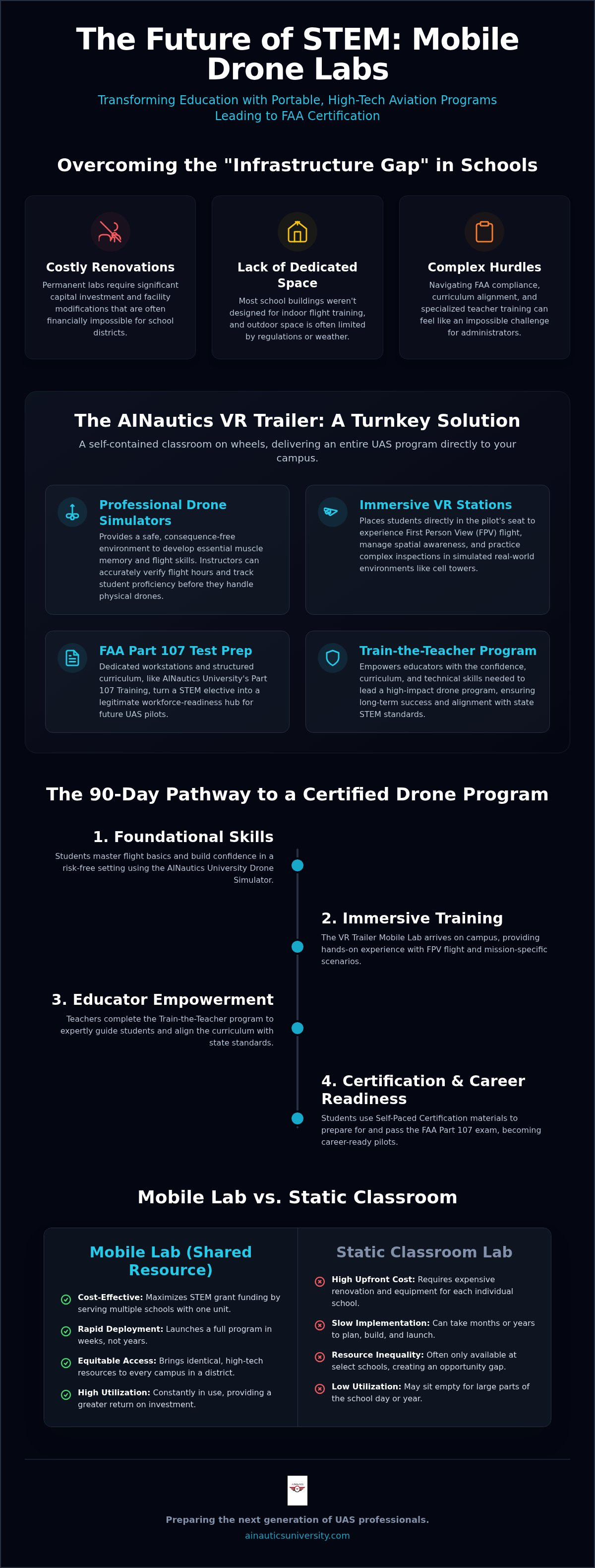
Many schools assume that launching a professional aviation program requires a year of bureaucratic planning and facility renovation. This misconception often delays student access to critical technology and high-paying career paths. By utilizing a mobile drone lab for schools, administrators can follow a compressed 90-day framework to reach full operational status. This rapid implementation model focuses on actionable milestones that move a district from initial interest to active flight operations within a single semester. It doesn't just save time; it ensures your program is current with 2026 industry standards from day one.
- Phase 1 (Days 1-30): Planning and curriculum alignment. Map existing state STEM standards to UAS competencies to ensure funding eligibility.
- Phase 2 (Days 31-60): Teacher certification. Staff begin their professional development through the Train-the-Teacher Program to become FAA-licensed pilots.
- Phase 3 (Days 61-75): Infrastructure arrival. The VR Trailer Mobile Lab is delivered, and Drone Simulator workstations are configured for student use.
- Phase 4 (Days 76-90): Official launch. Students enroll in the UAS Student Scholars program and begin hands-on flight operations and Part 107 preparation.
The Train-the-Teacher Model
Empowering existing staff is the key to program longevity and success. Instead of hiring expensive outside contractors, schools can transform their current science, math, or CTE teachers into certified aviation instructors. This professional development provides educators with the technical mastery needed to lead Part 107 Training sessions confidently. By investing in your own team, you create a sustainable internal resource that doesn't rely on external schedules. Teachers gain a prestigious credential, and the school keeps its expertise in-house, ensuring the program remains stable even as student enrollment grows.
Aligning with STEM and CTE Pathways
Modern drone education must lead to a tangible professional outcome. Mapping drone skills to specific NAICS codes ensures that your curriculum meets the actual workforce needs of 2026. Integrating Part 107 prep into the daily school schedule allows students to earn a professional credential alongside their high school diploma. The mobile lab serves as the ultimate venue for "Student Scholar" certification days. During these events, learners demonstrate their proficiency in a high-tech environment that mirrors commercial operations. This alignment turns a standard elective into a powerful workforce-readiness hub that prepares students for immediate employment in agriculture, public safety, or construction.
Ready to bring this technology to your district? You can launch your 90-day drone program with the support of industry experts who understand the unique needs of the educational environment.
The AINautics VR Trailer Mobile Lab: A Turnkey Solution
The AINautics VR Trailer Mobile Lab is more than just a vehicle; it's a fully integrated workforce-readiness hub designed to meet the specific needs of modern educators. While other providers might offer basic hardware kits, our solution provides a complete learning environment that mirrors the professional aviation industry. It functions as a mobile drone lab for schools that want to bridge the gap between classroom theory and high-stakes commercial operations. By combining immersive technology with a structured curriculum, we ensure that every student has a clear path toward mastery and employment.
Choosing the right partner is critical for schools navigating government funding and procurement rules. AINautics University is a Service-Disabled Veteran-Owned Small Business (SDVOSB). This status makes us a preferred partner for government-funded institutions, simplifying the contracting process while ensuring you're working with a team committed to professional standards. Our mobile drone lab for schools integrates seamlessly with our Self-Paced Certification modules and the Drone Simulator, allowing students to progress at their own speed while maintaining a high level of technical proficiency.
What’s Inside the AINautics Mobile Lab?
The interior of the trailer is meticulously organized to maximize learning outcomes within a compact, efficient space. It features high-performance flight simulators and VR headsets that provide students with immersive training scenarios. These tools are essential for developing the spatial awareness required for complex UAS missions. Inside, you'll find:
- Dedicated Part 107 Training study stations equipped with the latest regulatory resources.
- Flight mission planning tools that teach students how to analyze weather, airspace, and technical risks.
- Advanced VR stations for first-person view (FPV) flight proficiency.
- Customizable branding options that allow the trailer to represent your school district during public events.
This self-contained setup means your staff doesn't have to worry about managing loose equipment or finding space in a crowded media center. Everything has a place, and the unit is ready for flight operations the moment it arrives on campus.
Partnering for Student Success
Our commitment to your district extends far beyond the delivery of the trailer. When you join the UAS Student Scholars program, your students become part of a nationwide network of young aviation professionals. This program provides them with exclusive access to our pilot marketplace, connecting certified students with real-world career opportunities in their own communities. We don't just teach students how to fly; we help them find work. By focusing on the "Learn → Train → Certify → Fly → Work" pipeline, we ensure that your investment translates into tangible student success stories.
The future of your STEM curriculum is mobile, immersive, and career-focused. Taking the next step is simple. Contact AINautics to launch your mobile drone program in 90 days and give your students the competitive edge they need in the 2026 workforce.
Empower the Next Generation of Aviators Today
Launching a high-tech aviation program doesn't require years of construction or a massive budget for permanent facilities. By adopting a mobile drone lab for schools, your district can provide students with immersive training and STEM-aligned career pathways immediately. You've discovered how the right technology, like the Drone Simulator and VR Trailer Mobile Lab, transforms a standard curriculum into a professional launchpad. This approach ensures your learners are prepared for the high-tech demands of the 2026 workforce without the wait.
As a Service-Disabled Veteran-Owned Small Business (SDVOSB), AINautics University is dedicated to bridging the gap between current education and future industry needs. Our 90-Day Program Launch Guarantee ensures your school moves from planning to flight operations with efficiency and professional precision. It's time to move beyond the traditional classroom and into the cockpit.
Ready to see the technology in action? Schedule a Demo of the VR Trailer Mobile Lab to explore how we support your journey toward student mastery and FAA Part 107 certification. The future of flight is waiting for your students; let's help them reach it together.
Frequently Asked Questions
Is a mobile drone lab safe for use on school grounds?
Yes, a mobile drone lab for schools is exceptionally safe because it provides a dedicated, controlled environment for instruction. By keeping flight training inside the secure trailer or in a cordoned-off area, you avoid the risks associated with flying in crowded hallways or gyms. Students use professional-grade simulators to master controls before ever handling a physical aircraft, ensuring they understand safety protocols and FAA regulations from the start.
How many students can use the mobile drone lab at once?
A standard mobile lab can accommodate a full classroom of 20 to 30 students through a structured rotation model. While some students engage with high-performance VR headsets and flight simulators inside the trailer, others work on mission planning or Part 107 preparation at external workstations. This approach ensures every student remains active and engaged throughout the lesson rather than waiting for their turn to fly.
Does the mobile lab include FAA Part 107 certification training?
Yes, the curriculum is specifically designed to lead students toward earning their FAA Part 107 Remote Pilot Certificate. The program integrates Part 107 Training and Self-Paced Certification options directly into the learning path. Students gain the aeronautical knowledge required to pass the FAA exam, covering topics like weather patterns, airport operations, and emergency procedures through interactive modules and practice tests.
What kind of teacher training is required to operate the lab?
Educators don't need prior aviation experience to lead a successful program. Through our Train-the-Teacher Program, existing staff receive the technical training and certification support necessary to become FAA-licensed pilots. This professional development empowers teachers to manage the lab independently, ensuring the school maintains a sustainable, in-house expert who can guide students through the UAS Student Scholars program and beyond.
Can we use state STEM grants to fund a mobile drone lab?
Yes, most districts successfully use federal and state STEM or CTE grant funding to acquire a mobile drone lab for schools. Because the lab aligns with specific workforce-readiness standards and prepares students for high-demand careers, it meets the criteria for most educational technology grants. Our team often assists administrators in mapping the curriculum to state standards to maximize these funding opportunities.
What happens if the weather is too bad for outdoor flight?
Inclement weather doesn't stop the learning process because the mobile lab is fully climate-controlled and equipped for virtual flight. Students can log meaningful flight hours using the Drone Simulator and VR headsets regardless of rain, wind, or extreme temperatures. This ensures that your curriculum stays on schedule and students continue to build muscle memory and spatial awareness in a safe, indoor setting.
How does the mobile lab support students with no prior drone experience?
The program follows a logical "Learn, Train, Certify" pipeline that is perfect for beginners. Students start with basic flight theory before moving to a Drone Simulator, where they can practice maneuvers without the fear of damaging equipment. This supportive environment builds confidence and technical proficiency at a self-directed pace, allowing every learner to reach the standards required for the UAS Student Scholars program.
What are the maintenance requirements for a mobile VR trailer?
Maintenance is straightforward and focuses primarily on software updates and equipment hygiene. The AINautics team provides a clear schedule for updating the flight simulators and VR software to ensure students are always using current technology. Since the equipment is stored in a secure, climate-controlled trailer, it's protected from the wear and tear typically seen with portable kits that are moved between classrooms.

Article by
AINautics University Team
The team behind AINautics University, dedicated to drone education and FAA Part 107 certification prep, VR flight simulation, and STEM training programs for students and educators.


