
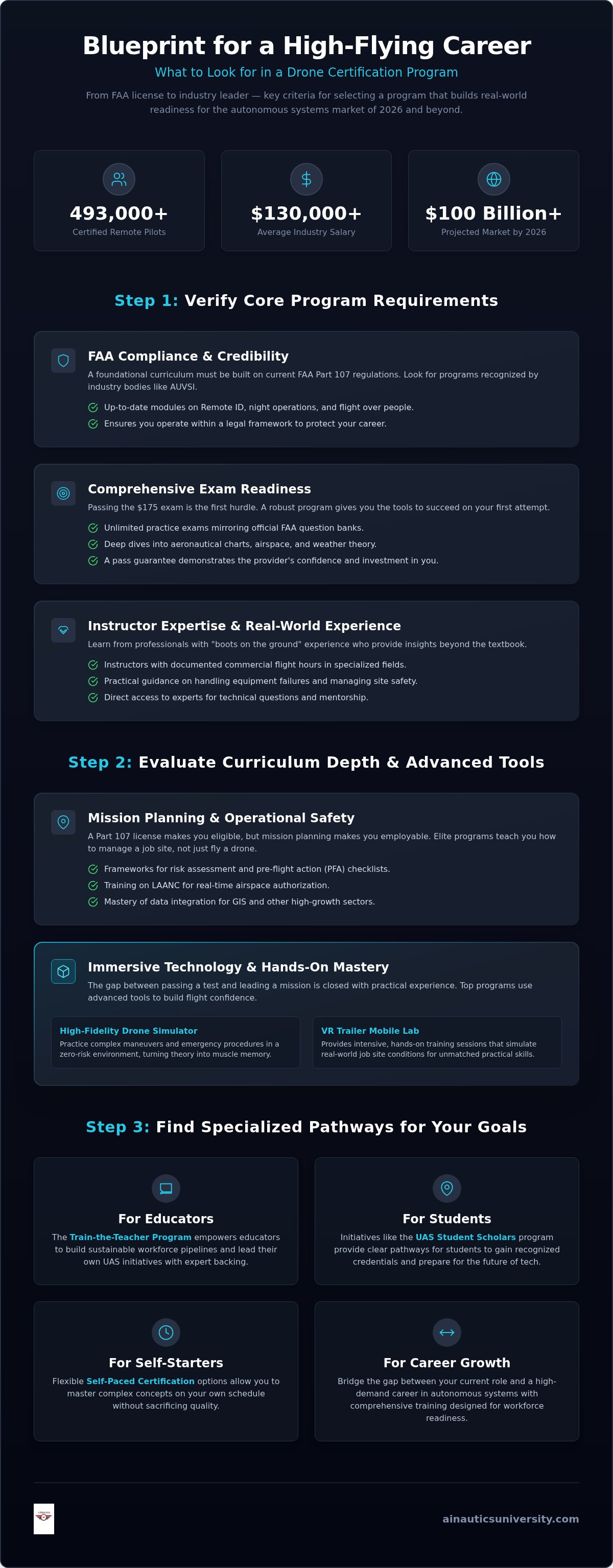
With more than 493,000 certified remote pilots in the sky as of 2026, simply holding an FAA license is no longer a competitive advantage. It's the bare minimum for a career where the average salary now exceeds $130,000. You likely feel the pressure to enter this $100 billion industry but fear wasting money on a surface-level course that leaves you clueless behind the controls. It's a common struggle to pass a $175 exam only to realize you lack the practical flight confidence to lead a mission. Knowing what to look for in a drone certification program is the difference between a simple permit and a high-growth career in autonomous systems.
This guide reveals the critical criteria for selecting a program that goes beyond test prep to build real-world readiness. We'll preview how immersive tools like our Drone Simulator and VR Trailer Mobile Lab turn theory into mastery. Whether you're interested in our comprehensive Part 107 Training, the Train-the-Teacher Program, or our Self-Paced Certification, you'll discover how to gain a recognized credential. From the UAS Student Scholars initiative to advanced mission planning, we'll show you how to prepare for the technological demands of the future with confidence and precision.
Key Takeaways
- Understand what to look for in a drone certification program to ensure it aligns with 2026 FAA Part 107 regulations and utilizes instructors with proven commercial experience.
- Move beyond simple test prep by prioritizing curricula that integrate mission planning, risk assessment, and immersive tools like our high-fidelity Drone Simulator.
- Discover how specialized pathways like the Train-the-Teacher Program and UAS Student Scholars empower educators and students to build sustainable workforce pipelines.
- Evaluate the benefits of different training formats, from flexible Self-Paced Certification to intensive hands-on sessions in our VR Trailer Mobile Lab.
- Learn how to identify programs that bridge the gap between earning a license and mastering data integration for high-growth sectors like GIS and autonomous systems.
Core Requirements: FAA Compliance and Program Credibility
The foundation of a successful career in autonomous systems starts with a curriculum that adheres strictly to the current FAA Part 107 regulations. As the global drone market scales toward a projected $100.74 billion by the end of 2026, regulatory knowledge remains your essential baseline. When evaluating what to look for in a drone certification program, verify that the provider includes the latest mandates on Remote ID, night operations, and flight over people. High-quality programs don't just teach you to fly; they ensure you operate within a legal framework that protects your professional reputation. Look for institutional credibility through memberships in organizations like AUVSI, which signals that the training meets rigorous industry standards.
FAA Part 107 Exam Readiness
Passing the aeronautical knowledge test requires more than memorizing facts. A robust program must offer unlimited practice exams that mirror the complexity and phrasing of actual FAA question banks. You need deep dives into aeronautical chart reading, airspace classifications, and complex weather theory modules to ensure mission safety. Our Part 107 Training and Self-Paced Certification options prioritize these technical areas so you can walk into the testing center with confidence. Many top-tier providers offer a pass guarantee. This commitment demonstrates the provider's confidence in their material and their investment in your success.
Instructor Expertise and Real-World Experience
Credibility is built on the documented flight hours of the people leading the course. Seek out instructors with "boots on the ground" commercial experience in specialized fields like infrastructure inspection, thermal mapping, or cinematography. They provide the practical insights that textbooks often miss, such as how to handle equipment failures or manage site safety in high-stress environments. For educational institutions, our Train-the-Teacher Program is a vital resource. It empowers educators to lead their own UAS Student Scholars initiatives with the backing of industry experts. This model ensures that students receive guidance from mentors who understand both the technology and the professional landscape. Prioritize programs that offer a direct line to these experts for technical questions, ensuring you have the support needed to master complex concepts.
Choosing a program that balances these core requirements prepares you for more than just a test. It sets the stage for long-term growth in a field where precision and compliance are the keys to leadership. By focusing on verified expertise and regulatory alignment, you'll gain the recognized credentials necessary for workforce readiness in 2026 and beyond.
Evaluating Curriculum Depth: Beyond Just Passing the Test
Many pilots view the Part 107 license as the final goal. In reality, it's just the beginning. When considering what to look for in a drone certification program, you must find a curriculum that bridges the gap between legal eligibility and professional mastery. While you must meet the official FAA requirements to fly commercially, those standards don't teach you how to manage a complex job site or process high-value data. A program that focuses only on the test leaves you unprepared for the nuances of 2026's autonomous systems market.
Mission Planning and Operational Safety
Professional training provides frameworks for risk assessment that go far beyond basic flight maneuvers. You need step-by-step guidance on using Low Altitude Authorization and Notification Capability (LAANC) to secure airspace access in real-time. A high-quality course will provide a drone compliance training checklist to ensure every flight meets federal and local safety standards. This includes often-overlooked details like wildlife assessments and environmental impact regulations. These are vital for large-scale infrastructure or agricultural projects where local ecosystems must be protected. You should also look for training that teaches you how to conduct a thorough Pre-Flight Action (PFA) to mitigate risks before the propellers even spin.
Workforce Readiness and Career Pathing
The industry is shifting from manual piloting to data analysis and mission supervision. Your chosen program should offer modules on how to integrate drone-captured data into Geographic Information Systems (GIS) and asset management software. Identifying what to look for in a drone certification program also means checking for industry-aligned data processing modules. This technical depth is what employers prioritize when hiring for the future of drone careers. Look for specialized tracks that focus on thermal imaging, 3D mapping, or vertical structure inspections. These skills allow you to command higher rates and secure long-term contracts. A curriculum that includes real-world case studies helps you understand how to deliver actionable insights to clients rather than just raw footage.
Our UAS Student Scholars program is designed to create this exact "Learn to Work" pipeline. We focus on mission-driven instruction that prepares students for actual client missions rather than just multiple-choice questions. If you want to move beyond the basics, exploring our Self-Paced Certification options can help you build a specialized portfolio that stands out to recruiters. By choosing a program with this level of curriculum depth, you ensure your education remains a valuable asset as the technology continues to evolve.
Advanced Training Tools: Simulators and Immersive Technology
Passive learning through video lectures often leaves a critical gap in a pilot's development. When you're researching what to look for in a drone certification program, look beyond the screen and evaluate the tools used to build actual muscle memory. High-fidelity technology allows you to crash a thousand times in a virtual environment so you don't crash once in the field. This risk-free skill building is essential for mastering the precision required in modern autonomous systems. Top-tier programs prioritize simulation as a core component of their workforce-readiness strategy.
The Role of Drone Simulators in Skill Mastery
A proprietary Drone Simulator is a cornerstone of professional training. It bridges the gap between theoretical rules and physical flight operations. By utilizing immersive drone training technology that mimics real-world physics, you can practice in high-stress scenarios without risking expensive hardware. Verify if the simulator includes mission-specific environments like cell tower inspections, vertical structure assessments, or emergency response zones. This level of specificity prepares you for specialized roles that demand more than just basic hovering. Mastery comes from repetition in complex environments where wind, obstacles, and equipment failures are part of the simulation.
Immersive Mobile Labs and Hands-on Experience
Immersive learning isn't limited to a desktop. Our VR Trailer Mobile Lab brings cutting-edge technology directly to school districts and community centers. This mobile approach allows for high-engagement learning that traditional classrooms simply can't match. It provides a localized hub for hands-on experience, making advanced UAS education accessible to a broader range of students. For educators looking to build a program quickly, we offer a 90-day program launch model. This allows schools to deploy a complete UAS ecosystem, integrating our Train-the-Teacher Program with these mobile labs. This rapid deployment ensures students in the UAS Student Scholars program get immediate access to industry-standard equipment and immersive scenarios.
Flexibility is also a key factor in modern education. Not every student can attend in-person sessions on a fixed schedule. Look for Self-Paced Certification options that integrate these advanced tools into a modular format. This allows you to achieve mastery at your own speed while still gaining the practical experience required by top employers. By prioritizing programs that invest in simulation and VR, you ensure your training is as forward-looking as the industry itself. These tools don't just help you pass the test; they build the professional confidence needed for a high-growth career.
Specialized Programs for Educators and Students
Most drone courses are designed for individual hobbyists, leaving school districts and educators to piece together their own curricula. This fragmented approach often fails to meet state educational standards or provide a sustainable workforce pipeline. Identifying what to look for in a drone certification program at the institutional level requires a focus on scalability and instructor support. You need a partner that understands the complexities of classroom management and STEM alignment. A truly effective program doesn't just provide a login; it provides a system for long-term success, a philosophy also embraced by the African Ancestral Traditional School in its structured digital approach to cultural heritage.
Train-the-Teacher and Classroom Integration
Empowering educators is the fastest way to scale technological literacy across a district. A robust Train-the-Teacher Program provides instructors with more than just a certificate. It offers a complete instructional ecosystem, including lesson plans, grading rubrics, and ongoing technical support. Educators should look for programs that offer professional development credits and regular curriculum updates to keep pace with drone technology education trends. This ensures that the training remains relevant as autonomous systems evolve. By training the trainers, schools can maintain internal expertise and reduce the recurring costs of outside consultants.
UAS Student Scholar Pathways
For students, a drone program shouldn't be just an elective. It should be a defined career pathway that starts in high school and leads directly to a professional Part 107 license. A high-quality program will offer a UAS scholarship for high school students to help bridge the financial gap for motivated learners. Our UAS Student Scholars program focuses on mission-driven instruction, teaching students to solve real-world problems using aerial data. This approach builds a professional portfolio that local industry partners value for internships and entry-level roles. It turns a classroom interest into a tangible workforce credential.
Integration with school standards is non-negotiable. Ensure the curriculum aligns with state Career and Technical Education (CTE) requirements and supports student organizations like SkillsUSA. When schools utilize our VR Trailer Mobile Lab and Drone Simulator, they provide students with hands-on experience that mirrors professional operations. This immersive setup allows for a 90-day program launch, giving districts a turnkey solution for workforce development. If you're ready to bring this technology to your school, explore our Train-the-Teacher Program to start building your district's future today.
Choosing the Right Program for Your Career Goals
Selecting a training provider is a strategic decision that shapes your professional trajectory for years. While many courses focus strictly on the two-hour FAA exam, true career readiness requires a broader perspective. This philosophy of deep specialization is visible in many tech-forward sectors where professionals explore Educational products and training systems to master the use of artificial intelligence in network marketing. Knowing what to look for in a drone certification program means evaluating how a provider supports your transition from a student to a mission commander. You need a partner that offers a clear pipeline from learning to working rather than a one-time test prep session. The best programs treat the Part 107 license as a starting line, not the finish line.
Self-Paced vs. Live Instruction
Your learning style and current schedule should dictate the format of your training. Our Self-Paced Certification options offer maximum flexibility for working professionals or students balancing a full course load. This modular approach allows you to master complex concepts like weather theory and airspace at your own speed. Conversely, live instruction provides the immediate feedback necessary for mastering difficult flight maneuvers. For those seeking an immersive experience, our VR Trailer Mobile Lab delivers high-intensity, hands-on training that builds confidence quickly. Determine whether you need the convenience of an online portal or the tactile engagement of a simulator-led classroom before committing your resources.
Long-term Support and Compliance Tracking
The drone industry moves fast. Your education shouldn't stop once you have your license. FAA regulations require pilots to complete free recurrent training every 24 months to maintain their remote pilot certificate. A high-quality program acts as a lifelong mentor, helping you manage these recurring requirements and stay current with Remote ID or BVLOS updates. When researching what to look for in a drone certification program, ask if the provider offers mission planning support or access to a professional network after graduation.
Programs like our UAS Student Scholars and Train-the-Teacher Program are built on the principle of program sustainment. We don't just help you pass; we provide the tools for long-term operational success. This includes access to our proprietary Drone Simulator for risk-free skill maintenance and guidance on data integration for commercial clients. Your goal is to secure a recognized credential that translates directly into workforce readiness. By choosing a partner invested in your long-term growth, you ensure a high return on investment for your career in autonomous systems.
Launch Your Future in Autonomous Systems
The drone industry is no longer just about flying; it's about managing complex data and executing high-stakes missions. Choosing the right training path ensures you don't just pass a test but actually master the skills required for a high-growth career. Understanding what to look for in a drone certification program is the first step toward becoming a leader in this $100 billion market. Prioritize programs that emphasize immersive learning, specialized career tracks, and long-term workforce readiness.
As a Service-Disabled Veteran-Owned Small Business, AINautics University provides a STEM-aligned curriculum designed for students, educators, and professionals. We bridge the gap between theory and flight with our proprietary Drone Simulator technology and mission-driven instruction. Whether you're starting a district-wide program or advancing your individual specialization, we're here to guide your journey. Explore AINautics University's Professional Training Programs today and take command of your professional future. Your career in the skies starts with the right foundation.
Frequently Asked Questions
What is the most important factor when choosing a drone certification program?
The most critical factor is finding a curriculum that bridges the gap between regulatory knowledge and practical flight skills. When deciding what to look for in a drone certification program, prioritize providers that offer mission-driven instruction and advanced tools like a Drone Simulator. This ensures you gain the hands-on proficiency required by employers rather than just a multiple-choice test certificate.
Does a drone certification program guarantee I will pass the Part 107 exam?
No program can legally guarantee an FAA result, but top-tier courses like our Part 107 Training offer a pass guarantee to demonstrate confidence in their curriculum. These programs provide unlimited practice exams that mirror the complexity of actual FAA question banks. Success depends on your engagement with the modules, but structured guidance significantly increases your chances of passing on the first attempt.
Are online drone certification programs as effective as in-person training?
Online programs are highly effective for mastering aeronautical theory and regulations at your own speed. Our Self-Paced Certification allows for this flexibility while still preparing you for the technical exam. However, in-person sessions using a VR Trailer Mobile Lab provide immediate, hands-on feedback that is difficult to replicate through a standard screen alone. Many students find a hybrid approach most beneficial.
How much should I expect to pay for a high-quality drone certification course in 2026?
While training costs vary based on depth and technology, you must factor in the mandatory $175 FAA knowledge test fee paid directly to the testing center. High-quality programs often include comprehensive study materials, simulator access, and long-term compliance support. Investing in a robust program provides a high return, especially since average drone pilot salaries in 2026 are reported as exceeding $130,000.
Can high school students enroll in a professional drone certification program?
Yes, high school students are eligible to earn their remote pilot certificate once they turn 16. Our UAS Student Scholars program is specifically designed to guide young learners through this process while offering a STEM-aligned curriculum. This pathway allows students to graduate high school with a professional credential, making them immediately competitive for internships and entry-level roles in the autonomous systems industry.
What is the difference between a Part 107 certificate and a drone training diploma?
The Part 107 certificate is the legal license issued by the FAA that allows you to operate a drone commercially. A drone training diploma or certificate from a provider like AINautics University proves you've completed specialized instruction beyond the legal minimum. This additional credential demonstrates your proficiency in mission planning, data analysis, and advanced flight operations to potential employers who require workforce readiness.
How long does it take to complete a comprehensive drone certification program?
Most students can master the aeronautical theory required for the exam within two to four weeks of dedicated study. For institutional users, we offer a 90-day program launch model that integrates the Train-the-Teacher Program and student pathways. The total timeline depends on whether you choose a Self-Paced Certification or an intensive, immersive course that includes hands-on simulator mastery and mission planning.
Do I need my own drone to start a certification program?
You don't need to own hardware to begin your journey into the UAS industry. High-quality programs utilize a proprietary Drone Simulator to build your flight skills in a risk-free virtual environment. This allows you to gain confidence and technical proficiency before investing in expensive equipment. Many professional pilots wait until they've identified their specific career track, such as mapping or inspection, before purchasing a drone.

Article by
AINautics University Team
The team behind AINautics University, dedicated to drone education and FAA Part 107 certification prep, VR flight simulation, and STEM training programs for students and educators.


