
With the commercial drone market growing by 18% as of August 2026, the traditional "no experience, no job" barrier has finally been dismantled. If you are searching for entry level drone pilot jobs, you don't need years of flight logs to prove your value to employers in logistics, energy, or e-commerce. You likely feel the weight of evolving FAA regulations, such as the new Part 108 rules for Beyond Visual Line of Sight operations, or the uncertainty of how to build a professional portfolio. It's a common challenge, but specialized mission mastery now outweighs raw flight hours.
This guide reveals exactly how to transition from a total beginner to a paid professional using a proven training-to-employment roadmap. You'll learn how to secure your Part 107 certification, identify which industries are actively hiring beginners, and gain mission-ready experience before your first interview. We will explore how tools like the AINautics Drone Simulator and the UAS Student Scholars program provide the technical edge needed to succeed. From mastering automated flight systems to understanding Remote ID compliance, you're about to gain the clarity required to launch your career as a UAS mission manager with confidence.
Key Takeaways
- Navigate the 2026 UAS landscape by understanding the industry shift toward automated mission management and new Part 108 regulations.
- Secure your FAA Part 107 certificate to qualify for entry level drone pilot jobs through specialized Self-Paced Certification programs.
- Pinpoint the specific industries, such as construction and real estate, that are currently hiring beginner pilots for high-value data collection.
- Build a professional flight portfolio that proves your technical skills by utilizing tools like the AINautics Drone Simulator to demonstrate mission readiness.
- Follow a proven "Learn, Train, Certify, Fly" roadmap to transition from a student to a certified professional ready for the modern workforce.
The Landscape of Entry-Level Drone Pilot Jobs in 2026
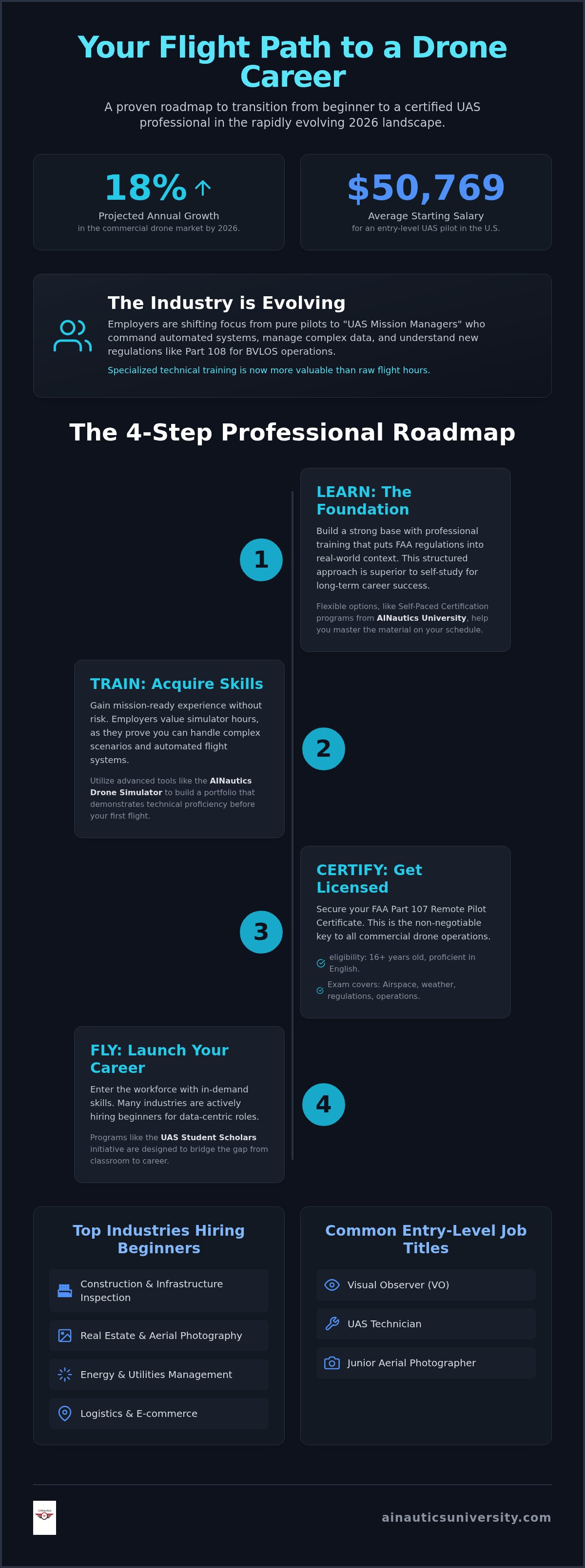
The definition of an entry-level role in the Unmanned Aircraft Systems (UAS) industry has fundamentally changed. In 2026, landing entry level drone pilot jobs no longer requires years of prior flight experience. Instead, employers seek "Mission Managers" who can operate automated systems and handle complex data. According to industry reports from August 2026, the demand for licensed commercial pilots has grown by 18% year-over-year. This surge is driven by a massive expansion in infrastructure inspections and public safety operations, especially following the FAA's finalization of Part 108 regulations.
The industry has shifted away from the "pilot-for-hire" model toward specialized data collection. Companies in logistics, energy, and e-commerce don't just want someone to fly; they need professionals who can manage photogrammetry software, LiDAR sensors, and thermal imaging tools. In this interconnected logistics environment, some pilots choose to diversify their commercial qualifications by visiting eastusatrucking.com for CDL training information. This evolution means that a beginner with the right technical training is often more valuable than a hobbyist with hundreds of manual flight hours. Programs like the UAS Student Scholars initiative are specifically designed to bridge this gap, preparing the next generation for immediate workforce entry.
Common Job Titles for New Pilots
Newcomers to the field often start in supporting roles that provide essential on-the-job training. The Visual Observer (VO) remains a critical first step, acting as the second set of eyes for Beyond Visual Line of Sight (BVLOS) missions. UAS Technicians focus on ground control station setup and hardware maintenance, ensuring fleet readiness. In the creative sector, Junior Aerial Photographers find consistent work in real estate and media, where they master the basics of aerial composition and digital asset management. These roles allow you to build a professional reputation while mastering the operational standards of a commercial crew.
Salary Expectations and Career Growth
Financial stability is a reality for new pilots entering the market today. As of August 2026, the average salary for an entry-level drone pilot in the United States is $50,769 per year, which translates to approximately $24.41 per hour. While this is a strong starting point, your earning potential increases significantly as you specialize. You can see how drone pilot career paths evolve by adding certifications in utility inspection or emergency response. Utilizing AINautics University’s Self-Paced Certification options allows you to gain these specialized skills while working. By focusing on niche applications early, you can quickly move from general operations to high-paying, specialized mission management roles.
Step 1: Mastering Drone Training Without Experience
To secure your place in the competitive market for entry level drone pilot jobs, you must first clear the regulatory hurdle of the FAA Part 107 exam. While some attempt self-study, professional Part 107 drone training is superior because it provides operational context that a textbook cannot. It transforms abstract regulations into safety standards that employers trust. For those managing a career transition, AINautics University offers Self-Paced Certification options that fit into a busy schedule without sacrificing the depth of instruction required to pass on your first attempt.
Acquiring Your FAA Remote Pilot Certificate
The FAA requires all commercial operators to hold a Remote Pilot Certificate for drones weighing less than 55 pounds. To be eligible, you must be at least 16 years old, be able to read and write English, and be in a physical and mental condition to safely fly. The exam itself costs $175 as of June 2026 and covers several critical areas:
- Airspace classifications and operating requirements.
- Aviation weather sources and its effects on performance.
- Emergency procedures and radio communication protocols.
- Maintenance and pre-flight inspection standards.
Registration is handled through an FAA-approved Knowledge Testing Center. Mastering these topics ensures you aren't just a pilot, but a legal and safe contributor to a professional flight crew. This certification is the non-negotiable foundation for your career.
Simulated Flight: The Secret to Rapid Skill Acquisition
In 2026, employers value simulator hours as much as real-world flight time. They recognize that simulation allows for the repetition of high-risk scenarios without the danger of equipment loss or liability. The AINautics Drone Simulator provides a hyper-realistic environment to build muscle memory. This allows you to practice complex maneuvers, such as flying near critical infrastructure or in adverse weather, long before you step onto a job site.
The VR Trailer Mobile Lab takes this a step further by placing you in a 360-degree digital workspace. Here, you can experience the pressure of mission management while receiving real-time feedback from instructors. This controlled environment is where hobbyists become professionals, gaining the "sticks-in-hand" confidence required for entry level drone pilot jobs. By the time you reach your first interview, you'll have a documented history of successful simulated missions to show potential employers.
Top Industries Hiring Beginner Drone Pilots Today
Identifying where your skills are most needed is the next step after securing your certification. In 2026, entry level drone pilot jobs span across sectors that prioritize high-precision data over simple aerial photography. While many candidates look toward logistics or e-commerce, the most immediate opportunities often exist in industries undergoing rapid digital transformation. These sectors value your Part 107 certification and your ability to follow strict mission protocols. AINautics University prepares you for these specific environments by integrating workforce-ready standards into every lesson.
Real Estate and Media Opportunities
Infrastructure and Utility Inspections
Infrastructure is a high-growth vertical for those seeking stable entry level drone pilot jobs. Utility companies and telecommunications firms use drones to inspect vertical structures and cell towers, significantly reducing the risk to human climbers. A major competitive advantage in this field is an understanding of wildlife-aware procedures. Compliance with the Migratory Bird Treaty Act is often a requirement for these missions to ensure nesting sites are not disturbed. Additionally, large-scale solar farms hire entry-level pilots to conduct thermal monitoring, identifying defective panels across hundreds of acres. This role requires the methodical flight patterns and attention to detail emphasized in our Part 107 Training.
Other industries are also opening doors for beginners. In construction and aggregates, drones are used daily for progress monitoring and calculating the volume of material stockpiles. Insurance companies rely on new pilots for roof inspections and catastrophe response, where speed and accuracy are paramount. Agriculture has also evolved, with beginners performing crop scouting and basic multispectral imaging to help farmers optimize yields. Each of these paths offers a clear trajectory toward specialization, proving that a career in UAS is about much more than just flying, it is about delivering actionable intelligence.
Step 2: Building Your Professional Flight Portfolio
Proving your value for entry level drone pilot jobs requires more than a certificate. You need a portfolio that speaks the language of safety and technical precision. Modern employers look for a digital flight log that documents your currency and adherence to strict pre-flight checklists. This isn't just about recording hours. It's about proving you can manage a mission from start to finish without incident. By documenting your risk assessments and mission planning files, you show that you prioritize operational integrity over simple aerial photography.
Your "Showreel" should demonstrate versatility across multiple environments. Include footage from diverse settings like open agricultural fields, industrial sites, and complex urban areas. If you haven't flown a commercial mission yet, use documented flights from the AINautics Drone Simulator to show your control in high-stakes scenarios. This level of transparency builds trust with hiring managers who need to know you can handle expensive hardware in real-world conditions. Networking through professional organizations like AUVSI can also help you find unlisted roles where these documented skills are in high demand.
What to Include in Your Pilot Resume
Highlight your Part 107 certification at the very top of your resume. If you've earned specialized UAS Student Scholar credentials, list them to prove you have a background in advanced mission management. Be specific about the hardware and software you've mastered. Mention your proficiency with platforms like DJI and Autel, along with data processing tools such as Pix4D. Don't neglect soft skills. Clear client communication and a deep understanding of airspace compliance are often the deciding factors for recruiters hiring for entry level drone pilot jobs.
The Power of Hands-on UAS Training
Theoretical knowledge provides the foundation, but attending an in-person UAS industry training event provides a significant credibility boost. These immersive events offer mission-driven experience where you can practice real-world scenarios, such as emergency battery swaps or signal interference recovery, under expert guidance. A documented "clean paper trail" of these training missions and safety logs significantly lowers the perceived risk for insurers when you apply for your first commercial liability policy. This proactive approach to safety makes you a much more attractive candidate for any flight crew.
Building a reputation in this industry takes time, but starting with the right tools accelerates the process. You can begin developing your professional flight portfolio today by enrolling in the workforce-ready certification programs at AINautics University.
How AINautics University Accelerates Your Career Path
The journey from a curious hobbyist to a professional mission manager requires a structured approach. AINautics University provides this through a comprehensive "Learn, Train, Certify, Fly, Work" ecosystem. This pipeline ensures you don't just pass a test; you emerge with the technical mastery required for entry level drone pilot jobs in 2026. Beyond the classroom, we connect our graduates to the iFlyDrone marketplace. This platform serves as a bridge to nationwide opportunities, allowing you to showcase your certified skills to employers who need verified UAS expertise immediately.
Our commitment to workforce development extends to every stage of the professional journey. The UAS Student Scholars program is a cornerstone of this mission, specifically designed to prepare high school students for immediate employment upon graduation. For those who have already mastered the skies, the Train-the-Teacher Program offers a path to transition from a pilot to an educator. This helps scale the industry by empowering the next generation of instructors to lead classrooms with authority and practical insight.
Specialized Training for High-Demand Sectors
Basic flight skills are no longer enough to stay competitive. To truly excel, you must look toward specialized data collection methods like thermal imaging and LiDAR. AINautics provides the advanced training necessary to handle these sophisticated sensors, which are essential in utility and infrastructure sectors. Aligning your skill set with these future of drone careers trends ensures long-term job security and higher earning potential. If you prefer the path of entrepreneurship, our 90-day program launch framework provides a benchmark for career speed, giving you the tools to start your own drone service business with a professional foundation from day one.
Your Next Steps Toward Certification
The path to the cockpit is now more accessible than ever. You can start today by signing up for the AINautics Self-Paced Certification dashboard. This platform allows you to master the complexities of FAA regulations and mission planning at your own speed, fitting your education around your existing commitments. To gain the physical confidence needed for commercial operations, you can schedule a session in our VR Trailer Mobile Lab. This immersive environment provides the high-stakes practice required to handle real-world challenges safely.
The UAS industry is moving fast, and the demand for skilled mission managers is only increasing. Don't wait for the market to pass you by. Join the next generation of autonomous systems professionals today and secure your future in the skies.
Launch Your Career in the Evolving UAS Industry
The transition from a student to a professional mission manager is no longer a matter of chance. Success in 2026 depends on your ability to combine FAA Part 107 compliance with specialized technical skills like LiDAR and thermal data processing. By building a professional portfolio that emphasizes risk assessment and operational safety, you position yourself at the top of the list for entry level drone pilot jobs. The industry has shifted toward data-centric roles, and those who master automated systems early will lead the modern workforce.
AINautics University is here to guide you through every step of this journey. As a Service-Disabled Veteran-Owned Small Business, we provide a STEM-aligned curriculum that transforms beginners into mission-ready experts. Our graduates gain exclusive access to a nationwide pilot marketplace, ensuring your new skills find immediate application in the field. Don't wait for the future of flight to arrive; build it yourself.
Start your professional drone career with AINautics University today and take command of your professional destiny in the skies.
Frequently Asked Questions
Can I get a drone job without a Part 107 license?
No, you cannot legally perform commercial work in the United States without an FAA Part 107 license. Any flight conducted for business purposes, even if you aren't charging a direct fee, requires this certification. Our Part 107 Training and Self-Paced Certification options are designed to help you master the regulations quickly. Attempting to work without a license risks heavy FAA fines and makes it impossible to secure professional liability insurance for your missions.
What is the best drone for a beginner to start a business?
The best drone for a beginner depends on your target industry, but the DJI Air 3 or Mavic 3 Pro are excellent starting points for media and real estate. These platforms offer high-resolution sensors and reliable flight stabilization. If you're looking at utility inspections, a platform with thermal capabilities is preferred. Focus on hardware that supports the data processing software you learned during your training, ensuring you can deliver professional-grade results to your first clients.
How many flight hours do I need for an entry-level drone job?
Most employers look for at least 10 to 20 documented flight hours for entry level drone pilot jobs, though mission-specific experience is often more important. You can supplement your real-world logs with time spent on the AINautics Drone Simulator. Documented simulation hours prove you've practiced emergency procedures and complex maneuvers. This combination of "sticks-in-hand" time and simulated mission management shows hiring managers that you're prepared for the technical demands of the role.
Are there drone pilot jobs that don't require traveling?
Yes, many drone pilot roles are based locally and don't require extensive travel. Residential real estate, local construction progress monitoring, and municipal roof inspections allow you to work within your own community. Additionally, as the industry moves toward automated systems, some "UAS Mission Manager" roles involve remote data processing and flight monitoring from a central office. These positions focus on analyzing the 3D models or thermal maps captured by field teams.
What industries pay the most for entry-level UAS pilots?
Utility inspections, energy, and logistics currently offer the highest compensation for entry level drone pilot jobs. As of August 2026, the average starting salary is $50,769 per year. Pilots who specialize in high-value data collection, such as LiDAR or multispectral imaging, often command higher rates. Using our 90-day program launch framework can help you quickly gain the specialized credentials needed to enter these lucrative sectors and increase your initial earning potential.
Is the drone pilot market oversaturated in 2026?
The market is not oversaturated, but it is becoming more specialized. While there are many hobbyists, there is a significant shortage of certified pilots who can manage complex missions. With a year-over-year growth rate of 18%, industries like e-commerce and public safety are struggling to find qualified talent. Completing a professional curriculum like the UAS Student Scholars program ensures you have the technical edge to stand out in this expanding field.
Do I need my own drone to get hired as a pilot?
You don't always need to own a drone to get hired. Many large firms in construction, insurance, and energy provide the necessary hardware, sensors, and insurance for their flight crews. However, owning a basic "prosumer" drone is helpful for maintaining your flight currency and building a portfolio. If you don't have equipment yet, practicing in the VR Trailer Mobile Lab is a cost-effective way to refine your skills without a large upfront investment.
How do I find drone internships or apprenticeships?
Finding internships or apprenticeships involves networking within professional organizations like AUVSI and utilizing specialized educational pipelines. Programs like UAS Student Scholars are specifically built to connect learners with industry partners for hands-on experience. You should also check local government agencies and utility companies, as they often have trainee programs for Part 107 certified pilots. These opportunities provide the "mission-driven" experience that traditional job boards often lack for beginners.

Article by
AINautics University Team
The team behind AINautics University, dedicated to drone education and FAA Part 107 certification prep, VR flight simulation, and STEM training programs for students and educators.


