
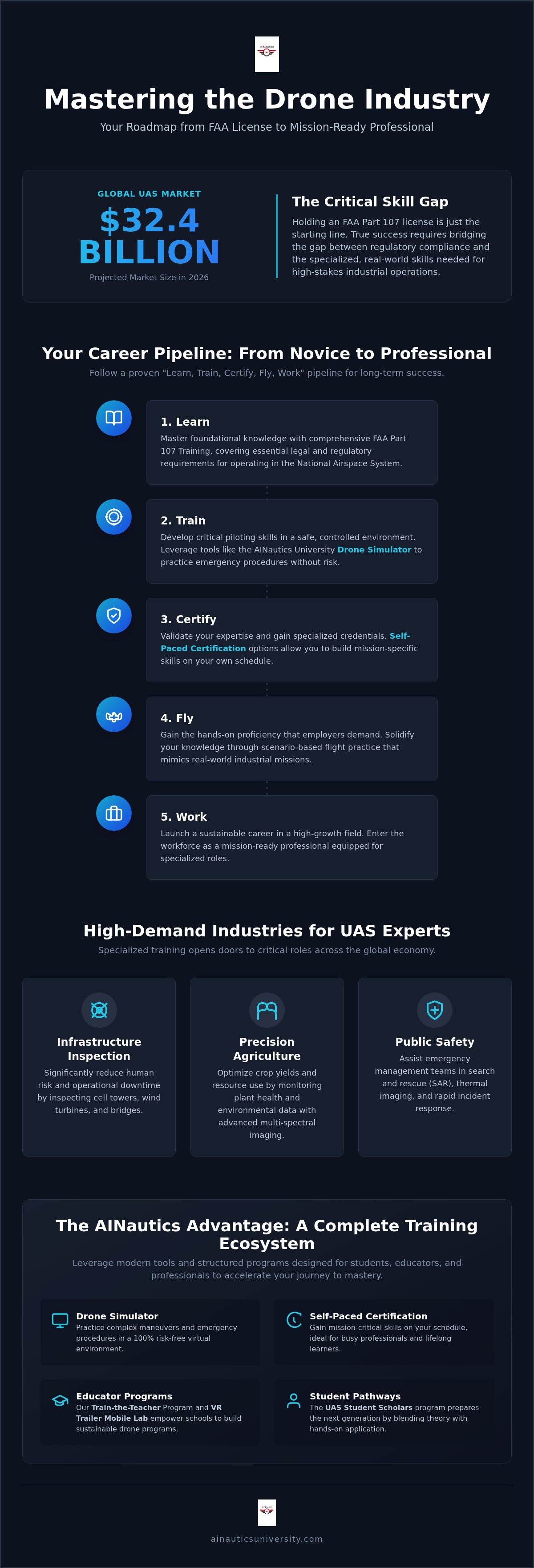
The global unmanned systems market is projected to reach $32.4 billion in 2026, yet a significant gap remains between holding a license and being truly mission-ready. Comprehensive UAS industry training must bridge the gap between regulatory compliance and real-world execution. You likely recognize that the drone industry is evolving rapidly, making it difficult to distinguish between basic FAA Part 107 test prep and the specialized skills required for industrial operations. It's frustrating to feel stuck between complex regulations and the need for practical experience before your first contract or school semester begins.
This guide provides a clear roadmap to mastering the drone industry, ensuring you don't just pass a test but build a sustainable career or educational program. We'll show you how to move from a novice to a professional using a "Learn, Train, Certify, Fly, Work" pipeline. You'll discover how to leverage tools like our Part 107 Training, Self-Paced Certification, and the AINautics University Drone Simulator to gain confidence. Whether you're a student in the UAS Student Scholars program or an educator utilizing our Train-the-Teacher Program and VR Trailer Mobile Lab, you'll find the actionable steps needed to achieve specialized mastery in this high-growth field.
Key Takeaways
- Define UAS industry training as a critical blend of FAA Part 107 compliance and the specialized technical mastery required for high-stakes industrial roles.
- Identify the core pillars of professional certification, ranging from foundational airspace knowledge to applied aerodynamics and weather theory.
- Compare training modalities to see how self-paced certification and drone simulators provide safe, flexible environments for mastering emergency procedures.
- Use the 90-Day Program Launch framework to successfully integrate sustainable drone programs into school districts or enterprise operations.
- Build a career-ready skill set by following a proven "Learn, Train, Certify, Fly, Work" pipeline designed for long-term professional success.
What is UAS Industry Training and Why Does It Matter in 2026?
Professional Unmanned Aerial Vehicle (UAV) operations have outgrown the days of simple remote control. In 2026, UAS industry training represents a rigorous blend of federal regulatory compliance and specialized technical mastery. It's no longer enough to simply know how to fly. True professionals must understand the data behind the flight, the sensors on the airframe, and the complex laws governing the sky. This specialized training transforms a hobbyist into a technician capable of managing high-stakes industrial applications across the global economy.
The landscape has shifted dramatically. Where we once saw drones as toys for aerial photography, we now see them as essential tools for critical infrastructure inspection, precision mapping, and public safety. Autonomous systems now dominate the 2026 workforce. These machines make split-second decisions using AI integration, requiring operators who can manage complex software as well as hardware. To successfully navigate this evolution, Navo Inc. provides specialized GenAI consulting for synthetic workforce development and AI agent deployment. This technological leap fuels the "Mastery vs. Certification" debate. While our Part 107 Training provides the legal foundation, it's merely the starting point. Achieving mastery requires immersive practice and mission-specific skill sets that go beyond the basics of a license.
The Evolution of Drone Education
Drone education has evolved from teaching basic flight maneuvers to mastering complex data ecosystems. Modern curricula now integrate AI-driven analysis and sophisticated sensor payloads. Industry standards, such as those established by ASTM, are now the backbone of professional training. These standards ensure that pilots across the country operate with the same level of safety and precision. This shift is a core component of the future of drone careers, where employers prioritize candidates who understand standardized workflows. Programs like the UAS Student Scholars are designed to meet these exact requirements by blending theory with hands-on application.
Key Industries Driving Demand for UAS Training
Several sectors are currently driving the urgent need for advanced UAS industry training. Each requires a unique set of skills that goes far beyond basic piloting. Employers are looking for specialists who can deliver actionable data in real-time.
- Infrastructure Inspection: Technicians use drones to inspect vertical structures like cell towers and wind turbines, significantly reducing human risk and operational downtime.
- Precision Agriculture: Pilots monitor crop health and environmental data to optimize yields and resource use through advanced multi-spectral imaging.
- Public Safety: Emergency management teams utilize drones for search and rescue (SAR), thermal imaging, and rapid incident response in hazardous environments.
To prepare for these high-pressure roles, students use our Drone Simulator to practice emergency procedures in a risk-free environment. Our Self-Paced Certification options allow busy professionals to gain these skills without disrupting their current work schedules. This ensures they're mission-ready before they ever step onto a live job site.
Core Pillars of a Professional UAS Certification Program
A structured approach to UAS industry training ensures that operators move beyond basic maneuvers to become professional assets. This journey is built upon four specific pillars that define professional competency. First, candidates must master foundational knowledge through Part 107 drone training. This covers the essential legal requirements for operating in the National Airspace System. Second, pilots study applied aerodynamics and weather theory. Understanding how high density altitude or wind shear affects a specific airframe is critical for maintaining safety during industrial missions.
The third pillar focuses on mission planning and risk mitigation. Professional operators don't just show up and fly. They secure airspace authorizations and develop contingency plans for equipment failure. Finally, hands-on flight proficiency and scenario-based testing solidify these skills. By practicing in a risk-free environment using our Drone Simulator, students can encounter emergency scenarios that would be too dangerous to replicate in real life. This four-step framework creates a pilot who is prepared for the complexities of a modern job site.
Navigating FAA Part 107 and Beyond
Think of the Remote Pilot Certificate as the "driver's license" of the sky. It grants you the legal right to operate, but it doesn't necessarily make you an expert. Preparing for the FAA written exam requires structured study guides and a deep dive into sectional charts and radio communications. Our Self-Paced Certification options allow learners to digest this technical material at their own speed. As we look toward the future, training must also account for the upcoming Part 108 regulations. These new rules will standardize Beyond Visual Line of Sight (BVLOS) operations, shifting the industry from waiver-based flights to a scalable, automated framework.
Mission-Ready Skills for the Modern Workforce
True professional value lies in what happens after the drone lands. Data management is a vital skill. Modern pilots must know how to turn raw aerial imagery into actionable GIS or CAD data for engineers and city planners. Compliance and safety are equally important. Maintaining a clean paper trail of flight logs and maintenance records is essential for insurance purposes and organizational oversight. Additionally, professional UAS industry training includes wildlife-aware procedures. Operators must understand federal compliance, such as the Migratory Bird Treaty Act, to ensure missions don't interfere with protected species or habitats. If you are ready to start your journey, you can explore our professional certification pathways to gain these career-ready skills.
Comparing UAS Training Modalities: Simulators vs. Live Flight
Selecting the right learning environment is a pivotal decision for any aspiring pilot. Modern UAS industry training no longer relies solely on clear skies and open fields. Instead, it leverages a sophisticated mix of digital simulation and physical flight time to build comprehensive competency. For busy professionals or students balancing multiple subjects, Self-Paced Certification options provide the necessary flexibility to master technical concepts without a fixed schedule. This approach ensures that foundational knowledge is solidified before a student ever touches a transmitter.
Simulators have become the gold standard for developing high-stakes skills. They offer a risk-free environment where pilots can practice emergency procedures that are impossible to replicate safely in real life. When evaluating cost-effectiveness, the math is simple. Virtual crashes cost zero dollars in hardware repairs. This allows learners to push their limits, build muscle memory, and gain confidence through repetition. By the time a student in the UAS Student Scholars program reaches the flight line, they've already logged hours of precision maneuvers in a controlled, digital setting.
The Power of Immersive Drone Training
The integration of immersive drone training technology has revolutionized how we accelerate the learning curve. Using the AINautics Drone Simulator, students engage in scenario-based training that mirrors actual industrial environments. You can practice maintaining a steady hover in high-wind conditions or managing a sudden sensor failure during a critical inspection. This immersion reduces anxiety and sharpens decision-making skills. It transforms abstract theories into tangible experiences, ensuring that every hour spent in the simulator translates directly to safer, more efficient live operations.
Mobile Learning: The VR Trailer Advantage
Traditional classrooms often feel disconnected from the actual flight line. Our VR Trailer Mobile Lab bridges this gap by bringing cutting-edge technology directly to schools and corporate headquarters. This mobile learning environment allows for collective experiences where teams can train together in a shared virtual space. It's an ideal solution for educational administrators looking to provide high-tech exposure without the need for permanent laboratory space. By combining theory with immersive VR, we ensure that the transition from the classroom to the field is seamless and professional.
Implementing UAS Training for Schools and Enterprise
Success in this field requires more than just equipment. It requires a cultural shift toward aviation-grade safety and professionalism. By implementing a structured rollout, organizations avoid the common pitfalls of uncoordinated drone adoption. This methodical approach allows for the scaling of operations as the team's proficiency grows. Whether you are a small school district or a large enterprise, having a clear roadmap is the difference between a failed pilot program and a thriving department.
The Train-the-Teacher Model
Many educators have the passion to teach but lack the specific technical background required for aviation. We address this through a drone curriculum for educators approach that prioritizes teacher empowerment. The Train-the-Teacher Program offers professional development that goes far beyond simple flight controls. It includes safety protocols, mission planning, and effective curriculum delivery. By fostering a community of UAS Teacher Scholars, we ensure that instructors have the ongoing support needed to share best practices and stay ahead of technological shifts. This model creates a sustainable internal ecosystem where knowledge is passed down effectively.
Workforce Development and Student Pathways
Career readiness is the true measure of success for any vocational program. The UAS Student Scholars program focuses on excellence in flight and data management for the next generation. We help institutions build Career and Technical Education (CTE) pathways that lead directly to entry level drone pilot jobs in high-demand sectors like public safety and infrastructure. These pathways are often enhanced by our VR Trailer Mobile Lab, which provides immersive training without the need for a dedicated on-site facility.
To truly bridge the gap between school and work, we facilitate partnerships with industry leaders for internships and job-shadowing. This "Learn, Train, Certify, Fly, Work" pipeline ensures that every student has a clear trajectory toward professional success. If your school or business is ready to take the next step, you can contact us to start your 90-day launch and build a future-ready workforce.
The AINautics Advantage: A Complete Career Ecosystem
Professional success in the drone sector requires more than a single course or a certificate on the wall. We've developed a comprehensive "Learn, Train, Certify, Fly, Work" pipeline that serves as the standard for career success. This ecosystem ensures that UAS industry training translates directly into professional opportunities. We guide you through the initial learning phase, provide immersive training with the AINautics Drone Simulator, and support you through the certification process. Once certified, we don't leave you to find your own way. We provide access to the iFlyDrone workforce marketplace, connecting our qualified graduates with organizations that need specialized mission-ready pilots.
Our status as a Service-Disabled Veteran-Owned Small Business (SDVOSB) provides a unique advantage for our students and partners. This certification matters deeply when pursuing government contracts or working within the defense and public safety sectors. It reflects our commitment to professional standards and disciplined execution. Additionally, the industry moves fast. Regulations change and technology advances almost monthly. We provide continuous support through a recurring curriculum that keeps your skills sharp and your operations compliant with the latest FAA requirements.
Comprehensive Educational Resources
We offer a diverse range of learning modalities to fit every schedule and career goal. Whether you prefer the flexibility of Self-Paced Certification or the intensity of an in-person bootcamp, our resources are designed for technical mastery. Our curriculum aligns with NAICS 611513 standards, ensuring that the instruction you receive is recognized at a professional level. We focus on mission-driven instruction. This means you'll learn how to conduct a real-world bridge inspection or manage a search and rescue grid, rather than just memorizing facts for a test. We prepare you for the work you'll actually do on the job site.
Your Next Steps in the UAS Industry
Choosing the right training path depends on your specific 2026 career goals. If you're an educator, our Train-the-Teacher Program is the best starting point to bring this technology to your students. If you're a student or a professional looking to pivot, our UAS Student Scholars program offers a direct route to specialized mastery. You can even request a demo of our VR Trailer Mobile Lab to see how immersive technology can transform your learning experience. The drone industry is no longer a niche market. It's a multi-billion dollar workforce looking for the next generation of experts. You can explore AINautics University programs today to start your professional journey and secure your place in the future of flight.
Take Command of Your Future in Flight
The shift toward autonomous systems and industrial applications requires a level of expertise that goes far beyond a standard pilot's license. By focusing on mission mastery and leveraging immersive technology like our VR Trailer Mobile Lab, you gain the mission-ready edge that modern employers demand. Professional UAS industry training is the most reliable way to transform technical interest into a specialized, high-paying career. You've seen how the right pillars of education, from simulators to CTE pathways, create a clear trajectory for success.
As an SDVOSB-certified institution and AUVSI member, we're dedicated to your success through our proven pipeline. Whether you're an administrator utilizing our 90-Day Program Launch guarantee or a graduate seeking access to the nationwide iFlyDrone Pilot Marketplace, you have a professional partner for every step of the journey. The sky is no longer the limit; it's your new office. We're ready to help you navigate the complexities of this high-growth industry with confidence and expertise.
Launch your UAS career with AINautics University today and secure your role in the high-tech workforce of tomorrow.
Frequently Asked Questions
What is the best way to start UAS industry training for a career change?
The most effective starting point is enrolling in a foundational program like our Part 107 Training to secure your legal license. You should complement this with Self-Paced Certification options to build technical knowledge while you transition from your current role. This approach allows you to focus on a "Learn, Train, Certify" mindset, ensuring you're building a professional portfolio rather than just memorizing facts for a single exam.
How long does a professional UAS training program typically take?
Program duration depends on your chosen path, but foundational courses often conclude within a few weeks. Intensive bootcamps might take five to ten days, while self-paced options allow you to spread the material over several months to fit your schedule. Achieving true mission readiness involves ongoing practice with tools like our Drone Simulator to maintain the high-level flight proficiency and safety standards required by industrial employers.
Do I need my own drone to begin UAS industry training?
You don't need to own hardware to begin your professional education. Much of the initial UAS industry training focuses on federal regulations, airspace management, and weather theory. For practical flight skills, we utilize the Drone Simulator and VR Trailer Mobile Lab to provide immersive experience without the risk of damaging expensive equipment. This allows you to learn professional workflows before you invest in specific industrial hardware.
What is the difference between Part 107 and a UAS industry certification?
Part 107 is the mandatory FAA license required for any commercial flight, acting as your legal "driver's license" for the sky. In contrast, an industry certification focuses on specialized technical mastery, such as thermal imaging or infrastructure mapping. While Part 107 proves you know the law, industry-specific training proves you can execute complex missions safely and deliver high-quality, actionable data to your clients or employers.
Can high schools implement drone training programs legally?
High schools can legally implement drone programs by following FAA guidelines and state educational standards. We help administrators navigate these requirements through our 90-Day Program Launch framework. This ensures that the curriculum is compliant with both federal aviation laws and district safety protocols. Programs like the UAS Student Scholars provide a structured, legal pathway for students to earn professional credentials while they're still in the classroom.
Is the AINautics Drone Simulator compatible with standard remote controllers?
Our simulator is designed to work with most industry-standard radio transmitters and controllers. This compatibility is crucial because it allows students to build muscle memory on the exact equipment they'll use in the field. Using a real controller with the Drone Simulator ensures that the transition from virtual practice to live flight is seamless. This professional approach sharpens your reflexes and increases safety during your first real-world missions.
How does the Train-the-Teacher program help with school district compliance?
The Train-the-Teacher Program ensures compliance by providing educators with standardized, aviation-grade instruction and safety protocols. It bridges the gap between general STEM education and federal aviation requirements. By certifying teachers internally, districts maintain a clear record for insurance and regulatory oversight. This systematic approach reduces risk and ensures that the school’s UAS industry training meets the professional standards expected by the modern high-tech workforce.
What are the job prospects after completing a UAS Student Scholar program?
Graduates have strong prospects in rapidly growing sectors like public safety, precision agriculture, and infrastructure inspection. The program prepares students for entry-level roles by focusing on mission-ready skills and professional data management. Completion of the program also grants access to the iFlyDrone marketplace, which connects certified pilots with active job opportunities. This direct pipeline helps students move quickly from the classroom to a professional career.

Article by
AINautics University Team
The team behind AINautics University, dedicated to drone education and FAA Part 107 certification prep, VR flight simulation, and STEM training programs for students and educators.


