
What if the most valuable skill you could acquire this year didn't require a four-year degree but could place you at the center of a $116 billion industry? With the global commercial drone market projected to reach record heights by the end of 2026, the opportunity for new pilots is massive. We understand that starting drone training for beginners often feels like navigating a maze of confusing FAA regulations and technical jargon. It's completely normal to feel overwhelmed by the Remote ID mandate or the fear of crashing expensive equipment during your very first flight.
You need a clear, actionable roadmap that leads to a real career. This guide provides exactly that, offering a comprehensive path from your first takeoff to becoming a certified UAS professional. You'll discover how to gain flight confidence using our Drone Simulator and prepare for the FAA knowledge test through our Self-Paced Certification options. We'll break down the essential steps to master the 2026 landscape, ensuring you have the specialized knowledge and regulatory clarity needed to excel in the modern workforce.
Key Takeaways
- Transition from a casual hobbyist to a workforce-ready professional by prioritizing drone training for beginners that emphasizes safety and regulatory mastery.
- Master the four core flight controls-pitch, roll, yaw, and throttle-while establishing a rigorous pre-flight checklist routine to prevent equipment damage.
- Identify the most efficient path to your Remote Pilot Certificate by comparing classroom learning with flexible Self-Paced Certification options.
- Build your flight confidence and muscle memory in a risk-free environment using advanced tools like the Drone Simulator and the VR Trailer Mobile Lab.
- Develop a professional mission portfolio to specialize in high-growth industries like infrastructure inspection, public safety, or STEM education.
Understanding the 2026 Drone Landscape: Where to Begin?
Drone training for beginners is often misunderstood as simply learning how to move joysticks. In reality, it's the structured acquisition of precision flight skills paired with a deep understanding of federal regulations. By 2026, the industry has shifted significantly. We've moved past the era where learning as you go is an acceptable approach. Today, workforce-ready training is outpacing hobbyist learning because organizations require pilots who can manage complex missions while following strict safety protocols. Mastering this landscape requires more than a manual; it requires a professional roadmap.
Choosing your path early is vital. Are you a recreational flyer or a commercial UAS operator? Starting with a professional mindset doesn't just make you a better pilot. It saves you from costly legal errors and equipment damage. Whether you're a student looking at future careers or an educator guiding the next generation, understanding this landscape is your first step toward mastery. A professional approach ensures you're prepared for the technical demands of the modern airspace.
The Difference Between TRUST and Part 107
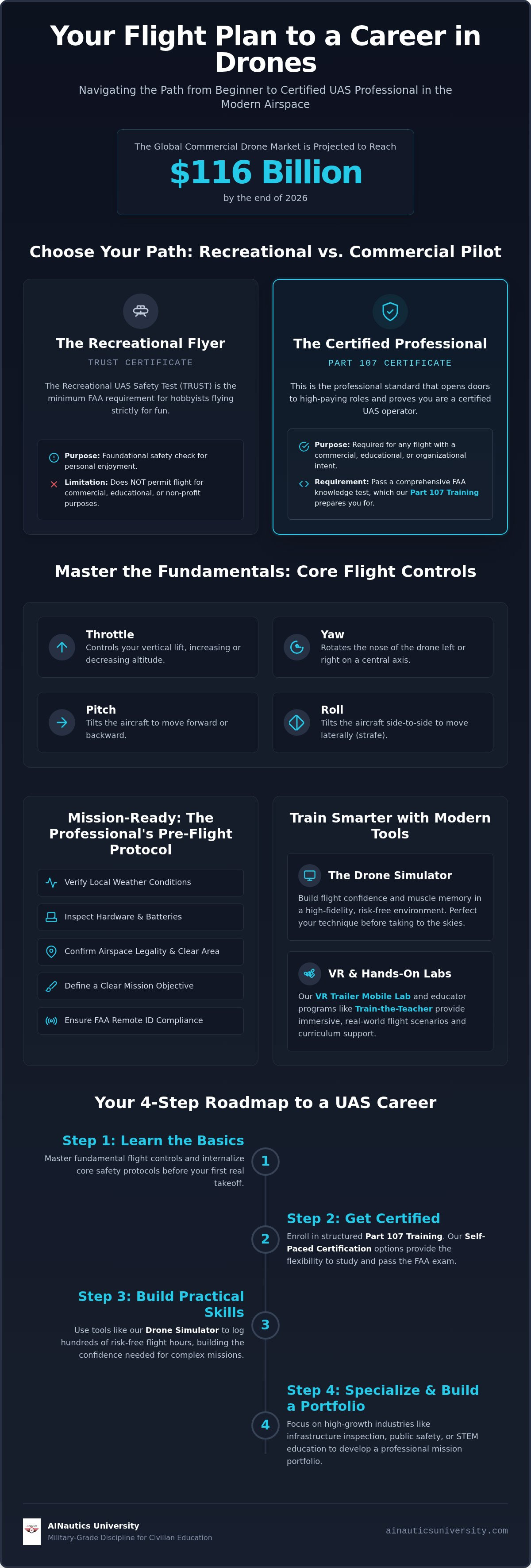
The FAA divides drone operations into two main categories. The Recreational UAS Safety Test (TRUST) is the minimum requirement for hobbyists. It's a foundational safety check for those flying strictly for fun. However, if you plan to use a drone for any commercial purpose, educational work, or even to help a non-profit, you must earn an FAA Part 107 Remote Pilot Certificate. Beginners should aim for Part 107 drone training early in their journey. This certification is the professional standard that opens doors to high-paying roles in infrastructure, agriculture, and public safety. It's the credential that proves you're a professional rather than a casual user.
Why Professional Training Matters in 2026
Professional training is about more than just a certificate; it's about reducing liability. Certified education teaches you how to manage insurance risks and execute emergency procedures that protect your equipment and the public. Compliance is also more technical than ever. Since the FAA Remote ID mandate became fully effective in March 2024, almost all drones must broadcast their location and identification. Professional programs ensure you understand these hardware requirements and modern airspace restrictions. At AINautics University, our status as a Service-Disabled Veteran-Owned Small Business (SDVOSB) means we bring military-grade discipline to civilian education. We don't just teach you to fly. We prepare you to lead in a regulated, high-stakes environment where safety and precision are the only options.
Master the Basics: Fundamental Flight Skills and Controls
Effective drone training for beginners starts with understanding that you aren't just operating a device; you're commanding an aircraft. To do this safely, you must master the four primary axes of movement:
- Throttle: Controls your vertical lift and altitude.
- Yaw: Rotates the nose of the drone to the left or right.
- Pitch: Tilts the aircraft forward or backward to create movement.
- Roll: Tilts the aircraft side-to-side to move laterally.
While modern flight controllers handle much of the stabilization, a professional pilot understands how these physical forces interact. Success in the field depends on preparation. Every professional mission begins with a pre-flight checklist. You'll need to verify local weather conditions, inspect hardware for structural integrity, and confirm your legal right to operate in the specific airspace. Moving from "flying for fun" to "executing a mission" means having a clear objective before the propellers even spin. If you want to practice these skills without the risk of damaging equipment, the AINautics Drone Simulator offers a high-fidelity environment to perfect your technique.
Developing Muscle Memory
New pilots often struggle with overcorrection. When the drone moves unexpectedly, the natural instinct is to jam the control sticks in the opposite direction. This leads to erratic, unsafe flight. To build the necessary finesse, we recommend practicing "Box" and "Circle" drills. These exercises force you to maintain orientation while moving the aircraft along a precise path. Keeping your drone within your Visual Line of Sight (VLOS) is a legal requirement, but it's also a fundamental skill. You must learn to judge distance and position accurately even when the drone is facing away from you.
Scenario-Based Training for Beginners
A true professional is defined by how they handle the unexpected. Scenario-based drone training for beginners prepares you for high-pressure moments, such as a sudden loss of GPS signal or a battery malfunction. You'll learn to execute emergency procedures calmly rather than panicking. This training also covers the ethical and legal complexities of the job. For instance, knowing how to safely fly drones over private property is essential for inspection or real estate missions. By simulating real-world data capture scenarios, you transform from a novice flyer into a mission-ready UAS operator.
Certification Pathways: From Novice to Licensed Pilot
Earning your Remote Pilot Certificate is the most significant milestone in drone training for beginners. It transforms you from a hobbyist into a federally recognized aviator. The process involves passing the FAA Part 107 aeronautical knowledge test. This assessment covers complex subjects like sectional charts, weather patterns, and airport operations. It isn't just a test of memory. It's a test of your ability to make safe, legal decisions in shared airspace. Mastering these concepts is the only way to move from casual flying to a professional career. Start early. Focus on the details.
Self-Paced vs. Instructor-Led Training
Choosing how you learn is just as important as what you learn. For many working professionals or students, self-paced drone certification offers the flexibility to master these concepts on a personal schedule. AINautics University structures its Part 107 Training using modular, high-impact lessons that prioritize long-term retention. However, if you're preparing for highly specialized UAS operations, instructor-led sessions provide the direct feedback needed for mastery. Our Train-the-Teacher Program even empowers educators to bring this expertise directly into the classroom. This ensures students receive guided support throughout their journey. Choose the method that fits your learning style.
The Part 107 Exam Experience
In 2026, the Part 107 exam remains a rigorous 60-question assessment and is the ultimate goal of drone training for beginners. You'll visit a PSI-authorized testing center where you'll have two hours to demonstrate your knowledge. Common pitfalls for beginners include misinterpreting airspace classifications on sectional charts or failing to account for the impact of density altitude on flight performance. We recommend utilizing the UAS Student Scholars program to connect with mentors who can share real-world testing insights. Remember, your certification isn't a permanent achievement. Maintaining your status requires completing recurrent training every 24 months. Choosing a high-quality Part 107 renewal course ensures you stay current with evolving FAA mandates. Staying educated is the only way to remain competitive in this fast-moving industry.
Modern Training Tools: Simulators, VR, and Hands-on Labs
Traditional flight training often carries a high price tag when beginners inevitably clip a branch or misjudge a landing. However, for those who wish to eventually transition from unmanned systems to the cockpit, Fun Flying Aviation Ltd offers structured microlight flight training that emphasizes safety and foundational skills. Modern technology has also eliminated this barrier for drone pilots. The AINautics Drone Simulator acts as the definitive first step in drone training for beginners, allowing you to crash, reset, and try again without financial consequence. By mastering the controls in a digital environment, you develop the muscle memory required for real-world missions. This immersive approach significantly reduces training costs by ensuring you don't damage expensive hardware during your learning phase.
Once you've mastered the basics on screen, the VR Trailer Mobile Lab provides a bridge to physical flight. This immersive environment simulates the sensory experience of being on a flight line. It allows students to practice complex procedures in a controlled, safe setting. Transitioning from these digital environments to hands-on UAS training becomes much more intuitive when you've already logged hours in a simulator. You aren't just guessing; you're executing maneuvers you've already perfected.
The Power of High-Fidelity Simulation
High-fidelity simulators offer more than just basic stick time. They allow you to practice in diverse weather conditions, such as high winds or low visibility, that would be too dangerous for a novice in the field. You can also learn to manage complex autonomous systems and software interfaces without the risk of equipment loss. Our simulators track your flight data, identifying specific skill gaps and measuring your progress against industry standards. This data-driven approach ensures you're truly mission-ready before you ever step onto a real flight line.
Mobile Labs: Bringing Training to the Community
Access to advanced technology shouldn't be limited by geography. The VR Trailer Mobile Lab is designed to bridge the gap for rural and underserved areas, bringing workforce-ready drone technology directly to schools and community centers. These mobile environments foster group learning, where students can collaborate on missions and learn from each other's flight patterns. This exposure is vital for the UAS Student Scholars program, as it provides hands-on experience with the same equipment used by professional inspection and public safety teams. If you're ready to start your journey with the latest technology, explore our immersive training labs today and see how we prepare you for the future of flight.
Launching Your UAS Career: From Beginner to Professional
The transition from a student to a professional aviator requires more than just a license; it requires a strategic mission portfolio. Drone training for beginners provides the essential foundation, but your career trajectory depends on how you document your flight hours and mission success. In the 2026 market, enterprise and government employers look for pilots who can demonstrate specialized expertise. Whether you're interested in infrastructure inspection, public safety, or cinematic media, your ability to provide data-driven results is what sets you apart. AINautics University supports this transition through a complete "Learn → Train → Certify → Fly → Work" ecosystem, ensuring you don't just earn a certificate, but a career path.
Staying competitive in this rapidly evolving industry means embracing specialization. The commercial drone market is projected to reach record values by the end of 2026, creating high demand for pilots who understand Beyond Visual Line of Sight (BVLOS) operations and AI-driven data analysis. You should focus on building a resume that highlights your technical proficiency and your commitment to safety. By leveraging the immersive experiences found in our VR Trailer Mobile Lab and Drone Simulator, you can prove to potential employers that you possess the muscle memory and regulatory knowledge required for high-stakes missions.
Pathways for Students and Educators
We're committed to building the next generation of UAS professionals through structured educational support. Our UAS Student Scholars program provides high school students with a defined path toward industry excellence and workforce readiness. For educators, the challenge often lies in keeping curriculum current with FAA mandates. The Train-the-Teacher Program empowers instructors to lead their own drone programs with confidence. Schools can achieve a full 90-Day Program Launch with our support, integrating workforce-ready technology directly into the classroom. This ensures that students aren't just learning a hobby; they're gaining a competitive edge in the global STEM economy.
Workforce Integration and Career Growth
Professional growth in the UAS sector is driven by continuous learning and workforce integration. Our programs are designed to connect certified pilots with real-world enterprise and government opportunities. We prioritize STEM-aligned training because it mirrors the technical demands of modern commercial success. As you advance, you might find yourself specializing in logistics, agriculture, or energy inspections. These fields require a high level of precision and a deep understanding of Remote ID compliance. Your journey starts with the right education. Enrolling in AINautics University gives you access to the tools, mentors, and certifications needed to master the skies. Take the next step today and transform your interest in flight into a sustainable, future-ready career.
Take Command of Your UAS Career
The path from novice flyer to certified professional is now a defined roadmap. By mastering fundamentals through high-fidelity simulation and navigating the FAA Part 107 certification process, you're positioning yourself at the forefront of a massive technological shift. Comprehensive drone training for beginners builds the muscle memory and regulatory expertise required for long-term success. Whether you're a student entering the workforce or an educator launching a school program, the right foundation makes all the difference.
AINautics University provides a mission-driven, STEM-aligned curriculum designed for real-world impact. As an SDVOSB and AUVSI Member, we're committed to nationwide training accessibility and workforce excellence. Our programs ensure you're prepared for the technical and legal demands of the 2026 landscape. Don't leave your career to chance when you can train with industry leaders. Start Your Journey at AINautics University Today and discover what it means to truly master the skies. Your future in aviation is waiting, and it starts with a single flight.
Frequently Asked Questions
Do I need a license to fly a drone as a beginner in 2026?
Yes, you need a license depending on your flight intent. For recreational use, you must pass The Recreational UAS Safety Test (TRUST). For any commercial, educational, or non-recreational work, you must earn an FAA Part 107 Remote Pilot Certificate. This certification is a core part of drone training for beginners, ensuring you understand legal requirements like Remote ID broadcasting that became mandatory in March 2024.
How long does it take to complete a drone training course for beginners?
Completion time depends on the learning format you choose. Our Self-Paced Certification modules allow most students to master the material in two to four weeks. If you prefer a more immersive experience, instructor-led Part 107 Training can be completed in a few intensive days. The goal is to ensure you don't just pass the test but actually retain the technical knowledge required for safe, professional missions.
What is the difference between a drone simulator and real flight training?
A simulator provides a risk-free environment to build muscle memory, while real flight introduces physical variables like wind and signal interference. Using the AINautics Drone Simulator allows you to crash and reset without damaging hardware. Real-world training, like the experience found in our VR Trailer Mobile Lab, adds the sensory pressure of a live flight line. Both are essential for moving from a novice to a mission-ready pilot.
Can high school students get certified through AINautics University?
Yes, high school students can achieve professional certification. We designed the UAS Student Scholars program specifically to help young learners navigate the path to becoming a licensed Remote Pilot. This program provides students with the STEM-aligned knowledge and flight practice needed to pass the FAA exam. It's an excellent way for students to build a technical resume before they even graduate high school.
Is FAA Part 107 certification required for teachers using drones in class?
Yes, the FAA generally requires teachers to hold a Part 107 certificate if they are operating drones for educational instruction. While students may fly under certain recreational rules, the instructor responsible for the mission should be certified. Our Train-the-Teacher Program prepares educators to meet this legal requirement while giving them the tools to manage a safe classroom flight environment and launch their school's drone program effectively.
What equipment do I need to start my beginner drone training?
You don't need to buy an expensive aircraft to start drone training for beginners. Many students begin with just a computer to run the Drone Simulator or a small, inexpensive indoor trainer drone to practice basic stick movements. As you progress into our Part 107 Training, you'll learn exactly which commercial-grade sensors and airframes are best suited for your specific career goals in inspection, media, or public safety.
How much does professional drone training typically cost for a beginner?
The total investment includes a $175 fee paid to an FAA-approved testing center for the knowledge exam. Training costs vary based on whether you choose Self-Paced Certification or immersive, hands-on labs. While some hobbyist materials are free, professional-grade training is an investment in your career safety and liability reduction. Proper education prevents the high cost of equipment damage and ensures you pass your certification exam on the first attempt.
What industries are hiring entry-level drone pilots in 2026?
In 2026, the energy, construction, and public safety sectors are the leading employers for entry-level pilots. Logistics and delivery services are also expanding rapidly, with the delivery drone market projected to reach $1.47 billion this year. Certified pilots are also in high demand for agricultural mapping and infrastructure inspections. Specializing in these high-growth fields allows you to leverage your UAS certification for a high-paying, future-ready career.

Article by
AINautics University Team
The team behind AINautics University, dedicated to drone education and FAA Part 107 certification prep, VR flight simulation, and STEM training programs for students and educators.


