
What if you could master complex flight maneuvers and mission-critical safety protocols without ever risking a thousand-dollar aircraft or leaving your school parking lot? For many educators and students, the high cost of hardware and the safety risks of beginner pilot errors are significant barriers to entry in the Unmanned Aircraft Systems industry. The mobile drone simulator lab changes this dynamic by bringing a professional, immersive training environment directly to your campus. This innovative approach eliminates the logistical headache of transporting large classes to distant flight fields while providing a controlled space for rapid skill development.
We understand that building a scalable STEM program feels daunting when budgets are tight and equipment is fragile. This article shows you how immersive VR technology prepares students for high-stakes UAS careers in a safe, cost-effective, and professional setting. We'll preview how AINautics University’s VR Trailer Mobile Lab and Drone Simulator create a seamless training pipeline. You'll see how these tools, combined with our Part 107 Training and UAS Student Scholars program, provide a direct path to professional certification. By the end, you'll have a clear vision of how to launch a future-ready drone program that prioritizes safety, scalability, and career readiness.
Key Takeaways
- Discover how a mobile drone simulator lab provides a professional-grade, portable environment that eliminates the risk of equipment damage and student injury.
- Learn how immersive VR technology and the Drone Simulator accelerate flight mastery by allowing students to gain critical mission experience in a controlled classroom setting.
- Explore the cost-effective benefits of scaling STEM programs without the logistical burden of transporting students to flight fields or maintaining large physical drone fleets.
- Understand the direct connection between simulator training and passing the FAA Part 107 exam through hands-on practice with airspace and weather regulations.
- See how the AINautics VR Trailer Mobile Lab supports a complete career pipeline, moving students from initial training to professional UAS certification and workforce readiness.
What is a Mobile Drone Simulator Lab?
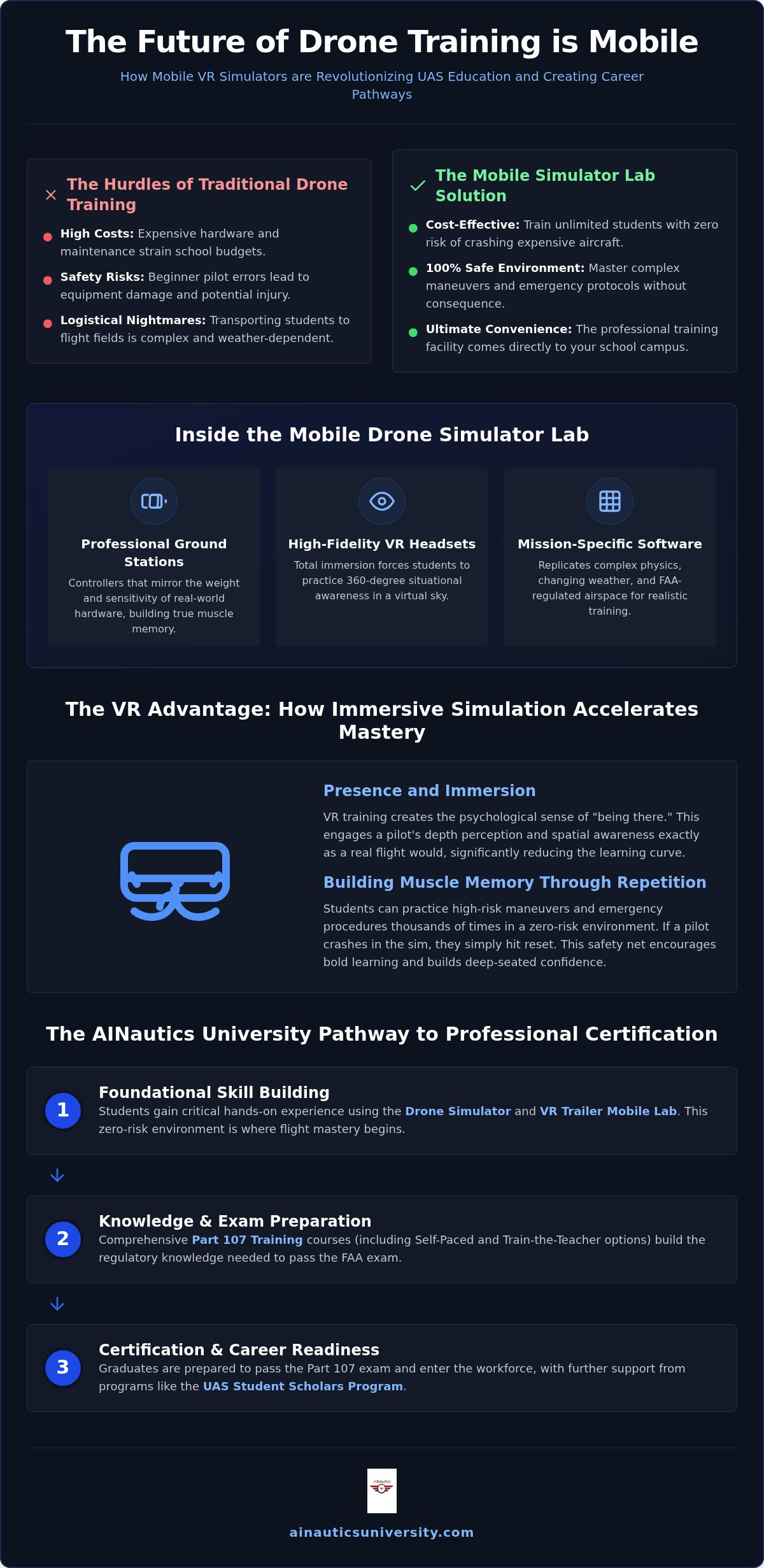
A mobile drone simulator lab is a portable, professional-grade training facility that transforms a standard parking lot into a high-tech aviation center. While many students are familiar with recreational flight simulators found on gaming platforms, those setups often lack the regulatory context and hardware precision required for commercial operations. Professional labs bridge this gap by focusing on workforce readiness and safety standards. A mobile lab is a climate-controlled, trailer-based classroom designed for immersive UAS education. By housing this technology in a mobile unit, organizations can provide a consistent, high-quality learning environment that remains independent of local weather or facility constraints. It integrates high-performance computing, VR headsets, and specialized software to create a safe environment where students can fail, learn, and master flight without the risk of damaging expensive equipment.
The Components of a Modern UAS Lab
Building a professional pilot requires more than a laptop and a joystick. A modern lab integrates several critical technologies to ensure students develop the muscle memory that applies to real aircraft.
- Professional Ground Control Stations: These controllers mirror the weight, layout, and sensitivity of the hardware used by commercial pilots in the field.
- High-Fidelity VR Headsets: These units provide total immersion, forcing students to practice 360-degree situational awareness and scan for obstacles in a virtual sky.
- Mission-Specific Software: Tools like the AINautics Drone Simulator replicate complex physics, varying weather conditions, and FAA-regulated airspace.
Why "Mobile" Matters for School Districts
For school districts, the mobility of the AINautics VR Trailer Mobile Lab solves several logistical nightmares. It eliminates the need to dedicate permanent, expensive square footage in a school building to a specialized program. Instead, districts can rotate the lab between multiple campuses, maximizing the return on investment and ensuring equitable access for all students. This mobility also simplifies the process of transporting students to flight fields, as the "field" essentially comes to them. Using the "Launch a Drone Program in 90 Days" framework, schools can quickly deploy these labs as a centerpiece for STEM events. This sparks interest in the UAS Student Scholars program and shows parents a visible, actionable path to FAA Part 107 certification and high-stakes careers. It's a turnkey solution that brings specialized knowledge to the student's doorstep.
The VR Advantage: How Immersive Simulation Accelerates Mastery
Presence in VR is the psychological sense of "being there." Unlike 2D mobile apps that rely on flat touchscreens, a mobile drone simulator lab uses VR to engage the pilot’s depth perception and spatial awareness. This immersion is critical because it forces the brain to process information exactly as it would during a real flight. By utilizing immersive drone training technology, students reduce their initial learning curve by mastering controls in a digital space before ever touching a physical aircraft. This approach allows pilots to practice high-risk maneuvers, such as total motor failure or battery fires, in a zero-risk environment. If a student crashes in the sim, they simply hit reset. This safety net encourages bold learning and ensures that when they eventually transition to physical UAS operations, they carry the confidence of a seasoned operator.
Building Muscle Memory Through Repetition
The path to mastery requires thousands of small, precise movements. Simulator flight hours translate directly to steadier hands during real-world missions because they allow for concentrated practice. Students can focus exclusively on perfecting landings, maintaining steady orbits, or executing complex emergency procedures without the downtime associated with battery swaps or travel to a flight field. Simulators allow for 10x more flight repetitions than traditional field training within the same timeframe. This density of experience is what builds the deep muscle memory required for professional-grade piloting. Schools looking to implement this can explore the Drone Simulator options to provide students with consistent, high-frequency flight time.
Scenario-Based Training for Commercial Success
Modern drone careers demand more than just basic flight skills. They require the ability to navigate urban obstacles, manage varied lighting, and operate in challenging weather conditions. The mobile drone simulator lab provides these specific scenarios on demand. Students can engage in autonomous systems training, learning how to oversee automated missions for industrial applications. This includes specialized training for vertical structure and cell-tower inspections, where proximity and precision are paramount. By simulating these high-stakes environments, students learn to anticipate risks and manage complex sensor payloads. This preparation ensures they are not just certified, but truly mission-ready for the technological demands of the 2026 workforce.
Key Benefits of Mobile UAS Labs for Schools and Students
School administrators and educators often face a common hurdle: the liability and cost of live flight training. A mobile drone simulator lab removes these obstacles by providing a professional environment with zero risk of injury or equipment damage during the initial learning phase. Beginners can make mistakes, experience crashes, and restart their missions instantly without the financial burden of replacing hardware. This safety net is essential for building the confidence required for high-stakes careers. Cost-efficiency is another major factor. Instead of purchasing 30 physical aircraft for a single class, districts can train an entire cohort simultaneously using high-capacity mobile facilities. This shared resource model ensures that budgets are spent on high-impact training rather than constant hardware maintenance and repairs.
Accessibility and standardization are equally critical for modern educational equity. Many students lack reliable transportation to remote flight fields, which are often located miles away from urban or suburban campuses. By bringing the lab directly to the school parking lot, districts ensure that every student has an equal opportunity to pursue specialized UAS knowledge. This mobile approach also guarantees that every student receives the same high-quality instruction and uses the same calibrated hardware. Whether a student is at a rural campus or a central metropolitan high school, their training experience remains consistent and professional.
Scaling STEM Programs with Ease
Expanding a drone program shouldn't take years of planning. Using the "Launch a Drone Program in 90 Days" framework, schools can implement a robust curriculum with rapid efficiency. These mobile labs support Career and Technical Education (CTE) pathways by providing students with a clear, actionable route to the workforce. Educators can use a mobile drone lab for schools as a central resource to spark interest in advanced technology. This turnkey solution allows districts to scale their offerings across multiple campuses without the need for permanent construction or dedicated lab space in every building. It creates a flexible, high-tech hub that moves where the students are.
Empowering Educators with Turnkey Solutions
The success of any school program depends on the confidence of its teachers. The Train-the-Teacher program is specifically designed to sustain these initiatives by giving educators the tools they need to lead with authority. By providing pre-configured, high-tech environments, we help reduce teacher burnout and the stress of managing complex technical setups. This allows teachers to focus on student engagement and mastery rather than troubleshooting hardware. All lab activities are carefully aligned with state and district educational standards, ensuring that flight hours also contribute to broader academic goals. This alignment makes it easier for schools to integrate the VR Trailer Mobile Lab into their existing STEM and aviation curricula while preparing students for the UAS Student Scholars program.
Bridging the Gap: From Simulator to Professional Part 107 Certification
Passing the FAA Part 107 exam is the first legal requirement for any commercial pilot, but theoretical knowledge alone doesn't guarantee mission success. A mobile drone simulator lab transforms abstract concepts like sectional charts and weather minimums into tangible flight experiences. Students don't just read about Class D airspace; they virtually fly through it while communicating with simulated air traffic control. This integration ensures that the $175 FAA exam fee is a sound investment rather than a gamble. By treating drone simulator training as a prerequisite, students develop the situational awareness needed to operate within the 400-foot altitude limit and maintain visual line of sight. It's the difference between knowing the rules and knowing how to follow them in a high-pressure environment.
Integrating FAA Regulations into Flight Practice
Effective training requires more than just avoiding obstacles. It requires strict adherence to federal law. Within the simulator, students practice flying in virtual "No Fly Zones" to understand how geofencing and compliance work in the real world. They can simulate complex night operations, which require specific anti-collision lighting and specialized pilot protocols. These rigorous sessions prepare students for the UAS Student Scholars certification, ensuring they are ready for the responsibilities of a Remote Pilot in Command. This hands-on approach demystifies the future of drone careers by showing students exactly what a professional flight day looks like. Mastery in the lab leads directly to confidence on the flight line.
Workforce Readiness and Industry Alignment
The transition from the lab to the workforce is a deliberate pipeline. AINautics University aligns simulator performance with real-world data collection roles in industries like infrastructure inspection and specialized media. Students learn to capture high-resolution imagery and manage sensor payloads while maintaining safe stand-off distances from structures. This high-fidelity simulation is used to verify pilot readiness before they enter the iFlyDrone marketplace, a nationwide network for professional pilots. By the time a student completes their training, they have a portfolio of simulated missions that prove their capability to potential employers. This ensures that every graduate is not just a certificate holder, but a qualified professional ready for immediate deployment.
Ready to start your journey toward professional certification? Explore our Part 107 Training and Self-Paced Certification options to begin your UAS career today.
Bringing the Future to Your Door: The AINautics VR Trailer Mobile Lab
The AINautics VR Trailer Mobile Lab represents a significant shift in how schools approach technical education. It isn't just a collection of headsets; it's a fully integrated, immersive UAS classroom that arrives at your doorstep ready for action. We've designed this experience around a clear "Learn → Train → Certify → Fly → Work" pipeline. This structure ensures that every minute spent in the lab contributes to a professional outcome. As a Service-Disabled Veteran-Owned Small Business (SDVOSB), we operate with a commitment to excellence and federal-grade standards. We bring the same discipline and precision found in military aviation to the local school environment. This high-standard approach prepares students for the accountability required in commercial drone operations. We invite every school to use the mobile lab as a gateway to the UAS Student Scholars program, where students can deepen their expertise and build long-term career networks.
A Look Inside the AINautics Mobile Experience
Step inside the lab, and you'll find a climate-controlled environment optimized for year-round training across the nation. This independence from weather is a major logistical advantage for districts that can't afford to lose training days to rain or wind. The facility features professional-grade VR stations that mirror the setups used by industrial pilots. We've also included collaborative learning zones. These areas allow students to watch their peers' flight paths on external monitors, fostering a team-based approach to problem-solving and mission planning. Our on-site support staff provides the expert guidance necessary to ensure every student achieves flight mastery. We don't just drop off equipment; we provide a guided learning journey that builds confidence through every virtual takeoff and landing.
Next Steps for School Administrators
Bringing this technology to your campus is a streamlined process. Requesting a visit is simple. School administrators can request a mobile lab visit to serve as the centerpiece of a new or existing aviation program. The mobile drone simulator lab is designed to align with existing STEM and CTE budgets, providing a high-impact resource without the need for permanent facility construction. This flexibility allows districts to share the lab across multiple campuses, ensuring equitable access for all students in the region. To start your 90-day implementation plan and secure a spot on our national tour, Contact AINautics University. Our team will work with you to integrate the lab into your curriculum and set your students on a clear path toward FAA Part 107 certification and beyond. This turnkey solution ensures your district remains at the forefront of the rapidly evolving UAS industry.
Launch Your Future in the Skies
The transition from a student to a professional remote pilot requires more than just a passing grade on a written exam. It demands the muscle memory and situational awareness that only immersive, high-stakes practice can provide. By integrating a mobile drone simulator lab into your curriculum, you eliminate the safety risks and high hardware costs that often stall new programs. This approach ensures every student is mission-ready for the technological demands of the 2026 workforce, from infrastructure inspection to advanced media production. You don't have to wait for the future of aviation to arrive; you can bring it directly to your campus today.
As a Service-Disabled Veteran-Owned Small Business (SDVOSB), AINautics University provides mission-driven instruction designed for real-world commercial mastery. We offer nationwide delivery of our immersive VR training trailers, making it easier than ever to bring specialized knowledge to your district. Whether you're a student exploring new career paths or an administrator looking to scale a STEM program, we provide the expertise to help you succeed. Launch your school drone program in 90 days with AINautics University and provide your community with a clear path to professional certification. The sky is no longer the limit; it's your new office.
Frequently Asked Questions
What is a mobile drone simulator lab and how does it work?
A mobile drone simulator lab is a climate-controlled trailer equipped with professional-grade VR stations and UAS software. It works by immersing students in 360-degree virtual environments that replicate real-world flight physics and FAA-regulated airspace. Students use ground control stations that mirror commercial hardware, allowing them to build muscle memory without risking physical aircraft. This turnkey facility brings the flight field directly to your campus parking lot.
Do students need prior experience to use the VR drone simulator?
No, the simulator is designed for all skill levels, from absolute beginners to advanced pilots. The AINautics Drone Simulator features progressive difficulty levels that guide students through basic hovering to complex obstacle navigation. This allows learners to build confidence at their own pace before ever touching a real aircraft. It's an ideal entry point for students in the UAS Student Scholars program who are just starting their aviation journey.
Can a mobile drone lab help students pass the FAA Part 107 exam?
Yes, the lab provides a practical context for the theoretical knowledge required for the FAA Part 107 exam. By flying in virtual environments that simulate restricted airspace and weather minimums, students better understand complex regulatory concepts. This hands-on practice complements our Part 107 Training and Self-Paced Certification options. It helps students bridge the gap between reading a textbook and making real-time aeronautical decisions.
How much space is required to host a mobile VR drone trailer?
A standard school parking lot or large flat surface is typically sufficient to host the mobile drone simulator lab. The unit is self-contained and climate-controlled, meaning it doesn't require indoor classroom space. This portability allows school districts to rotate the lab between campuses easily, maximizing access for all students within the region. It's an efficient way to share high-tech resources across a whole district without permanent construction.
What are the safety benefits of using simulators over real drones?
Simulators provide a zero-risk environment where students can fail and learn without injury or property damage. Pilots can practice high-risk emergency procedures, such as motor failures or battery fires, that would be impossible to replicate safely in the field. This safety net builds the necessary skills for high-stakes UAS careers before students transition to physical flight. It ensures that every mistake becomes a valuable learning moment rather than a costly accident.
How long does a typical training session in the mobile lab last?
Training sessions are flexible and can be tailored to fit standard school periods or full-day intensives. Most sessions focus on specific mission objectives, such as cell tower inspections or night flight navigation. This modular approach allows for high-frequency repetition, which is critical for developing the deep muscle memory required for professional-grade piloting. Students can complete multiple missions in a single hour, maximizing the instructional value of every lab visit.
Is the AINautics VR Trailer Mobile Lab available nationwide?
Yes, we provide nationwide delivery of our immersive VR training trailers to support school districts across the country. As an SDVOSB, we're committed to bringing professional-grade UAS education to diverse communities. Our team handles the logistics and on-site support to ensure every district can launch a successful program within our 90-day framework. This commitment ensures that specialized career pathways are accessible to every student regardless of their location.
How does the Train-the-Teacher program work with the mobile lab?
The Train-the-Teacher program empowers educators to lead the mobile lab sessions with confidence and authority. We provide the specific curriculum and technical training needed to manage the VR stations and guide students through flight missions. This ensures the drone program remains sustainable and well-integrated into the school's existing STEM or CTE pathways. It allows teachers to focus on student mastery while we handle the high-tech infrastructure and software updates.

Article by
AINautics University Team
The team behind AINautics University, dedicated to drone education and FAA Part 107 certification prep, VR flight simulation, and STEM training programs for students and educators.


