
By 2030, the FAA projects the number of certificated remote pilots will swell to over 628,000, fueling a global drone market currently valued at nearly $100 billion. You likely recognize that drones represent the future of work, but the logistics of bringing this technology into the classroom often feel overwhelming. Learning how to start a drone club in high school involves more than just unboxing hardware. It requires navigating strict FAA regulations, managing the high cost of potential crashes, and finding instructors with the right expertise.
We agree that the path to a sanctioned school program should be clear, safe, and professional. This guide provides the exact steps to transition from a casual hobbyist group to a career-focused UAS program. You'll learn how to secure institutional support and implement safety standards that protect your equipment. We will explore how tools like the Drone Simulator and the Train-the-Teacher Program bridge the gap between classroom learning and professional mastery. From achieving Part 107 Training success to joining the UAS Student Scholars, this 2026 implementation guide ensures your students are ready for the specialized roles of the future.
Key Takeaways
- Discover a proven 90-day roadmap on how to start a drone club in high school that transitions from a casual hobbyist group to a professional workforce development program.
- Understand the vital regulatory distinction between recreational TRUST requirements and FAA Part 107 standards to maintain full school compliance.
- Learn how to leverage a Drone Simulator to build student flight proficiency and mitigate the high costs associated with equipment damage.
- Explore the Train-the-Teacher Program as a solution for schools that lack qualified instructors to lead specialized UAS curriculum.
- Identify clear career pathways for students through professional certification and the elite UAS Student Scholars achievement program.
Why Every High School Needs a Drone Program in 2026
The global drone market has surpassed the $100 billion mark in 2026, marking a definitive shift from hobbyist gadgets to essential commercial tools. For educators and administrators, understanding how to start a drone club in high school is no longer just about offering a fun extracurricular activity. It's about building a workforce development engine. Modern drone programs serve as a gateway to high-paying careers in autonomous systems, artificial intelligence, and data analytics. By integrating drone technology education into the school ecosystem, you provide students with a tangible path toward economic mobility and technical mastery.
These programs fulfill critical STEM and Career and Technical Education (CTE) requirements by turning abstract concepts into mission-driven results. Students don't just study physics; they apply it to lift and drag calculations. They don't just learn about circuits; they maintain complex flight hardware. This "Learn to Work" pipeline transforms the high school experience into a professional training ground, ensuring graduates are ready for the specialized demands of the future.
Bridging the STEM Gap with Autonomous Systems
Drones are the ultimate multi-disciplinary platform. An Unmanned Aerial Vehicle (UAV) integrates physics, engineering, and computer science into a single, engaging tool. When students participate in a club, they transition from classroom theory to real-world flight operations. They learn to code autonomous flight paths and troubleshoot hardware failures under pressure. This hands-on approach keeps students motivated through mission-driven learning, such as simulated search-and-rescue or precision agriculture tasks. Using tools like the Drone Simulator allows them to practice these complex maneuvers safely before taking to the skies.
The 2026 Drone Career Outlook for High School Graduates
The demand for licensed pilots has exploded across sectors like construction, public safety, and infrastructure inspection. A high schooler who earns their Part 107 Training certificate can enter the workforce with a starting wage between $25 and $45 per hour. Club participation also opens doors to the UAS scholarship for high school students, which supports further education in aerospace and engineering. Programs like the UAS Student Scholars represent the gold standard for club achievement, signaling to employers that a student is ready for professional responsibility. By mastering how to start a drone club in high school, you create a direct pipeline from the classroom to a specialized career in the low-altitude economy.
FAA Compliance: Ensuring Your School Drone Club Flies Legally
Operating a fleet on campus involves significant legal responsibility. When researching how to start a drone club in high school, compliance must be your first priority. The FAA maintains strict oversight of the national airspace; ignorance of these rules doesn't protect a school district from fines. Establishing a legal framework early ensures your program remains sustainable and sanctioned by the administration. A compliant program protects students while building the professional habits required in the aviation industry.
Part 107 vs. TRUST: Which Rules Apply to Your Students?
The FAA provides two primary paths for operators. The Recreational UAS Safety Test (TRUST) is a free, mandatory requirement for hobbyists. While some school activities can operate under recreational rules, professional programs should aim for Part 107 certification. Part 107 is the federal standard for commercial operations and workforce readiness. You can review the specific FAA rules for educational drone use to see where your club fits. An individual must be at least 16 years old to obtain an FAA Part 107 Remote Pilot Certificate. This makes it an ideal milestone for high school juniors and seniors. For most clubs, having a licensed Pilot in Command (PIC) is essential. This individual, often a teacher who has completed the Train-the-Teacher Program, supervises flights to ensure safety. Following a drone compliance training checklist helps club leaders manage these regulatory layers efficiently.
Implementing Professional Standards in a School Setting
Professionalism starts on the ground. Every flight must include pre-flight checklists and maintenance logs. This practice mirrors federal contracting standards and prepares students for high-stakes industry roles. Schools must also manage airspace authorizations through LAANC (Low Altitude Authorization and Notification Capability). Using digital tools to secure these approvals is a core skill for any student pilot. AINautics mission-driven instruction emphasizes these protocols to build a culture of safety across the campus. These standards ensure that every takeoff is planned and every landing is documented.
Insurance providers require a clean paper trail to cover school activities. Documenting every flight, battery cycle, and repair protects the district from liability. If an incident occurs, these records prove the club followed established safety protocols. Implementing these standards early makes it easier to scale your program into a full career pathway later. If you need help structuring your legal framework, explore the professional Part 107 Training options available for educators.
Three Successful Models for High School Drone Clubs
Selecting the right framework is the first step in learning how to start a drone club in high school. Your choice determines the equipment you buy and the drone certification program your students will eventually pursue. While many groups start as hobbyist circles, the most successful clubs align with specific industry verticals to maximize career impact. Whether your students are drawn to the thrill of competition or the precision of data science, choosing a defined model provides the structure needed for long term growth.
The Workforce-Ready Aerial Media and Inspection Club
This model focuses on high-demand commercial skills that translate directly to the 2026 job market. Students perform mock cell-tower or vertical-structure inspections using stabilized camera platforms. They also capture high-quality aerial media for school sports, graduations, or district marketing events. The primary milestone for this club is completing Part 107 Training. By achieving this federal certification, students prove they can operate within professional standards. This model turns the club into a service provider for the school district, allowing students to build a professional portfolio of real-world deliverables.
The Competitive Drone Racing and FPV Model
For students drawn to speed and high-performance engineering, the racing model is ideal. Participants join national student racing leagues and compete on technical courses. This model emphasizes deep engineering skills because students must build, tune, and repair their own racing frames. Mastering complex FPV (First Person View) flight maneuvers requires significant practice and specialized reflexes. We recommend using a Drone Simulator to build these skills without the high cost of equipment damage from crashes. It is a high-energy environment that fosters technical knowledge of propulsion, radio systems, and aerodynamics.
The STEM Research and Data Analytics Club
This model appeals to students interested in environmental science, urban planning, and civil engineering. Instead of just flying, students use drones for orthomosaic mapping of the campus to create high-resolution 2D and 3D models. They learn to integrate this data into GIS (Geographic Information Systems) and asset-management software. These activities teach students how to turn raw aerial footage into actionable data. Students in this track often aim for the UAS Student Scholars program, which recognizes those who apply drone technology to solve complex problems. Most schools find that a hybrid model, combining elements of racing with professional Self-Paced Certification, provides the best balance of engagement and workforce readiness when discovering how to start a drone club in high school.
The 90-Day Roadmap to Launching Your High School Drone Program
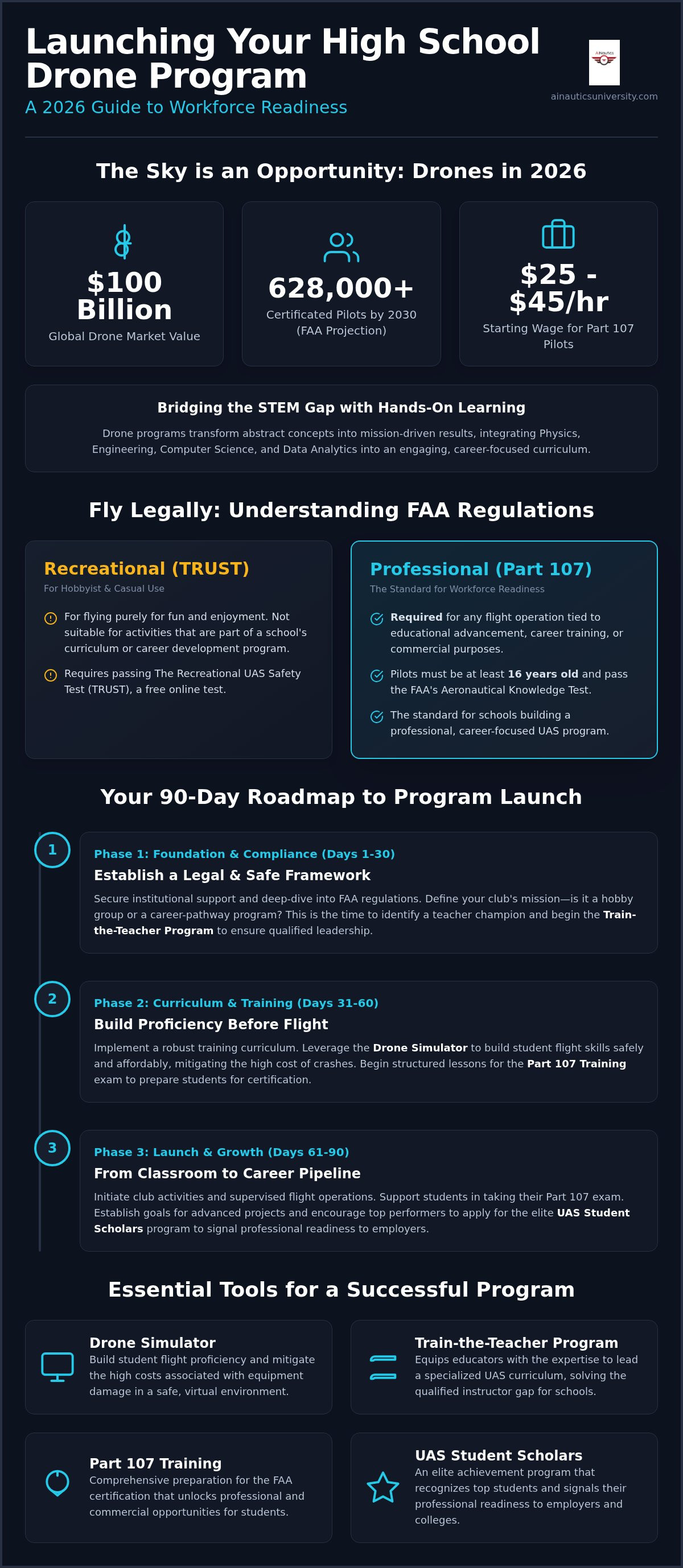
A successful launch requires a structured timeline that balances administrative requirements with technical preparation. When you explore how to start a drone club in high school, think of it as a professional deployment rather than a casual startup. This 90 day roadmap provides a clear path to move from a concept to a fully operational, FAA compliant program. By following this methodical approach, you ensure the program is sustainable, safe, and supported by your district leaders.
Phase 1: Planning, Funding, and Admin Approval (Days 1-30)
The first month focuses on establishing the club's foundation. You must develop a mission statement that aligns with state and district educational standards. This alignment makes it easier to secure funding through STEM grants or Career and Technical Education (CTE) budget allocations. During this phase, you should also draft a comprehensive flight safety manual. This document outlines exactly where, when, and how drones will operate on campus. Having these protocols in place early builds trust with administrators and insurance providers. Use a professional drone curriculum for educators to ensure your planning meets industry standards from day one.
Phase 2: Teacher Certification and Equipment Selection (Days 31-60)
A program is only as strong as its leadership. Schools often struggle to find qualified instructors, which is why the Train-the-Teacher Program is a vital investment during this phase. This training empowers your existing staff to lead the club with confidence and technical authority. While teachers earn their certifications, you should select hardware that supports both live flight and digital training. Look for drones that are durable and compatible with professional software. You also need to establish a dedicated workshop space. This area serves as the club's hangar where students will perform maintenance, battery management, and hardware repairs.
Phase 3: Student Recruitment and Initial Flight Ops (Days 61-90)
With the infrastructure ready, it's time to bring in the students. Open club registration and conduct a mandatory safety orientation that covers both school rules and federal regulations. Before students touch a real controller, they should log hours on the AINautics Drone Simulator. This practice builds muscle memory and prevents costly equipment damage during the learning curve. Once students demonstrate proficiency in the virtual environment, you can execute the club's first sanctioned on-campus flight mission. This milestone marks the official transition from planning how to start a drone club in high school to running a functioning UAS program. To begin your journey, explore our Part 107 Training and implementation tools today.
Scaling for Success: Simulators, VR, and Professional Growth
One of the greatest barriers to scaling a drone program is the high cost of equipment and the risk of crashes. A Drone Simulator is the most effective tool for mitigating these expenses during the early learning phase. It allows students to master complex flight maneuvers and commercial mission planning in a risk-free environment. Scenario-based training prepares them for real-world challenges, such as navigating tight spaces or managing sensor payloads during infrastructure inspections. By integrating Self-Paced Certification options, students can progress through flight hours and technical knowledge at their own speed. This modular approach ensures that every club member achieves a baseline of proficiency before they operate live aircraft on campus, protecting your school's investment in hardware.
The VR Trailer Mobile Lab: Bringing the Industry to Campus
To truly scale impact across a district, the VR Trailer Mobile Lab provides a unique, immersive solution. This mobile lab brings advanced technology directly to the campus, creating a powerful "wow factor" that secures ongoing support from parents and district administrators. Immersive VR experiences allow students to step inside autonomous systems and visualize complex data in three dimensions. It bridges the gap between digital theory and physical application, providing hands-on access to the latest UAS innovations. This district-wide reach ensures that the benefits of your drone program aren't confined to a single classroom. Instead, it serves as a catalyst for technological literacy across the entire student body as you continue to refine how to start a drone club in high school for future cohorts. By utilizing mobile labs, you turn a single club into a district-wide resource for autonomous systems education.
Empower the Next Generation of UAS Professionals
Transitioning from a casual hobbyist group to a professional UAS program is a transformative step for any district. By prioritizing FAA compliance and industry-recognized certifications, you turn a simple interest into a powerful workforce development engine. Mastering how to start a drone club in high school requires a strategic blend of administrative foresight, safety protocols, and advanced training tools. These elements work together to create a safe environment where students can move from virtual simulation to real-world flight missions with confidence.
You don't have to navigate this complex regulatory and technical landscape alone. Launch your school drone program in 90 days with AINautics University. Our 90-Day Program Launch Framework, Train-the-Teacher Certification, and STEM-Aligned UAS Curriculum provide the structure needed to build a sustainable and successful program. By implementing these professional standards, you're doing more than just teaching flight; you're opening doors to high-paying careers in the autonomous systems industry. The future of aviation is here, and your students are ready to lead it.
Frequently Asked Questions
Do students need a license to fly drones in a high school club?
Students flying purely for recreation must pass the free TRUST test. If the club performs tasks for the school, such as filming athletic events, it falls under professional Part 107 rules. We recommend all students over 16 pursue Part 107 Training to build professional habits. This certification is the industry standard for commercial operations. It ensures everyone understands airspace and safety protocols before they take off on campus.
How much does it cost to start a drone club in high school?
Initial costs include flight hardware, batteries, and safety gear. You can mitigate these expenses by using a Drone Simulator for initial flight training. This prevents students from damaging expensive aircraft while they are still learning basic maneuvers. Many districts secure funding through STEM grants or CTE budget allocations. When you research how to start a drone club in high school, remember that software and training are just as important as the drones.
Is it safe to fly drones on a high school campus?
Safety is maintained through strict adherence to FAA regulations and school safety manuals. You should always use pre-flight checklists and maintain detailed maintenance logs for every aircraft. Having a licensed Pilot in Command supervise all flights is essential. Schools can also use the VR Trailer Mobile Lab to provide immersive, controlled environments for students to practice complex autonomous missions without endangering people or property on the ground.
What is the best drone for a beginner high school club?
The best choice depends on your club model. For media and inspection, look for drones with high-resolution cameras and GPS stabilization. If you choose the racing model, you need robust frames that students can repair themselves. Regardless of the hardware, the most important tool is a professional curriculum. Using Self-Paced Certification options allows students to master the theory before they ever handle the physical controls of a drone.
How can a teacher get certified to lead a drone program?
Educators can gain the necessary expertise through a specialized Train-the-Teacher Program. This training covers Part 107 regulations, flight proficiency, and classroom integration strategies. It empowers teachers to lead their programs with confidence even if they don't have a prior background in aviation. Having a certified instructor on staff is the most sustainable way to ensure your high school drone program remains compliant and effective for years to come.
Can drone club experience help with college applications?
Can drone club experience help with college applications?
To earn a Remote Pilot Certificate, a student must be at least 16 years old. They must pass the FAA Part 107 knowledge test, which currently has a $175 fee paid to a testing center. Candidates also undergo a TSA background check. This professional credential allows students to operate commercially. It's a key milestone in learning how to start a drone club in high school that produces career-ready graduates for the modern workforce.
How do we get insurance for our school drone club?
Schools typically secure insurance through their district's existing risk management policies. To get approval, you must provide a detailed flight safety manual and proof of instructor certification. Keeping a clean paper trail of flight logs and maintenance records is vital for maintaining coverage. Professional programs often use standardized checklists to prove they follow federal safety protocols. This documentation gives insurers the confidence to cover your club's aerial operations on campus.

Article by
AINautics University Team
The team behind AINautics University, dedicated to drone education and FAA Part 107 certification prep, VR flight simulation, and STEM training programs for students and educators.


