
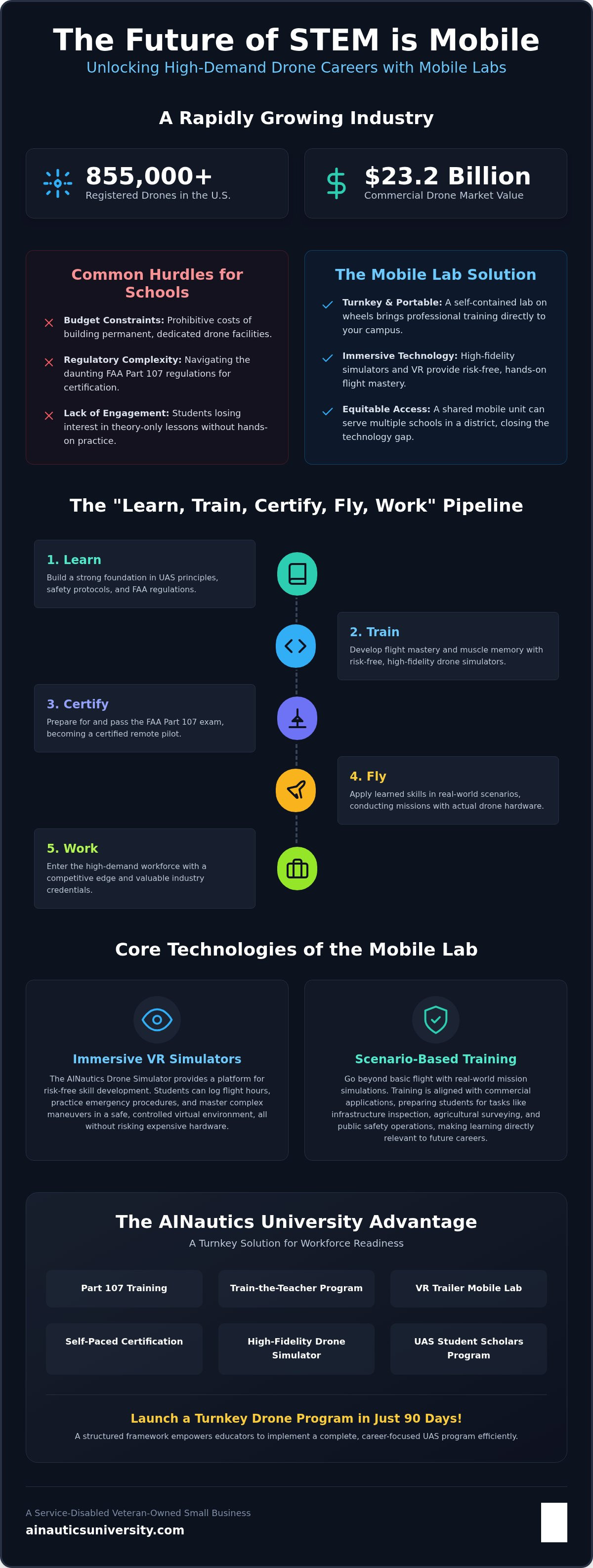
As of June 2026, there are over 855,000 registered drones in the U.S., and the commercial market has reached a value of $23.2 billion. This explosive growth means that implementing a mobile drone lab for schools is no longer just an elective choice; it's a critical workforce development strategy. Most educators agree that traditional STEM programs lack the resources to keep pace with such rapid industry shifts. You likely face the common hurdles of budget constraints for permanent facilities and the daunting complexity of FAA Part 107 regulations. It's frustrating to see students lose interest in theory when they could be gaining high-demand skills.
This guide demonstrates how these portable solutions transform challenges into opportunities. You'll discover how immersive VR technology and tools like the Drone Simulator turn classroom learning into a career-focused journey. We'll preview the "Learn, Train, Certify, Fly, Work" pipeline, showing how programs like UAS Student Scholars and the Train-the-Teacher framework integrate into your CTE pathways. As a Service-Disabled Veteran-Owned Small Business, AINautics University understands the importance of mission-ready training. You'll see how a VR Trailer Mobile Lab provides the equitable access and professional certification your students need to succeed in the autonomous systems industry.
Key Takeaways
- Learn how a mobile drone lab for schools provides a self-contained, portable environment that brings professional-grade UAS training directly to your campus.
- Explore the "Learn, Train, Certify, Fly, Work" pipeline that prepares students for high-demand careers through the UAS Student Scholars program.
- Understand the role of high-fidelity Drone Simulators and the VR Trailer Mobile Lab in building flight mastery without hardware risks.
- Discover how to launch a turnkey drone program in just 90 days using a structured framework and the Train-the-Teacher Program.
- Gain insights into the FAA Part 107 certification process and how it serves as a gateway to the $23.2 billion autonomous systems industry.
What is a Mobile Drone Lab for Schools?
A mobile drone lab for schools is a self-contained, portable learning environment that brings professional-grade Unmanned Aircraft Systems (UAS) technology directly to a campus. It functions as a classroom on wheels, typically housed in a customized trailer equipped with workstations, flight zones, and advanced simulation hardware. This innovative approach eliminates the need for expensive, permanent laboratory construction or dedicated building renovations. Instead of waiting years for a facility to be built, schools can deploy a turnkey solution that focuses on immersive technology, including high-fidelity simulators and virtual reality experiences.
The Evolution of the Classroom to the Parking Lot
Traditional classrooms often struggle to accommodate the unique requirements of high-tech flight training. Standard ceilings are too low for safe indoor flight, and the logistics of transporting students to off-site airfields can be a nightmare. A mobile lab solves these issues by turning the school parking lot into an active flight line. There's no need for buses or complex off-site permission slips. Students simply walk out of their standard period and step into a professional environment. This model is particularly effective for solving the technology gap in underserved districts. By sharing a mobile unit across multiple schools, a district ensures that every student has access to an Unmanned Aerial Vehicle (UAV) curriculum that meets modern industry standards.
Key Differences Between Mobile STEM and Dedicated Drone Labs
While general STEM makerspaces are becoming common, they often lack the specialized focus needed for workforce readiness. A dedicated mobile drone lab moves beyond basic robotics to emphasize professional mastery. The AINautics VR Trailer Mobile Lab provides a sophisticated space where students engage in complex mission planning and data analysis. Unlike general STEM carts, this specialized lab prioritizes the "Learn, Train, Certify, Fly, Work" pipeline. Key components include:
- Risk-Free Mastery: The AINautics Drone Simulator allows students to build muscle memory and log flight hours without the risk of damaging hardware.
- Professional Standards: Training is aligned with FAA Part 107 regulations, ensuring students prepare for actual certification rather than just recreational play.
- Scalability: Through the Train-the-Teacher Program, educators receive the specific UAS knowledge required to lead these high-tech sessions confidently.
By focusing on these specific career pathways, the UAS Student Scholars program helps students transition from casual hobbyists to certified remote pilots ready for the commercial marketplace. This specialization is what transforms a simple school activity into a legitimate gateway for the $23.2 billion drone industry.
Core Technology of an Advanced Mobile Drone Lab
Integrating a mobile drone lab for schools requires a sophisticated blend of hardware and software designed for workforce readiness. It's a high-tech ecosystem where students move beyond basic flight to master the complexities of autonomous systems. This environment relies on high-fidelity tools that provide a bridge between classroom theory and commercial application. By utilizing scenario-based training, students prepare for the $23.2 billion drone market in a safe, controlled setting. Many of these programs are supported by Aviation Workforce Development Grants, which highlight the federal commitment to training the next generation of remote pilots.
The Power of Immersive VR Simulators
The AINautics Drone Simulator serves as the foundation for safe flight mastery. It allows students to build essential muscle memory without the risk of expensive hardware damage. Simulators provide a platform to practice emergency procedures and fly in complex weather conditions that would be too dangerous for beginners in the real world. Teachers can track student progress through data-driven flight metrics, ensuring every learner meets specific competency benchmarks. This quantitative approach ensures that when students eventually transition to live flight, they do so with a high level of confidence and skill. Schools looking to modernize their CTE pathways can explore the VR Trailer Mobile Lab to see these technologies in action.
Scenario-Based Training for Real-World Application
Effective UAS education moves beyond "flying in circles" to mission-driven instruction. The technology inside a mobile drone lab for schools creates immersive environments that mimic real-world commercial work. Students engage in specialized missions, such as:
- Infrastructure Inspection: Simulating cell tower and vertical structure assessments to learn precise positioning.
- Environmental Monitoring: Integrating wildlife-aware procedures and federal compliance training into flight plans.
- Emergency Response: Practicing search and rescue patterns in simulated disaster zones.
This mission-focused strategy ensures that the "Learn, Train, Certify, Fly, Work" pipeline remains grounded in practical utility. By integrating these scenarios with professional UAS Student Scholars curriculum and Part 107 Training software, schools provide a clear path to certification. The goal is to produce graduates who don't just know how to fly, but understand how to operate as professionals within the national airspace. This level of specialization is what makes a mobile lab a turnkey solution for any district aiming for measurable career outcomes.
Workforce Readiness: The Commercial Value of Mobile Training
The commercial drone industry has matured into a multi-billion dollar sector where the most valuable skills involve data analysis and mission planning. Implementing a mobile drone lab for schools allows districts to align directly with these workforce demands. By moving beyond basic flight maneuvers, students prepare for high-growth careers in construction, agriculture, and public safety. This mobile approach creates a dedicated space where the "Learn, Train, Certify, Fly, Work" pipeline becomes a reality, connecting classroom theory to the $23.2 billion U.S. drone market.
Pathways to FAA Part 107 Certification
The cornerstone of professional UAS operation is the FAA Part 107 Remote Pilot Certificate. A mobile drone lab for schools provides the focused environment necessary to master complex aeronautical knowledge. Students study airspace classifications, weather patterns, and emergency procedures while following established FAA rules for educational drone use. This isn't just about passing a test; it's about developing a culture of operational safety and compliance. Integrating specialized Part 107 drone training into the curriculum ensures that students are ready for the $175 knowledge test. This certification acts as a professional passport, allowing graduates to enter the workforce immediately as legal, commercial operators.
UAS Student Scholars: Building Excellence in Flight
The UAS Student Scholars program serves as a bridge between basic certification and career mastery. It validates that a student has not only passed the FAA exam but has also demonstrated proficiency in real-world flight scenarios. Employers in sectors like utilities and infrastructure inspection look for this level of documented expertise. The program helps students build a "clean paper trail" of flight logs and mission reports, which are essential for securing insurance and employment in the industry. These credentials prove to future employers that the student is workforce-ready and capable of managing autonomous systems.
The ultimate goal of this pipeline is to connect students to the broader economy. Through the iFlyDrone marketplace, certified students find opportunities to apply their skills in professional settings. Whether they're conducting cell tower inspections or capturing high-end media content, the foundation laid in the mobile lab ensures they operate with the confidence of an industry professional. This turnkey approach transforms a school's CTE pathway into a direct link to the autonomous systems industry, ensuring that every hour spent in the lab translates to measurable career outcomes.
Implementing a Drone Program in 90 Days
Launching a mobile drone lab for schools requires a methodical strategy to ensure the program thrives beyond the initial excitement. AINautics University provides a 90-Day Program Launch framework that simplifies this transition for school districts. This timeline is broken into four distinct phases: strategic planning, instructor certification, deployment, and long-term sustainment. By following this structured path, educators can avoid common implementation pitfalls and focus on student outcomes. As a Service-Disabled Veteran-Owned Small Business, we prioritize mission-ready deployment for grant-funded school projects.
Drone Professional Development for Teachers
Teachers are the backbone of any successful UAS initiative. Empowering educators through the UAS Teacher Scholars model is essential for bridging the gap between general STEM interest and technical drone expertise. Many instructors feel intimidated by FAA regulations or flight hardware; however, the Train-the-Teacher Program provides the necessary confidence and credentialing. Effective drone professional development for teachers is the key to program longevity. It ensures that instructors aren't just supervisors, but mentors who can guide students through Part 107 Training and complex flight scenarios. This investment in human capital ensures that the mobile lab remains a vibrant part of the school's culture for years to come.
Aligning with CTE and STEM Standards
A mobile drone lab for schools must do more than provide entertainment. It must meet local and national education requirements to qualify as a legitimate Career and Technical Education (CTE) pathway. This involves customizing the curriculum for different age groups. Middle school learners might focus on the physics of flight and basic safety, while high school students dive into data science and advanced mission planning. We map UAS skills to specific career clusters in aviation, engineering, and data science. This alignment ensures that every hour spent in the VR Trailer Mobile Lab or on the Drone Simulator counts toward graduation requirements and industry credentials. By integrating these standards early, districts create a clear "Learn to Work" pipeline that prepares students for the autonomous systems workforce.
Ready to bring high-tech career training to your campus? You can start your 90-day drone program launch today by connecting with our expert team.
The AINautics Advantage: Your Turnkey UAS Solution
AINautics University stands as a national leader in UAS education, offering a complete ecosystem for workforce development. Our status as a Service-Disabled Veteran-Owned Small Business (SDVOSB) and a member of AUVSI underscores our commitment to professional standards. We don't just deliver equipment; we provide a scalable, turnkey solution for individual schools or entire K-12 districts. This comprehensive model integrates high-fidelity Drone Simulators with career-path platforms like the UAS Student Scholars program. We ensure every student has a clear trajectory from the classroom to the commercial marketplace. By providing nationwide delivery of specialized drone education and VR technology, we help districts build sustainable programs that evolve with the industry.
Why Schools Choose the VR Trailer Mobile Lab
Schools prioritize the VR Trailer Mobile Lab because it shifts the focus from recreational play to mission-driven instruction. This distinction is critical for achieving measurable career outcomes in sectors like infrastructure and public safety. By choosing a mobile solution, districts significantly reduce the administrative burden associated with starting a drone program in school. Our veteran-led expertise ensures that every aspect of the program, from flight safety to FAA compliance, meets the highest industry benchmarks. This specialized guidance allows educators to focus on student engagement while we manage the technical complexities of UAS integration. A mobile drone lab for schools offers the flexibility to serve multiple campuses, maximizing the impact of your investment.
Next Steps: Bringing the Future of UAS to Your Campus
Bringing the future of UAS to your campus starts with a simple consultation to review the 90-Day Program Launch framework. We guide you through the process of evaluating funding options and aligning with federal or state-level grants. Whether you choose our Self-Paced Certification options or the full immersive experience of a mobile lab, we ensure your facility is prepared for success. Preparing your campus involves identifying a suitable parking area and coordinating with staff to begin the Train-the-Teacher Program. This methodical approach ensures your program is operational, compliant, and ready to empower students by the designated launch date. Our team remains a long-term partner, providing the curriculum updates and technical insights needed to stay ahead of the autonomous systems curve.
Empowering the Next Generation of Remote Pilots
The rapid expansion of autonomous systems is reshaping the modern workforce, and your district's ability to prepare students depends on the tools you provide today. A mobile drone lab for schools isn't just a portable classroom; it's a direct bridge to a high-growth career path. By integrating high-fidelity Drone Simulators and the UAS Student Scholars program, you ensure your students aren't just hobbyists. They become certified professionals ready to enter an industry with massive commercial potential. This immersive approach solves the challenges of teacher training and facility costs while delivering measurable career outcomes.
AINautics University provides the expert framework to make this transition seamless. Our FAA-aligned curriculum and veteran-led expertise simplify the complexities of Part 107 certification. As an SDVOSB certified provider and a member of AUVSI, we're dedicated to your community's long-term success and safety. Don't let budget constraints or regulatory hurdles hold your students back from the future of aviation. Take the first step toward a turnkey UAS solution that transforms your CTE pathways. Launch your school drone program in 90 days with AINautics University and empower your learners to reach new heights in the autonomous systems industry.
Frequently Asked Questions
How much space is required for a mobile drone lab at my school?
A mobile drone lab for schools typically requires a standard parking lot area sufficient to accommodate a customized trailer and a designated safety perimeter for outdoor flight activities. The specific footprint depends on the trailer size, but most campuses find that a few adjacent parking spaces provide ample room. You don't need a permanent building or indoor flight cage; the trailer serves as the primary classroom and command center for all UAS operations.
Do teachers need prior drone experience to use the mobile lab?
Educators don't need any prior drone experience to successfully lead a program. Our Train-the-Teacher Program is designed to guide instructors through every technical and regulatory hurdle. We provide the specific aeronautical knowledge and flight skills needed to mentor students effectively. This professional development ensures that teachers feel confident using the Drone Simulator and managing the VR Trailer Mobile Lab without requiring a background in aviation or engineering.
Is the curriculum aligned with FAA Part 107 regulations?
Yes, the curriculum is strictly aligned with FAA Part 107 regulations to ensure students are prepared for professional certification. The training covers essential topics such as airspace classifications, weather patterns, and emergency procedures. By integrating our Part 107 Training into the mobile lab experience, schools provide a clear path for students to earn their remote pilot certificates. This alignment is critical for transitioning from recreational flying to legal, commercial operations.
What age groups are eligible for the UAS Student Scholar certification?
The UAS Student Scholars program is primarily designed for middle school and high school students. While younger learners can engage with basic flight physics, the certification focus is tailored for students exploring CTE pathways and future careers. High schoolers specifically benefit from the workforce-ready credentials that validate their proficiency to future employers. This program ensures that students of various ages develop a clean paper trail of flight mastery and mission planning.
How long does a typical mobile drone lab residency last?
A typical residency can vary based on the district's specific needs and the 90-Day Program Launch framework. Some schools choose short-term intensive sessions, while others integrate the lab into a semester-long CTE curriculum. We work with administrators to determine a schedule that maximizes student engagement and ensures all participants have enough time on the Drone Simulator to meet their specific competency benchmarks and flight goals.
Can mobile drone labs help with state-mandated STEM requirements?
Mobile labs are excellent tools for meeting state-mandated STEM and CTE requirements. The curriculum maps directly to career clusters in aviation, engineering, and data science. By providing hands-on experience with autonomous systems, schools can satisfy rigorous standards for technical education and workforce readiness. This approach transforms traditional STEM lessons into actionable career training that aligns with the growing $23.2 billion U.S. drone market and modern industry demands.
What safety protocols are included in the mobile lab experience?
Safety is the foundation of the entire mobile lab experience. Every session includes comprehensive pre-flight checklists, hazard identification, and strict adherence to FAA rules for educational drone use. Students learn to manage risk by practicing emergency procedures in a high-fidelity Drone Simulator before attempting live flights. Our veteran-led expertise ensures that all operations maintain a professional safety culture, mirroring the standards used in commercial and military aviation environments.
How do we fund a mobile drone lab for our district?
Schools often fund a mobile drone lab for schools through federal Aviation Workforce Development Grants, CTE Perkins V funding, or specialized STEM grants. Our status as a Service-Disabled Veteran-Owned Small Business (SDVOSB) often helps districts qualify for specific government-funded projects. We assist administrators in evaluating these funding options to ensure the program is financially sustainable. This proactive approach helps districts bring high-tech UAS training to their campuses without straining local budgets.

Article by
AINautics University Team
The team behind AINautics University, dedicated to drone education and FAA Part 107 certification prep, VR flight simulation, and STEM training programs for students and educators.


