
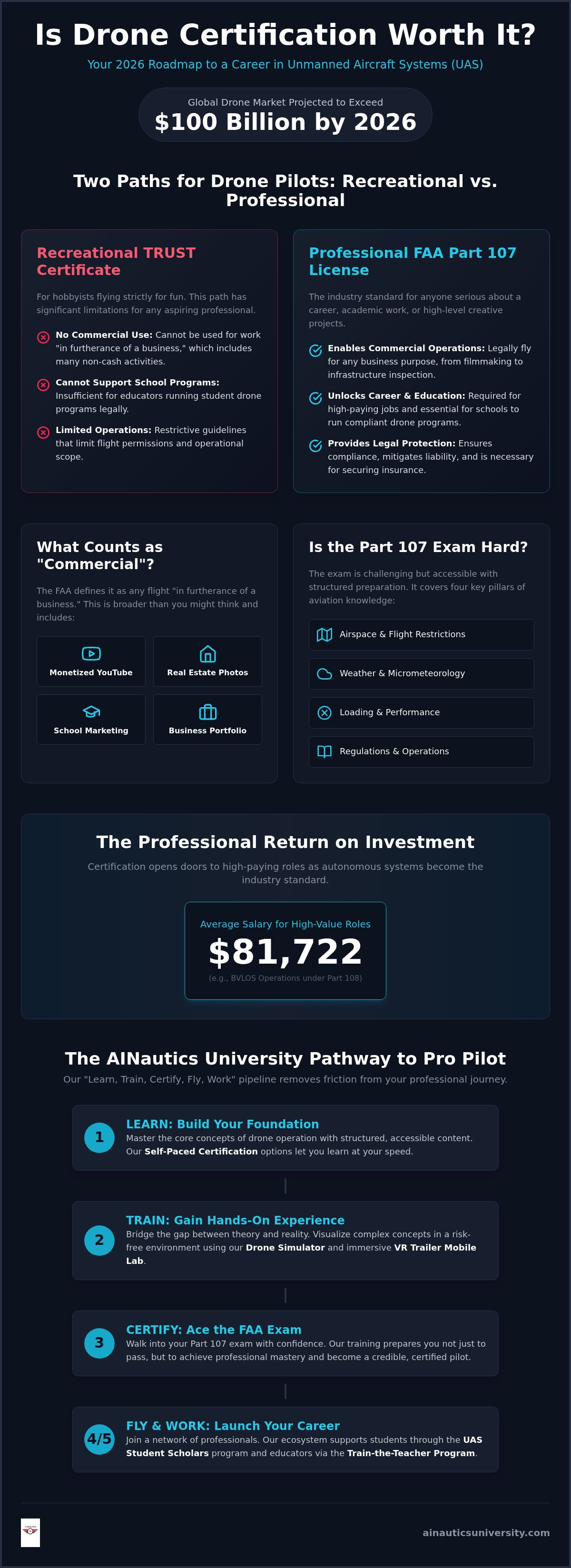
With the global drone market projected to exceed $100 billion in 2026, you've likely asked yourself: is drone certification worth it? It's common to feel stuck between the simplicity of a recreational TRUST certificate and the perceived hurdle of a professional FAA license. You might worry the exam is too difficult or that the job market is already saturated. We agree that the distinction between a hobby and a career can feel blurry when regulations are constantly evolving.
This article promises to clarify the legal requirements and the actual career ROI of becoming a certified pilot in today's autonomous economy. You'll learn exactly how the new Part 108 rules for Beyond Visual Line of Sight operations are creating high-paying roles with average salaries reaching $81,722. We'll preview the "Learn, Train, Certify, Fly, Work" pipeline, showing how resources like our Drone Simulator and Self-Paced Certification programs remove the friction from your professional journey. By the end, you'll have a clear roadmap to mastery in the Unmanned Aircraft Systems industry.
Key Takeaways
- Understand why is drone certification worth it by distinguishing between recreational flight rules and the professional legalities required for business growth.
- Discover the reality of the FAA Part 107 exam and how structured preparation makes mastering airspace and weather topics manageable for any learner.
- Learn about the operational boundaries of TRUST and why schools must utilize Part 107 certification to legally run student drone programs.
- Identify high-value career paths in infrastructure and specialized inspections that are opening as autonomous systems become the industry standard in 2026.
- See how immersive tools like the VR Trailer Mobile Lab and our Drone Simulator bridge the gap between passing a test and becoming a professional pilot.
The "Just a Hobby" Myth: Why Certification Matters Beyond Commercial Work
The belief that you only need an FAA license if you're a "pilot-for-hire" is one of the most persistent myths in the industry. In 2026, the line between recreational and professional flight isn't drawn by whether you receive a direct paycheck. The FAA defines commercial work as anything in "furtherance of a business." This includes filming for a monetized YouTube channel, capturing footage for a school's social media, or even an educator demonstrating technology to a class. If the flight isn't strictly for fun, you need a license. When people ask, "is drone certification worth it," they often overlook these non-cash benefits that protect their creative and academic work.
Transitioning from a hobbyist to an Autonomous Systems Professional changes how you interact with the world. It's about more than just flying; it's about managing a sophisticated tool within a complex airspace. Understanding that "compensation" includes marketing your own brand or building a professional portfolio helps answer the question: is drone certification worth it? Even if you don't charge for your services today, the legal protection and expanded flight permissions are essential for any serious creator or student in the 2026 economy.
The Legal Reality of 2026 Airspace
Operating under Part 107 requirements simplifies your operational rules. It provides a clear framework for where and when you can fly, especially as the industry prepares for expanded BVLOS operations. Without this certification, you're restricted to the limited TRUST guidelines, which cannot legally support professional-grade operations or school programs. Non-compliance carries heavy risks, including federal fines and the inability to secure insurance. A professional license creates a clean paper trail, ensuring your organization or personal business stays protected and compliant.
Certification as a Credibility Tool
In the 2026 economy, credibility is your strongest asset. Clients and employers prioritize certified operators because it significantly mitigates liability. Taking Part 107 drone training does more than prepare you for a test; it builds the psychological confidence needed for complex missions. AINautics University supports this growth through immersive tools like our Drone Simulator and the VR Trailer Mobile Lab. These resources, combined with our Self-Paced Certification options, ensure you aren't just passing an exam; you're achieving professional mastery. Whether you're a student in our UAS Student Scholars program or an educator in the Train-the-Teacher Program, certification is the foundation of your professional identity.
Debunking the Difficulty: Is the FAA Part 107 Exam Actually Hard?
Many aspiring pilots hesitate to start because they fear the FAA knowledge test is an insurmountable wall of technical aviation theory. You might see forum posts claiming you need the background of a commercial airline pilot to pass. The reality is far more encouraging. While the exam requires serious study, the high pass rates for those who use structured prep materials prove that it's accessible. When you consider if is drone certification worth it, remember that the difficulty is simply a filter for safety and professionalism, not a barrier to entry.
The exam covers four primary pillars: Airspace, Weather, Loading and Performance, and Operations. These topics might sound intimidating at first. However, drone training for beginners focuses on translating these concepts into practical, everyday language. You don't need a math degree to understand weight and balance or a meteorology background to interpret a TAF report. You just need the right framework to connect these facts to your actual flight missions.
Modern Training vs. Old-School Rote Memorization
We've moved past the days of staring at dry handbooks. Our Drone Simulator and VR Trailer Mobile Lab allow you to visualize complex airspace concepts in a 3D environment. This immersive approach makes the material stick because you're seeing it, not just reading it. Our Self-Paced Certification options allow you to digest the material at your own speed, ensuring you feel confident before ever stepping into a testing center. Scenario-based training prepares you for real-world decisions, which is much more effective than memorizing answers for a test.
The 90-Day Roadmap to Success
A structured path is the best way to handle math and science anxiety. Our UAS Student Scholars and participants in the Train-the-Teacher Program follow a proven three-step process. First, build foundational knowledge through our Part 107 Training. Second, spend time on the high-fidelity simulators to build muscle memory and spatial awareness. Third, use targeted practice exams to refine your knowledge. This roadmap ensures first-time success and answers the question of is drone certification worth it by providing a direct line to professional status. If you're ready to start your journey, explore our comprehensive UAS learning ecosystem today.
TRUST vs. Part 107: The High Cost of Staying a "Recreational" Pilot
Choosing between the FAA TRUST test vs Part 107 is the most critical decision a new pilot makes in 2026. While the TRUST certificate is a free and necessary starting point for hobbyists, it carries heavy operational costs for anyone with professional ambitions. When you ask is drone certification worth it, you must look at the operational ceiling of a recreational flyer. Under TRUST, you're legally prohibited from flying over people, moving vehicles, or operating at night without meeting strict hobbyist-only criteria. These limitations effectively ground you before your career even takes off.
Staying recreational creates an invisible barrier between you and the thriving autonomous economy. For instance, the iFlyDrone marketplace is a primary source of work for many operators, but it's inaccessible to those without a federal license. You can't accept a paid gig, market your services, or even use your drone to help a local non-profit under recreational rules. The cost of "staying a hobbyist" is the loss of every professional opportunity that 2026 has to offer.
Why Educators Must Lead with Certification
Schools cannot legally run a drone program solely under TRUST rules because educational activities often fall outside the "purely for fun" definition. This is why our Train-the-Teacher Program is essential for safe and legal classroom integration. Certified teachers ensure that their school's drone curriculum for educators aligns with Career and Technical Education (CTE) standards. This alignment allows schools to secure funding and provide students with a legitimate pathway to industry-recognized credentials. A certified educator doesn't just teach flight; they model the professional standards required in the workforce.
The Student Perspective: Building a Resume Early
For students, the UAS Student Scholars program turns a casual interest into a college-ready credential. Having a federal license before graduating high school provides a massive competitive advantage. "Just flying" is no longer enough to win a UAS scholarship or land a competitive internship in 2026. Admissions officers and employers look for the Part 107 seal because it proves a student has the discipline to master complex federal regulations. Is drone certification worth it for a teenager? Absolutely. It's the difference between having a toy and having a career-launching asset. Using our Drone Simulator and VR Trailer Mobile Lab, students can build the high-level skills that transform their resumes from "hobbyist" to "professional."
Industry ROI: Calculating the Professional Value of a Drone License
To truly answer if is drone certification worth it, you must analyze the tangible return on investment in the 2026 economy. We're seeing a massive shift away from generalist "drone pilots" toward specialized "UAS technicians." A Part 107 license is the mandatory entry ticket to the future of drone careers. High-value sectors like telecommunications and civil engineering now require certified operators for precision cell tower and bridge inspections. These aren't just photos; they're critical data points for multi-million dollar infrastructure projects.
Professionalism in 2026 also includes regulatory mastery. Municipalities often need Migratory Bird Treaty Act assessments for infrastructure projects. A pilot who can perform these wildlife-aware inspections commands a much higher rate than a standard hobbyist. This isn't just about flying. It's about providing actionable data that meets federal and municipal compliance standards. When you hold a professional license, you aren't just an operator; you're a compliance officer for the sky.
High-Growth Sectors for 2026
Public safety and government services are currently the fastest-growing employers. Fire departments and emergency management teams use drones for real-time situational awareness during disasters. In the private sector, precision agriculture relies on data-driven monitoring for crop health and environmental impact. Our Train-the-Teacher Program helps educators bring these real-world scenarios into the classroom. This ensures students are prepared for high-demand roles before they even graduate. Specialized knowledge in these fields adds a significant premium to your pilot rate.
The "Learn to Work" Pipeline
AINautics University bridges the gap between learning a skill and earning a paycheck. We connect our certified graduates to missions through the nationwide iFlyDrone pilot marketplace. This ecosystem benefits both pilots and clients. Municipalities gain predictable budgeting through recurring drone media contracts, while pilots secure steady work. Whether you've mastered flight in our VR Trailer Mobile Lab or used our Self-Paced Certification to fit study into a busy schedule, you're building a career-ready profile. The difference between a "casual" operator and a "workforce-ready" pilot is the quality of their foundational training.
Take the first step toward a high-paying UAS career today. Join the AINautics University community and start your professional journey.
Beyond the License: How AINautics University Accelerates Your UAS Career
Obtaining your Part 107 certificate is a significant milestone, but it's only the first step. In the 2026 autonomous systems economy, the true value lies in how you apply that credential to real-world challenges. When evaluating if is drone certification worth it, consider the ecosystem that supports your long-term growth. Professional mastery requires a bridge between passing a written test and executing high-stakes missions with confidence. A license gets you into the airspace; specialized training keeps you there. Beyond technical skills, building a robust professional network through Network In Action can help you establish local referral groups that connect your services with the right clients.
We believe that education should be as dynamic as the technology itself. Our approach focuses on career sustainment, ensuring that students and educators have a clear path from their first flight to their first professional contract. By joining a community backed by Service-Disabled Veteran-Owned Small Business (SDVOSB) values and AUVSI membership, you align yourself with the highest standards in the industry.
Immersive drone training technology is the catalyst for this professional transition. By using our Drone Simulator, you can master flight dynamics and emergency procedures before ever touching a physical controller. This significantly reduces flight-hour costs and equipment wear while building muscle memory. Our VR Trailer Mobile Lab takes this further by simulating complex environments, such as cell tower or utility inspections, in a safe setting. These immersive experiences ensure that when you finally take to the sky, you're operating with the precision of a seasoned expert.
Your Next Steps in Autonomous Systems
For educational institutions, we provide a 90-Day Program Launch model that streamlines the integration of UAS technology into the classroom. Whether you choose our Self-Paced Certification for individual flexibility or the instructor-led Train-the-Teacher Program for institutional leadership, we provide the tools to build a lasting program. Educators can confidently lead their UAS Student Scholars through a curriculum that meets CTE standards and prepares them for the workforce. Integrating these skills into a K-12 or enterprise environment becomes a seamless process with the right support structure.
If you're still wondering if is drone certification worth it, look at the specialized skills and industry connections you gain through our platform. Success in 2026 isn't just about having a license; it's about being part of a forward-thinking ecosystem that prioritizes human expertise alongside technological advancement. Start your journey with AINautics University today.
Your Future in the Autonomous Systems Economy Starts Now
The landscape of 2026 makes it clear that the answer to is drone certification worth it is a definitive yes. Moving beyond recreational flight opens doors to specialized roles in public safety, infrastructure, and environmental monitoring that simply didn't exist a decade ago. By choosing a professional path, you aren't just following rules; you're positioning yourself at the forefront of a multi-billion dollar industry.
AINautics University provides the complete Learn, Train, Certify, Fly, Work pipeline to ensure your success. As a Service-Disabled Veteran-Owned Small Business, we're committed to excellence through our STEM-aligned curriculum for K-12 and workforce development. Whether you're a student building a college-ready resume through the UAS Student Scholars program or an educator launching a classroom initiative, we provide the immersive tools and community support you need to thrive.
Don't let the complexity of federal regulations hold you back. Master the Skies: Enroll in Part 107 Training at AINautics University and take command of your professional journey today. The sky is no longer the limit; it's your new office.
Frequently Asked Questions
Is it worth getting a Part 107 license if I only fly for fun?
If you only fly for fun, the free TRUST certificate is sufficient. However, if you plan to post monetized videos to YouTube or use your drone for any business-related task, you need a license. Many hobbyists find that is drone certification worth it for the expanded flight permissions, like flying over people or at night, which are restricted under recreational rules.
How much does it cost to get drone certified in 2026?
The FAA charges a standard $175 knowledge test fee for the initial Part 107 exam in 2026. While costs for our Self-Paced Certification vary, investing in professional prep ensures first-time success. You should also factor in the cost of equipment and insurance. Professional certification is a foundational investment that pays for itself through high-value career opportunities in the autonomous systems economy.
Can I fly a drone for my school or church without a Part 107 license?
No, you cannot fly for a school, church, or non-profit under recreational rules. The FAA considers these activities to be in "furtherance of an organization," which requires a Part 107 license. Educators should utilize our Train-the-Teacher Program to ensure their classroom activities remain compliant. This legal requirement protects both the organization and the pilot from federal fines and liability issues during official events.
Does a drone certification expire, and how do I renew it?
Your Remote Pilot Certificate never expires, but your legal authority to fly does. You must maintain currency by completing a recurrent knowledge test every 24 calendar months. In 2026, this renewal is a free online course provided by the FAA. Staying current is essential for professional pilots to remain compliant with evolving regulations, ensuring they can continue working on specialized infrastructure and public safety missions.
Is the Part 107 exam difficult for people without aviation experience?
The exam is challenging because it covers technical topics like sectional charts and weather reports, but it's very manageable with structured study. Our Part 107 Training is designed specifically for non-technical learners. By using tools like the Drone Simulator, you can visualize complex airspace concepts before the test. Most students realize that is drone certification worth it once they see how accessible the material becomes with immersive technology.
What kind of jobs can I get with a drone certification in 2026?
Certification opens doors to high-growth sectors like cell tower inspection, precision agriculture, and emergency management. In 2026, average drone pilot salaries reach $81,722, with specialized roles in infrastructure and wildlife-aware inspections commanding even higher rates. Certified pilots can join our iFlyDrone marketplace to find consistent work. This credential transforms a hobby into a professional career path within a projected $100 billion global market.
How does AINautics University help schools start drone programs?
We provide a comprehensive ecosystem to launch school programs in just 90 days. Our Train-the-Teacher Program equips educators with the skills to lead, while our UAS Student Scholars program provides students with college-ready credentials. We also offer the VR Trailer Mobile Lab to provide immersive, hands-on experiences without the need for expensive hardware. This STEM-aligned approach ensures schools meet CTE standards while staying legally compliant.
Can I use a drone simulator to prepare for my certification?
Absolutely. Our Drone Simulator is a critical tool for mastering flight dynamics and spatial awareness before your first real mission. While the Part 107 exam is a written test, simulator practice helps you understand the practical application of airspace rules and emergency procedures. This immersive training builds the confidence required to transition from a student to a workforce-ready pilot, making the certification process more intuitive and effective.

Article by
AINautics University Team
The team behind AINautics University, dedicated to drone education and FAA Part 107 certification prep, VR flight simulation, and STEM training programs for students and educators.


