
The dream of launching a professional drone career shouldn't be stalled by a mountain of paperwork or uncertainty about the clock. While many aspiring pilots worry that the FAA process is an endless maze, the reality is that mastering the skies is more structured than you think. If you're wondering exactly how long to get Part 107 license in 2026, the answer typically spans between two and ten weeks, depending on your preparation strategy. It's natural to feel overwhelmed by the technical requirements or the fear of a $175 re-test fee if you aren't ready.
We understand that your time is valuable and you want a clear roadmap to commercial flight. This guide provides the exact timeline for FAA certification, from your first session using Self-Paced Certification tools to the day your permanent Remote Pilot Certificate arrives. You'll discover how to navigate IACRA, use resources like the AINautics Drone Simulator to build confidence, and understand the gap between your temporary email permit and the physical card. We'll even explore how programs like the UAS Student Scholars and our Train-the-Teacher Program are streamlining this journey for the next generation of aviators.
Key Takeaways
- Master the three-phase certification roadmap that takes most pilots from their first study session to commercial flight in just two to six weeks.
- Learn exactly how long to get Part 107 license by accounting for study time, PSI testing center availability, and TSA background check processing.
- Avoid common administrative delays by completing your IACRA registration and obtaining your FAA Tracking Number (FTN) before you even schedule your exam.
- Utilize high-impact tools like Self-Paced Certification and the Drone Simulator to reduce preparation time and ensure a passing score on the 60-question knowledge test.
- Discover how educators can leverage the 90-Day Program Launch and Train-the-Teacher Program to build a sustainable UAS curriculum for their students.
The 2026 Part 107 Timeline: A High-Level Overview
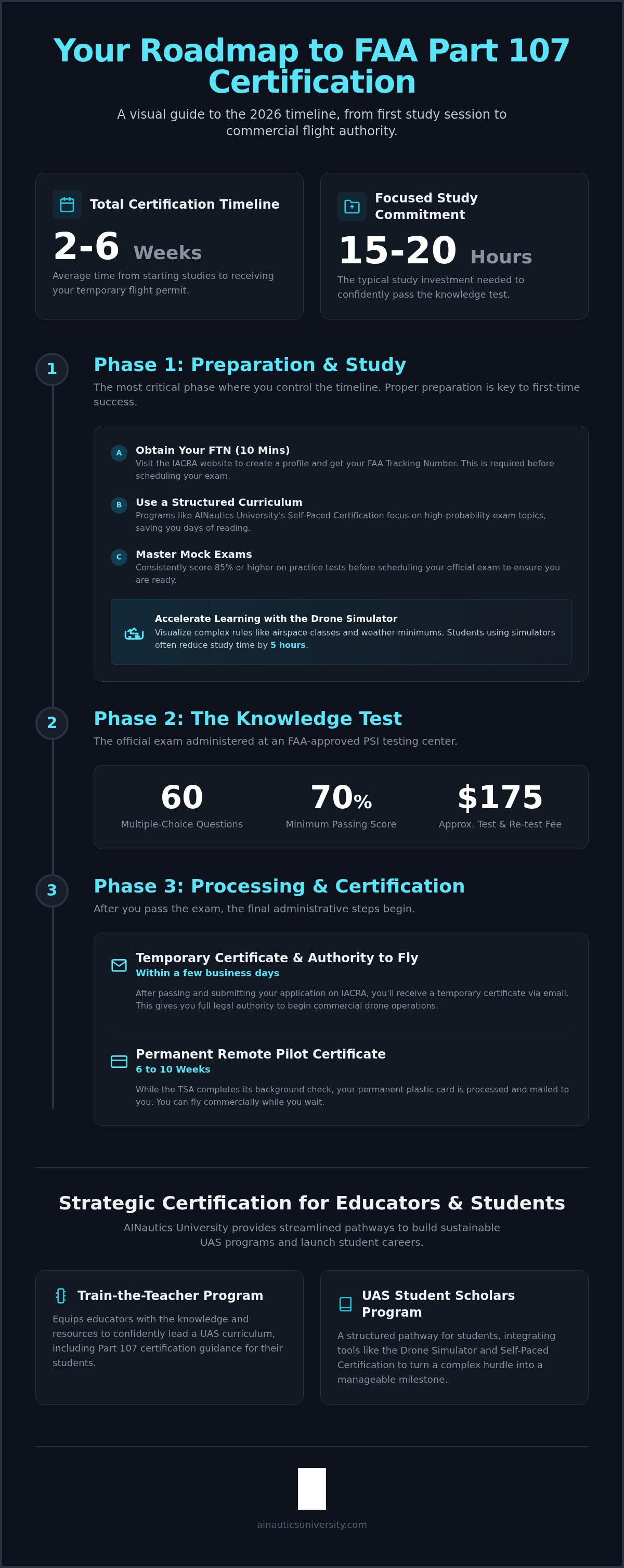
The FAA Part 107 license serves as the essential regulatory requirement for any individual or organization conducting commercial Unmanned Aircraft Systems (UAS) operations. When planning your career, the first question is usually how long to get Part 107 license. While the process is rigorous, the average candidate completes the entire journey in two to six weeks. This timeline varies based on your prior aviation experience and the intensity of your study schedule. In 2026, the certification process is divided into three distinct phases: comprehensive preparation, the formal knowledge test, and final FAA administrative processing.
The landscape has changed significantly since the early days of drone flight. Modern pilots must master updated regulations regarding Remote ID and evolving Beyond Visual Line of Sight (BVLOS) protocols. These additions mean that the 2026 exam requires a more disciplined approach to study than in previous years. Attempting to guess your way through the exam often leads to failure and a mandatory waiting period before re-testing. Success requires a commitment to understanding how these new technologies integrate into the national airspace.
Total Time Commitment: Hours vs. Days
Success on the knowledge test typically requires 15 to 20 hours of focused preparation. While it's possible to condense this into a single weekend, spreading your learning over 14 days significantly improves long-term retention. Using Part 107 drone training programs helps streamline this process by focusing on the exact concepts you'll face on exam day. Our Self-Paced Certification options allow you to build mastery at your own speed, ensuring you don't waste time on irrelevant material. For students in the UAS Student Scholars program, this structured approach turns a complex regulatory hurdle into a manageable milestone.
The 'License in Hand' vs. 'Authority to Fly' Distinction
A common point of confusion when calculating how long to get Part 107 license is the difference between passing the test and receiving your physical card. You don't have to wait for the mail to arrive before you start flying commercially. Once you pass your exam and submit your application through the IACRA portal, the FAA typically issues a Temporary Remote Pilot Certificate via email. This document grants you full legal authority to operate while the TSA completes its background check. While the permanent plastic card may take six to ten weeks to arrive at your door, your career can take flight within just a few business days of passing your exam.
Phase 1: Preparation and Study Time Requirements
The initial phase of your journey is where you have the most control over the clock. Determining how long to get Part 107 license starts with your study habits and administrative readiness. Before you open a textbook, you must complete a few foundational steps to ensure your progress isn't stalled by technicalities.
- Step 1: Obtain your FTN. Visit the IACRA website to create a profile and secure an FAA Tracking Number (FTN). This process takes about 10 minutes and is required before you can schedule any testing.
- Step 2: Select a structured curriculum. Don't attempt to digest raw regulatory text alone. A curated program highlights high-probability exam topics, saving you days of unnecessary reading.
- Step 3: Master mock exams. Use practice tests to identify knowledge gaps. Don't schedule your actual exam until you consistently score at least 85%.
- Step 4: Practice hands-on conceptualization. Connect theoretical rules, like right-of-way and cloud clearances, to real-world flight scenarios.
Leveraging the AINautics Drone Simulator for Faster Mastery
Abstract concepts like Class E airspace or weather minimums can be difficult to grasp through text alone. Our Drone Simulator allows students to visualize these complex environments in a risk-free virtual space. By flying through simulated airspace, you bridge the "abstraction gap" that often leads to confusion during the exam. Data from our UAS Student Scholars program suggests that students using simulators often require 5 fewer hours of textbook study because the concepts become intuitive through experience. This hands-on approach is a core part of our mission-driven instruction, ensuring you're ready for the field, not just the test.
Self-Paced Certification vs. Classroom Learning
When you ask how long to get Part 107 license, the answer depends heavily on whether you choose a self-guided or structured path. For working professionals, self-paced drone certification offers the flexibility to study during evening hours without sacrificing quality. The AINautics University platform tracks your progress automatically, helping you maintain momentum and stay on schedule. We recommend a 14-day study calendar: spend 60 to 90 minutes each night on specific modules. This steady rhythm beats "cramming" and ensures the information sticks for your long-term career. If you're ready to begin your professional journey, you can explore our comprehensive training modules to find the right fit for your schedule.
Phase 2: Scheduling and Taking the FAA Knowledge Test
Once your practice scores consistently hit the 85% mark, it's time to move from the desk to the testing center. This stage is a major factor in how long to get Part 107 license because it involves external scheduling. You must book your appointment through PSI Services, the FAA's exclusive testing partner. While some centers offer next-day appointments, you should generally expect a two to five day lead time for a seat. This is especially true in high-demand areas where professional pilot training is surging.
The exam itself consists of 60 multiple-choice questions. You have a strict two-hour time limit to complete the test. Most well-prepared students finish in under 90 minutes, leaving plenty of time to review flagged questions. The moment you submit your final answer, the computer generates your score. If you pass, you'll receive an Airman Knowledge Test Report (AKTR) featuring a raised seal and a unique 17-character ID code. This document is vital. You cannot complete your final FAA application without the information found on this report.
What to Expect on Testing Day
Arrive at the testing center at least 15 minutes early with a valid, government-issued photo ID. The proctor will provide you with the Airman Knowledge Testing Supplement, which is the same book of maps, charts, and legends you practiced with during your AINautics Part 107 Training. You aren't allowed to bring personal electronics, calculators with memory storage, or outside notes into the room. One common time-waster is over-analyzing the sectional charts. Use the legend provided in the supplement to verify symbols quickly rather than relying on memory alone. This methodical approach ensures you stay within the two-hour window without feeling rushed.
Factors That Influence Test Center Availability
National testing demand continues to rise as the FAA reports over 330,000 certified remote pilots nationwide. This growth means that Friday and Saturday slots fill up weeks in advance. To speed up your timeline, look for mid-week appointments on Tuesdays or Wednesdays. These days often have the most flexibility. A professional pro-tip is to create your PSI account and verify your FAA Tracking Number (FTN) before you finish your final study module. This allows you to view live seat availability in real-time. If you're an educator using our Train-the-Teacher Program, we recommend scheduling your cohort's testing dates as a block to ensure everyone moves through the pipeline together.
Phase 3: Post-Exam Processing and IACRA Wait Times
Passing the knowledge test is a major milestone, but your legal authority to fly commercially depends on the final paperwork. To finish the process, you must log back into the Integrated Airman Certification and Rating Application (IACRA) portal. Here, you'll start a new application for a remote pilot certificate. You'll need the 17-character ID number from your Airman Knowledge Test Report to link your exam results to your profile. This submission, known as Form 8710-13, is the official trigger for the FAA to begin their final review of your credentials.
The total duration of how long to get Part 107 license often hinges on this specific administrative window. Once you submit your application, the FAA coordinates with the TSA to perform a security vetting. If your application is straightforward, you can expect to receive your Temporary Remote Pilot Certificate via email within seven to ten business days. This digital document is fully valid for commercial work. While you can start flying immediately with the temporary permit, the physical plastic license takes longer. In 2026, most pilots receive their permanent card in the mail within six to eight weeks of their initial submission.
The TSA Background Check: The Unseen Variable
The TSA background check is the most unpredictable part of the certification timeline. While many applications clear the security vetting in 48 hours, others can take up to two weeks. The TSA checks for specific security risks and ensures that all applicants meet the federal safety standards for aviators. Delays often occur due to manual reviews triggered by simple errors. If your IACRA profile name doesn't match your government ID exactly, the system may flag your file for human intervention. Reviewing the specific Part 107 requirements before you file can help you avoid these common administrative traps.
Maintaining Your License: The 24-Month Recurrent Cycle
Your Remote Pilot Certificate doesn't expire, but your legal currency does. To keep your license active, you must complete free online recurrent training every 24 calendar months. The FAA has moved this process to an online portal, which eliminates the need to visit a testing center for renewals. This modern system ensures that your career momentum isn't interrupted by long wait times every two years. We recommend keeping your IACRA login information in a secure place. You'll need those exact credentials to log your training in 2028 and maintain your professional status. If you want to ensure your skills remain sharp between these cycles, explore our UAS Student Scholars program for ongoing educational support.
Strategic Certification for Educators and Career-Bound Students
Schools and workforce development centers often face a more complex question than the individual pilot. Determining how long to get Part 107 license for an entire classroom requires a strategic framework that balances academic standards with federal timelines. AINautics University addresses this through our 90-Day Program Launch. This framework helps educational institutions move from zero to a fully certified cohort within a single semester. By providing a structured roadmap, we ensure that schools don't get bogged down in administrative hurdles that typically stall UAS initiatives.
Success in the classroom starts with the instructor. Our Train-the-Teacher Program empowers educators with the specialized knowledge needed to lead Part 107 cohorts with confidence. To accelerate student engagement, we deploy the VR Trailer Mobile Lab. This immersive environment allows students to experience complex flight scenarios before they ever touch a real controller. When paired with the Drone Simulator, these tools reduce the learning curve and ensure students are prepared for the rigors of the FAA knowledge test.
Integrating Part 107 into the School Year
Educators must decide between a semester-long integration or an intensive boot camp model. A semester-long course allows for deep dives into STEM and Career and Technical Education (CTE) pathway standards. This slower pace provides ample time for students to master the 15 to 20 hours of study material required for the exam. Managing 30 or more student applications simultaneously can be daunting. Our platform streamlines this by tracking individual progress, ensuring every student stays on the timeline to receive their credentials before graduation. This methodical approach ensures that the question of how long to get Part 107 license is answered by the school calendar rather than administrative delays.
The AINautics Ecosystem: Learn to Work
The journey doesn't end with a plastic card in the mail. Our UAS Student Scholars program is designed to move learners through a pipeline that reduces friction as they enter the workforce. We focus on a clear progression: Learn, Train, Certify, and Fly. By the time a student enters the professional marketplace, they have already moved beyond basic certification into specialized mastery. We bridge the gap between classroom theory and real-world application, positioning our graduates as future-ready innovators in the drone industry. This comprehensive ecosystem ensures that the path from student pilot to specialized professional is clear, direct, and efficient.
Take Command of Your Aviation Future
Becoming a certified remote pilot is a structured journey that transforms you from a hobbyist into a professional aviator. Understanding how long to get Part 107 license allows you to plan your career milestones with precision. Whether you are an individual pursuing Self-Paced Certification or an educator looking for our 90-Day Program Launch framework, the path to the skies is clear. By leveraging tools like our advanced Drone Simulator, you can reduce study fatigue and enter the testing center with the confidence of an industry leader.
As an SDVOSB certified organization and proud AUVSI member, AINautics University is committed to your long-term success. We provide the mission-driven instruction you need to navigate FAA regulations and master the technical demands of the 2026 landscape. We guarantee a 90-Day School Program Launch to ensure your institution stays ahead of the curve. Your future in Unmanned Aircraft Systems starts with a single, decisive step toward mastery.
Enroll in AINautics University Part 107 Training to begin your professional journey today. The horizon is waiting for you to lead.
Frequently Asked Questions
How many hours should I study for the Part 107 exam?
You should plan for 15 to 20 hours of focused study to ensure success. This timeframe allows you to digest complex regulations and airspace classifications without rushing. Using AINautics University's Self-Paced Certification tools can help you organize these hours effectively. Spreading your learning over two weeks improves retention compared to a single weekend of cramming. Most students find that a consistent nightly routine is the most efficient path to mastery.
Can I take the Part 107 test online in 2026?
No, the initial FAA Part 107 Knowledge Test must be taken in person at an authorized PSI testing center. While the FAA has modernized many administrative steps, the security of the initial exam still requires a proctored environment. You can use the online portal only for your free recurrent training every 24 months. To minimize travel time, create your PSI account early to find the closest location with available seats for your preferred date.
What happens if I fail the drone license exam?
If you don't pass, you are required to wait 14 days before attempting the test again. You must also pay the $175 testing fee for each new attempt. To avoid these delays and costs, we recommend using the AINautics Drone Simulator to build practical understanding before your appointment. High practice scores on mock exams are the best indicator that you are ready to pass on your first try.
How long does the physical Part 107 card take to arrive by mail?
The physical plastic Remote Pilot Certificate typically arrives by mail within 6 to 10 weeks after your IACRA application is processed. However, you don't need to wait for the mail to begin your career. Your temporary certificate is usually available for download within 7 to 10 business days. This digital permit allows you to fly commercially while the FAA finishes printing and shipping your permanent card.
Is there a way to fast-track my FAA background check?
There is no official expedited service for the TSA background check, but you can prevent unnecessary delays by ensuring your data is perfect. Any mismatch between your government ID and your IACRA profile can trigger a manual review, adding weeks to your timeline. When you enroll in our Part 107 Training, we guide you through the application process to ensure every field is filled out correctly. Accuracy is the only real way to speed up the system.
Do I need to renew my Part 107 license every two years?
Yes, you must maintain your currency every 24 calendar months to remain a legal commercial pilot. The process has become much simpler recently. You no longer need to visit a testing center or pay a fee for renewals. Instead, you complete a free online training course through the FAA safety website. Our UAS Student Scholars program helps graduates stay informed about these regulatory shifts so they never miss a renewal window.
How much does it cost to get a Part 107 license in 2026?
The primary out-of-pocket cost is the $175 fee paid directly to the PSI testing center for the knowledge exam. Additionally, you must pay $5 to register each drone you intend to fly commercially. These federal fees are separate from any educational resources you choose. Investing in professional training can actually save you money by preventing expensive re-tests. Determining how long to get Part 107 license often depends on how well you budget for these initial steps.
Can high school students get their Part 107 license?
Yes, high school students who are at least 16 years old are eligible to earn their Remote Pilot Certificate. This is a powerful way for young learners to build a resume in a high-growth technology field. Our UAS Student Scholars program is specifically designed to help students navigate the certification timeline alongside their schoolwork. By starting early, students can enter the workforce with a professional credential already in hand.

Article by
AINautics University Team
The team behind AINautics University, dedicated to drone education and FAA Part 107 certification prep, VR flight simulation, and STEM training programs for students and educators.


