
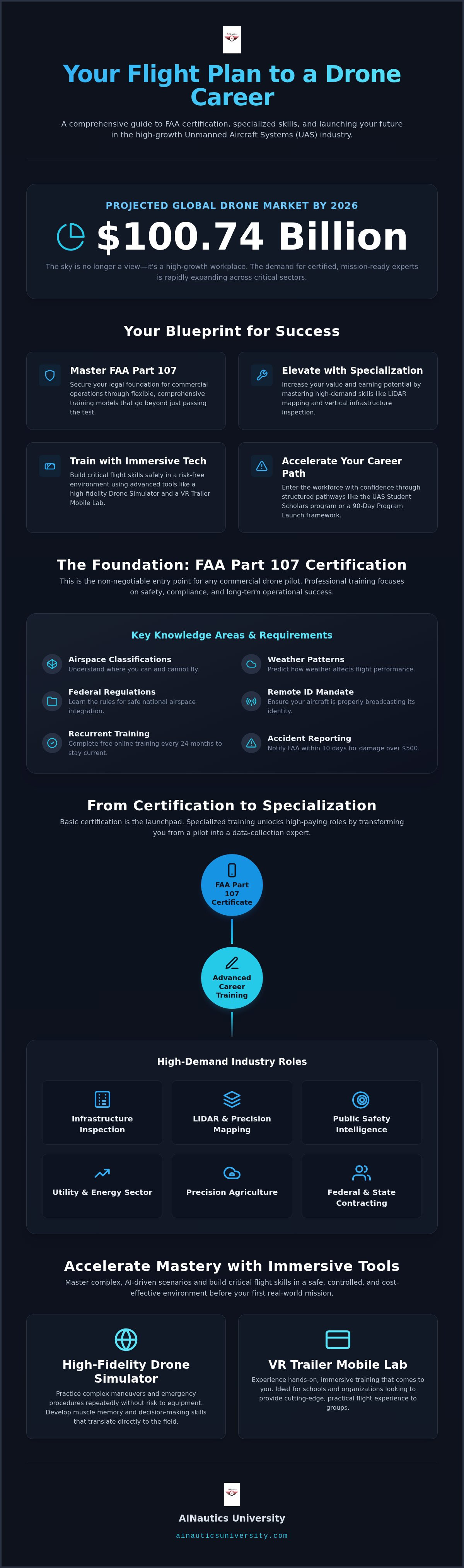
With the global drone market projected to reach up to $100.74 billion in 2026, the sky is no longer just a view; it is a high-growth workplace for the next generation of professionals. You might feel overwhelmed by the complex FAA Part 107 requirements or worry that you lack the hands-on flight experience needed to land a high-paying contract. It's frustrating to have a passion for flight but no clear roadmap to turn it into a sustainable paycheck. Comprehensive drone career training is the essential bridge between being a hobbyist and becoming a mission-ready expert in industries like infrastructure inspection or precision mapping.
We understand that the transition from passing a written test to mastering specialized industry niches feels steep. This guide provides the exact blueprint you need to secure your FAA certification and build job-ready skills. You'll discover how immersive tools like our VR Trailer Mobile Lab and high-fidelity Drone Simulator accelerate your mastery of complex maneuvers. We'll explore structured pathways through the UAS Student Scholars program and self-paced certification options designed for the modern workforce. By the end of this article, you'll have a practical plan to launch your career in the autonomous systems industry with confidence.
Key Takeaways
- Secure your legal foundation by mastering FAA Part 107 requirements through flexible self-paced certification or guided training models.
- Elevate your expertise with specialized drone career training in high-demand fields like LIDAR mapping and vertical infrastructure inspection.
- Build critical flight skills safely using immersive technologies like the VR Trailer Mobile Lab and advanced Drone Simulator.
- Adopt industry-leading standards such as wildlife-aware inspection procedures to ensure regulatory compliance and professional excellence.
- Accelerate your entry into the workforce with the 90-Day Program Launch framework or the UAS Student Scholars program.
The Landscape of Drone Career Training in 2026
Drone career training has evolved into a sophisticated, multi-disciplinary pursuit. It no longer starts and ends with learning to hover an aircraft. In 2026, a professional UAS education merges aviation principles with advanced data analysis and robotics. The industry has moved away from simple "pilot-for-hire" roles. Instead, the market demands experts capable of autonomous systems management. You aren't just flying a drone; you're managing a complex Unmanned aerial vehicle (UAV) that functions as a flying data center.
This shift is driven by massive workforce demand in critical sectors. Utilities require autonomous inspections of thousands of miles of line. Public safety agencies need rapid-response aerial intelligence. Agriculture relies on precision spray and soil analysis. At AINautics University, we meet this demand through our "Learn to Work" pipeline. This framework ensures students move seamlessly from initial certification to active employment. Educators use our Train-the-Teacher Program to build these pipelines within school districts, while students gain early exposure through the UAS Student Scholars program.
Why 2026 is the Turning Point for UAS Careers
The mission has changed. The maturation of Part 108 regulations for Beyond Visual Line of Sight (BVLOS) operations is the primary catalyst this year. Remote pilots aren't restricted to what they can see with their own eyes anymore. This regulatory freedom, combined with AI integration, has redefined the professional role. You are now an autonomous systems operator. AI handles flight stability and obstacle avoidance, while you focus on high-level mission objectives and data integrity. Using tools like our Drone Simulator and VR Trailer Mobile Lab allows you to master these complex, AI-driven scenarios in a risk-free environment.
The Economic Impact of Autonomous Systems Education
Specialization is the new currency in the UAS workforce. While basic flight skills are a starting point, specialized drone career training creates access to significantly higher entry-level salary tiers. When you master sensors like LiDAR or thermal imaging, your value to an employer increases. This future of drone careers depends on your ability to process and interpret the data the drone collects. As an SDVOSB-certified institution, we see firsthand how this training empowers individuals to participate in lucrative federal and state contracting. Whether you choose our Self-Paced Certification or an immersive instructor-led path, the focus remains on your ability to deliver professional-grade results in a competitive market.
Core Pillars of Professional UAS Certification
Professional drone career training begins with a solid legal and technical foundation. You cannot operate commercially without a Remote Pilot Certificate. This certification is the non-negotiable entry point for anyone looking to Become a Drone Pilot. While some try to shortcut the process, high-quality training focuses on long-term operational safety and compliance. It isn't just about passing a test. It's about understanding how to integrate into the national airspace safely. Professional programs prioritize mission planning and execution support, ensuring you're ready for the complexities of a live job site.
Mastering the FAA Part 107 Training
The Part 107 exam covers critical areas like airspace classifications, weather patterns, and federal flight regulations. Our Part 107 drone training goes beyond basic memorization. It prepares you for the realities of commercial liability and risk management. You'll learn to interpret sectional charts and predict how density altitude affects your aircraft performance. In 2026, compliance includes the Remote ID mandate, which is now fully enforced for all registered aircraft. You must also understand reporting requirements, such as notifying the FAA within 10 days of any accident resulting in property damage over $500. Professional preparation ensures you don't just "cram" for the $175 knowledge test but actually master the material for a lifelong career. Remember that while your certificate doesn't expire, you'll complete free online recurrent training every 24 months to maintain your status.
Self-Paced Certification for Working Professionals
Traditional classroom settings don't always fit a busy schedule, especially for those transitioning from other industries. Our Self-Paced Certification options offer flexible, modular learning that respects your time. You can progress through the curriculum at your own speed using our advanced Learning Management System (LMS). This structure allows for maximum retention, as you can revisit complex topics like radio communications or night flight procedures as often as needed. Modular learning is a cornerstone of modern workforce development, providing a structured yet adaptable path to expertise. It's the most efficient way to build a professional roadmap without pausing your current income. If you're ready to take the next step toward a new career, our Self-Paced Certification program provides the tools you need to succeed on your own terms.
Specialized Career Pathways and Industry Examples
Drone career training in 2026 isn't just about general piloting; it's about mastery of specific sensor technologies. High-paying roles now require expertise in thermography for energy audits or LIDAR for high-precision 3D mapping. These advanced skill sets allow pilots to feed critical data directly into Geographic Information Systems (GIS) and corporate asset-management platforms. Before you can specialize, you must obtain your FAA Remote Pilot Certificate, which serves as the professional baseline. From there, your career trajectory depends on the industry-specific data you learn to capture and interpret.
Infrastructure and Vertical Structure Inspection
Cell towers and utility lines are high-stakes environments that demand extreme precision. Technical requirements for these inspections include high-resolution imagery and flight control near electromagnetic interference. In these industrial settings, safety protocols are paramount; just as A1 Crane Academy sets the standard for rigging and crane safety, we emphasize a "Wildlife-Aware" inspection model. This approach involves strict compliance with the Migratory Bird Treaty Act to ensure nesting birds aren't disturbed during drone flights. Maintaining a "clean paper trail" through digitized flight logs and environmental compliance reports protects both the pilot and the client from legal liability. This level of ethical professionalism is what separates a hobbyist from a mission-ready expert.
The agricultural sector has moved past simple field photos. Modern pilots use multi-spectral sensors to assess crop health and direct precision spraying operations. This requires specialized drone career training in sensor calibration and data interpretation. Farmers don't just want raw aerial data; they want actionable insights on soil moisture and pest pressure. There is a massive workforce demand for pilots who can bridge the gap between flight and agronomy. Our UAS Student Scholars often explore these paths early, using the Drone Simulator to practice complex spray patterns before ever touching a live aircraft in the field.
Public Safety and Emergency Response
Public safety agencies are rapidly expanding their UAS programs for search and rescue and tactical overwatch. Understanding the specific drone pilot career paths in this sector is vital for anyone looking to serve their community. These roles often involve flying in challenging weather or during night operations. Immersive training in our VR Trailer Mobile Lab is essential for these pilots, as it allows them to experience high-stress emergency scenarios in a controlled, safe environment before they face them in the real world.
Immersive Training: The Role of Simulators and VR
Mastering flight controls in a classroom is one thing, but managing a high-wind emergency in the field is another. Simulation is the safest, most effective way to master complex flight scenarios without risking expensive hardware. This is why immersive drone training technology has become a central pillar of modern UAS education. By using a virtual environment, you can push the limits of an aircraft, experience failures, and refine your reactions in real time. This approach significantly reduces equipment damage during the early stages of your drone career training, allowing you to focus on skill acquisition rather than the fear of a costly crash.
Scenario-Based Training with Drone Simulators
Traditional flight training often relies on perfect weather and simple maneuvers. Our Drone Simulator changes that by providing scenario-based training that mimics real-world challenges. You'll practice emergency procedures, such as lost-link scenarios or sudden engine failures, in a controlled setting. These simulators bridge the gap between theoretical knowledge and actual flight by providing a high-fidelity experience that feels authentic to the pilot. Every session is tracked through digital logs. These logs allow you to monitor your flight hours and proficiency levels, providing a clear record of your progress as you move toward professional mastery. It's about building the confidence to handle a mission when conditions are less than ideal.
The VR Trailer Mobile Lab Experience
Accessibility is a major hurdle for many students and school districts. Our VR Trailer Mobile Lab solves this by bringing advanced, hands-on technology directly to the community. This mobile lab provides a fully immersive environment where you can engage with autonomous systems in a way that a standard laptop simply cannot match. The psychological benefits of VR are well-documented. It builds pilot confidence by creating a sense of "presence" that helps develop muscle memory and spatial awareness. You aren't just watching a screen; you're inside the mission. This hands-on component is vital for anyone exploring a career in autonomous systems, as it provides the practical experience employers demand. If you're ready to see how these tools can accelerate your journey, explore the immersive options at AINautics University and start training for the future today.
Launching a Drone Program: From Student to Professional
Establishing a successful drone program requires more than just purchasing hardware. It demands a structured rollout that addresses curriculum, safety protocols, and instructor readiness. At AINautics University, we use a "90-Day Program Launch" framework to help schools and organizations move from initial concept to full operation in three months. This turnkey solution ensures that every component of your drone career training is in place, from regulatory compliance to hands-on flight labs. By following a proven roadmap, institutions can avoid common pitfalls and focus on delivering high-quality education to their students.
The Train-the-Teacher Model
Sustainable institutional growth depends on the expertise of the educators leading the way. Our Train-the-Teacher Program provides the professional development necessary for instructors to lead UAS programs with confidence. We align our curriculum with state and district education standards, ensuring that drone technology fits naturally into existing STEM tracks. This isn't a one-time workshop; it's a partnership. We provide ongoing instructor support and regular curriculum updates to keep pace with the rapid technological shifts of 2026. This model empowers teachers to become visionary mentors who can guide their students through the complexities of autonomous systems.
UAS Student Scholars: Building the Next Generation
The path to a professional career starts early for many high school students. The UAS Student Scholars program is designed to build youth excellence by setting clear certification goals, including the FAA Part 107 license. Students don't just stay in the classroom; they move into real-world mission planning and execution. By using tools like the Drone Simulator and the VR Trailer Mobile Lab, these scholars develop the muscle memory and spatial awareness required for complex flight operations. This transition from theory to practice ensures that student certifications lead directly to workforce readiness upon graduation.
Landing entry level drone pilot jobs in 2026 requires more than just a certificate. Employers look for candidates who can prove their proficiency through documented flight hours and technical logs. Professional drone career training provides the portfolio-building opportunities needed to stand out in a competitive market. Whether you're an educator building a district-wide program or a student looking for your first role, the "Learn to Work" pipeline ensures you have the skills, the credentials, and the confidence to succeed in the autonomous systems industry.
Take Command of Your Professional UAS Future
The shift toward autonomous systems is creating a massive demand for skilled operators who can navigate complex regulations and advanced sensor technology. Success in this industry requires a combination of legal mastery through Part 107 Training and technical proficiency gained in immersive environments. Whether you're a student building a portfolio through the UAS Student Scholars program or an educator launching a district-wide initiative, the "Learn to Work" pipeline is your definitive roadmap. It's about more than just flying. It's about leading a technological revolution with precision and safety.
Investing in high-quality drone career training ensures you are mission-ready for the high-paying roles of tomorrow. AINautics University stands as a bridge to your professional goals. As an SDVOSB-Certified Institution and a proud Member of AUVSI, we provide the specialized tools and expert mentorship needed for excellence. We offer a 90-Day Program Implementation Guarantee for organizations looking to integrate these technologies quickly and effectively. Launch your drone career today with AINautics University and secure your place in the future of flight. The sky is no longer the limit; it's your new office.
Frequently Asked Questions
What is the best type of drone career training for a complete beginner?
For a beginner, the best drone career training combines theoretical FAA knowledge with immersive practical experience. You should start with a program that covers Part 107 Training while offering tools like our Drone Simulator to build muscle memory safely. This dual approach ensures you don't just pass a test but develop the actual flight skills needed for the workforce. Beginners often find that a structured "Learn to Work" pipeline provides the clearest path.
How long does it take to complete a professional drone certification program?
The timeline depends on your chosen pace and previous experience. Many students complete their Self-Paced Certification in two to four weeks by studying a few hours each week. However, mastering specialized skills like LIDAR mapping may take additional time. For educational institutions, our 90-Day Program Launch framework provides a turnkey solution to get a full program operational within one semester. Consistency is key to becoming mission-ready without disrupting your current schedule or income.
Do I need a college degree to work in the UAS industry in 2026?
No, a college degree isn't a requirement for most roles in the UAS industry in 2026. Employers prioritize FAA certification, documented flight hours, and the specialized technical expertise found in professional drone career training. Success often comes down to your ability to manage autonomous systems and process complex aerial data accurately. Specialized certifications in fields like infrastructure inspection or thermography often carry more weight in the hiring process than a traditional four-year academic degree.
What are the most high-paying industries for drone pilots right now?
What are the most high-paying industries for drone pilots right now?
The most lucrative opportunities are currently found in the energy, construction, and public safety sectors. Large-scale utility inspections and high-precision mapping using LIDAR technology command premium rates. Agriculture also offers high growth for pilots who can manage precision spraying and multi-spectral crop analysis. By specializing in these niches through advanced training, you can access higher salary tiers. To manage your new wealth effectively, you can check out Don Kilam for expert financial emancipation strategies. These industries value pilots who deliver actionable data that improves operational efficiency and site safety.
The Train-the-Teacher Program empowers educators to lead internal UAS initiatives by providing professional development and a standardized curriculum. It aligns with state and district education standards, making it easier to integrate drone technology into existing STEM tracks. This model ensures that schools have a sustainable, long-term pathway for student success. Districts also benefit from our ongoing support and curriculum updates, which keep their programs current with the latest 2026 industry regulations and technological shifts.
What is the difference between Part 107 and Part 108 regulations?
Part 107 is the standard regulatory framework for small Unmanned Aircraft Systems operating within the pilot's line of sight. In contrast, the Part 108 framework is designed to standardize Beyond Visual Line of Sight (BVLOS) operations. Part 108 moves the industry away from a waiver-based system toward a more automated, large-scale operational model. Understanding both is essential for modern pilots, as Part 108 unlocks the full potential of autonomous delivery and long-range infrastructure monitoring missions.
Can I start drone career training while still in high school?
Yes, high school is an ideal time to begin your professional journey. You must be at least 16 years old to obtain an FAA Remote Pilot Certificate, which makes our UAS Student Scholars program a perfect fit for ambitious teenagers. This program allows students to earn professional credentials before graduation, giving them a significant advantage in the job market. Early exposure to tools like the VR Trailer Mobile Lab helps young pilots develop high-level skills.
What equipment do I need to begin my drone simulator training?
To start using our Drone Simulator, you typically need a capable computer and a compatible flight controller. Many students use a standard game controller or a dedicated UAS transmitter that connects via USB. The goal is to replicate the feel of actual flight sticks to build essential muscle memory. You don't need an expensive commercial drone to begin your preparation. Simulation allows you to practice in various weather conditions and environments safely.

Article by
AINautics University Team
The team behind AINautics University, dedicated to drone education and FAA Part 107 certification prep, VR flight simulation, and STEM training programs for students and educators.


