
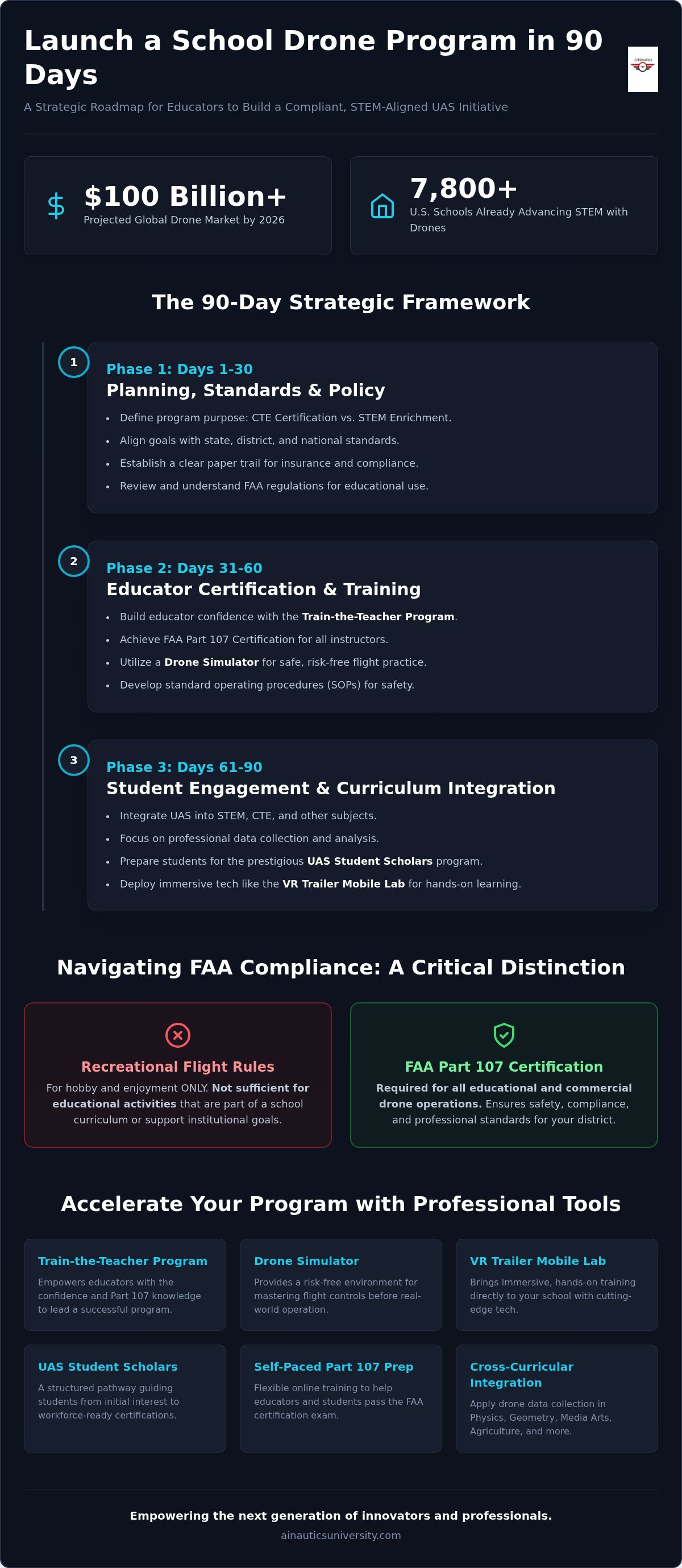
With the global drone market projected to exceed $100 billion in 2026, over 7,800 U.S. schools have already begun the flight toward advanced STEM education. However, many educators still feel grounded by the fear of regulatory non-compliance or a lack of confidence behind the controls. Learning how to integrate drones into classroom settings shouldn't feel like navigating a storm without a map.
You likely want to provide your students with workforce-ready skills but worry about aligning activities with state standards or mastering the FAA Part 107 requirements. It's a common challenge to bridge the gap between classroom theory and professional application. This guide provides a professional framework to launch a compliant, STEM-aligned drone program in your school within 90 days. You'll discover how to move from initial planning to student excellence using tools like our Train-the-Teacher Program and the immersive VR Trailer Mobile Lab.
We'll break down the 2026 regulatory landscape, explore how to use a Drone Simulator for risk-free training, and outline the path to the prestigious UAS Student Scholars certification. This roadmap ensures your program is safe, scalable, and focused on the future of the UAS industry.
Key Takeaways
- Master a structured 90-day roadmap that prioritizes strategic planning and compliance over hardware purchases to ensure long-term program success.
- Understand the critical legal distinctions between recreational flight and professional Part 107 standards to keep your school district fully compliant with FAA regulations.
- Learn how to integrate drones into classroom curricula across multiple subjects using professional data collection methods that align with state STEM and CTE standards.
- Build educator confidence through specialized initiatives like the Train-the-Teacher Program and risk-free flight training using a Drone Simulator.
- Accelerate student achievement and workforce readiness by preparing learners for industry-standard certifications and the UAS Student Scholars program.
Empowering the Next Generation: Why Drones Belong in Your Classroom
In 2026, an unmanned aerial vehicle (UAV) is no longer just a high-tech gadget. It's a precision instrument driving the global economy. As industries from agriculture to infrastructure inspection embrace autonomous technology, Unmanned Aircraft Systems (UAS) have become a cornerstone of modern workforce development. Educators are finding that learning how to integrate drones into classroom environments is the most effective way to prepare students for these high-demand roles. This shift represents a transition from viewing drones as hobbyist tools to recognizing them as essential career-building blocks.
Drones act as a powerful engagement hook that captures student interest in a way traditional textbooks cannot. They transform passive learning into active, mission-driven exploration. While students might initially be drawn to the thrill of flight, the educational landscape in 2026 has matured. We focus on moving from flying for fun to flying for a career. Adopting a professional drone curriculum for educators is the first step. This framework provides the structure needed to turn a simple flight activity into a comprehensive lesson on data collection, analysis, and professional ethics.
Bridging the STEM Gap with Autonomous Systems
The demand for certified pilots is surging across sectors like public safety, media, and industrial inspection. By understanding how to integrate drones into classroom settings, schools create a direct pipeline to these lucrative fields. Programs like our UAS Student Scholars initiative provide a structured pathway to professional excellence. We help students foster an early interest in autonomous systems, moving them toward workforce-ready certifications. This isn't just about learning a skill. It's about securing a place in the future economy. Schools that implement these programs today are giving their students a significant competitive advantage in the job market of tomorrow.
The 90-Day Roadmap: A Strategic Framework for Program Rollout
Launching a sustainable Unmanned Aircraft Systems (UAS) initiative requires more than just buying technology. Many districts rush to purchase hardware only to find it gathering dust because of a lack of operator confidence or regulatory confusion. Our "Launch a Drone Program in 90 Days" framework shifts the focus from hardware to strategy. This structured approach ensures that you understand how to integrate drones into classroom environments while maximizing budget efficiency and minimizing institutional liability.
Phase 1: Planning, Standards, and Policy
Success begins with a clear definition of your program's purpose. Are you aiming for Career and Technical Education (CTE) certification or middle school STEM enrichment? Identifying stakeholders early helps align your goals with state and district standards. It's vital to establish a clean paper trail for insurance and compliance from day one. This includes reviewing FAA regulations for educational drone use to ensure every flight meets federal safety requirements. For a deeper look at the initial setup, explore our guide on How to Start a Drone Program in School.
Phase 2: Teacher Certification and Training
Educator anxiety is the most common barrier to program success. We address this through our Train-the-Teacher program, which builds mastery in both flight skills and instructional delivery. We recommend that teachers pursue FAA Part 107 certification even if they plan to fly primarily indoors. This credential establishes a professional standard and provides a foundational understanding of airspace that is critical for student safety. Ongoing professional development ensures the program remains current as technology evolves toward 2027 and beyond.
Phase 3: Student Engagement and Flight Operations
The final phase transitions students from digital environments to live flight operations. We start with high-fidelity simulations to build muscle memory before moving to a controlled outdoor environment. This is where mission-driven instruction takes center stage. Mission-driven instruction is a method where students solve specific problems using aerial data. By mastering how to integrate drones into classroom settings, you create a dynamic learning environment that prepares students for the 2026 workforce. If you're ready to empower your faculty, consider starting with our specialized Train-the-Teacher Program to lead this transformation.
Cross-Curricular Mastery: Practical Ideas for Every Subject
Understanding how to integrate drones into classroom settings involves seeing the technology as a cross-curricular bridge rather than a standalone elective. In 2026, the most successful programs use Unmanned Aircraft Systems (UAS) to meet existing curriculum requirements, ensuring that drone activities enhance rather than distract from core learning objectives. This approach relies on professional-grade data collection methods to ground every lesson in real-world utility, making the technology a natural extension of the modern educational toolkit.
STEM and Technical Applications
In mathematics, drones provide a tangible way to explore geometry and algebra. Students calculate flight paths, estimate battery endurance based on payload, and use photogrammetry ratios to measure distance and area from aerial imagery. Science classes can leverage drones for environmental monitoring. By following wildlife-aware procedures, students collect atmospheric data or track local plant health without disturbing ecosystems. Physics students analyze the mechanics of autonomous flight, studying the relationship between lift, drag, and weight. These activities align with FAA rules for educational drone use, ensuring that all data collection remains safe and compliant while meeting rigorous academic standards.
Creative Arts and Humanities
The utility of UAS technology extends far beyond the science lab. Digital media students capture raw aerial footage, learning the post-production skills required for professional cinematography and marketing. In geography and history, drones create high-resolution orthomosaic models of local terrain or historical sites, allowing students to map their communities with centimeter-level accuracy. Literature teachers can use "from above" perspectives as prompts for creative storytelling or documenting human impact on the landscape. This breadth of application is essential when deciding how to integrate drones into classroom environments, as it ensures every student finds a point of connection with the technology regardless of their primary interest. To further encourage hands-on creativity and problem-solving beyond the drone lab, students can explore AI-driven DIY projects with I CRAFT MY CRAFT, which helps them create innovative crafts using everyday materials.
Differentiated learning is key to classroom success. By utilizing our Self-Paced Certification options, educators allow students to progress through technical material at their own speed. This flexibility ensures that those pursuing the UAS Student Scholars program can dive deeper into advanced topics while others focus on foundational skills. Using tools like the Drone Simulator or the VR Trailer Mobile Lab provides immersive experiences that accommodate various learning styles, making professional UAS training accessible and engaging for everyone.
Compliance is the backbone of any sustainable aeronautical program. When administrators ask how to integrate drones into classroom environments, safety must be the first answer provided. Operating a drone is more than a simple flight activity; it's an operation within the National Airspace System. Failure to adhere to federal standards exposes a school district to significant liability and potential fines. By building a program rooted in regulatory mastery, you protect your students, your staff, and your school's reputation.
The Legal Framework: Part 107 vs. TRUST
The FAA distinguishes between recreational and commercial drone operations. Students typically fly under the Exception for Limited Recreational Operations, which requires them to pass The Recreational UAS Safety Test (TRUST). However, educators directing these programs must hold an FAA Part 107 Remote Pilot Certificate to maintain professional standards. The FAA Part 107 is the regulatory requirement for any flight that is not purely for recreation. This certification ensures teachers understand complex airspace, weather patterns, and emergency procedures. Compliance also extends beyond the FAA; schools must respect environmental laws like the Migratory Bird Treaty Act, which prohibits disturbing nesting birds during flight operations. Our Professional FAA Part 107 Drone Training provides the comprehensive knowledge needed to navigate these legal complexities.
Building a Culture of Safety
Professionalism in the classroom should mirror professionalism in the field. Establishing Standard Operating Procedures (SOPs) for classroom flight labs creates a predictable and safe learning environment. Students should be trained to use pre-flight checklists and formal mission planning tools, just like commercial pilots in the construction or public safety sectors. These protocols don't just prevent accidents. They prepare students for the rigorous demands of industry careers. When you understand how to integrate drones into classroom settings with a safety-first mindset, you transform a high-tech tool into a disciplined career pathway. Operational safety services and structured training protect the district's investment while fostering a culture of excellence. If you're ready to establish a compliant program, explore our Part 107 Training to get started today.
Scaling Excellence: Leveraging Professional Training and Immersive Tech
Scaling a program effectively requires moving beyond basic flight drills toward high-fidelity, immersive experiences. In 2026, the most successful districts don't just add more hardware. They invest in tools that accelerate the learning curve while protecting their budget. When educators master how to integrate drones into classroom environments using advanced technology, they create a bridge between academic theory and the high-stakes reality of commercial UAS operations. This professional approach ensures that students aren't just playing with technology; they're mastering a trade.
Immersive Learning: Simulators and VR
The transition from a classroom to the flight line can be intimidating for both teachers and students. We bridge this gap using the AINautics Drone Simulator, which provides a risk-free environment to master complex flight controls. Scenario-based training in a simulator builds critical muscle memory without the financial risk of equipment damage. Students can practice emergency procedures and precision maneuvers a thousand times before ever touching a live controller. This foundation is further enhanced by Immersive Drone Training Technology, which uses virtual reality to help students visualize complex autonomous systems and internal sensor mechanics.
For schools that want to bring these high-tech experiences directly to their campus, the VR Trailer Mobile Lab serves as a turnkey solution. It provides a professional-grade environment where students engage with the latest UAS tools in a mobile, high-engagement setting. This immersive approach is a core component of how to integrate drones into classroom settings at scale. You can learn more about bringing these resources to your district in our guide on the Mobile Drone Lab for Schools.
Long-Term Program Sustainment
A drone program's success shouldn't depend on a single motivated teacher. Long-term sustainment requires a system of ongoing curriculum updates and peer-to-peer support. We recommend the UAS Teacher Scholars model, where certified educators mentor their colleagues across the district. This creates a self-sustaining ecosystem of expertise that survives staff transitions. As technology evolves toward 2027, staying connected to workforce marketplace trends is essential for graduating students. By focusing on workforce-ready certifications, schools ensure their program remains relevant and provides a clear return on investment for the community. Scaling excellence means building a legacy of technical mastery that prepares every student for the autonomous future.
Take Flight: Building the Future of UAS Education
The transition from recreational flying to professional workforce development is the defining shift for schools in 2026. By following a structured 90-day roadmap, your district can move beyond simple flight drills to create a compliant, high-impact learning environment. You now have the tools to bridge the gap between classroom theory and industry reality through strategic planning, teacher mastery, and immersive simulation technology.
Learning how to integrate drones into classroom settings doesn't have to be a solo journey. As an SDVOSB certified provider with a STEM-aligned curriculum and nationwide training support, we're here to guide your school toward long-term success. Whether you're building a new CTE pathway or enhancing an existing science lab, the focus must remain on preparing students for the autonomous economy.
Are you ready to transform your campus into a hub for technological innovation? Launch your school’s drone program in 90 days with AINautics University. It's time to empower your students with the skills they need to lead the next generation of aviation.
Frequently Asked Questions
Do teachers need a special license to fly drones in the classroom?
Teachers should obtain an FAA Part 107 Remote Pilot Certificate to oversee educational programs legally. While students often operate under recreational exceptions, the instructor acts as the professional lead for the district. Our Train-the-Teacher Program is designed to help educators master these regulations while building flight proficiency. This ensures the school maintains a high standard of safety and professionalism during every lesson, regardless of whether the flight occurs indoors or outside.
What is the difference between FAA Part 107 and the TRUST test for schools?
Part 107 is the professional certification required for any non-recreational drone operation, including most school-directed activities. In contrast, the TRUST test is a basic safety requirement for recreational flyers. Understanding this distinction is vital when learning how to integrate drones into classroom environments. We provide specialized Part 107 Training to ensure faculty members meet federal standards, while students can focus on developing their skills through the UAS Student Scholars program.
Can we fly drones indoors without FAA authorization?
The FAA does not govern indoor airspace, so formal flight authorizations like LAANC aren't required for gymnasium or classroom flights. However, schools must still implement strict internal safety protocols to protect students and equipment. We recommend starting with a Drone Simulator to build basic skills before moving to indoor flight. This approach reduces the risk of hardware damage while allowing students to practice complex maneuvers in a controlled, non-regulated environment.
How much does it cost to start a drone program in a high school?
Initial costs depend on your choice of immersive technology, such as the VR Trailer Mobile Lab, and the number of students enrolled. A structured approach typically includes investments in curriculum, teacher certification, and flight simulators. By using our 90-day framework, districts can avoid wasting funds on unnecessary hardware. Instead, focus on high-value resources like Self-Paced Certification options that allow for scalable growth without an overwhelming upfront financial burden.
What are the best drones for classroom use in 2026?
In 2026, the best drones for educational use are those that comply with Remote ID regulations and support professional data collection. You should prioritize aircraft that allow students to practice mapping, thermal imaging, or 3D modeling. While the specific model depends on your budget, the goal is to use tools that mirror industry standards. This ensures that the skills students learn are directly transferable to the commercial UAS workforce upon graduation.
How do drones align with state STEM and CTE standards?
Drones serve as a cross-curricular bridge that makes abstract concepts tangible. In STEM, they apply physics and trigonometry to real-world flight missions. For CTE pathways, they provide a direct line to careers in inspection, agriculture, and public safety. Our STEM-aligned curricula ensure that every flight activity supports existing state standards. This alignment is a critical factor when schools evaluate how to integrate drones into classroom settings to boost student engagement and academic performance.
What safety precautions should a school take when starting a drone lab?
Schools should establish a "safety first" culture by implementing Standard Operating Procedures (SOPs) and pre-flight checklists. Physical precautions like safety netting for indoor labs are essential to protect bystanders from moving rotors. Utilizing an immersive environment like our VR Trailer Mobile Lab provides a highly controlled space for advanced training. These safety measures don't just prevent accidents; they teach students the disciplined habits required of professional pilots in the UAS industry.
Is there a specific curriculum for teaching drones to K-12 students?
Yes, effective drone education requires a mission-driven curriculum that focuses on solving specific problems with aerial data. Our STEM-aligned programs provide a step-by-step roadmap for K-12 integration, moving students from basic flight to advanced certifications. By participating in the UAS Student Scholars program, students follow a structured path toward professional excellence. This comprehensive approach ensures that the technology remains a purposeful educational tool rather than a simple distraction in the classroom.

Article by
AINautics University Team
The team behind AINautics University, dedicated to drone education and FAA Part 107 certification prep, VR flight simulation, and STEM training programs for students and educators.


