
What if the drone program you built to inspire students actually puts your school district at risk of federal fines? Most educators recognize the incredible potential of UAS technology for STEM, yet the evolving legal requirements often feel like a moving target. It's difficult to balance innovative learning with the weight of FAA drone regulations for schools and the pressure of school board liability. You want to lead a cutting-edge program without the fear of non-compliance holding you back.
This guide provides a clear roadmap to master these complexities, ensuring your campus stays safe and fully professional. We'll explore the 2026 safety standards and clarify exactly which certifications your team needs. You'll learn how resources like our Part 107 Training and the Train-the-Teacher Program empower educators to lead with confidence. We also preview how the UAS Student Scholars program and the VR Trailer Mobile Lab can transform your district into a hub for future-ready careers. By the end of this guide, you'll have the specialized knowledge to bridge the gap between a simple hobbyist club and a professional, career-ready UAS program. It is time to move from uncertainty to mastery.
Key Takeaways
- Differentiate between Section 44809 recreational rules and Part 107 standards to select the correct legal path for your classroom activities.
- Stay ahead of 2026 compliance mandates by understanding the specific FAA drone regulations for schools regarding Remote ID and fleet registration.
- Identify why educators need Part 107 certification to move beyond hobbyist flying and provide professional, career-focused instruction.
- Utilize a 90-day launch framework and the Train-the-Teacher Program to build a sustainable, legally sound UAS department in your district.
Understanding the FAA Regulatory Framework for Schools
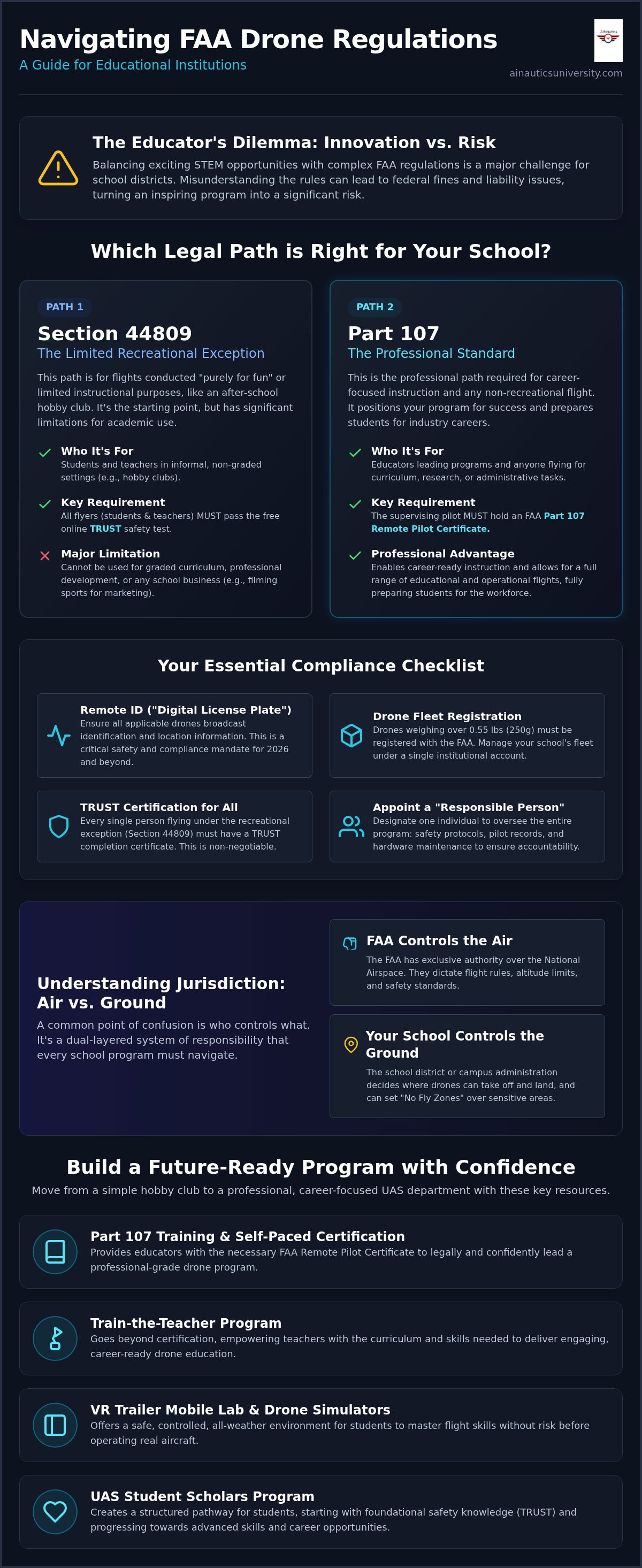
The Federal Aviation Administration (FAA) manages the National Airspace System (NAS) with a clear mission: safety. For educational institutions in 2026, this means drones aren't toys; they're aircraft. Understanding FAA drone regulations for schools starts with recognizing your district's role as an institutional operator. Adhering to these standards ensures that your program remains professional and future-ready. You aren't just flying on a weekend; you're managing a fleet. Every district should appoint a "Responsible Person" to oversee safety protocols, pilot records, and hardware maintenance. This centralized oversight ensures that your program meets federal standards while protecting the school from liability.
The Distinction Between Classroom Learning and Commercial Use
The FAA provides two primary paths for flight: Section 44809 for recreational flyers and Part 107 for commercial operations. In a school setting, "recreational" is strictly defined as "purely for fun." While an after-school club might operate under Section 44809, any activity tied to a graded curriculum or professional development typically requires higher certification. Administrative tasks, such as using a drone for roof inspections or filming a football game for marketing, are never recreational. These tasks legally require a Part 107 Remote Pilot Certificate. Programs like our Train-the-Teacher Program help educators master these distinctions, ensuring they provide career-ready instruction through a specialized drone curriculum for educators. Moving toward professional standards prepares students for real-world industry demands.
Federal vs. Local Property Rules
A common point of confusion is the boundary between federal and local authority. The FAA holds exclusive authority over the regulation of all flight operations within the National Airspace System, superseding any local or state ordinances that attempt to restrict drone flight paths. However, your school board still controls the ground. While the FAA says where you can fly, the school district decides where you can take off and land. Compliance involves balancing these federal mandates with local privacy policies and "No Fly Zones" near sensitive campus areas. By integrating Part 107 Training and resources like the UAS Student Scholars program into your district's framework, you create a culture of safety that respects both federal law and community standards. This dual-layered approach ensures your program is both legally compliant and socially responsible.
Section 44809: The Limited Recreational Exception for Educators
Section 44809 offers a specific pathway for educational institutions to integrate flight without the immediate need for a commercial license. This "Limited Recreational Exception" allows students and teachers to fly for instructional purposes, provided the flight is not part of a commercial enterprise. To remain within the bounds of FAA drone regulations for schools, your program must follow the safety guidelines of an FAA-recognized Community-Based Organization (CBO). These organizations provide the necessary safety framework for altitude limits and distance from crowds, which are essential for district liability management. These rules dictate where and how you fly, ensuring that student operations don't interfere with the broader National Airspace System.
Safety standards remain high even under this exception. Maintaining a Visual Line of Sight (VLOS) is a fundamental requirement. This means the pilot or a designated visual observer must see the drone at all times with their own eyes. While indoor flight in a gym or lab provides a controlled environment free from FAA oversight, moving outdoors requires strict adherence to these visual standards. Establishing clear boundaries on campus for these labs prevents accidental incursions into restricted areas. It's a practical way to build a culture of safety before students move toward professional certification.
The TRUST Test Requirement
The Recreational UAS Safety Test (TRUST) is the mandatory starting point for every person involved in your school's program. Both students and teachers must complete this free, online safety training before their first flight. It ensures everyone understands basic airspace rules and emergency procedures. TRUST isn't just a suggestion; it's a federal requirement that serves as the minimum entry point for any compliant campus program. Many districts integrate this as a foundational step for their UAS Student Scholars, ensuring every participant has a baseline of safety knowledge.
Supervising Student Pilots
When students take the controls, the teacher acts as the primary safety officer. FAA rules allow for this direct supervision, but the educator must be prepared to intervene instantly if a safety issue arises. We've found that students who practice on a drone simulator show significantly higher proficiency during their first outdoor flights. This digital training minimizes hardware damage and maximizes learning time. To maintain professional standards, keep a flight log documenting every student session. If you want to ensure your staff is fully prepared for this responsibility, our Train-the-Teacher Program offers the specialized training required to manage a safe and legal classroom environment. Adhering to these FAA drone regulations for schools protects your district while empowering your students.
Part 107 Certification: When Schools Must Go Professional
While recreational exceptions provide a starting point, most sustainable school programs eventually transition to professional standards. The shift occurs when the objective moves from simple exploration to workforce development. A comprehensive drone curriculum for educators often targets Part 107 mastery because it provides the only legal framework for flights that aren't purely recreational. If a student is flying for a grade, or if a teacher is using a drone to capture footage for the school website, these actions fall outside the "fun" exception. Following FAA drone regulations for schools means recognizing these boundaries early to avoid institutional liability.
Teachers leading advanced UAS programs need this certification to establish their authority as industry experts. This isn't just about compliance; it's about career readiness. When students earn their Remote Pilot Certificate, they graduate with a federal license that is immediately recognized by employers in construction, agriculture, and public safety. This transition from student to professional pilot is the ultimate goal of a high-performing Career and Technical Education (CTE) pathway.
The Remote Pilot Certificate Process
The path to becoming a certified commercial pilot is rigorous but achievable for high school students and staff. To be eligible, an individual must be at least 16 years old, proficient in English, and pass a TSA security vetting process. The centerpiece of this journey is the FAA Knowledge Test. This exam covers complex topics like sectional charts, aviation weather, and emergency procedures. Success requires a dedicated approach to study. Many districts utilize our Part 107 drone training to ensure their pilots are fully prepared for the testing center.
Institutional Benefits of a Licensed Staff
Having a licensed staff provides more than just educational value; it offers significant legal and financial protection. Insurance providers often look favorably on districts that maintain certified pilot oversight, which can lead to reduced premiums for the school's fleet. Certification also empowers students through initiatives like the UAS Student Scholar program, where they gain hands-on experience under professional supervision. This setup protects the district during public events or media capture sessions, ensuring every flight meets the highest safety standards. By prioritizing professional certification, your school district moves from a basic hobbyist level to a visionary, industry-aligned institution.
Operational Compliance: Remote ID and Drone Registration
Managing a school drone fleet in 2026 requires more than just piloting skills; it demands strict operational compliance. Every aircraft in your inventory must meet current Remote ID standards to satisfy FAA drone regulations for schools. Remote ID acts as a digital license plate for safety, broadcasting the drone's identity and location to nearby receivers. Most modern drones come with Standard Remote ID built into the hardware. If your district uses older equipment, you must attach a Remote ID Broadcast Module to remain legal during any outdoor flight operations.
Registration is another critical step for institutional safety. It's best practice to register all UAS assets under the school district’s name rather than individual teachers. This ensures the district maintains ownership and liability coverage regardless of staffing changes. You can manage your entire fleet through the FAA DroneZone portal. This central hub allows you to track registration numbers, renewal dates, and pilot certifications in one location. Organized registration is the first line of defense against administrative errors that could lead to federal fines.
Remote ID in the Classroom
Does every drone in your program need Remote ID? If you're flying exclusively indoors, such as in a gymnasium or a specialized lab, Remote ID is not required. However, the moment that aircraft crosses the threshold to the outdoors, it must comply. Schools can also apply for their campus to become an FAA-Recognized Identification Area (FRIA). In a FRIA, drones without Remote ID equipment can fly legally within specific boundaries. These areas are valuable for schools with limited budgets for hardware upgrades. Understanding these nuances is vital for any campus fleet manager aiming for total compliance.
Maintaining Logbooks and Maintenance Records
Documentation is the backbone of a professional program. You should maintain detailed flight logs and maintenance records for every aircraft. These logs prove that your program follows safety protocols. They're often essential during insurance audits or FAA inquiries. Using a mobile drone lab for schools helps centralize your equipment management. It provides a structured environment for these administrative tasks while keeping your gear ready for action. It's about building a system that scales as your program grows. If you're ready to modernize your district's approach to safety, partner with AINautics University for expert compliance guidance today.
Implementing a Compliant Program with AINautics University
Building a professional aviation program doesn't have to be a multi-year struggle. Our "Launch a Drone Program in 90 Days" framework provides school districts with a structured, efficient path to full operational readiness. We focus on removing the administrative burden from educators by providing a turnkey solution that respects all FAA drone regulations for schools. This framework ensures your district aligns with both state and national standards through our specialized UAS Teacher Scholars program. By establishing this foundation, you move beyond simple hobbyist activities and start hands-on UAS training that fits seamlessly into your existing STEM or CTE pathways. We provide the roadmap; you provide the vision.
Sustaining a program requires more than just initial setup. As technology and laws evolve in 2026, AINautics University remains your long-term partner for compliance and advanced operations. Whether your district needs support for complex FAA waivers or guidance on advanced school missions like search and rescue simulations, our experts are available to help. We ensure your program doesn't just start strong but grows into a permanent, high-value asset for your community.
The Train-the-Teacher Model
Sustainability starts with your staff. The Train-the-Teacher model empowers your educators to become the district's internal UAS experts. This professional development goes far beyond preparing for a certification exam. We focus on real-world flight operations, classroom management of drone hardware, and safety protocols that protect the school. Because FAA rules are subject to change, we provide continuous support and curriculum updates. This ensures your teachers always have the most current information to lead their students with confidence and authority. You're not just hiring a service; you're building institutional knowledge.
Scaling with the VR Trailer Mobile Lab
Reaching every student in a large district can be a logistical challenge. The VR Trailer Mobile Lab solves this by bringing immersive, compliant technology directly to your campus. Students engage in high-stakes training using the AINautics Drone Simulator, which allows them to master flight maneuvers in a risk-free digital environment before ever touching a real controller. This creates a robust "Learn → Train → Certify" pipeline. Students learn the theory, train on the simulator, and then move to live flight to earn their professional credentials. This scalable model ensures that every student, regardless of their school's individual lab space, has access to the same elite level of UAS education.
Empowering the Next Generation of UAS Professionals
Mastering FAA drone regulations for schools is the vital foundation of a sustainable and safe educational environment. By moving beyond simple recreational flight and embracing professional Part 107 standards, you prepare your students for high-demand careers in a rapidly evolving industry. You've learned how to navigate complex Remote ID requirements and the importance of centralized institutional fleet management for 2026. Now, it's time to turn that theoretical knowledge into a workforce-ready program that inspires your entire community.
As an SDVOSB Certified institution with a STEM-Aligned Curriculum, AINautics University provides the expert guidance your district needs to succeed. Our Part 107 Expert Instructors are ready to help you build a lasting legacy of safety and technical innovation. Launch your school drone program in 90 days with AINautics University and lead your district toward a future defined by technological mastery. The sky is no longer a distant limit; it is your classroom's newest and most exciting frontier. We are here to support every step of your journey.
Frequently Asked Questions
Do students need a Part 107 license to fly drones in class?
Students don't need a Part 107 license for basic classroom instruction if they fly under the Limited Recreational Exception. They must, however, pass the TRUST test before their first flight. For those pursuing professional career pathways, earning a license through our Self-Paced Certification options provides a significant advantage. This professional credential proves they have mastered the specialized knowledge required for the modern UAS workforce.
Can a school fly drones over its own football stadium for games?
Capturing game footage is considered an institutional or commercial use, which requires a Part 107 certified pilot. The operation must also comply with FAA rules regarding flight over people and moving vehicles. Following FAA drone regulations for schools in these high-visibility scenarios protects the district from liability. We recommend that staff involved in media production complete our Part 107 Training to ensure every flight is legally sound.
What is the minimum age for a student to get an FAA drone license?
The FAA requires applicants to be at least 16 years old to receive a Remote Pilot Certificate. Students younger than 16 can still participate in UAS education and build flight proficiency. Our UAS Student Scholars program uses the Drone Simulator to help younger learners develop elite piloting skills. This preparation ensures they're ready to pass the official exam the moment they reach the required age.
Does our school need a special FAA waiver to fly drones indoors?
No, the FAA doesn't regulate flight inside buildings like gyms or classrooms because it isn't part of the National Airspace System. You can conduct flight labs indoors without Remote ID or a Part 107 license. However, safety remains the priority for any school program. Our VR Trailer Mobile Lab offers a perfect example of how to bring compliant, high-tech learning experiences to any campus regardless of outdoor airspace restrictions.
What happens if a school drone is involved in an accident?
If an accident causes serious injury or property damage over $500, the pilot must report it to the FAA within 10 days. Documenting every flight in a logbook is essential for these situations and for insurance audits. Educators who complete our Train-the-Teacher Program learn exactly how to manage these incidents. Proper reporting and a "Responsible Person" framework help maintain your district's professional reputation after an equipment failure.
Are there specific FAA rules for "educational use" vs. "recreational use"?
Educational use is often permitted under recreational rules if it's part of a non-commercial curriculum. However, any activity that benefits the school's business operations, like roof inspections or marketing, requires a professional license. Navigating FAA drone regulations for schools means knowing when to transition from a hobbyist mindset to professional standards. Our experts help districts clarify these boundaries to ensure every campus flight remains within federal law.
How does Remote ID affect drones purchased before 2024?
Older drones must have a Remote ID Broadcast Module attached to fly legally in outdoor spaces. The only exception is flying within an FAA-Recognized Identification Area (FRIA) on campus. Our Part 107 Training provides fleet managers with the technical guidance needed to update older hardware. Keeping your equipment compliant with 2026 standards is a vital part of maintaining a professional, career-ready UAS program for your students.
Can teachers be fined by the FAA for student flying errors?
The FAA can hold the supervising teacher or the Remote Pilot in Command responsible for any safety violations that occur during a flight. This makes professional development and mastery of the rules essential for all UAS educators. By participating in the Train-the-Teacher Program, staff gain the confidence and expertise to mitigate risks. This specialized training protects the educator and the school district from potential federal enforcement actions or fines.

Article by
AINautics University Team
The team behind AINautics University, dedicated to drone education and FAA Part 107 certification prep, VR flight simulation, and STEM training programs for students and educators.


