
Did you know that roughly one in six test-takers failed the FAA Remote Pilot exam in 2025? As the global drone market scales toward a projected $100 billion valuation by the end of 2026, learning how to pass the Part 107 exam first try has become a critical milestone for any aspiring professional. It's understandable if you feel overwhelmed by complex sectional charts or the high stakes of the $175 testing fee. You don't have time to gamble on a second attempt when your career is ready to take flight.
This guide provides the definitive blueprint for success by shifting your focus from simple memorization to true spatial mastery. We understand that educators, students, and professionals need more than just a list of facts. You need a deep understanding of the 2026 regulatory landscape, including Remote ID and Operations Over People. We will preview how to leverage specialized resources like our Self-Paced Certification and the AINautics Drone Simulator to build real-world confidence. By the end of this article, you will have a clear path to mastering the exam and joining the next generation of UAS Student Scholars in the commercial workforce.
Key Takeaways
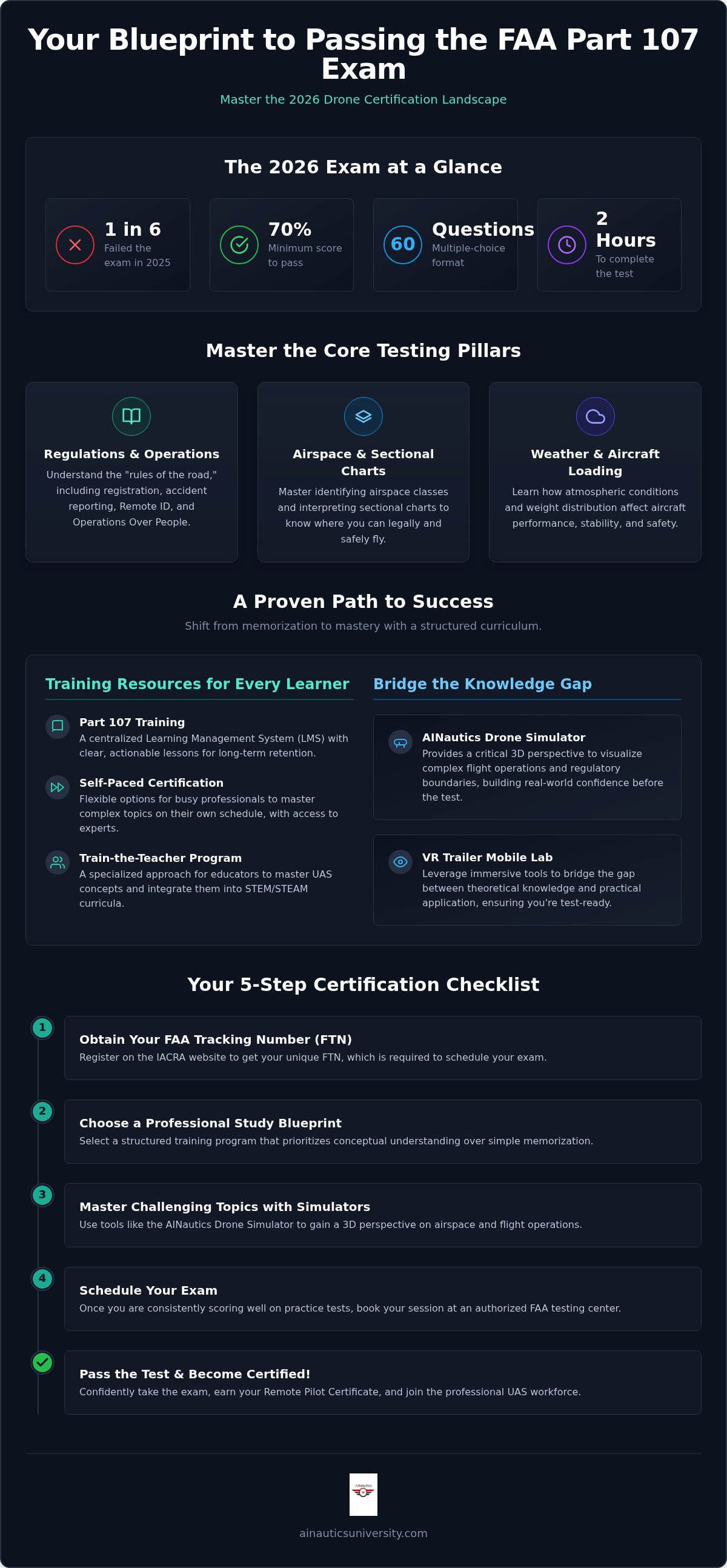
- Understand the 2026 FAA exam landscape, including the 60-question structure and the 70% passing threshold required for your Remote Pilot Certificate.
- Discover how to pass the Part 107 exam first try by choosing a professional study blueprint that prioritizes conceptual mastery over rote memorization.
- Master the most challenging technical topics like airspace classifications, sectional charts, and weather reports to avoid common testing pitfalls.
- Learn how immersive tools like the AINautics Drone Simulator provide the 3D perspective needed to visualize complex flight operations and regulatory boundaries.
- Navigate the final administrative steps with confidence, from obtaining your FAA Tracking Number (FTN) to scheduling your session at an authorized testing center.
The 2026 Part 107 Landscape: What to Expect on the Exam
The FAA Part 107 exam is the official Knowledge Test required to earn your Remote Pilot Certificate. It's the legal gateway for anyone wanting to fly drones for business purposes. Understanding how to pass the Part 107 exam first try requires more than just skimming a manual; it demands a strategic grasp of aviation logic. You'll face 60 multiple-choice questions and need a score of 70% or higher to pass within a two-hour window. During the test, you'll rely heavily on the Airman Knowledge Testing Supplement (Book CT-8080-2H). This book contains the actual sectional charts, legends, and diagrams you must interpret to answer specific flight scenarios.
By 2026, the exam has evolved to reflect a more complex and crowded sky. Questions now place a significant focus on Remote ID compliance and the nuances of Category 1 through 4 operations over people. These Part 107 regulations ensure that every pilot in the national airspace operates with a high degree of safety and accountability. Failing to grasp these updates doesn't just mean a failing grade. It means risking the $175 testing fee and delaying your entry into a high-growth industry.
Core Testing Categories in 2026
Success depends on mastering three primary pillars. First, Regulations and Operating Requirements cover the essential "rules of the road" for UAS. This includes everything from registration requirements to the specific protocols for reporting accidents. Second, Airspace Classification tests your ability to identify different classes of airspace and understand where you can legally fly. Finally, Weather and Loading focuses on how atmospheric conditions and weight distribution affect your aircraft’s performance. Our Part 107 Training breaks these technical topics into clear, actionable lessons designed for long-term retention.
Why 'Winging It' Fails in the Modern Industry
The days of passing by simply memorizing old question banks are over. The FAA has shifted toward scenario-based questions that require you to apply your knowledge to real-world flight problems. If you don't understand the underlying logic of a rule, you'll likely struggle with these multi-layered prompts. This increased difficulty ensures that only qualified pilots enter the workforce. For busy students or educators, our Self-Paced Certification options provide a flexible yet rigorous path to expertise. The Remote Pilot Certificate is the foundational credential for the 2026 drone workforce.
Step 1: Choosing a Study Method That Guarantees Success
Deciding on a study path is the most significant factor in your success. While free online videos might seem tempting, they often lack the technical depth needed to meet official FAA requirements in 2026. To discover how to pass the Part 107 exam first try, you need a structured curriculum that follows a mission-driven approach. This method moves beyond rote memorization and focuses on the "Learn, Train, Certify, Fly, Work" pipeline. Professional Part 107 Training offers a centralized Learning Management System (LMS) to track your progress and identify specific areas where you need more practice before the clock starts at the testing center.
Self-Paced vs. Instructor-Led Training
Your learning style will determine which study format works best for your schedule. Busy professionals often find that Self-Paced Certification options provide the flexibility required to master complex technical concepts without the pressure of a fixed timeline. This format allows you to revisit difficult topics, such as aeronautical decision-making or loading calculations, as many times as necessary. A major benefit of choosing a professional path is the direct access to industry experts like Taz Little. Having an expert clarify confusing airspace regulations can save you from a failing grade and the frustration of a 14-day waiting period for a retake.
The Educator’s Path: Passing to Teach
Educators face a unique challenge because they must master the material well enough to explain it to students. Integrating Unmanned Aircraft Systems (UAS) into STEM or STEAM curricula requires a specialized approach. Our Train-the-Teacher Program is designed to help instructors align their study with district standards for Career and Technical Education (CTE) pathways. By participating in this program, educators can confidently lead their own UAS Student Scholars through the certification process and into the workforce. Schools looking for a rapid implementation can utilize our 90-Day Program Launch framework to ensure all regulatory requirements are met. For a deeper look at how technology supports this learning, explore our immersive drone training resources.
Mastering the 'Big Three' Failure Points: Airspace, Charts, and Weather
Airspace, sectional charts, and weather reports are the primary reasons candidates fail. These three areas require logic and application rather than simple memorization. Mastering these technical pillars is the secret to how to pass the Part 107 exam first try. You'll need to understand the 'alphabet soup' of airspace classification to ensure you're flying legally and safely. Controlled airspace requires specific authorizations, while uncontrolled areas offer more freedom for commercial operations. Our UAS Student Scholars program emphasizes this distinction to prepare students for real-world mission planning.
- Class B: Surrounds the busiest airports; think "Big City" environments.
- Class C: Serves moderately busy airports with radar control; think "Crowded" but smaller than Class B.
- Class D: Covers smaller airports with an active control tower; think "Dialogue" because you'd need to talk to them if you were in a manned aircraft.
- Class E: Controlled airspace that isn't A, B, C, or D; it's "Elsewhere" but still requires attention.
- Class G: Uncontrolled airspace where most drone flights occur; think "Ground" or "Go for it."
Decoding Sectional Charts Like a Pro
Reading a sectional chart is like learning a new language for the sky. You must identify the floor and ceiling limits of controlled airspace, which are often marked in MSL (Mean Sea Level). However, your drone's altitude limits are usually measured in AGL (Above Ground Level). Confusing these two can lead to airspace violations. While you can find basic FAA-provided study materials online, interpreting these graphics in a high-pressure testing environment requires practice. You must also recognize Special Use Airspace, such as Prohibited areas, Restricted zones, and Military Operations Areas (MOAs), to avoid grounding your mission before it starts.
Aviation Weather for Remote Pilots
Decoding METAR codes and TAF reports is a mandatory skill for any commercial pilot. These reports use a shorthand that tells you about visibility, cloud cover, and wind speed. Stable air typically leads to poor visibility and steady precipitation, while unstable air creates turbulent conditions but offers better visibility. Density altitude significantly reduces UAS lift by decreasing air density, which requires more power for propellers to generate the necessary thrust in 2026. Understanding these atmospheric shifts is a core component of our Part 107 Training modules.
Weight and balance are equally critical. Calculating the center of gravity (CG) ensures your aircraft remains stable during complex maneuvers. If your drone is overloaded or the weight is poorly distributed, its performance will suffer, especially in high-density altitude conditions. These calculations aren't just for the exam; they're essential for the safety of your hardware and the people on the ground.
Using Simulators and VR to Bridge the Knowledge Gap
Visualizing the invisible boundaries of the national airspace is one of the greatest hurdles for new pilots. While previous sections focused on decoding 2D sectional charts, true mastery requires a 3D perspective. Staring at a flat map often leads to confusion during the test when you're asked to calculate floor and ceiling limits in a high-pressure environment. If you're wondering how to pass the Part 107 exam first try, the answer lies in immersive technology. Simulators and Virtual Reality (VR) transform abstract regulations into tangible experiences. They allow you to see the airspace before you ever set foot in a testing center.
Airspace Visualization with Simulation
The AINautics Drone Simulator serves as a bridge between theory and practice. By setting up simulator missions in Class D airspace, you can practice identifying controlled boundaries and understanding communication requirements without risk. This digital environment is perfect for practicing complex 2026 scenarios like 'Ops Over People'. You can test the limits of your aircraft and your knowledge of category-specific rules in a risk-free setting. This type of preparation is essential for those looking toward the future of drone careers where proficiency is just as important as certification.
The VR Mobile Lab Experience
Our VR Trailer Mobile Lab takes this immersive learning a step further by bringing high-tech training directly to schools and organizations. Inside the lab, students engage in immersive pre-flight checks and emergency procedure drills that mirror real-world challenges. This isn't just about learning the mechanics of flight; it's about psychological preparation. Virtual flight hours provide a sense of familiarity that significantly reduces exam-day anxiety. When you've already flown through a restricted zone or handled a simulated battery failure in VR, the test questions become much less intimidating.
Mastering these skills in a virtual environment makes the transition to hands-on UAS training much smoother. You'll arrive at the flight line with a deep understanding of the regulatory logic that governs every maneuver. If you're ready to move beyond the textbook, explore our immersive UAS training programs today to gain the confidence you need for success.
Final Countdown: Scheduling and Nailing the Exam
Your final preparation phase is as much about logistics as it is about knowledge. To secure your testing slot, you must first register on the Integrated Airman Certification and Rating Application (IACRA) website to obtain an FAA Tracking Number (FTN). This unique identifier is mandatory. You cannot schedule your exam through a PSI Authorized Testing Center without it. Once you have your FTN, you can book your session at a location that fits your schedule. Remember that the testing environment is strictly controlled. Arriving early allows you to settle in and complete the check-in process without unnecessary stress.
When you head to the testing center, bring a valid government-issued photo ID that includes your current physical address. You are permitted to bring a basic, non-programmable calculator to help with loading and performance math. The testing center will provide the Airman Knowledge Testing Supplement and scratch paper. Many successful candidates use a 24-hour 'brain dump' strategy. This involves reviewing your most difficult formulas and airspace codes right before entering the room. As soon as the clock starts, write these details on your scratch paper. This clears your mental bandwidth and ensures you have a reliable reference for the most challenging questions.
The 'First Try' Checklist
Success is a result of consistent performance. Before you sit for the actual test, ensure you are scoring at least 85% on your final practice exams. This buffer accounts for the added pressure of the real testing environment. Use the AINautics 'Quick Look' sheet to perform last-minute checks on weather decoding and airspace ceilings. During the 120-minute window, manage your time wisely. Don't get stuck on a single question. Flag difficult items and return to them after you've secured the easier points. This methodical approach is a key part of how to pass the Part 107 exam first try.
After the Exam: Learn, Train, Certify, Work
Passing the exam is a major victory, but it's only the beginning of your professional journey. Once you receive your passing score, return to the IACRA website to complete your application for a temporary Remote Pilot Certificate. This document allows you to start flying commercially while you wait for your permanent card to arrive by mail. For those still in school or looking for a career jumpstart, consider joining the UAS Student Scholars program. This initiative helps bridge the gap between certification and the professional workforce by providing a clear pathway into the industry. To keep your certificate active, remember that you must complete free recurrent training every 24 months. Staying current ensures you remain a safe and effective operator in the ever-evolving 2026 airspace.
Launch Your Professional UAS Career in 2026
The 2026 drone industry offers unprecedented opportunities for those who approach certification with a strategic mindset. By mastering the technical logic of airspace and weather rather than relying on rote memorization, you secure more than just a passing score. You build the foundation for a sustainable career. We've detailed the critical steps for success, from visualizing 3D airspace with immersive technology to navigating the final administrative hurdles of the IACRA process. These strategies represent the most efficient path to entering the commercial workforce.
Understanding how to pass the Part 107 exam first try is about choosing the right partner for your educational journey. As a Service-Disabled Veteran-Owned Small Business (SDVOSB) and a proud AUVSI Member, AINautics University is dedicated to workforce readiness. We utilize immersive simulator-based learning to ensure you aren't just prepared for a test, but ready for the flight line. Whether you're a student, parent, or educator, the path to specialized UAS knowledge is clear and accessible.
Enroll in AINautics University’s Part 107 Training and pass your exam with confidence. Your future in the national airspace starts today. We're excited to support your journey into the sky.
Frequently Asked Questions
How much does the Part 107 exam cost in 2026?
The FAA Part 107 exam costs $175 per attempt in 2026. You pay this fee directly to the PSI testing center when you schedule your appointment. This cost is separate from any study materials or drone registration fees. Because of this high stakes investment, many candidates look for structured programs to learn how to pass the Part 107 exam first try. Professional training ensures you don't waste money on multiple testing attempts.
Can I take the Part 107 exam online from home?
No, you cannot take the initial Part 107 aeronautical knowledge test from home. You must schedule and attend your session in person at a PSI Authorized Testing Center. Before booking, ensure you have your FAA Tracking Number from the IACRA website. While the test is in person, you can complete your preparation through our Self-Paced Certification modules from any location with internet access. This flexibility is ideal for busy professionals.
What happens if I fail the Part 107 exam on my first try?
If you fail the exam, you must wait 14 calendar days before you can take it again. You'll also have to pay the $175 testing fee for each new attempt. This waiting period and cost highlight the importance of using professional resources like our Part 107 Training. Our curriculum focuses on conceptual mastery to ensure you walk into the testing center with the confidence needed for success on your next visit.
Do I need to own a drone to take the Part 107 test?
You don't need to own a drone to take the Part 107 exam. The test evaluates your knowledge of regulations, airspace, and safety procedures rather than your physical flying skills. However, using tools like the AINautics Drone Simulator can help you visualize the 3D airspace concepts mentioned in the test. This immersive experience bridges the gap between reading a textbook and understanding real-world commercial flight operations as a professional pilot.
How long should I study for the Part 107 exam?
Most successful candidates spend between 15 and 20 hours studying for the exam. This time frame allows you to move beyond memorization and achieve true mastery of technical topics like sectional charts and weather decoding. If you're a busy professional or student, our Self-Paced Certification allows you to break this study time into manageable sessions that fit your schedule. Consistent practice is the most effective way to learn how to pass the Part 107 exam first try.
Is the Part 107 exam multiple choice?
Yes, the Part 107 exam consists of 60 multiple-choice questions. Each question has three possible answers. You'll have 120 minutes to complete the test. Many questions require you to refer to the Airman Knowledge Testing Supplement to find specific information on maps or charts. Our training includes practice exams that mirror this structure to help you get comfortable with the testing format and the specific phrasing used by the FAA during the actual evaluation.
Can high school students take the Part 107 exam?
High school students are eligible to take the exam starting at age 16. This is an excellent way for young people to start a career in a high-growth technology field. Our UAS Student Scholars program is specifically designed to support students and educators in this journey. It provides a clear pathway from the classroom to the professional workforce by aligning with STEM and CTE standards, ensuring students gain both the certificate and practical industry skills.
How do I renew my drone license in 2026?
In 2026, you maintain your Remote Pilot Certificate by completing a free online recurrent training course every 24 calendar months. You don't need to retake the $175 in-person exam to renew your license. This online training is available through the FAA Safety Team website. It ensures that all commercial pilots stay updated on the latest regulations, such as Remote ID requirements and advanced operations over people, keeping the national airspace safe for everyone.

Article by
AINautics University Team
The team behind AINautics University, dedicated to drone education and FAA Part 107 certification prep, VR flight simulation, and STEM training programs for students and educators.


