
Approximately 17% of candidates failed the Part 107 exam in 2025, a statistic that highlights how the FAA is shifting away from simple memorization toward operational mastery. It's natural to feel anxious about decoding complex METAR reports or navigating the dense symbology of sectional charts, especially when a failed attempt costs $175 and a mandatory 14-day waiting period. Understanding the common mistakes on FAA drone test attempts is the first step toward securing your professional future. You aren't just studying to pass a test. You're preparing to join a high-growth industry as a competent remote pilot.
This guide will help you master the operational logic of the National Airspace System and avoid the technical traps that lead to failure. We'll break down 14 critical errors, from misinterpreting airspace classifications to failing to account for unscored validation questions. By leveraging tools like the AINautics University Drone Simulator and our Self-Paced Certification options, you can transform confusion into confidence. We'll show you exactly how to approach the most challenging topics so you can pass on your first attempt and launch your drone career with certainty.
Key Takeaways
- Shift your focus from rote memorization to operational logic to effectively bypass the most common mistakes on FAA drone test attempts.
- Develop a technical mastery of sectional charts to accurately distinguish between MSL and AGL elevations and identify complex Class E airspace floors.
- Decode weather reports with confidence by mastering the nuances of METAR wind directions and TAF probability factors.
- Optimize your testing performance by using the "First Pass" method and familiarizing yourself with the FAA-CT-8080-2H Testing Supplement before exam day.
- Utilize immersive training tools, such as the AINautics Drone Simulator, to visualize 3D airspace boundaries and transition from theoretical study to professional flight competence.
Beyond Memorization: Why 1 in 6 Pilots Fail the FAA Test
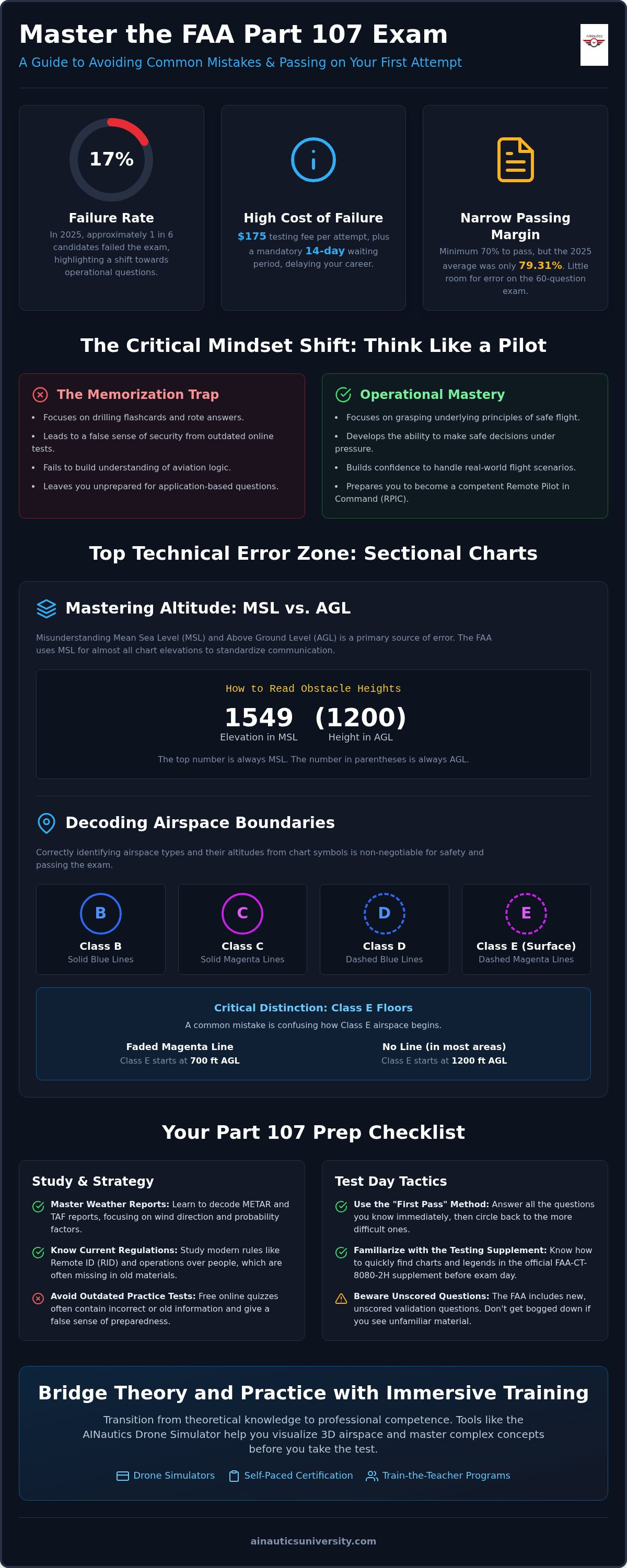
Many applicants fall into the "Memorization Trap." They spend weeks drilling flashcards and rote answers without grasping the underlying aviation logic required for safe flight. In 2025, approximately 1 in 6 candidates failed the exam. This 17% failure rate reflects a significant shift in FAA testing strategy toward application-based questions. The 2026 Airman Knowledge Test (AKT) consists of 60 multiple-choice questions with a two-hour time limit. You need a minimum score of 70% to pass, but the average score in 2025 was only 79.31%. This narrow margin for error means that common mistakes on FAA drone test attempts often stem from a lack of deep comprehension.
Failing the test carries a heavy price. Each attempt requires a $175 testing fee paid to the PSI center. If you don't pass, you must wait 24 days before you can try again. This delay can stall your career momentum or delay critical business projects. To avoid these setbacks, you must aim for operational mastery. This level of understanding is the core focus of professional Part 107 drone training. It ensures you don't just recognize a correct answer but understand why it's the only safe choice in a real-world scenario.
The Problem with Outdated Practice Tests
Free online tests often provide a false sense of security. These outdated resources frequently miss critical 2026 regulatory updates, such as Remote ID (RID) requirements and the nuances of flying over people. The FAA regularly refreshes its question bank to include unscored validation questions that test new concepts. Relying on stale data is one of the most frequent common mistakes on FAA drone test preparations. Success requires current, high-quality materials that reflect today's National Airspace System (NAS) standards.
The Mental Shift: Thinking Like a Remote Pilot in Command
Becoming a certified pilot requires a psychological transition. You're no longer just a hobbyist; you're a Remote Pilot in Command (RPIC). The FAA evaluates your ability to make safe decisions under pressure, not just your capacity for factual recall. You're responsible for the safety of the NAS and everyone on the ground. This philosophy of leadership and accountability is a cornerstone of the UAS Student Scholar program. By adopting this professional mindset early, you prepare yourself for the exam and a long-term career in the UAS industry.
Decoding Sectional Charts: The #1 Source of Technical Error
Sectional charts represent the most challenging technical hurdle for many students. These maps pack an immense amount of data into a small space, often leading to visual overload during the exam. Mastering these visual nuances will help you avoid the common mistakes on FAA drone test questions that trip up unprepared candidates. You must move beyond looking at the map and start interpreting the three dimensional environment it describes.
Mastering the Altitude Maze: AGL vs. MSL
AGL measures your height directly above the ground, whereas MSL measures altitude relative to a global sea level standard. This distinction is vital because the FAA uses MSL for almost all chart elevations to ensure standardized communication between pilots. When you see two numbers next to an obstacle, the top number is the elevation in MSL. The FAA uses parentheses to denote the height of that same obstacle in AGL. To calculate your actual ground clearance when flying near terrain, subtract the ground elevation from the MSL figure provided. Miscalculating these figures is a frequent error that leads to test failure.
Navigating Controlled Airspace Boundaries
Identifying Class B, C, and D circles is essential for regulatory compliance. Class B airspace uses solid blue lines, Class C uses solid magenta, and Class D uses dashed blue lines. You must also be able to identify the ceiling and floor of each segment, which are often expressed as fractions on the chart. For example, a "110/SFC" notation means the airspace extends from the surface up to 11,000 feet MSL.
A critical distinction involves "dashed" vs. "faded" lines on the chart. A dashed magenta line indicates that Class E airspace starts at the surface. Conversely, a faded magenta line indicates the floor of Class E airspace is 700 feet AGL. Failing to recognize this shift is one of the most common mistakes on FAA drone test attempts. If you are outside both of these areas, Class E typically begins at 1,200 feet AGL.
Other technical pitfalls include misinterpreting Military Operations Areas (MOAs) and ignoring the "Notes" section in the FAA-CT-8080-2H Testing Supplement. Many students assume MOAs are prohibited airspace. In reality, you can fly in an MOA without prior authorization, though you must exercise extreme caution. Additionally, the Testing Supplement is an open-book resource. It contains specific airport data and legends that provide the answers if you take the time to read them. You can practice these visual cues with the AINautics Drone Simulator to gain a true 3D perspective of the airspace before your exam.
Weather and Regulatory Logic: Where Theory Meets Reality
Weather analysis is often where theory meets a cold reality for test-takers. Unlike airspace charts, weather reports require you to decode a compact, alphanumeric language in seconds. One of the most common mistakes on FAA drone test sessions is the confusion between True North and Magnetic North. Remember this simple rule: if you read it, it's True; if you hear it, it's Magnetic. METARs and TAFs are written reports, so the wind direction is always relative to True North. Conversely, a briefing from an Automated Terminal Information Service (ATIS) over the radio provides wind direction relative to Magnetic North.
Another frequent error involves the "Probability" (PROB) factor in TAF reports. A "PROB30" or "PROB40" indicates a specific percentage chance of a weather event occurring during a set time window. Many students overlook these prefixes, leading to incorrect assumptions about flight safety. Mastery of these nuances is a core component of professional drone training for beginners. It ensures you can make safe "go/no-go" decisions based on real-world data rather than guesswork.
Cracking the METAR and TAF Code
A standard 2026 METAR string looks like this: METAR KJFK 141651Z 19008KT 10SM CLR 22/16 A3002. This code tells you the station (KJFK), the day and time (14th at 16:51 Zulu), the wind (from 190 degrees at 8 knots), and the visibility (10 statute miles). You must also memorize common abbreviations that appear without explanation. For example, "BR" stands for mist (think "baby rain") and "FG" stands for fog (think "full grown"). These small details often determine whether you pass or fail the weather portion of the exam. TAF reports follow a similar logic but project weather conditions over a 24 or 30 hour period, requiring you to track changes over time.
Loading and Performance Calculations
Understanding how your aircraft handles under stress is critical for both the test and your career. You must be able to read load factor charts to determine how steep turns affect your drone. A 60 degree bank angle doubles the effective weight of the aircraft (2 Gs). This increased load can lead to an unexpected stall if you don't account for it. High density altitude, caused by high temperatures, high humidity, or high elevations, further complicates this. It makes the air "thinner" and less efficient for lift and thrust. Overloading a UAS in these conditions creates a high risk of structural failure or loss of control.
Regulatory logic is also a moving target. In 2026, you no longer need a "Daylight Waiver" for night operations if you have completed the required FAA recurrent training and equipped your UAS with anti-collision lights visible for three statute miles. Confusing these current standards with old rules is a recurring pitfall. Our Self-Paced Certification options keep you updated on these evolving standards so you can fly legally and safely from day one.
The Part 107 Prep Checklist: Avoiding Test-Day Pitfalls
Technical knowledge is only half the battle. Success on the Part 107 exam also requires a tactical approach to the testing environment. Many candidates fail because they lack a structured strategy for the two-hour window. One of the most avoidable common mistakes on FAA drone test attempts is rushing through the questions without a plan. By following a disciplined checklist, you can manage your time effectively and ensure that simple errors don't stand between you and your certification.
Leveraging the Airman Knowledge Testing Supplement
The FAA-CT-8080-2H Airman Knowledge Testing Supplement is your most powerful tool during the exam. This is the exact same booklet you'll use at the testing center. You should spend significant time familiarizing yourself with its layout before your test date. The legend at the front is essentially a legal cheat sheet for symbols and chart features. If you encounter a symbol you don't recognize, don't guess. Cross-reference the legend to verify its meaning. You can also use the printed scales on the chart pages to measure distances accurately, which is often required for navigation questions. Mastering this resource is a key feature of our Self-Paced Certification options, which teach you how to navigate the supplement with speed and precision.
Time Management and Question Psychology
The FAA uses "distractor" answers to test your attention to detail. These are options that look correct at a glance but are technically incomplete or based on common misconceptions. Always read the full question and all three distractors before selecting an answer. Use the "First Pass" method to build momentum. Go through all 60 questions and answer only the ones you're 100% certain about. Flag technical chart questions or complex weather decodes for a second pass. This ensures you secure the easy points early and leaves you plenty of time for the more demanding technical problems.
Don't be intimidated by "None of the above" or "All of the above" logic. If two of the answers seem equally plausible, re-read the question for a specific qualifier like "most likely" or "initial action." The 120-minute time limit is generous for 60 questions. Rushing is the leading cause of simple errors. Once you've completed every question, perform a final review of your flagged items with a fresh perspective. This methodical approach transforms the test from a source of anxiety into a manageable professional milestone.
Mastering UAS Flight: How Immersive Training Prevents Mistakes
Purely academic study often fails because it lacks operational context. You can memorize that Class C airspace has a five-mile inner circle, but seeing that boundary in a virtual environment changes your perspective entirely. This is the primary value of immersive drone training technology. It transforms abstract numbers and symbols into spatial awareness. By visualizing the National Airspace System in three dimensions, you naturally avoid the common mistakes on FAA drone test questions that involve complex spatial reasoning and altitude calculations.
The Power of UAS Simulators in Certification Prep
Simulation bridges the gap between a static 2D chart and the dynamic reality of 3D flight. The AINautics Drone Simulator allows you to fly through virtual representations of controlled airspace, making the complex "shelves" of Class B and C visible and intuitive. Scenario-based training helps you internalize emergency procedures, such as lost link protocols or battery fires, until they become second nature. We integrate these simulators into our self-paced certification path to ensure that your knowledge is functional, not just theoretical. This hands-on approach is especially vital for educators using our Train-the-Teacher Program. It provides a safe environment for students to fail and learn without risking expensive hardware or violating real-world regulations.
Building a Career Pathway with AINautics University
Our VR Trailer Mobile Lab brings this technology directly to schools, providing an immersive experience that traditional classrooms cannot match. We support institutions with a 90-day drone program launch, ensuring that educators have the tools and curriculum needed to build workforce readiness. For individual learners, becoming a UAS Student Scholar offers a structured route into the industry. This program focuses on specialization and future-readiness, preparing you for the high-stakes demands of a professional pilot career in 2026.
The UAS industry is evolving rapidly. Success requires more than just a certificate; it requires a deep understanding of how to operate safely in a complex environment. By focusing on application rather than rote learning, you eliminate the common mistakes on FAA drone test attempts that hold others back. Your journey doesn't end with the exam. It begins with a commitment to excellence and a clear vision for the future of drone careers. With the right training and immersive technology, you can confidently step into this bold new professional landscape as a leader in aviation.
Elevate Your Career with Operational Mastery
Securing your Part 107 certification is the essential first step toward a professional drone career. By shifting from rote memorization to operational logic, you can effectively navigate the technical traps that often lead to failure. We've explored how mastering sectional charts and decoding complex weather reports helps you avoid the common mistakes on FAA drone test attempts. Success requires a disciplined strategy, from leveraging the official testing supplement to utilizing immersive simulation technology that brings 2D charts to life in a 3D environment.
AINautics University is committed to your professional growth as a SDVOSB certified institution and a proud member of AUVSI. We support educational institutions with our 90-Day Program Launch Guarantee, ensuring educators have the specialized tools to build robust UAS curricula. Whether you're a student seeking a career pathway or an educator looking to integrate advanced technology, we provide the expert guidance you need. Start your journey to Part 107 mastery with AINautics University today. Your future as a remote pilot in command is within reach. Step into the 2026 workforce with confidence and specialized knowledge.
Frequently Asked Questions
How many questions can I get wrong on the FAA Part 107 test?
You can get a maximum of 18 questions wrong on the FAA Part 107 test. To pass, you must answer at least 42 out of 60 questions correctly, achieving a score of 70% or higher. Students who use our Self-Paced Certification options often find that taking practice exams helps them identify weak areas before the actual test. Don't leave any answers blank, as there's no penalty for guessing. Every point counts toward your professional certification and future career.
What is the most difficult section of the FAA drone exam?
Sectional charts and airspace classifications are consistently rated as the most challenging parts of the exam. Many applicants struggle to visualize 3D airspace boundaries using 2D maps, leading to common mistakes on FAA drone test attempts. To overcome this hurdle, AINautics University utilizes a Drone Simulator to provide immersive training. This tool allows you to see exactly where Class B or Class C airspace begins and ends, making the technical data much easier to grasp.
Can I use a calculator during my Part 107 knowledge test?
You are permitted to use a basic, non-programmable calculator during your exam. The testing center will usually provide one, or you can bring your own as long as it doesn't have memory storage or communication capabilities. This is particularly helpful for density altitude and weight and balance calculations. We recommend practicing these math problems during your Part 107 Training so you feel comfortable using a calculator under the pressure of the two-hour time limit.
What happens if I fail the FAA drone test on my first try?
If you don't pass on your first attempt, you must wait 24 days before you can schedule a retake. You'll also need to pay the $175 testing fee again for the new attempt. This waiting period is a good time to revisit your study materials and focus on the areas where you struggled. Our UAS Student Scholars program emphasizes comprehensive preparation to help students succeed on their very first try and avoid these costly delays.
How long should I study for the Part 107 test in 2026?
Most students should dedicate between 15 and 20 hours to focused study before taking the exam in 2026. However, your prior aviation knowledge and chosen study method will influence this timeline. If you use structured Part 107 Training, you can often prepare more efficiently than with self-study alone. AINautics University offers modular, actionable lessons that help you move through the material at your own pace while ensuring you achieve true operational mastery and technical confidence.
Are Remote ID (RID) questions included in the 2026 FAA drone test?
Yes, Remote ID (RID) questions are a standard part of the 2026 FAA drone test. You should understand the different types of RID, including Standard Remote ID and Broadcast Modules, as well as the compliance requirements for your aircraft. Staying current with these regulations is essential for avoiding common mistakes on FAA drone test sessions. Our training materials are updated to reflect the latest 2026 standards, ensuring you aren't surprised by new regulatory questions.
Do I need to know how to read METAR and TAF reports for the exam?
Reading and interpreting METAR and TAF reports is a mandatory skill for passing the Part 107 exam. You must be able to decode alphanumeric strings to understand visibility, cloud ceilings, and wind conditions. While these reports look like a different language at first, they follow a logical structure. We break down these codes in our Self-Paced Certification path, providing you with the tools to decode any weather report without needing a reference key or outside help.
Is there a recurrent exam I need to take after passing the initial test?
You don't need to take another in-person exam after you pass your initial test. To maintain your currency, you must complete a free online recurrent training course through the FAA every 24 calendar months. This ensures you stay updated on the latest safety protocols and regulatory changes without paying additional testing fees. AINautics University also provides ongoing resources to help our community stay sharp and professional throughout their careers in the rapidly evolving UAS industry.

Article by
AINautics University Team
The team behind AINautics University, dedicated to drone education and FAA Part 107 certification prep, VR flight simulation, and STEM training programs for students and educators.


