
What if passing the FAA Part 107 test is only the first decision in a public-safety drone program? Getting a drone license for public safety starts with identifying who will operate, what the mission involves, and which FAA operating path and agency policies apply. Depending on the operation, the path may involve Part 107, a public-agency Certificate of Authorization (COA), or both. A certificate alone doesn’t make a pilot mission-ready.
Certification and agency authorization serve different purposes. The right approach depends on the operation the agency plans to conduct, not simply the public-safety role of the pilot.
This guide explains when Part 107 may fit, how a COA differs, and what to check as you prepare under current FAA requirements. It also covers the steps between exam preparation and operational readiness, including the decisions to make before a public-safety flight.
AINautics University’s Part 107 Training and Self-Paced Certification can support exam preparation, while its Drone Simulator offers a way to practice. Simulation complements training, but it doesn’t replace agency authorization or mission-specific preparation.
Key Takeaways
- Before getting a drone license for public safety, clarify who will operate, what the mission involves, and which FAA operating path and agency policies apply.
- Understand what a Part 107 Remote Pilot Certificate demonstrates, and what it doesn’t authorize for every public-safety mission.
- Separate studying and testing from the FAA’s certificate application and issuance process.
- Distinguish knowledge-test preparation and simulator practice from agency onboarding and mission-specific exercises.
- Choose learning resources that fit your goals, such as AINautics University’s Part 107 Training, Self-Paced Certification, or Drone Simulator.
Getting a Drone License for Public Safety: What the Credential Does, and Does Not, Mean
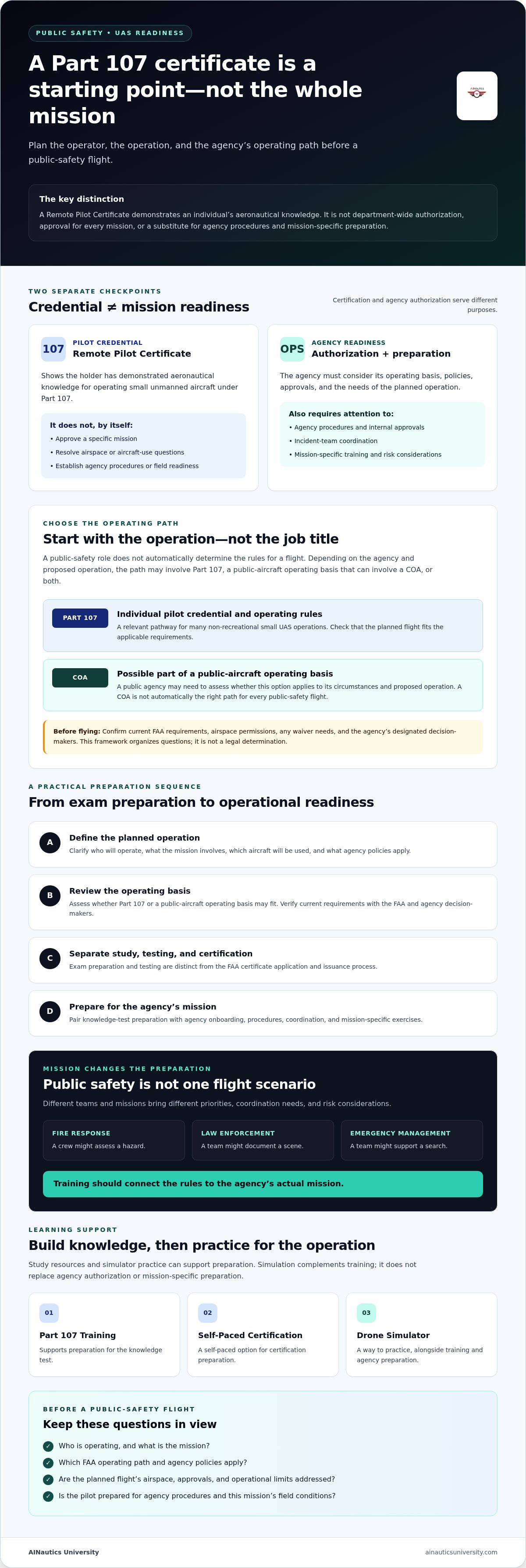
Getting a drone license for public safety often begins with the FAA Remote Pilot Certificate, commonly called a Part 107 certificate. It shows that an individual has demonstrated aeronautical knowledge for operating small unmanned aircraft under Part 107. It is a pilot credential, not a department-wide authorization or approval for every planned flight.
Fire response, law enforcement, emergency medical services (EMS), and emergency management teams may use drones for different purposes. A fire crew might assess a hazard, law enforcement might document a scene, and emergency managers might support a search. The public-safety label alone doesn’t determine the rules for a flight. Before choosing an operating basis, the agency needs to consider its operator, the mission, the aircraft use, and its applicable policies.
What does a Part 107 certificate allow a remote pilot to do?
A Remote Pilot Certificate qualifies its holder to operate small UAS under Part 107 requirements. It doesn’t, by itself, approve a specific mission or resolve questions about airspace, aircraft use, or other operational limits. Before flying, pilots and agencies need to check that the planned operation fits the rules and identify any approvals or additional authority that may apply. For a broad overview of FAA regulations for drones, consult this summary alongside current FAA guidance.
Public agencies shouldn’t assume every emergency-response flight follows the same pathway. An agency may need to assess whether an operation will be conducted under Part 107 or a public-aircraft operating basis, which can involve a Certificate of Authorization (COA). The appropriate option depends on the agency’s circumstances and the proposed operation. Confirm current requirements with the FAA and the agency’s designated decision-makers before flying.
Why does public-safety work need more than a license?
The certificate demonstrates an individual’s aeronautical knowledge. It doesn’t establish agency procedures, clarify who coordinates with the incident team, or prepare a pilot for every field condition. Those elements call for agency-defined training and planning. A search may require coordination around the area being covered, while scene documentation or hazard assessment may call for different priorities, communication, and risk considerations.
Certification and agency mission readiness are separate checkpoints. Treat the certificate as a foundation, then confirm that the pilot understands agency procedures and that the operation has an appropriate legal basis. This helps a team move from knowing the rules to making mission-specific decisions.
Choose the Right FAA Operating Path Before Pursuing a Public-Safety Drone License
Before getting a drone license for public safety, define the operation the agency intends to conduct. A pilot’s public-safety role doesn’t automatically exempt a flight from Part 107. The appropriate operating basis depends on the agency, the mission, and the circumstances of the planned operation. Use these questions to frame the review:
| Decision factor | What to clarify |
|---|---|
| Operator identity | Will an individual pilot operate, or is a public agency conducting the flight? |
| Mission purpose | Is the flight for response, search, scene documentation, training, or another purpose? |
| Aircraft use | Which aircraft will be used, and how does the planned operation fit the applicable rules? |
| Agency policy | What internal approvals, procedures, and operating conditions apply? |
Use this framework to organize questions, not as a legal determination. Compare Part 107 with the public-aircraft operating option, including whether a COA is relevant. Verify current FAA guidance and consult qualified counsel before relying on an operating basis. Airspace permissions and waiver needs also depend on the specific flight, so check current FAA requirements for the planned operation rather than assuming a general approval covers it.
When should an individual consider Part 107 certification?
Part 107 is a relevant pathway for many non-recreational small UAS operations. If you expect to operate under this rule, review the FAA’s current instructions for how to become a certificated remote pilot. Then confirm how your intended operation is classified. “Emergency response” on its own isn’t enough to determine which requirements apply.
For structured exam preparation, AINautics University’s Part 107 Training is one learning option. Training can help build knowledge, but the FAA sets certificate requirements and issues the certificate.
What should a public-safety agency verify before choosing an operating path?
Make the decision specific to the program. Identify who will operate, who is responsible for the flight, and what the mission involves. Document the agency’s chosen operating basis, approvals, applicable conditions, and procedures so the team can refer to a shared plan.
Review the distinction between Part 107 and public-aircraft operations with current FAA guidance and qualified legal counsel. Revisit the decision if the mission, aircraft use, or agency policy changes. This helps the agency choose suitable preparation without assuming public-safety status alone establishes authority to fly.
How to Get a Drone License for Public Safety: A Practical Preparation Sequence
Once you’ve confirmed that Part 107 fits your intended operation, follow a deliberate sequence. Getting a drone license for public safety means preparing for an FAA credential, then completing the FAA’s testing and application steps. A training course supports preparation; it doesn’t issue the Remote Pilot Certificate.
- Confirm the operating need. Recheck the agency’s intended missions and operating basis before focusing on a credential.
- Review current FAA material. Confirm eligibility, testing procedures, application steps, and recurrent requirements directly with the FAA.
- Prepare for the knowledge test. Study the subjects in current FAA testing guidance and use structured Part 107 preparation to find gaps in your understanding.
- Complete the FAA process. Follow current instructions to schedule and take the knowledge test, submit any required application, and check certificate status.
- Track ongoing requirements. Keep certification records and verify recurrent training obligations with FAA sources.
Use current FAA guidance to prepare, complete the required test and application steps, then verify your certificate status and ongoing requirements. The sequence is clear, but the time it takes depends on the individual and the current FAA process.
How should candidates prepare for FAA knowledge testing?
Focus on understanding how to apply the material, not just recalling terms. Study airspace and how to recognize restrictions that may affect a flight, weather and its effect on safe decisions, and operating limitations. Practice applying these ideas to scenarios. For example, consider whether conditions or a planned location call for more review before launch. Use current FAA study materials alongside structured Part 107 preparation. For additional foundational learning, see Drone Training for Beginners: 2026 Guide to UAS Mastery.
AINautics University’s Part 107 Training and Self-Paced Certification support different learning preferences. Neither substitutes for the FAA’s testing and application process. Check the FAA’s official guide to becoming a certificated remote pilot for current instructions before you act.
What should candidates do after completing preparation?
Completing a course isn’t the same as earning an FAA certificate. Follow the current FAA process for testing and application, then confirm your certificate status through the appropriate FAA channels. Keep course-completion records and certification documents organized for your own reference and any agency procedures.
Also check the FAA’s current recurrent-training requirements. As of September 2026, remote pilots must complete online recurrent training every 24 calendar months to exercise Part 107 privileges. Verify the current requirement directly with the FAA, since completing training alone doesn’t confirm your standing or authorize a specific public-safety mission.
Compare Part 107 Study with Public-Safety Mission Training
Part 107 study builds knowledge for FAA testing. Public-safety mission training applies that knowledge within an agency’s procedures and team structure. Passing the test is a meaningful milestone, but it doesn’t automatically prepare a pilot for emergency-response work. A mission may involve changing conditions, coordination with responders, and decisions specific to the agency’s operating plan.
Think of readiness as a progression, not a single course or credential:
- Knowledge-test preparation: Learn the FAA material and understand the rules and concepts covered by the test.
- Simulator practice: Rehearse flight decisions in scenarios before making those decisions in an operational setting.
- Agency onboarding: Learn who approves and coordinates flights, how teams communicate, and which agency procedures apply.
- Supervised exercises: Practice assigned roles and procedures under appropriate agency oversight before operational deployment.
Each stage has a distinct purpose. A simulator can help learners practice decisions, but it doesn’t grant certification, agency approval, or field authorization. Agency procedures and supervised practice help bridge that gap.
Which skills should public-safety learners develop beyond test knowledge?
Build skills that support the whole mission, not just aircraft control. Practice planning around the operational objective, communicating with the team, coordinating crew roles, and reviewing what happened after a flight. A search may require a different plan and team coordination than scene documentation or hazard assessment.
Confirm how agency policy addresses privacy, evidence handling, and safety procedures. These aren’t details to assume from a general Part 107 course. Simulator scenarios can help learners rehearse choices, recognize when to pause, and prepare questions for agency-led instruction. They are practice, not a substitute for field judgment or approval.
How can learners assess a public-safety drone training program?
Check whether a program’s outcomes align with current FAA material, your experience, and the agency’s learning needs. Ask whether it includes relevant scenarios, what instructor support is available, and how learners can continue practicing. Confirm that it separates certification preparation from agency procedures and operational exercises. For context on simulation and other learning approaches, see Immersive Drone Training Technology: Shaping the Future of UAS Education in 2026.
AINautics University’s Part 107 Training supports certification preparation, and its Drone Simulator offers a separate practice resource. Explore Part 107 training and drone simulation options as you build a learning pathway that also includes agency onboarding and supervised practice.
Build a Public-Safety Drone Learning Pathway with AINautics University
After getting a drone license for public safety, build skills around the work learners are preparing to do. Start by identifying intended missions, who will learn, the agency’s operating basis, and the gaps between certification knowledge and mission-specific practice. Then choose education resources to support those goals. Training can prepare learners, but it doesn’t replace FAA requirements, agency approval, or field judgment.
Which AINautics University program fits each learner?
For individuals preparing for the FAA knowledge test, AINautics University offers Part 107 Training and Self-Paced Certification. These options support preparation; the FAA administers its certification process and issues the certificate. Learners who want additional practice can use the Drone Simulator to work through simulated flight decisions. Simulation can reinforce learning, but it doesn’t grant certification or authorize an agency mission.
For educators developing a learning pathway, the Train-the-Teacher Program and VR Trailer Mobile Lab may fit educator-led settings. Students exploring UAS education can consider the UAS Student Scholars program. Match the resource to the learner and instructional goal rather than assuming one option meets every training need.
What should an agency or educator do next?
Before choosing resources, write down the intended missions, learner group, operating basis, and specific training gaps. Learners may need FAA test preparation, decision-making practice, or instruction connected to agency procedures. Those goals call for different learning activities. Education resources should complement, not replace, agency onboarding or supervised operational exercises.
Next, verify current FAA requirements and agency policies for the planned operations. Make sure learners understand which parts of their pathway prepare them for certification and which must be addressed through agency instruction. Revisit the plan as mission needs or learner experience change.
AINautics University’s offerings support individual, student, and educator learning pathways. Explore AINautics University drone training programs to compare the available options and consider which may align with your learning goals.
Build Your Next Step Toward Public-Safety Drone Readiness
Getting a drone license for public safety starts with choosing the appropriate operating path and preparing for the FAA process that applies. A certificate is only one part of readiness. Public-safety teams also need training that connects knowledge to agency procedures, mission planning, and sound decisions in the field.
Set your next steps by identifying the missions, learners, and skills your program needs to support. AINautics University offers Part 107 Training and Self-Paced Certification for individual preparation, plus a Drone Simulator for practice. Educators can explore the Train-the-Teacher Program and VR Trailer Mobile Lab, while students building a UAS learning pathway can consider UAS Student Scholars. These resources support learning, but don’t replace FAA requirements or agency approval.
Ready to compare options for your learning goals? Explore AINautics University drone training programs. Identify the learning needs you want to address and choose a program to support your next step toward responsible, mission-ready public-safety drone operations.
Frequently Asked Questions
Can firefighters or police officers fly a drone under Part 107?
Yes. Firefighters and police officers can fly under Part 107 when the agency selects that operating basis and the pilot meets current FAA requirements. A job title or public-safety mission alone doesn’t determine which rules apply. Before a flight, the agency should review the operation, its authority, and applicable FAA requirements. Confirm the agency’s operating basis using current FAA guidance and qualified legal counsel rather than relying on a blanket assumption.
Do public-safety drone pilots need an FAA Part 107 certificate?
It depends on the operation and the agency’s chosen operating basis. Public-safety work isn’t automatically exempt from Part 107, and one rule shouldn’t be assumed to fit every program. Part 107 is a relevant pathway for many small UAS operations. Agencies should assess their missions, review current FAA guidance, and check agency policy before deciding whether a pilot needs a Remote Pilot Certificate for the planned flights.
How do I get a drone license for public-safety work?
Start by identifying the missions you may support and confirming the agency’s operating basis. If Part 107 applies, review current FAA eligibility and testing requirements, prepare with FAA study materials or structured training, and follow the FAA’s testing and application process. Getting a drone license for public safety is only one part of preparation. Learn agency procedures, build mission-specific skills, and confirm readiness with the responsible agency before operational flights.
Is a Part 107 certificate enough to fly public-safety missions?
No. A Part 107 certificate doesn’t automatically approve every public-safety flight. The operation may also require review of the agency’s operating authority, airspace considerations, mission plan, and applicable approvals. Requirements vary with the operation, so ask the responsible agency to clarify its policy and verify current FAA guidance before deployment. Pilots should also understand the team’s procedures and coordination plan rather than treating the credential as a substitute for mission preparation.
Can I use a drone simulator to prepare for public-safety operations?
Yes. A drone simulator can help learners practice flight concepts and scenario-based decisions in a learning environment. It doesn’t provide FAA certification, agency authorization, or any field preparation the agency requires. Before selecting a course, ask how simulator exercises connect to learning goals and what further practice may be needed. Treat simulation as one part of a broader pathway that includes applicable procedures and supervised experience determined by the agency.
What training should a public-safety drone pilot complete beyond Part 107?
Begin with the agency’s missions, responsibilities, and procedures. There isn’t one additional course that fits every team. Depending on assigned duties, learning goals may include mission planning, communication, crew coordination, scenario practice, and post-flight review. The agency should identify which topics apply and how learners will practice them. When comparing programs, check that instruction supports the intended responsibilities and complements, rather than replaces, agency onboarding and operational preparation.
Can students or teachers pursue public-safety drone training?
Yes. Students and teachers can explore UAS education and educator-led learning while keeping FAA certification and operational permissions separate from classroom participation. A school learning program doesn’t automatically authorize agency flights. AINautics University offers the Train-the-Teacher Program and UAS Student Scholars for education pathways. Students and educators should review current program details, confirm applicable FAA requirements for any planned operations, and coordinate with the responsible agency before taking part in operational missions.

Article by
AINautics University Team
The team behind AINautics University, dedicated to drone education and FAA Part 107 certification prep, VR flight simulation, and STEM training programs for students and educators.


