
Passing the FAA test can qualify you to fly commercially, but it doesn’t automatically authorize every mission. That distinction is central to commercial drone license requirements. The Remote Pilot Certificate establishes your pilot qualification. Each operation must still meet the rules that apply to its location and flight conditions. This is a common source of confusion for students and career changers planning their next step.
This guide explains who can qualify under Part 107, what to expect from the aeronautical knowledge test, and how to distinguish the certificate from permissions or rules that may apply to a specific operation. You’ll also find practical ways to prepare without treating training as a guarantee of passing. AINautics University’s Part 107 Training and Self-Paced Certification options can support test preparation, while its Drone Simulator offers a complementary way to practise scenarios. We’ll begin with FAA eligibility, then cover mission-specific checks and study planning.
Key Takeaways
- Understand what “commercial drone license” means under Part 107 and what the Remote Pilot Certificate qualifies you to do.
- Use the commercial drone license requirements checklist to assess your eligibility before starting the FAA application process.
- Separate pilot certification from aircraft, airspace, and mission-specific checks when planning a commercial flight.
- Build a preparation plan that fits your learning needs, whether you prefer guided instruction or self-paced study.
- AINautics University’s Part 107 Training, Self-Paced Certification, and Drone Simulator can support learning, but they do not replace FAA requirements.
Commercial drone license requirements: what FAA Part 107 actually means
“Commercial drone license” is the common phrase, but the FAA credential is called a Remote Pilot Certificate. Under Part 107, the certificate qualifies a person to act as a remote pilot for applicable small-unmanned-aircraft operations. It is a pilot qualification, not blanket permission to fly any drone, anywhere, or in any way.
That distinction makes commercial drone license requirements easier to understand: first establish that the pilot is qualified, then check the rules for the aircraft, airspace, and planned operation. This guide covers the certification baseline and ways to prepare. It does not cover every operating rule, authorization process, or possible exception, so verify current FAA guidance before planning a specific flight.
What does a commercial drone license authorize?
The Remote Pilot Certificate shows that a pilot has met the FAA’s qualification requirements for applicable Part 107 operations. It does not, by itself, clear a flight in restricted airspace or remove conditions that may apply to a particular mission. Aerial photography, inspections, and other professional uses can involve different operating considerations, so assess the planned flight rather than relying on the certificate alone.
Payment isn’t the only factor to consider. The purpose and circumstances of an operation matter when determining which FAA rules apply. For a broader introduction to the U.S. regulatory landscape, see U.S. Drone Regulations, then use current FAA materials to confirm the requirements for your situation.
Who should understand Part 107 requirements?
Aspiring commercial pilots and career changers can use Part 107 requirements to map their first certification steps. Students can build a foundation for future UAS careers, while educators can use the same framework to connect aviation rules with classroom learning and practical skills.
An individual preparing for certification has a different task from a school developing a drone program. The individual focuses on personal eligibility, FAA instructions, and knowledge-test preparation. A school must also consider its broader educational and operational needs. AINautics University’s professional FAA Part 107 training guide can help readers explore the certification path. Its Part 107 Training and Self-Paced Certification options provide structured ways to study, but the FAA issues the certificate.
Who qualifies for an FAA Remote Pilot Certificate?
Part 107 eligibility involves personal qualifications, an FAA knowledge test, and a security review. Check the current FAA instructions before applying, since the FAA controls the official process and terminology.
What personal eligibility criteria should applicants check?
Under the current Part 107 rule, an applicant must meet these baseline criteria:
- Age: Be at least 16 years old.
- English: Be able to read, speak, write, and understand English.
- Safe operation: Be in a physical and mental condition that allows safe operation of a small unmanned aircraft system.
These are core eligibility checks, not a substitute for reading the FAA’s application instructions. The rule does not describe the fitness criterion as a medical examination in this eligibility provision. Review the official 14 CFR Part 107 text if you need to understand the regulatory language directly. Don’t assume an exception applies unless current FAA guidance supports it.
What testing and review are part of certification?
First-time applicants generally need to pass the FAA’s initial aeronautical knowledge test, officially titled Unmanned Aircraft General - Small (UAG). The test assesses knowledge relevant to operating under Part 107. Prepare with current FAA materials and focus on understanding the subjects, rather than relying only on memorized answers.
After testing, follow the FAA’s current application instructions. The FAA conducts a security vetting as part of certification. Meeting the age, language, and fitness criteria or passing the test does not guarantee approval. Use official instructions for the required steps and status updates instead of relying on informal timelines.
For a clear sequence of application steps, consult the published guide on getting an FAA drone license. Focused study can help organize test preparation, but a training program doesn’t issue the certificate or guarantee a passing result. If structured learning would help, explore AINautics University Part 107 Training as one preparation option. Commercial drone license requirements establish a starting point. Next, match your intended operations to the rules that apply.
Does a Part 107 certificate let you fly any commercial mission?
No. A Remote Pilot Certificate qualifies you as a pilot for applicable Part 107 operations, but it doesn’t automatically make every aircraft, location, or flight compliant. Treat certification as one part of preflight planning. The mission and intended flight location determine what else you need to check.
Separate the pilot’s qualification from the aircraft’s requirements and the flight’s operating conditions. Under Part 107, drones must be registered regardless of weight. Most drones must also meet the FAA’s Remote ID requirements. Holding a certificate does not replace these obligations.
Check the pilot, aircraft, location, and mission separately
| Area | What to check |
|---|---|
| Pilot | Whether the person is qualified and current for the planned Part 107 operation. |
| Aircraft | Applicable registration and Remote ID requirements for the drone. |
| Location | Airspace restrictions and whether FAA airspace authorization is needed before flight. |
| Operation | Whether the flight conditions require meeting additional rule provisions or obtaining a waiver. |
For example, a flight in controlled airspace may require FAA authorization. A planned night operation or flight over people must meet the applicable Part 107 conditions. The certificate alone doesn’t satisfy those conditions. Some operations may be allowed under standard rules when requirements are met, while others may call for a waiver or another authorization. Don’t assume that a commercial purpose or a valid certificate settles the question.
Include location and operating conditions in your planning from the start. Before launch, check current FAA information for the airspace, aircraft, and proposed flight, and confirm whether an authorization or waiver applies. The FAA’s Become a Certificated Remote Pilot page is a useful starting point for certification information. For operational rules, consult current FAA Part 107 guidance and confirm the requirements for your specific mission.
This distinction is central to commercial drone license requirements: the certificate qualifies the pilot, while separate checks establish whether a particular flight can proceed as planned. Build those checks into your workflow, and repeat them whenever the aircraft, location, or mission changes.
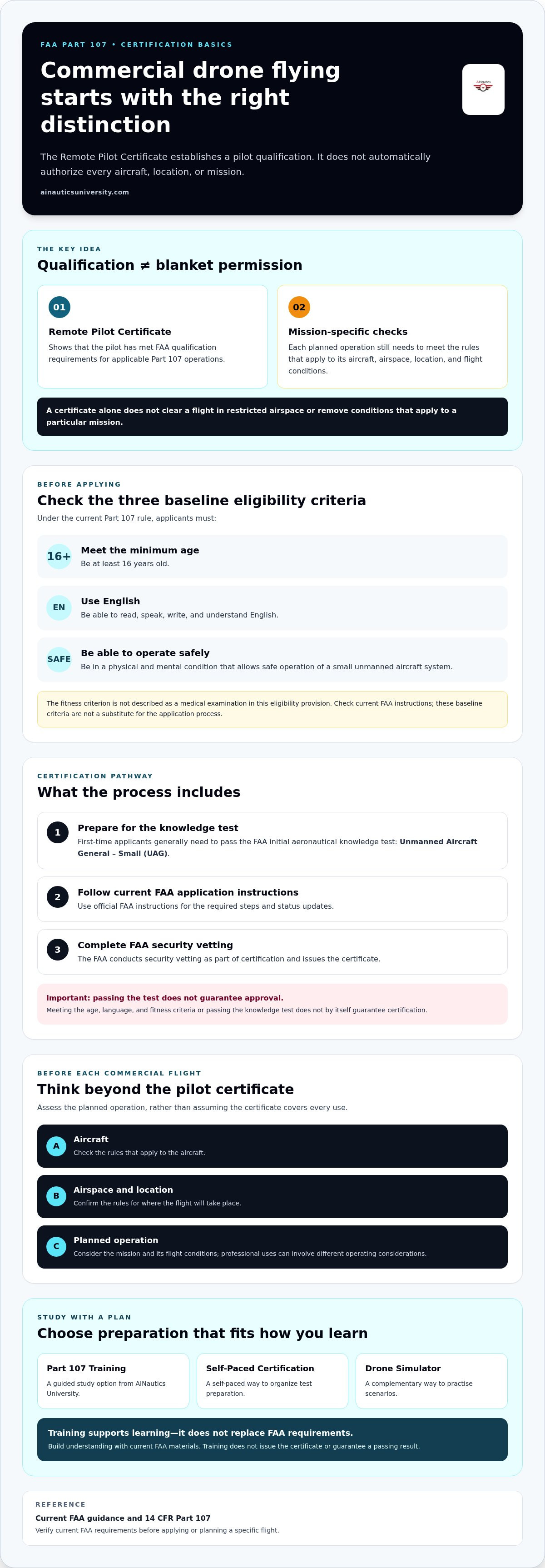
Use this commercial drone certification checklist before applying
A clear plan helps you separate FAA certification steps from optional study choices and longer-term career goals. Use this checklist to get organized, then confirm current details on FAA websites before testing or submitting an application.
Before the knowledge test
- Confirm eligibility. Review the FAA’s current Remote Pilot Certificate criteria, including age, English-language ability, and the ability to safely operate a small unmanned aircraft.
- Find official test instructions. Check the FAA’s Remote Pilot certification guidance for the current process and test requirements. The initial knowledge test is called Unmanned Aircraft General - Small (UAG). Confirm the latest scheduling instructions and fee with the FAA and its designated testing provider before booking.
- Identify study priorities. Review current test guidance and note which subjects are unfamiliar. Build a realistic study plan around your schedule, using reliable FAA materials as a reference.
- Choose preparation that fits you. A structured course can help organize your study; self-paced learning may suit someone who prefers to set their own rhythm. AINautics University’s Part 107 Training and Self-Paced Certification options support preparation, but training isn’t required by the FAA and can’t guarantee a passing result.
Keep the goal focused: prepare for the test first. Buying equipment, seeking work, or planning a business can be separate career decisions, not prerequisites for applying for the certificate.
After the knowledge test
- Follow FAA application instructions. Use the current FAA process to submit the required application after testing. Check that your information is accurate and complete.
- Monitor official updates. The FAA conducts a security review as part of certification. Track your application through the official channel and wait for FAA instructions. Don’t rely on assumed processing times or unofficial assurances.
- Confirm your next step. Read the FAA’s status messages carefully and follow any additional instructions. For timing questions, consult the article on Part 107 certification timelines, while treating FAA updates as authoritative for your individual application.
Use this commercial drone license requirements checklist as a planning tool, not a substitute for current FAA directions. If guided preparation would help you build a study routine, explore AINautics University Part 107 Training.
Prepare for commercial drone certification with focused training
Preparing for the Part 107 knowledge test doesn’t require a particular course. The FAA sets the certification requirements. Training is an optional way to organize your study, strengthen your understanding, and identify subjects that need more attention. Choose an approach you can sustain, and use current FAA materials to check that your preparation reflects the test guidance.
Which preparation format fits your learning style?
Self-paced learning may suit you if you need flexibility around school, work, or other responsibilities. A guided course may be a better fit if you prefer a structured sequence and clear subject areas to work through. Neither format replaces the FAA’s test or guarantees a result. Choose the one that helps you study consistently and understand the material.
AINautics University offers Self-Paced Certification options and Part 107 Training for learners who want different levels of structure. Its Drone Simulator can complement knowledge-test preparation by letting learners practise scenarios. Simulation is a learning resource, not an FAA requirement, and it doesn’t replace checking the rules for real flights.
As you study, keep a simple record of what you understand and what you need to revisit. If airspace concepts feel unfamiliar, for example, set aside time to review them using current FAA guidance before moving on. A focused plan can make preparation more manageable without promising a particular exam outcome.
How can certification connect to education and career planning?
Think beyond the test, too. Consider what kind of UAS work interests you, such as capturing images, supporting inspections, or contributing to a school program. That goal can help you identify which skills to develop after exam preparation. A certificate addresses pilot qualification, but it doesn’t provide every skill or permission a particular job or flight may require.
Students and educators may also connect certification study with broader learning goals. AINautics University’s Train-the-Teacher Program and UAS Student Scholars are relevant options for those focused on teaching or student development. Individual learners can start with their study needs and career interests, then choose resources that fit.
If structured support would help you prepare, explore AINautics University training resources. Use them alongside official FAA instructions, and take the next step at a pace that works for you.
Build your next step toward confident UAS operations
Commercial drone license requirements start with qualifying for an FAA Remote Pilot Certificate, but certification is only one part of responsible flight planning. Check the rules for the aircraft, location, and mission before each operation. Follow current FAA instructions for testing and application.
Preparation can help you approach the knowledge test with a clearer plan. Choose a format that fits how you learn, whether guided instruction or self-paced study. AINautics University offers Part 107 Training, Self-Paced Certification options, and a Drone Simulator for scenario-based learning. These resources support preparation, but the FAA sets the requirements and issues the certificate.
Explore AINautics University’s Part 107 training resources to build your UAS knowledge at a pace that works for you.
Frequently Asked Questions
What are the requirements for a commercial drone license?
“Commercial drone license” usually means the FAA Remote Pilot Certificate under Part 107. Applicants must be at least 16, able to read, speak, write, and understand English, and in a physical and mental condition to safely operate a drone. They must pass the initial Unmanned Aircraft General - Small (UAG) knowledge test and complete the FAA application and security review. Training alone doesn’t issue a certificate, and the certificate doesn’t authorize every flight.
How old do you have to be to get an FAA drone pilot certificate?
You must be at least 16 years old to receive an FAA Remote Pilot Certificate under Part 107. Age is one eligibility condition, not the entire certification process. Applicants must also meet the FAA’s English-language and safe-operation criteria, pass the required initial knowledge test, and complete the application process, including FAA security vetting. Check current FAA instructions before applying, especially if you’re helping a student or minor plan a future certification path.
Do you need a Part 107 certificate to make money with a drone?
Commercial drone work commonly operates under Part 107, but payment alone doesn’t determine which FAA rules apply. The activity and how the drone is used matter, so check current FAA guidance for the specific work you plan to do. A Remote Pilot Certificate addresses pilot qualification; it doesn’t replace aircraft obligations, airspace checks, or any authorization or waiver that may apply to a particular operation.
Does a Part 107 certificate let you fly a drone anywhere?
No. A Part 107 certificate qualifies you as a pilot, but it doesn’t remove airspace restrictions or conditions tied to a specific operation. Before each mission, check current FAA requirements for the planned location and flight. For example, access to controlled airspace may require FAA authorization. Confirm what applies to your operation through official FAA sources rather than assuming your certificate alone clears the flight.
How long does a commercial drone license last?
The Remote Pilot Certificate is permanent, but pilots must maintain aeronautical knowledge currency to continue flying commercially under Part 107. The FAA requires recurrent online training every 24 calendar months. If currency lapses, the certificate isn’t invalidated, but you can’t legally conduct Part 107 operations until you complete the required training. Check current FAA instructions for the applicable recurrent course and process.
Is Part 107 training required to get a drone license?
No. The FAA doesn’t require applicants to take a paid training course, but first-time applicants must pass the required knowledge test and complete the FAA application process. Preparation can include independent study, a structured course, or simulator practice. AINautics University offers Part 107 Training, Self-Paced Certification options, and a Drone Simulator to support learning. These resources don’t issue an FAA certificate or guarantee a passing result.

Article by
AINautics University Team
The team behind AINautics University, dedicated to drone education and FAA Part 107 certification prep, VR flight simulation, and STEM training programs for students and educators.


