
A drone can capture a view of a jobsite, but making that information useful takes more than piloting skill. UAS training for construction management helps teams plan operations and connect aerial information to project work. For students and career changers, learning how flight operations, data, and coordination fit together can also help clarify career interests across the UAS field.
Part 107 knowledge is a foundation for people pursuing certification, but construction work can call for broader abilities too. Educators preparing future UAS professionals and learners exploring industry roles may ask how flight skills connect with project planning, data interpretation, and team coordination.
This 2026 guide explains competencies relevant to construction workflows, how to assess training for practical value, and how to turn learning into responsible team operations. Whether you’re a construction professional, student, parent, or educator, use it to consider a path from foundational knowledge to applied learning and career preparation.
Key Takeaways
- Identify where UAS may support construction workflows, including progress documentation, mapping, and site communication.
- Use UAS training for construction management to develop operational awareness, mission planning, data interpretation, and team coordination.
- Match training to learner roles: managers need oversight skills, while flight personnel need preparation for conducting operations.
- Compare training options by course scope, practice opportunities, delivery format, and how learners will apply their knowledge afterward.
- Build a practical learning plan by defining goals, assigning roles, practicing, and reviewing what participants learn.
What UAS Training for Construction Management Can and Cannot Do
UAS training for construction management develops the knowledge and skills to plan, oversee, or conduct drone operations as part of a project team. The goal is broader than learning to control an aircraft. Teams also need to understand how aerial information is collected, reviewed, and shared in ways that support project needs.
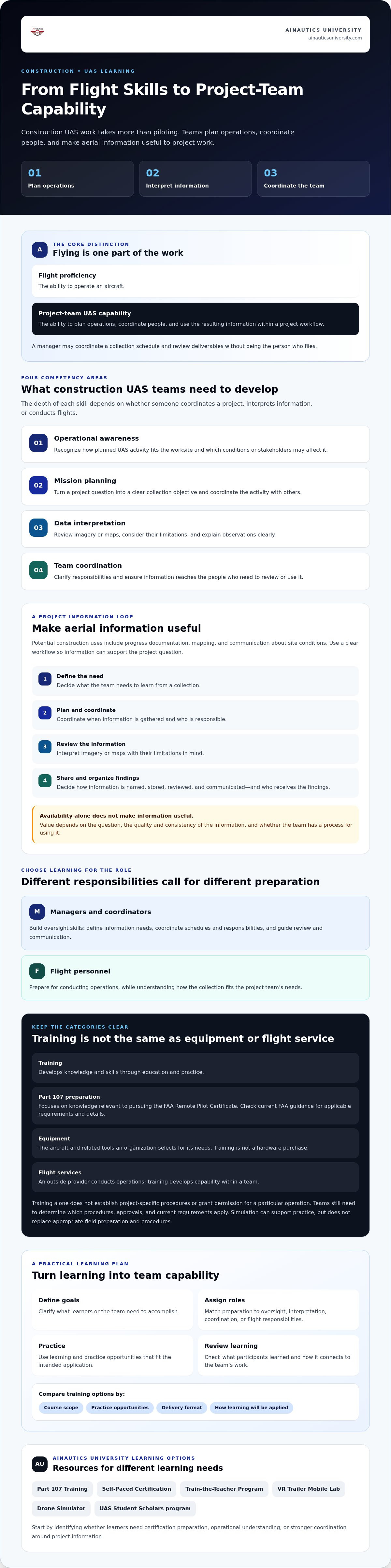
Flight proficiency is the ability to operate an aircraft; project-team UAS capability is the ability to plan operations, coordinate people, and use the resulting information within a project workflow. Both matter, but they serve different needs. A manager, for example, may coordinate a collection schedule and review deliverables without being the person who flies.
Where UAS Skills Fit in a Construction Project
Depending on the project, aerial information may support progress documentation, mapping, or communication about site conditions. The drone applications in construction overview provides examples of how these uses fit within the wider range of UAV applications. In practice, a manager might define what the team needs to learn from a collection, coordinate when information is gathered, and decide who reviews it and how relevant observations are shared.
Value depends on the question the team needs to answer, the quality and consistency of the information, and whether there’s a process for using it. An image set or map isn’t automatically useful just because it’s available. Before making aerial information part of a routine workflow, decide how it will be named, stored, reviewed, and communicated. Also clarify who is responsible for interpreting it and who needs to receive the findings.
Training, Certification, Equipment, and Flight Services Are Different
These are related but distinct parts of building UAS capability:
- Training develops knowledge and skills through education and practice. It can help learners understand roles, planning, and operations.
- Part 107 preparation focuses on knowledge relevant to pursuing the FAA Remote Pilot Certificate. Check current FAA guidance for applicable requirements and details.
- Equipment refers to the aircraft and related tools an organization selects for its needs. Training isn’t a hardware purchase.
- Flight services involve having an outside provider conduct operations. Training instead develops capability within a team.
Training alone doesn’t establish project-specific procedures or grant permission for a particular operation. Teams still need to determine which procedures, approvals, and current requirements apply to their intended use. Simulation can help learners practice scenarios, but it doesn’t replace appropriate preparation and procedures for field operations.
AINautics University offers Part 107 Training, Self-Paced Certification, enterprise UAS training, and the Drone Simulator as learning options. It doesn’t sell drone hardware or provide pilot-for-hire services. Start by identifying whether the team needs certification preparation, operational understanding, or stronger coordination around project information.
Which UAS Competencies Matter for Construction Management?
Construction UAS work draws on skills beyond operating an aircraft. Students and career explorers can use these competencies to understand the range of responsibilities involved. Educators can connect classroom learning with workplace needs. The depth required depends on whether someone will coordinate a project, interpret information, or conduct flights.
Role shapes the UAS skills a construction team needs, from coordinating project information to planning and carrying out flight operations.
These four competency areas provide a useful framework for learners and teams:
- Operational awareness: Recognize how planned UAS activity fits the worksite and what conditions or stakeholders may affect it.
- Mission planning: Translate a project question into a clear collection objective and coordinate the activity with others.
- Data interpretation: Review imagery or maps, consider their limitations, and explain observations in clear terms.
- Team coordination: Communicate responsibilities and ensure information reaches the people who need to review or use it.
These areas help aspiring UAS professionals see how technical skills connect with communication, judgment, and project awareness. Educators can use them to discuss the different roles that support an operation. For a practical learning objective, have participants explain what information a team needs, who should collect and review it, and how findings should be communicated.
Flight Planning, Safety, and Regulatory Awareness
People preparing to conduct flights need to develop skills in airspace awareness, preflight planning, site coordination, and risk identification. Managers and students exploring oversight roles can learn to ask informed questions: What is the purpose of the planned operation? How will it be coordinated with site activity? What conditions might require the plan to change?
Part 107 study supports foundational regulatory knowledge, but a certificate alone doesn’t demonstrate readiness for every site or task. Learners and organizations should check current FAA guidance and consider what additional preparation and project-specific procedures apply to their intended work.
Turning Aerial Data into Project Information
UAS learning can also build the ability to make captured information understandable and relevant. Mapping, image review, and progress documentation may form part of a workflow, but teams need to understand what the information can support, where its limits are, and how to communicate findings without overstating them.
Photogrammetry creates maps or 3D representations from overlapping photographs. LiDAR uses laser measurements to represent distances and surfaces. These are different approaches, not universal requirements. For students and educators, understanding the purpose of each method can connect UAS concepts with future workplace learning.
AINautics University’s Part 107 Training and Drone Simulator are options to consider for foundational and scenario-based learning. Explore UAS training options and compare them with the skills learners or team members need to develop.
How to Compare UAS Training Options for a Construction Team
Choose training based on the work your team needs to perform, not the format alone. Compare course scope, intended learners, opportunities to practice, delivery method, and how participants can apply what they learn afterward. Part 107 preparation may address certification knowledge, but it isn’t automatically a complete program for managers, coordinators, and flight personnel.
Questions to Ask Before Choosing a Course
Start with the people who will use the skills. Ask which roles and experience levels the course is designed to support, and whether its scenarios relate to your organization’s intended work. Check how learners practice planning, decision-making, or communicating information instead of relying only on a list of topics. Confirm current course details directly, including what is covered and what learners need to provide.
Use this comparison to clarify what each format can contribute. Formats may be combined, but don’t assume any single one covers every team need.
| Format | May suit | What to evaluate |
|---|---|---|
| Self-paced study | Learners who need flexibility to work through material independently. | Whether the content matches the learner’s goals and how they’ll apply it after study. |
| Instructor-led learning | Teams that value guided explanation and opportunities to discuss questions. | Whether the instruction addresses different roles and connects concepts to realistic work situations. |
| Simulator-supported practice | Learners who can benefit from working through scenarios in a simulated setting. | Whether practice builds relevant judgment and reinforces, rather than replaces, field procedures. |
Look for Practice That Transfers to Work
If you’re concerned a course may be too theoretical, ask learners to explain how they would respond to a realistic scenario. Can they identify the information a project team needs, plan how to coordinate its collection, and describe how findings should be communicated? Scenario-based learning can make concepts more tangible, but confirm which scenarios are actually included. Don’t assume a general UAS course covers construction-specific workflows.
AINautics University offers Part 107 Training, Self-Paced Certification, enterprise UAS training, and the Drone Simulator. Compare these options with learner roles and organizational needs, and confirm current scope directly. To explore its UAS training information, first consider which skills your team needs to develop.
When Simulation and Self-Paced Learning May Help
The Drone Simulator can support scenario-based learning, while Self-Paced Certification may suit learners who need flexibility in their study. Simulation is a learning tool, not a substitute for field procedures. For more context on simulation-supported learning, read the immersive drone training technology guide. A thoughtful UAS training for construction management plan connects the chosen format to a clear role and a practical next step.
How to Put UAS Training into a Construction Team’s Learning Plan
Turn a project’s learning needs into a plan that connects people, preparation, and review. Involve project leadership, safety stakeholders, and prospective operators so the learning reflects actual responsibilities. For educators and workforce programs, the same process can connect classroom activities to skills used in construction UAS roles while keeping instruction grounded in appropriate procedures.
Start with the Project Need and Learner Roles
Identify the priority: oversight, data literacy, flight operations, or workforce development. Then map who will coordinate, conduct, review, and communicate UAS work. In a classroom or career pathway, educators can use these role distinctions to help learners explore which skills they want to develop. The drone curriculum guide for educators offers related ideas for connecting instruction with UAS learning.
Use the needs assessment to shape a practical sequence:
- Define the need: State what the organization or learning program wants participants to understand or accomplish.
- Assign roles: Clarify who oversees operations, who may conduct flights, and who will use or share collected information.
- Select learning: Match preparation to each role, learners’ prior knowledge, and organizational goals.
- Practice and apply: Use suitable scenarios to rehearse planning and decisions before any operational application.
- Review and refine: Gather feedback, document lessons, and identify what learning or procedures need attention next.
Practice, Apply, and Review the Learning
Scenario-based practice can help learners connect concepts with choices they may encounter in a role. Students can use it to explore operational responsibilities, while teams can rehearse coordination and planning. Simulation supports learning, but it doesn’t replace preparation for field operations or organization-specific procedures.
After practice or approved operational activity, review whether the information served its intended purpose, reached the right people, and supported clear communication. Document lessons so educators can strengthen future instruction and project teams can refine their workflows. Before field practice, verify current applicable rules and follow the organization’s procedures.
Site procedures, insurance considerations, data handling, and applicable requirements need organization-specific review. To compare learning options for your team or workforce pathway, explore UAS training resources from AINautics University.
Build Construction UAS Capability with AINautics University Training
Once your team has defined its goals and roles, select learning that addresses the capability it needs. AINautics University offers Part 107 Training, Self-Paced Certification, enterprise UAS training, and the Drone Simulator. These options can support different learning needs, but course fit depends on each learner’s role, prior knowledge, and your organization’s priorities.
Match AINautics Learning Options to Your Goals
For learners who need foundational knowledge related to FAA Part 107, explore Part 107 Training and Self-Paced Certification. For a team considering broader UAS learning, investigate enterprise training. The Drone Simulator supports scenario-based instruction and provides a way to practice decision-making as part of learning. Confirm current course content and whether relevant construction scenarios are included before selecting an option.
Part 107 preparation is one part of capability building, not a substitute for every project-specific skill. A manager may need to understand roles, planning, and how information will be used, while a person conducting flights may need more focused operational preparation. For certification-focused detail, see the professional FAA Part 107 training guide. Check current FAA guidance and course details as you plan.
Choose a Clear Next Step
Before choosing, summarize what your team needs to learn and who needs to learn it. Then compare those needs with the available formats. Consider whether learners need foundational study, team-focused instruction, scenario-based practice, or a combination. Ask about current scope directly, especially if your intended application depends on construction-specific scenarios or particular operational skills.
AINautics University provides education and training, not drone hardware sales or hired flight operations. Keep the decision focused: training develops people and team capability, while equipment selection and project flight arrangements are separate organizational considerations.
UAS training for construction management works best when project needs, learner roles, and appropriate preparation align. If you’re ready to compare your goals with available learning formats, explore AINautics University training options and ask which option may fit your learners.
Turn UAS Learning into Project Capability
Strong UAS programs start with a clear purpose. Identify what the team needs to learn, match preparation to each person’s role, and plan how aerial information will be reviewed and shared. Certification knowledge can provide a foundation, while project-specific procedures and ongoing review connect learning to responsible workplace practice.
That’s the practical value of UAS training for construction management: developing team capability, not just flight proficiency. AINautics University offers Part 107 Training, Self-Paced Certification, and enterprise UAS training. The AINautics Drone Simulator also supports simulation and scenario-based learning, giving teams another format to consider as they compare their needs with available options.
Ready to identify a learning path for your role or team? Explore UAS training options with AINautics University.
Frequently Asked Questions
What is UAS training for construction management?
UAS training for construction management develops the knowledge and skills a team needs to plan, oversee, or conduct drone operations related to project work. Management learning may focus on defining information needs, coordinating roles, and reviewing aerial data. Piloting focuses on operating the aircraft and requires separate preparation. A manager may coordinate a mapping or progress-documentation workflow without personally flying, while designated flight personnel need skills suited to their operational responsibilities.
Does a construction manager need an FAA Part 107 certificate to use drone data?
Not necessarily. A manager who only coordinates work or reviews drone data may have different requirements from someone who conducts a commercial flight. FAA Part 107 requirements depend on the operation and each person’s role. People serving as remote pilots for covered operations should confirm the applicable certification requirements. Check current FAA guidance before planning or conducting flights, since this answer is general information, not a determination for a specific project.
What can drones be used for in construction management?
Drones may support workflows such as documenting site progress, creating maps, reviewing site conditions, and sharing aerial information with project stakeholders. A team might compare images collected at different project stages or use a map to support a site discussion. The best use depends on the project question, the quality of the collected information, and how the organization reviews and communicates it. A drone capture alone doesn’t guarantee a useful project insight.
Can UAS training help construction teams interpret aerial data?
It can help learners build data literacy: understanding what imagery or maps show, recognizing limitations, and communicating observations clearly. That knowledge complements flight skills, since useful project information depends on both how it is collected and how the team interprets it. Course coverage varies, so ask providers whether data review is included and whether any examples match your work. Confirm current course details rather than assuming a program teaches specific software or construction platforms.
How do I choose UAS training for a construction team?
Start by identifying learner roles and the capability each person needs. Compare course scope, learner experience level, delivery format, and opportunities to practice planning or decision-making. Ask whether the learning includes scenarios relevant to your organization, and how participants can apply it afterward. Distinguish certification preparation from broader team learning. Before enrolling, confirm current course content and requirements directly, especially if you expect instruction in a particular construction workflow.
Is simulator training useful for construction UAS learning?
Simulation can support scenario-based learning by giving participants a setting to rehearse planning and decision-making. A Drone Simulator may help learners explore how they respond to a situation before applying concepts in an operational environment. It isn’t a substitute for field experience, site procedures, or preparation for actual operations. Ask what scenarios a program currently includes and whether they suit your learners’ roles; don’t assume construction-specific exercises are part of every simulator-supported course.
Can I learn UAS skills through self-paced training?
Yes. Self-paced learning can give participants flexibility to study foundational material according to their learning needs. AINautics University offers Self-Paced Certification as an option for learners pursuing certification-focused study. Consider whether independent study addresses your goals, or whether your role also calls for instructor guidance or scenario-based practice. Confirm current course scope, format, and requirements directly so you can choose an approach that fits your background and intended application.

Article by
AINautics University Team
The team behind AINautics University, dedicated to drone education and FAA Part 107 certification prep, VR flight simulation, and STEM training programs for students and educators.


