
By 2030, the Federal Aviation Administration projects the number of certificated remote pilots will surge to approximately 628,600. Yet, many students, parents, and educators face a frustrating barrier. You might feel overwhelmed by confusing FAA Part 107 requirements, or stuck with a lack of advanced, hands-on training facilities in local schools. It's easy to feel uncertain about which certifications actually lead to real jobs. Joining an elite UAS student scholar program bridges this gap, transforming raw interest into professional credibility.
You can master the path to professional drone certification and high-tech career readiness through the industry-leading UAS Student Scholar framework. At AINautics University, we provide a proven roadmap to help you obtain an FAA Part 107 license, build a professional portfolio, and gain access to immersive flight technology. This 2026 guide breaks down how specialized tools like our Drone Simulator, interactive Part 107 Training, and the VR Trailer Mobile Lab accelerate your journey from the classroom straight into the workforce.
Key Takeaways
- Discover how a structured UAS student scholar program connects academic STEM concepts directly to high-paying aviation career paths.
- Learn how to master critical aviation regulations and build flight confidence using specialized Part 107 Training and interactive simulators.
- See how schools can launch a compliant drone curriculum in just 90 days by leveraging a sustainable Train-the-Teacher Program model.
- Explore how cutting-edge tools like the VR Trailer Mobile Lab bring immersive flight technology directly to students to eliminate equipment barriers.
What is a UAS Student Scholar Program?
A UAS student scholar program serves as a specialized educational pathway designed to build absolute mastery in Unmanned Aircraft Systems. Rather than treating drones as recreational toys, this framework combines rigorous academic STEM standards with FAA-regulated flight training. As the autonomous systems workforce expands rapidly in 2026, the industry requires individuals who understand both the scientific theory and the practical application of an Unmanned aerial vehicle (UAV). To bridge the gap between classroom study and real-world execution, the curriculum integrates professional-grade technology like the AINautics Drone Simulator. This ensures students develop muscle memory and spatial awareness before ever stepping onto a live flight line.
The Mission of the UAS Student Scholar
The core mission focuses on transitioning students from hobbyist flight to professional mission execution. Flying for weekend recreation differs wildly from gathering engineering-grade data or conducting thermal inspections. Scholars develop the strict, safety-first mindset required for complex commercial operations, minimizing risks while maximizing data accuracy. This program builds deep technical literacy across multiple critical disciplines:
- Flight Dynamics: Understanding micro-weather patterns, aerodynamics, and weight-and-balance limitations.
- Data Collection: Learning how to capture clean, actionable imagery for spatial mapping and 3D modeling.
- AI Integration: Utilizing modern automated flight software to execute precise, repeatable infrastructure inspections.
Who Should Apply for Scholar Status?
This structured pathway caters to specific groups aiming to lead the next generation of aviation. High school students pursuing Career and Technical Education (CTE) pathways gain a distinct competitive advantage, graduating with industry credentials that position them for immediate workforce entry. Educators looking to expand their school's capabilities can utilize this framework to lead the Train-the-Teacher program, establishing sustainable, long-term aviation programs in their local districts. Finally, community organizations can leverage the model to build a certified youth drone corps. Participating in a comprehensive UAS student scholar program sets the elite standard for youth drone education.
Core Pillars of Professional Drone Certification
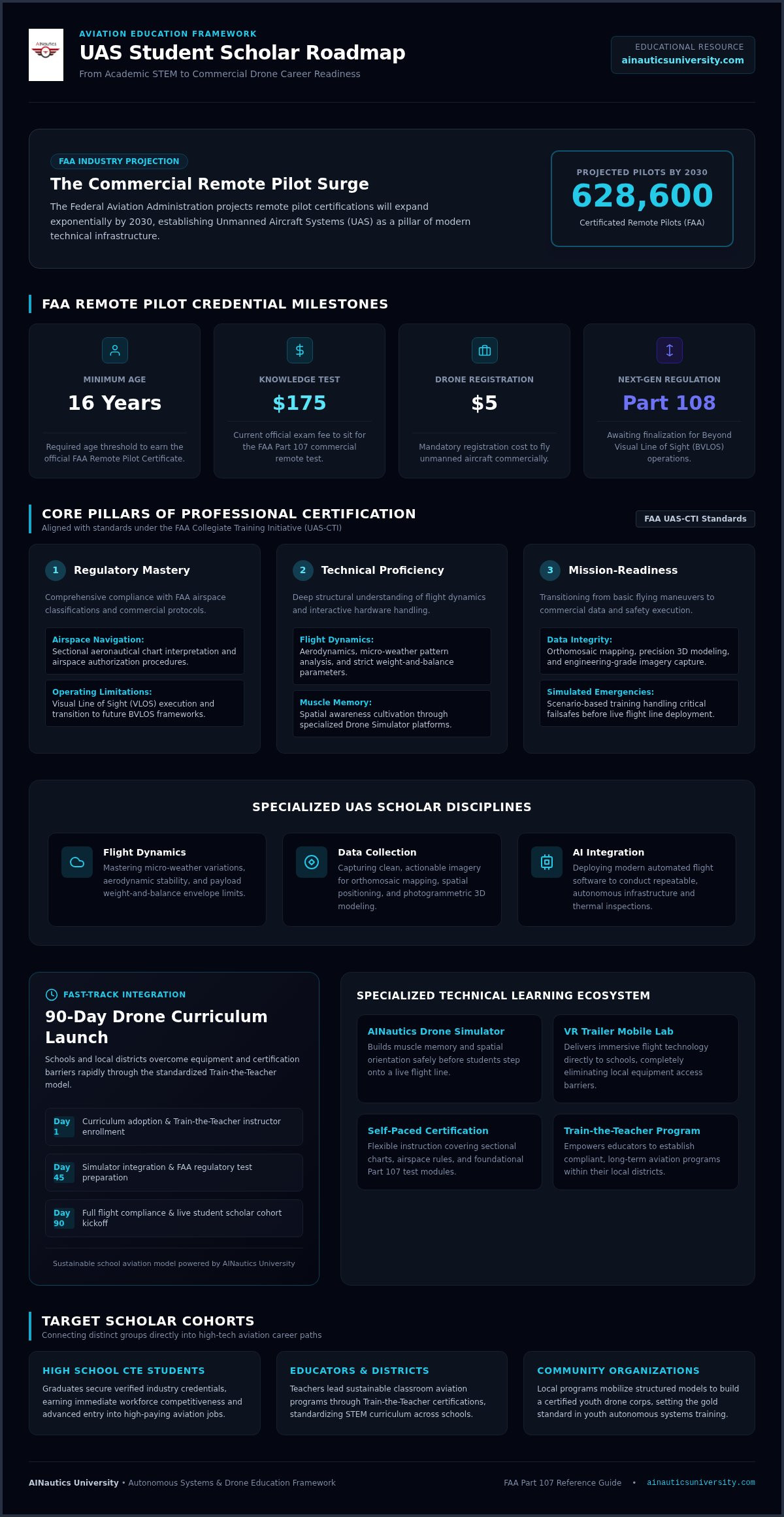
Success in the autonomous industry requires more than just basic flight skills. A high-quality UAS student scholar program focuses on three critical pillars: regulatory mastery, technical proficiency, and mission-readiness. Certification isn't just a legal requirement. It's a badge of professional competence that separates hobbyists from career-ready pilots. To reach this level, students must move beyond simple maneuvers and learn to manage complex airspace environments. The curriculum aligns with the high standards seen in the FAA's Collegiate Training Initiative (UAS-CTI), ensuring every participant meets national benchmarks for aviation excellence.
FAA Part 107 and Beyond
The Remote Pilot Certificate is the mandatory foundation for any commercial drone career. To earn this, students must be at least 16 years old and pass the FAA knowledge test, which currently carries a $175 exam fee. Our FAA Part 107 drone training prepares scholars for every nuance of the exam, from weather patterns to sectional chart reading. We also guide students through the $5 commercial drone registration process. While Part 107 covers visual line-of-sight operations, we also look ahead. As the industry awaits the finalization of Part 108 for Beyond Visual Line of Sight (BVLOS) operations, our scholars stay informed on the evolving regulatory landscape. You can start building this foundation today through our Self-Paced Certification options.
Scenario-Based Flight Training
Mastery comes through repetition in realistic environments. We use scenario-based training to prepare students for the high-pressure demands of the workforce. Instead of just flying in circles, scholars execute mission profiles that mirror real-world jobs. This includes practicing emergency procedures in a simulator to avoid hardware risks before transitioning to live flight. Key skills focused on in the UAS student scholar program include:
- Orthomosaic Mapping: Stitching hundreds of photos into one highly accurate, top-down map.
- Infrastructure Inspection: Using high-zoom and thermal sensors to identify defects in bridges or power lines.
- Airspace Authorizations: Utilizing LAANC (Low Altitude Authorization and Notification Capability) to gain legal access to controlled airspace near airports.
- Mission Planning: Using automated software to plot precise flight paths for repeatable data collection.
These pillars ensure that when a student completes their training, they aren't just a pilot. They're a professional technician ready to deliver value to any organization.
How Schools Launch a Drone Program in 90 Days
Launching a high-tech aviation elective shouldn't take years of bureaucratic planning. While some traditional institutions might suggest a multi-year rollout, we specialize in a 90-day program launch framework. This accelerated timeline moves schools from initial interest to an active UAS student scholar program within a single semester. It's a methodical progression that balances regulatory compliance with academic rigor, ensuring students gain immediate access to the autonomous workforce. The process follows a strict 90-day schedule:
- Days 1-30: Focus on stakeholder alignment and curriculum customization. We map the program to specific district goals and student needs.
- Days 31-60: We implement educator certification through the Train-the-Teacher Program. This provides the foundation for sustainable, long-term instruction.
- Days 61-75: This phase involves equipment procurement and the setup of a high-fidelity drone simulator lab to ensure safe, cost-effective skill building.
- Days 76-90: We finalize student enrollment and launch live flight operations, putting technology directly into the hands of learners.
Aligning with State and District Standards
Success depends on ensuring the UAS curriculum meets existing STEM and Career and Technical Education (CTE) requirements. We map drone skills to national science and math standards, turning flight data into practical geometry and physics lessons. Securing funding is also a priority. Many districts leverage workforce development and technology grants to cover initial costs. High-achieving students can look to established models like the University of Alaska Scholars Program as proof that academic excellence in specialized fields leads to significant educational support and career opportunities.
Sustainable Instructor Support
Certified teachers are the backbone of any successful school program. They don't just teach flight; they manage safety protocols and maintain the UAS student scholar program standards. We provide ongoing professional development to keep staff current with FAA regulatory changes and emerging technology. Educators gain access to a nationwide network of UAS experts, ensuring they never have to troubleshoot technical or regulatory hurdles alone. This support system transforms a simple classroom into a professional training hub that can adapt as quickly as the drone industry itself.
Immersive Learning: VR Labs and Mobile Technology
Geographic location and unpredictable weather no longer dictate the quality of a student's flight training. A robust UAS student scholar program leverages immersive technology to ensure every learner, regardless of their school's physical infrastructure, receives elite-level preparation. By integrating high-fidelity simulators, we accelerate the Learn → Train phase of our professional pipeline. Students don't just read about flight; they experience it in a controlled, virtual environment. This approach significantly reduces training costs and virtually eliminates the risk of hardware accidents during the initial stages of skill development.
The AINautics VR Trailer Mobile Lab
Many schools lack the permanent square footage required for a dedicated aviation lab. The VR Trailer Mobile Lab serves as a turnkey solution that brings a professional-grade learning environment directly to the campus. It's equipped with the latest VR flight technology and autonomous systems, creating a centralized hub for certification testing and flight clinics. This mobile approach ensures that students in rural or space-constrained districts aren't left behind as the industry moves toward a projected 628,600 certificated pilots by 2030. It provides a consistent, hands-on environment that remains operational regardless of local geography or seasonal weather shifts.
Digital Twins and Flight Simulation
Modern training involves more than just generic flight paths. Scholars practice in digital twins, which are exact virtual replicas of real-world environments like utility substations, construction sites, or disaster zones. High-fidelity simulators reduce the barrier to entry for new pilots by providing a risk-free space to build muscle memory before operating expensive hardware. Instructors can analyze flight data from these sessions to pinpoint exactly where a student needs to improve their performance. This data-driven approach ensures that by the time a scholar steps into the field, they've already successfully completed hundreds of missions in the virtual world. This transition from virtual mastery to live flight ensures a higher level of safety and technical proficiency.
Ready to bring this technology to your district? Explore our VR Trailer Mobile Lab options today.
The Career Path: From Student Scholar to UAS Professional
Earning an FAA Remote Pilot Certificate marks the beginning of a highly structured career pipeline. In 2026, full-time commercial drone pilots earn a typical salary ranging from approximately $57,000 to $95,000 per year, with advanced specialists exceeding $130,000. Entering this market with an industry-recognized credential provides a distinct economic advantage, allowing young professionals to bypass entry-level hurdles. Graduates can leverage platforms like the iFlyDrone marketplace to find immediate freelance and contracted opportunities. Participating in a structured future-ready drone career pathway ensures students are prepared for high-demand sectors:
- Infrastructure: Conducting structural integrity scans on bridges, wind turbines, and power grids.
- Public Safety: Supporting emergency response teams with tactical aerial mapping and search-and-rescue data.
- Media: Providing advanced cinematography and precision spatial data for commercial development.
Workforce-Ready Skills
Modern employers look for technical capabilities that extend far beyond basic flight controls. A comprehensive UAS student scholar program ensures participants master data analysis, Geographic Information Systems (GIS) integration, and advanced sensor management. Pilots must also understand environmental compliance, including wildlife-aware flight protocols that respect federal frameworks like the Migratory Bird Treaty Act (MBTA). By focusing on these specialized skills, students build a comprehensive professional portfolio while still in high school, proving their capability to handle complex, real-world data collection missions.
Joining the AINautics Ecosystem
Graduating from this framework connects students directly to an established network of industry leaders. AINautics University operates as a Service-Disabled Veteran-Owned Small Business (SDVOSB), providing a trusted pipeline for students aiming for competitive government and enterprise roles. Our active membership in the Association for Unmanned Vehicle Systems International (AUVSI) guarantees that our curriculum aligns precisely with national industry standards. This ecosystem bridges the gap between early education and long-term professional success. Join the UAS Student Scholars and start your flight journey today!
Take Command of Your Future in Flight
The transition from a recreational hobbyist to a certified professional requires a structured, mission-driven approach. By mastering the FAA Part 107 framework and utilizing advanced tools like the VR Trailer Mobile Lab, students build the technical literacy needed for high-demand industries. The UAS student scholar program at AINautics University provides this essential pipeline, transforming classroom learning into workforce readiness. As a Service-Disabled Veteran-Owned Small Business and a proud member of AUVSI, we stand behind our curriculum with a 90-Day Implementation Guarantee for schools.
It's time to move beyond basic flight and start delivering engineering-grade data in a rapidly growing field. Whether you are a student seeking a high-tech career or an educator building a sustainable program, the path to excellence is clear. You don't have to manage the complexities of aviation regulations alone. Enroll in the UAS Student Scholar Program at AINautics University and secure your place in the autonomous workforce today. Your journey toward professional mastery starts with a single flight.
Frequently Asked Questions
What exactly is the UAS Student Scholar program?
It's a specialized educational pathway focusing on Unmanned Aircraft Systems mastery. The program combines academic STEM standards with FAA-regulated flight training to prepare students for the autonomous systems workforce. Through AINautics University, participants access professional tools like the Drone Simulator and VR Trailer Mobile Lab. This framework follows a "Learn, Train, Certify, Fly, Work" pipeline, ensuring every student moves beyond basic flight to expert-level mission execution.
Do I need my own drone to join the program?
You don't need to purchase hardware to begin your training. The program prioritizes skill development through high-fidelity simulation and immersive technology. AINautics University provides access to the VR Trailer Mobile Lab and the Drone Simulator, allowing you to build muscle memory and spatial awareness without the risk of damaging expensive equipment. This approach ensures that schools and students can focus on mastery rather than worrying about initial hardware costs.
How long does it take to complete the UAS certification?
The timeline varies based on your chosen path, but most students can prepare for the FAA knowledge test within a few months. Our Self-Paced Certification options allow you to move at your own speed, while our 90-day school launch framework gets entire programs operational in a single semester. Focused study typically results in readiness for the FAA Part 107 exam after completing our comprehensive curriculum and scenario-based training sessions.
Can high school students get FAA Part 107 certified?
Yes, students can obtain a Remote Pilot Certificate starting at age 16. This is a legal requirement for any non-recreational drone flight in the United States. The UAS student scholar program specifically targets high schoolers in Career and Technical Education (CTE) pathways. By earning this professional certification before graduation, students gain a significant head start in the tech industry, moving straight from the classroom into high-paying autonomous career roles.
What are the career prospects for drone pilots in 2026?
The industry is expanding rapidly, with the FAA projecting over 628,600 certificated remote pilots by 2030. Commercial pilots in 2026 typically earn between $57,000 and $95,000 annually, with specialists in defense or surveying earning even more. Graduates from the UAS student scholar program are positioned to fill these roles by mastering data analysis, sensor management, and regulatory compliance. High-demand sectors include infrastructure inspection, public safety, and precision agriculture.
Is the UAS Student Scholar program available for middle schoolers?
While the FAA Part 107 certificate requires pilots to be 16 years old, the program is designed to build a pipeline for younger learners. Middle schoolers can engage with the curriculum through the Drone Simulator and VR Trailer Mobile Lab to develop foundational STEM skills. This early exposure prepares them for full scholar status and certification once they meet the federal age requirement, creating a seamless transition into advanced aviation studies.
How does the 90-day school program launch work?
Our structured rollout moves schools from planning to flight operations in three months. The first 30 days focus on stakeholder alignment and curriculum customization. During the second month, we implement the Train-the-Teacher Program to certify instructors. The final 30 days involve setting up the Drone Simulator lab and launching live flight operations for students. This rapid implementation ensures districts can offer high-tech aviation electives without the typical multi-year bureaucratic delays often found in traditional education.
What is the difference between a hobbyist and a UAS Scholar?
A hobbyist flies for recreation, but a UAS Scholar trains for professional mission execution. Scholars master complex regulations, airspace authorizations, and data collection techniques like orthomosaic mapping. While hobbyists might focus on simple maneuvers, scholars prioritize safety-first mindsets and federal compliance, including wildlife-aware procedures. The program transforms a general interest in drones into a technical career path backed by professional certifications and a portfolio of real-world mission data.
Article by
AINautics University Team
The team behind AINautics University, dedicated to drone education and FAA Part 107 certification prep, VR flight simulation, and STEM training programs for students and educators.


