
In 2025, roughly one out of every six test-takers walked away without a passing score on the FAA remote pilot knowledge test. If you just received your results and fell short of the 70% passing threshold, asking what happens if you fail the Part 107 exam is your first step toward getting back on course.
Leaving the testing center without your certificate feels frustrating and stressful. Whether you are an educator preparing to lead a classroom or a student launching a commercial aviation career, staring at cryptic deficiency codes and facing another $175 testing fee can feel like a major roadblock. It is easy to worry about lost momentum, delayed teaching timelines, or simply repeating the same study mistakes on your next attempt.
Failing this exam isn't a dead end; it's a diagnostic blueprint that exposes your exact knowledge gaps. You will discover the official FAA retest rules, mandatory waiting timelines, and how to translate your Airman Knowledge Test Report into an actionable recovery strategy. Below, we break down the retest process step by step so you can study with purpose and pass your retake with total confidence.
Key Takeaways
- Understand what happens if you fail the Part 107 exam, from scoring rules to why an unsuccessful attempt leaves no permanent mark on your commercial pilot record.
- Decode the cryptic Learning Statement Codes on your Airman Knowledge Test Report to transform missed questions into a clear diagnostic study guide.
- Navigate the official FAA retest timeline, including the mandatory 14-calendar-day waiting rule and the scheduling process for your next attempt.
- Shift from rote answer memorization to foundational mastery across challenging topics like airspace classification, weather codes, and sectional charts.
- Build a structured study plan using comprehensive training pathways designed to help students, adult professionals, and educators pass with confidence.
Immediate Reality: What Happens When You Fail the FAA Part 107 Exam?
Walking out of an authorized testing center without a passing grade can feel like an absolute gut punch. Yet, understanding exactly what happens if you fail the Part 107 exam quickly strips away that initial shock. In reality, test failure is a routine stepping stone encountered by thousands of skilled remote pilots during their aviation journeys. It carries zero permanent professional career penalties and leaves no negative mark on your permanent FAA pilot record.
Immediately after your computer terminal locks, the proctor prints out your official Airman Knowledge Test Report (AKTR). This document contains your official percentage score, a raised testing center seal, and categorical codes detailing every question topic you missed. While receiving a failing score is frustrating, this physical report serves as an exact roadmap showing you what to fix before your next attempt.
Understanding the 70 Percent Passing Threshold
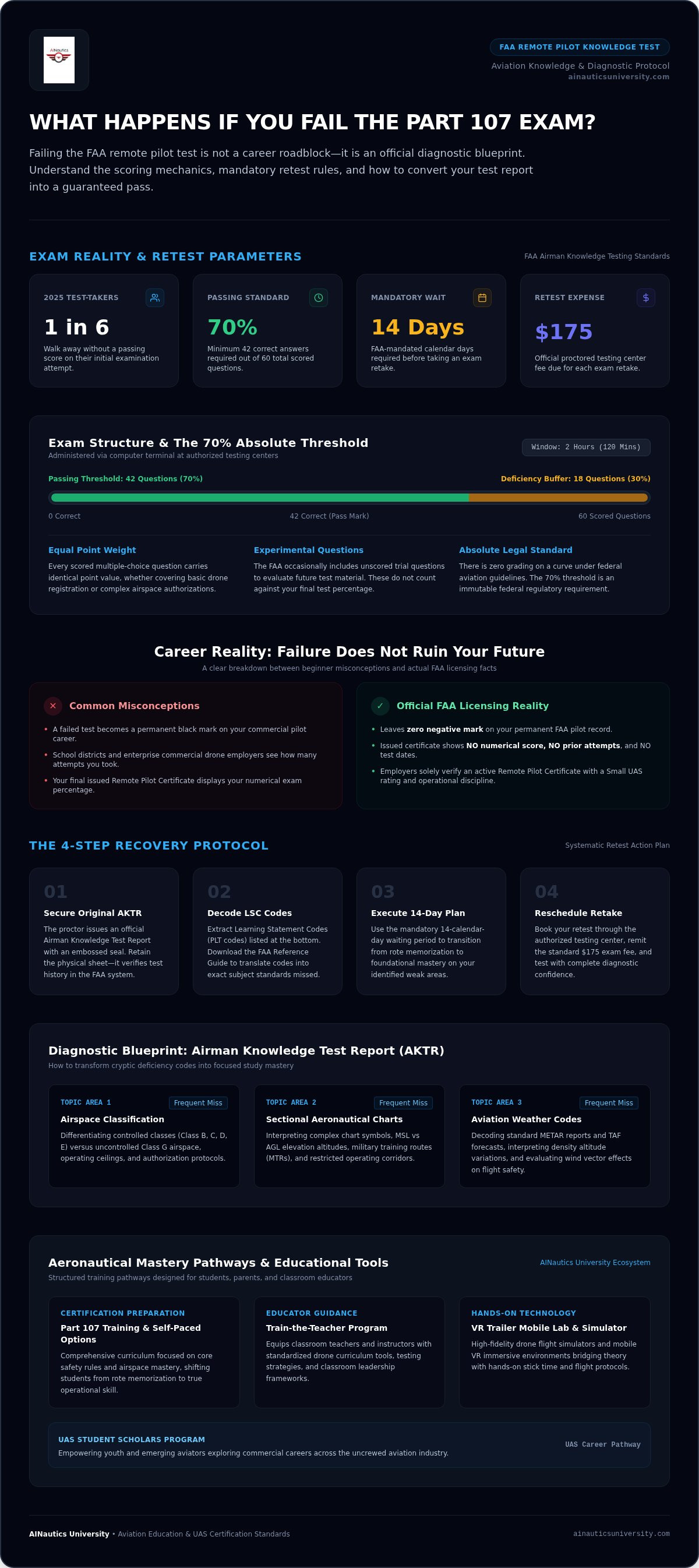
The FAA Airman Knowledge Test consists of 60 multiple-choice questions administered over a two-hour window. To achieve certification, you must score at least 70%, which means answering a minimum of 42 questions correctly.
- Equal point weight: Every single scored question carries identical weight toward your final score, regardless of whether it covers basic drone registration or complex airspace authorization.
- Experimental questions: The FAA occasionally includes unscored trial questions during testing sessions to evaluate future test material. These do not count against your overall score.
- No curve: The 70% threshold is an absolute legal standard under federal aviation guidelines, meaning there is no grading on a curve.
Why Failing the Test Does Not Ruin Your Drone Career
A common misconception among beginner operators, parents, and educators is that a failed test hurts your standing in the commercial aviation sector. That is simply not true. When you pass your retake, the permanent FAA Remote Pilot Certificate issued to you does not display your numerical test score. It does not mention previous failed attempts, dates of prior testing, or how many tries it took to earn your wings.
Commercial clients, school districts, and enterprise drone employers only verify whether you hold a valid, active Remote Pilot Certificate with a Small UAS rating. They care about your aeronautical decision-making, operational discipline, and mission safety. If you are starting fresh or recalibrating after a tough attempt, reviewing drone training for beginners provides structured perspective on the broader aviation ecosystem. Mastering core safety rules and airspace knowledge will always matter far more than scraping by on your first attempt.
Decoding Your Airman Knowledge Test Report (AKTR) and Learning Statement Codes
When you examine what happens if you fail the Part 107 exam, your physical test sheet becomes your most valuable asset. The testing center issues an official Airman Knowledge Test Report (AKTR) bearing an embossed seal. Do not discard this paper. You must retain the original document for your records, as it verifies your testing history within the FAA tracking ecosystem and serves as your diagnostic blueprint for a successful retake.
How to Read Learning Statement Codes on Your Score Sheet
Near the bottom of your report, you will find a list of alphanumeric identifiers known as Learning Statement Codes. FAA Learning Statement Codes function as precise diagnostic markers that map missed exam questions directly to the corresponding subject standards in the federal testing matrix.
To decode them, download the official FAA Learning Statement Reference Guide for Airman Knowledge Testing from the FAA website. Search for each code listed on your sheet (such as codes beginning with "PLT" or specific Airman Certification Standards tags). Rather than guessing which topics hurt your score, this reference guide matches each code to its exact subject area. If you want structured support to master these specific subjects before testing again, exploring targeted Part 107 Training provides clear explanations that turn test deficiencies into practical aeronautical skill.
Common Trouble Spots That Cause Unsuccessful Part 107 Tests
Most candidates who fail do not struggle with general drone safety; they stumble over specific, nuanced aviation concepts that require formal instruction. The three most frequent problem areas include:
- Airspace Classifications: Misreading Sectional Aeronautical Charts represents the number one failure point. Candidates frequently confuse Class B, C, and D airspace boundaries, misidentify controlled airspace floors starting at 700 or 1,200 feet AGL, or misunderstand ceiling figures presented in mean sea level (MSL).
- Aviation Weather Reports: Deciphering coded METAR surface observations and TAF terminal aerodrome forecasts trips up many beginners. Calculating the aerodynamic impact of high density altitude on multirotor thrust also catches unprepared students off guard.
- Regulations and Operations: Questions covering physiological factors (such as hyperventilation and spatial disorientation), emergency procedures, and Crew Resource Management (CRM) require deep operational understanding rather than quick guesses.
The Retest Protocol: Mandatory Waiting Periods, Scheduling, and Fees
Federal aviation rules establish a clear, structured path for retesting. When looking at what happens if you fail the Part 107 exam, the regulatory guidelines remove the guesswork from scheduling your next attempt. Under Title 14 of the Code of Federal Regulations (14 CFR § 107.71), applicants must wait 14 calendar days before retaking the aeronautical knowledge test. Unlike manned pilot certification exams, the FAA does not require an authorized flight instructor endorsement to retest for Part 107. You are legally clear to self-study, address your deficiencies, and rebook the exam independently.
Every retest carries the standard testing provider fee. The non-refundable testing cost is $175 per attempt, paid directly to PSI when securing your testing seat. There is no statutory ceiling on the number of attempts you can make, provided you honor the mandatory waiting period and pay the test fee each time.
Calculating Your 14-Calendar-Day Waiting Window
Timing your retake requires precise calendar math. The FAA applies a "day-zero" rule: test day does not count toward your mandatory waiting period. The 14-day countdown starts the day after your unsuccessful test attempt.
- Day Zero: The day you sit for the exam and receive your score report.
- Days 1 through 14: The mandatory regulatory cooling-off and study window.
- Day 15: The earliest calendar date you are legally eligible to sit for your retake.
The PSI scheduling software integrates directly with FAA airman registries. If you attempt to schedule a slot on day 12 or 13, the booking engine will automatically block the transaction. Treat this enforced two-week pause as an opportunity for disciplined, focused revision rather than a setback.
Navigating PSI Re-Registration and Testing Center Requirements
Rebooking your test seat is straightforward. You do not need to create a new profile or generate a new FAA Tracking Number (FTN). Instead, follow these steps to secure your retake:
- Log into your existing candidate dashboard on the official PSI true talent testing portal.
- Select the Unmanned Aircraft General - Small (UAG) test category using your original FTN profile.
- Choose your preferred testing center and pick an open slot that falls on or after day 15.
- Remit the $175 retest fee to lock in your appointment.
On test day, bring an unexpired, government-issued photo ID that matches your FTN profile name and shows your current physical residential address. Arrive early, keep your focus sharp, and execute your updated test plan.
Proven Study Strategies: How to Pass Your Part 107 Retest on the Second Try
Rethinking your preparation is the fastest way to turn an initial failure into a decisive victory. Knowing what happens if you fail the Part 107 exam gives you legal clarity, but your recovery hinges on how you use your 14-day study window. Industry estimates show that students using structured preparation achieve pass rates between 85% and 90%, whereas applicants relying on minimal or unstructured review see success drop to roughly 65% to 75%. To guarantee success on your second attempt, execute this five-step remediation framework:
- Step 1: Conduct a code-by-code post-mortem. Pull out your test report and map every Learning Statement Code directly to the federal testing standards. Identify the exact knowledge domain responsible for each lost point.
- Step 2: Replace rote memorization with foundational mastery. Memorizing static question banks fails because the FAA constantly rephrases operational stems. Learn the underlying aerodynamic and regulatory principles instead of answers to specific mock questions.
- Step 3: Master sectional chart fundamentals. Revisit chart legends, floor and ceiling notations, Class E transition zones, and Special Use Airspace boundaries until reading visual flight charts feels second nature.
- Step 4: Take timed, full-length practice tests. Build pacing by answering 60 random questions within the two-hour limit. Aim to score consistently above 85% on practice rounds before retesting.
- Step 5: Apply theory through practical application. Translate static textbook concepts into dynamic flight decisions using interactive tools and realistic flight planning exercises.
Targeted Chart Reading and Weather Interpretation Drills
Spend dedicated hours practicing with the official Airman Knowledge Testing Supplement booklet. Rather than guessing, pinpoint unfamiliar symbols directly in the testing legend. Practice reading raw METAR and TAF strings line by line, calculating cloud ceilings, wind shear, and visibility minimums manually without software aids. Calculate load factor multiplications during steep turns and review how high density altitude diminishes propeller thrust so you can solve performance calculation questions quickly.
Interactive Scenarios and Simulation-Based Learning
Bridging abstract textbook rules to operational practice dramatically improves memory retention. When students understand how weather fronts cause turbulence or how controlled airspace borders impact physical flight corridors, abstract rules become intuitive. Educators and academic programs regularly use immersive drone training technology to bring theoretical rules to life inside classrooms. If you want a flexible, comprehensive pathway that ensures total mastery before you retest, enroll in Self-Paced Certification to rebuild your foundational knowledge systematically.
Building Lifelong Aeronautical Competence with AINautics University
Passing an aeronautical knowledge test marks an essential milestone, but true airmanship extends far beyond a single score sheet. When students and educators reflect on what happens if you fail the Part 107 exam, the healthiest response is to view the test not as a permanent barrier, but as an entry checkpoint into long-term commercial aviation competence. Lasting flight proficiency requires turning theoretical aerospace principles into sharp operational habits.
Scenario-based tools like the proprietary AINautics Drone Simulator convert abstract regulations into instinctive flying skills. Instead of simply memorizing facts about wind drift or emergency checklists, learners experience real-time flight dynamics and airspace hazards directly from simulated flight controls.
Comprehensive Preparation Options: Self-Paced and Guided Part 107 Training
Rebuilding your confidence after a missed attempt requires deliberate instruction tailored to your schedule. Structured Part 107 Training eliminates recurring knowledge gaps through systematic breakdowns of federal airspace, chart interpretation, and weather reports. For adult learners balancing professional schedules, Self-Paced Certification options allow candidates to master technical topics at their own speed. Review the complete certification roadmap in our professional FAA Part 107 drone training guide.
Empowering Educators and Future Pilots Across Modern Classrooms
Aeronautical education is transforming modern classrooms. Through the Train-the-Teacher Program, educators gain the pedagogical frameworks, technical expertise, and instructional confidence needed to guide high school cohorts through Part 107 testing. Secondary students explore hands-on UAS career pathways through the UAS Student Scholars curriculum, developing foundational engineering and piloting disciplines early.
Certified remote pilots enter an expanding industrial ecosystem spanning aerial mapping, infrastructure inspection, agriculture, and public safety. Connect test readiness to expanding industry opportunities detailed in the future of drone careers. With proper mentorship and structured tools, an initial setback becomes the catalyst for lifelong aeronautical success.
Accelerate your drone certification journey with AINautics University and build the specialized knowledge required to command commercial airspace with complete confidence.
Transform Your Test Score into Lasting Aviation Mastery
Understanding what happens if you fail the Part 107 exam proves that an unsuccessful score is simply a temporary checkpoint, not the end of your commercial aspirations. Your score report provides the exact diagnostic coordinates to eliminate knowledge gaps, while the mandatory 14-day waiting window gives you the dedicated time needed to replace surface memorization with genuine aeronautical understanding. Your path to becoming a licensed remote pilot remains wide open.
As a Service-Disabled Veteran-Owned Small Business (SDVOSB) credentialed in federal training standards, AINautics University delivers a complete educational ecosystem supporting K-12 educators, career-changers, and student scholars nationwide. Through scenario-based instruction powered by the proprietary AINautics Drone Simulator, we help you turn complex airspace rules into instinctive piloting habits. Master the Part 107 curriculum with AINautics University and take command of your commercial aviation career with total confidence.
Frequently Asked Questions
How many times can you fail the FAA Part 107 exam?
There is no legal limit to how many times you can fail or retake the Part 107 exam. Federal regulations permit unlimited attempts as long as you observe the mandatory 14-day waiting period between tests and pay the testing fee each time. However, sitting for multiple retakes without changing your study routine gets expensive quickly. Focusing on foundational aviation knowledge rather than question memorization prevents repeated failures.
How long do you have to wait to retake the Part 107 exam after failing?
You must wait 14 full calendar days before you can retake the test. When evaluating what happens if you fail the Part 107 exam, remember the countdown begins the day after your test date. If you test on the first of the month, the earliest date you can retest is the 16th. The PSI booking system automatically enforces this waiting window, giving you two structured weeks to review missed subjects.
Do you have to pay the full exam fee again if you retake the Part 107 test?
Yes, you must pay the full $175 testing fee for every retake attempt. The FAA does not offer discounted retest rates, free retakes, or fee waivers through third-party testing centers. Because every testing seat costs $175, investing in comprehensive ground preparation like structured Self-Paced Certification saves both money and time by ensuring you pass decisively on your second try.
What is a passing score on the FAA Part 107 aeronautical knowledge exam?
A passing score is 70% or higher. The test consists of 60 multiple-choice questions, meaning you must answer at least 42 questions correctly within the two-hour allotment. Every scored question carries identical weight toward your final percentage. There is no curve, so earning a 70% meets the exact federal threshold required to apply for your Remote Pilot Certificate.
Can you see which exact questions you missed on the Part 107 test?
No, the FAA does not reveal the specific test questions you answered incorrectly. Instead of displaying actual test questions, your Airman Knowledge Test Report lists Learning Statement Codes. These codes identify the broad knowledge categories where errors occurred, such as weather interpretation or controlled airspace. Using the official FAA reference guide lets you decode these tags to target your weakest study areas effectively.
Does a failed Part 107 test appear on your final commercial drone license?
No, your permanent FAA Remote Pilot Certificate does not display failed attempts or test scores. When considering what happens if you fail the Part 107 exam, candidates often fear career damage. In reality, your final airman certificate looks identical to someone who passed on their first attempt with a perfect score. Commercial employers, clients, and school districts only verify that your certificate is active and valid.
What happens if an educator or high school student fails the Part 107 exam?
An unsuccessful test simply delays credentialing by 14 days and requires a standard retake. For classroom teachers and secondary students, this pause provides a valuable diagnostic teaching moment. Educators participating in the Train-the-Teacher Program and students in the UAS Student Scholars track use hands-on tools like the AINautics Drone Simulator to convert difficult chart and weather concepts into practical understanding before retesting.

Article by
AINautics University Team
The team behind AINautics University, dedicated to drone education and FAA Part 107 certification prep, VR flight simulation, and STEM training programs for students and educators.


