
Your physical FAA Remote Pilot Certificate never actually expires, but letting your 24-calendar-month currency lapse will instantly ground your commercial flight operations. Many commercial operators and educators delay the FAA drone pilot renewal process because they assume it requires another expensive testing center appointment or complicated paperwork. You aren't alone if you find government portals confusing or feel uncertain about recent regulatory shifts like Remote ID and night flight rules.
Fortunately, maintaining your Part 107 aeronautical knowledge currency is now completely free, self-paced, and hosted entirely online through FAASafety.gov. Mastering this renewal routine ensures your commercial flight privileges stay active without unexpected downtime or out-of-pocket exam fees. In this complete guide, you'll walk through the exact steps to access the free ALC-677 recurrent training course, pass the updated knowledge check, and secure your verifiable completion certificate.
Key Takeaways
- Learn the vital legal distinction between holding a permanent Remote Pilot Certificate and maintaining your mandatory 24-calendar-month operational currency.
- Follow clear steps to complete the official FAA drone pilot renewal process online through FAASafety.gov without paying testing center fees.
- Unlock expanded operational privileges, including routine night flights and updated Remote ID compliance, right inside the recurrent training module.
- Avoid costly ramp inspection violations by knowing exactly how to document, store, and present your completion certificate in the field.
- Discover practical ways to maintain emergency flight proficiency between renewal cycles using hands-on simulation tools and advanced UAS training pathways.
Understanding the FAA Drone Pilot Renewal Rules and Currency Requirements
The FAA Part 107 regulatory framework treats your physical certificate and your legal flight currency as two distinct items. Your physical Remote Pilot Certificate never expires once issued. However, you cannot legally exercise commercial privileges without an active currency record. Mastering the FAA drone pilot renewal process is essential for maintaining legal standing without spending extra money or taking unnecessary exams.
The 24-Calendar-Month Currency Standard Explained
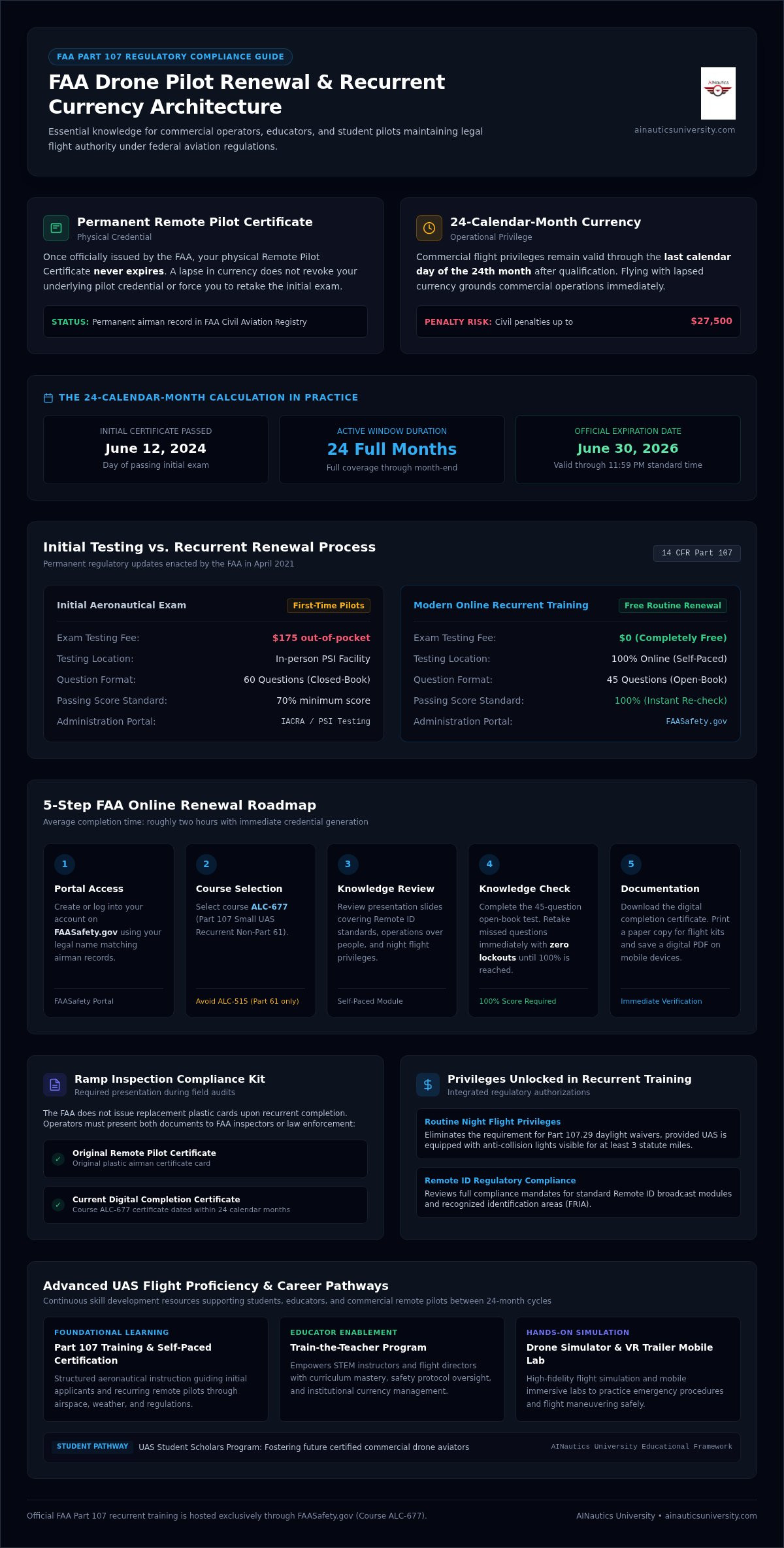
Federal regulations calculate your currency window on a 24-calendar-month schedule. Your operational privileges extend through the final calendar day of the 24th month following your previous qualification. For example, if you earned your certificate on June 12, 2024, your currency remains fully active until June 30, 2026. Flying commercially after that date grounds your operations under federal law, risking civil penalties that reach up to $27,500 for unauthorized flights. If your currency lapses, you don't lose your credential permanently, nor do you need to retake the initial test. You simply complete the recurrent module to restore your flight authorization.
Initial Testing vs. Modern Online Recurrent Training
First-time remote pilots must schedule an appointment, pay a $175 exam fee, and pass an in-person, 60-question test at an approved PSI testing facility. In contrast, the current FAA drone pilot renewal process is completely free, web-based, and completed at your own pace. In April 2021, the agency permanently eliminated mandatory in-person testing center visits for renewals. Modern recurrent modules focus on continuous education regarding updated FAA regulations for commercial drone operations, transforming routine renewal into an accessible learning experience rather than a stressful testing hurdle.
Who Must Complete Recurrent Training Under Part 107
The requirement to complete recurrent training applies across several operational categories:
- Commercial remote pilots: Any individual operating drones for commercial work, business operations, or non-recreational purposes under Part 107.
- Educators and flight directors: Instructors supervising student flight lines or leading school drone curricula must maintain currency to ensure legal, safe institutional flight operations.
- Part 61 manned aircraft pilots: Licensed airplane or helicopter pilots who hold a current flight review qualify for a dedicated, shortened online training track (course ALC-515) rather than the standard small UAS module.
Step-by-Step Guide to the FAA Drone Pilot Renewal Process Online
Completing the FAA drone pilot renewal process takes roughly two hours from any computer. Because the FAA hosts this training on FAASafety.gov rather than the initial IACRA testing system, you must follow specific navigation steps to access the correct module without administrative delay.
Navigating FAASafety.gov and Course Selection
Start by creating an account on FAASafety.gov using the legal name tied to your airman registry profile. Next, head to the "Courses" tab in the main navigation menu. In the search catalog, look specifically for "Part 107 Small UAS Recurrent Non-Part 61" (designated as course ALC-677). Avoid selecting course ALC-515, which is reserved exclusively for manned aircraft pilots holding current flight reviews under Part 61.
Completing the Knowledge Check and Retest Rules
Once enrolled, review each presentation slide before starting the 45-question knowledge exam. This assessment operates under an open-book format, allowing you to cross-reference federal reference guides as you work. If you answer a question incorrectly, the portal highlights the missed concept and directs you to review the material before answering again. You must achieve a 100% score to generate your credential, with zero lockouts or testing penalties for incorrect answers.
Validating and Documenting Your Certificate for Flight Operations
The FAA doesn't mail a replacement plastic card after you pass. Instead, the portal generates a digital completion certificate. Print a physical copy for your flight kit and keep a PDF saved on your smartphone. During routine field ramp inspections, FAA safety inspectors and law enforcement officers require you to present both your original Remote Pilot Certificate and your current completion form. Aligning your operational documentation with standards championed by professional drone industry organizations protects your flight privileges. If you want structured study materials before reviewing complex airspace rules, turning to Self-Paced Certification options will help sharpen your operational foundation.
Key Regulatory Topics Covered in the FAA Recurrent Exam
Completing your recurrent training does more than satisfy an administrative checkpoint. It immediately integrates recent federal rule changes into your standard flight workflows. By working through the official FAA guidelines on how to Keep Your Remote Pilot Certificate Current, you learn how to plan complex flight operations safely without relying on individual operational waivers.
Night Operations and Anti-Collision Lighting Protocols
Under updated regulations, certified pilots can conduct routine flights at night and during civil twilight without filing a Section 107.29 daylight waiver. You must mount anti-collision lighting visible for at least 3 statute miles with a strobe rate sufficient to avoid airborne collisions. The training also highlights dark adaptation, autokinesis, and visual illusions that impair spatial awareness in low-light environments.
Operations Over People and Moving Vehicles
The recurrent module examines the four distinct categories governing sustained flight over human beings and moving vehicles:
- Category 1: Small drones weighing under 0.55 pounds (including safety cages) with covered rotating parts that cannot cause lacerations.
- Category 2: Drones with FAA declarations of compliance proving they transfer less than 11 foot-pounds of kinetic impact energy upon contact.
- Category 3: Commercial platforms transferring under 25 foot-pounds of impact energy, restricted from operating directly over open-air assemblies of people.
- Category 4: Aircraft holding an airworthiness certificate issued under federal Part 21 aviation standards.
Sustained flight directly above open-air assemblies remains strictly prohibited unless your aircraft meets specific Category 1, 2, or 4 design rules.
Airspace Classifications, LAANC, and Remote ID Compliance
Safe navigation hinges on mastering controlled airspace boundaries. The knowledge check reviews operating protocols for Class B, Class C, Class D, and surface Class E airspace. It also tests your ability to secure instant, automated authorization through Low Altitude Authorization and Notification Capability (LAANC) service providers.
Finally, the module reinforces federal Remote ID requirements. Since enforcement took full effect on March 16, 2024, every registered drone operating under commercial rules must broadcast its location, control station telemetry, and identification data. Completing the modern FAA drone pilot renewal process confirms you know how to operate compliant Standard Remote ID systems and broadcast modules without risking unauthorized airspace entries.
Common Mistakes and Field Compliance Issues During Recurrent Windows
Field compliance failures rarely stem from intentional rule-breaking. Instead, operational downtime typically occurs because a pilot or program manager misunderstands basic administrative timelines. When you manage individual missions or oversee multi-pilot teams, maintaining active operational currency demands consistent record-keeping long before an FAA inspector arrives on site.
Lapsed Currency vs. Revocation: Addressing Common Misconceptions
Allowing your 24-calendar-month window to close doesn't mean the FAA revoked your remote pilot credentials. Your certificate remains valid indefinitely. What lapses is your legal authority to operate an unmanned aircraft under Part 107 rules. If you realize your currency lapsed while your aircraft was in storage, do not launch any commercial missions. Complete the free online training first. Once you finish the module and print your certificate, your flight privileges instantly resume.
Insurance and Operational Liability Risks
Operating without active currency triggers immediate financial vulnerabilities beyond regulatory enforcement. Aviation insurance underwriters require strict regulatory compliance as a prerequisite for coverage. If an uncurrent pilot suffers a flyaway, structural collision, or battery failure during a commercial shoot, the insurer can deny coverage on the grounds that the flight was unauthorized under federal aviation regulations.
For high schools, career tech centers, and collegiate STEM programs, this liability exposure directly affects district administration. Establishing foundational safety protocols through structured Part 107 drone training ensures educators and student operators preserve institutional coverage and maintain rigorous flight line safety standards.
Enterprise and Educational Drone Fleet Record-Keeping
Preventing operational lapses across enterprise flight departments and academic programs requires proactive administration rather than individual memory. Flight leaders should institute standardized operational checks across three key areas:
- Centralized registry tracking: Keep a shared spreadsheet or management portal logging initial test dates, recurrent completion dates, and expiration deadlines for every remote pilot on staff.
- Digital document kits: Require every operator to carry a laminated paper copy of their completion certificate alongside an offline PDF saved to their field tablet.
- Aircraft maintenance binders: Pair remote pilot credentials with individual aircraft registration documents and pre-flight battery logs to simplify unscheduled FAA ramp inspections.
If you oversee an academic flight team and want to standardize classroom compliance, enroll your staff in our Train-the-Teacher Program to build sustainable flight protocols.
Sustaining Your Operational Skills and Professional Drone Career Pathway
Treating your biennial currency renewal as a mere administrative checkbox overlooks a vital professional reality. The FAA drone pilot renewal process guarantees basic legal compliance, but true operational competence requires deliberate, ongoing flight practice. As commercial operations expand into increasingly complex airspace, skilled remote pilots maintain disciplined decision-making habits that stretch far beyond reviewing slides every two years.
Advanced Flight Simulation and Scenario-Based Practice
Simulation platforms allow operators to experience critical equipment emergencies without endangering aircraft, property, or bystanders. Practicing manual altitude-hold recoveries, sensor glitches, and unexpected Return-to-Home disconnects builds immediate physical muscle memory. Implementing hands-on training with a specialized Drone Simulator or an interactive VR Trailer Mobile Lab lets pilots rehearse tight navigation maneuvers and sudden wind shear scenarios safely indoors before managing complex live missions.
Empowering Educators Through Structured Curriculum Sustainment
Educators face the dual challenge of keeping their personal FAA credentials current while guiding dozens of students through technical flight competencies. Sustainable school programs rely on repeatable instructional frameworks. Through structured Train-the-Teacher Program initiatives and workforce-ready pathways like UAS Student Scholars, academic institutions can build self-sustaining drone programs that mentor the next generation of engineers, surveyors, and commercial aviators.
Expanding Career Horizons Across Emerging UAS Sectors
Holding active operational currency positions you at the forefront of rapid industry expansion. Today's commercial remote pilots inspect utility infrastructure, survey environmental habitats, and manage autonomous logistics networks. Staying current on foundational airspace rules prepares you to adapt as operational regulations evolve to support larger commercial fleets. Reviewing the future of drone careers reveals how high-growth industries consistently reward verified, continuous training. By pairing the FAA drone pilot renewal process with comprehensive professional programs through AINautics University, you turn regulatory compliance into lasting commercial momentum.
Take Command of Your Commercial UAS Future
Keeping your flight privileges active doesn't have to be complicated or expensive. By completing the free FAA drone pilot renewal process online every 24 calendar months, you maintain operational currency, protect commercial insurance coverage, and stay aligned with modern airspace mandates. Remember to keep your completion certificate readily accessible alongside your permanent Remote Pilot Certificate on every flight line.
Regulatory compliance is simply the entry point to professional flight mastery. As an SDVOSB certified enterprise and proud AUVSI organizational member, we help student pilots, educators, and enterprise teams bridge the gap between basic rules and advanced field execution. When you're ready to expand your technical skills and build sustainable operational pathways, Explore Professional UAS Training and Certification at AINautics University. The commercial airspace is expanding rapidly, and your next professional milestone starts today.
Frequently Asked Questions
How much does it cost to complete the FAA Part 107 drone license renewal?
Completing your recurrent training is 100% free through the FAA. While your initial Part 107 certification required paying a $175 exam fee at an in-person testing center, the modern FAA drone pilot renewal process incurs zero direct testing costs. The agency hosts the entire recurrent curriculum on FAASafety.gov, allowing active remote pilots to review updated regulations and maintain flight currency without paying third-party administrative or proctoring fees.
How often do I need to complete the FAA drone pilot recurrent training?
You must complete recurrent training every 24 calendar months to keep your commercial flight privileges active. Under federal aviation regulations, calendar-month accounting means your currency remains valid until the final day of the 24th month after your last test or course completion date. For instance, if you finish your training on October 5, your currency extends through October 31 two years later.
What happens if my Part 107 renewal date passes and my currency expires?
If your currency window passes, you cannot legally conduct commercial flights, but the FAA does not revoke your Remote Pilot Certificate. Your physical license remains intact permanently. You are simply grounded until you complete the free online recurrent course. Once you log into the portal, pass the 45-question knowledge assessment, and generate a new completion certificate, your legal flight authorization restores immediately.
Do I have to visit a physical testing center to renew my drone pilot certificate?
No, you do not need to visit a physical testing center to renew your operational currency. The FAA transitioned recurrent testing to a fully online, self-paced format in April 2021. You can review the course material and complete the knowledge check from any personal computer. This web-based delivery eliminates the need to schedule appointments or travel to commercial testing facilities.
What score do I need to pass the online FAA recurrent training course?
You must achieve a final score of 100% to generate your completion certificate. However, the system is designed as an open-book educational tool rather than a high-stakes exam. If you select an incorrect answer on any of the 45 questions, the software highlights the relevant rule, explains the safety concept, and allows you to re-answer the prompt until you achieve complete mastery.
What physical documents must I carry when flying under renewed Part 107 currency?
You must carry your permanent FAA Remote Pilot Certificate alongside proof of recurrent training completion whenever you conduct commercial missions. The FAA accepts either a printed paper completion certificate or an accessible digital copy saved on your smartphone or tablet. Additionally, carry government photo identification, current aircraft registration documentation, and proof of Remote ID compliance to satisfy potential field ramp inspections.
Can Part 61 licensed manned aircraft pilots renew Part 107 credentials online?
Yes, Part 61 licensed pilots who hold a current flight review under 14 CFR 61.56 can complete their UAS recurrent training online. Manned aircraft pilots take a specialized, shorter course on FAASafety.gov titled ALC-515 rather than the standard ALC-677 module. Completing this targeted online course satisfies all recurrent Part 107 aeronautical knowledge requirements without requiring an in-person knowledge exam.

Article by
AINautics University Team
The team behind AINautics University, dedicated to drone education and FAA Part 107 certification prep, VR flight simulation, and STEM training programs for students and educators.


