
Downloading an official FAA Part 107 study guide pdf gives you hundreds of pages of raw material, but passing the remote pilot exam requires true operational systems mastery, not static memorization. If dense federal handbooks, cryptic military airspace symbols, and sectional aeronautical charts feel intimidating, you aren't alone. Facing a 60-question test packed with unfamiliar aviation jargon creates genuine anxiety, especially when you want to pass on your first attempt and avoid wasting costly testing center fees.
You can master every FAA Part 107 knowledge area with a structured, step-by-step breakdown designed to turn complex aviation regulations into practical test-day success. In this guide, you will learn the exact testing framework required to score 70% or higher, confidently decode sectional charts and METAR weather reports, and bridge your remote pilot certificate into commercial workforce readiness. Below, we break down the five core knowledge domains and explore how self-paced study and simulator practice transform raw concepts into real-world flight confidence.
Key Takeaways
- Discover how to pair the official FAA Part 107 study guide pdf with authorized testing supplements to eliminate test-day surprises.
- Unpack the five mandatory knowledge domains mandated by federal regulations, prioritizing high-yield topics like airspace classifications and flight restrictions.
- Master practical decoding methods for sectional aeronautical charts, METARs, and TAF weather reports using physical reference figures.
- Implement a structured four-week study roadmap designed to organize study sessions and ensure first-attempt testing success.
- Learn how connecting written certification concepts with practical flight simulation bridges classroom knowledge into commercial workforce competence.
What Is the FAA Part 107 Study Guide PDF? Official Materials Demystified
Title 14 of the Code of Federal Regulations (14 CFR) Part 107 serves as the binding legal framework governing the commercial operation of small unmanned aircraft systems weighing under 55 pounds in the United States National Airspace System. To help candidates prepare for certification under these rules, the Federal Aviation Administration publishes FAA-G-8082-22 (Remote Pilot Study Guide) alongside FAA-S-ACS-10B (Airman Certification Standards). These documents detail the aeronautical knowledge required for the Unmanned Aircraft General - Small (UAG) knowledge exam. A standard FAA Part 107 study guide pdf compiles foundational safety principles, but reading static pages rarely provides the operational context needed to translate dry legal rules into quick situational decisions during actual commercial flights.
Understanding the Remote Pilot Certification Exam Structure
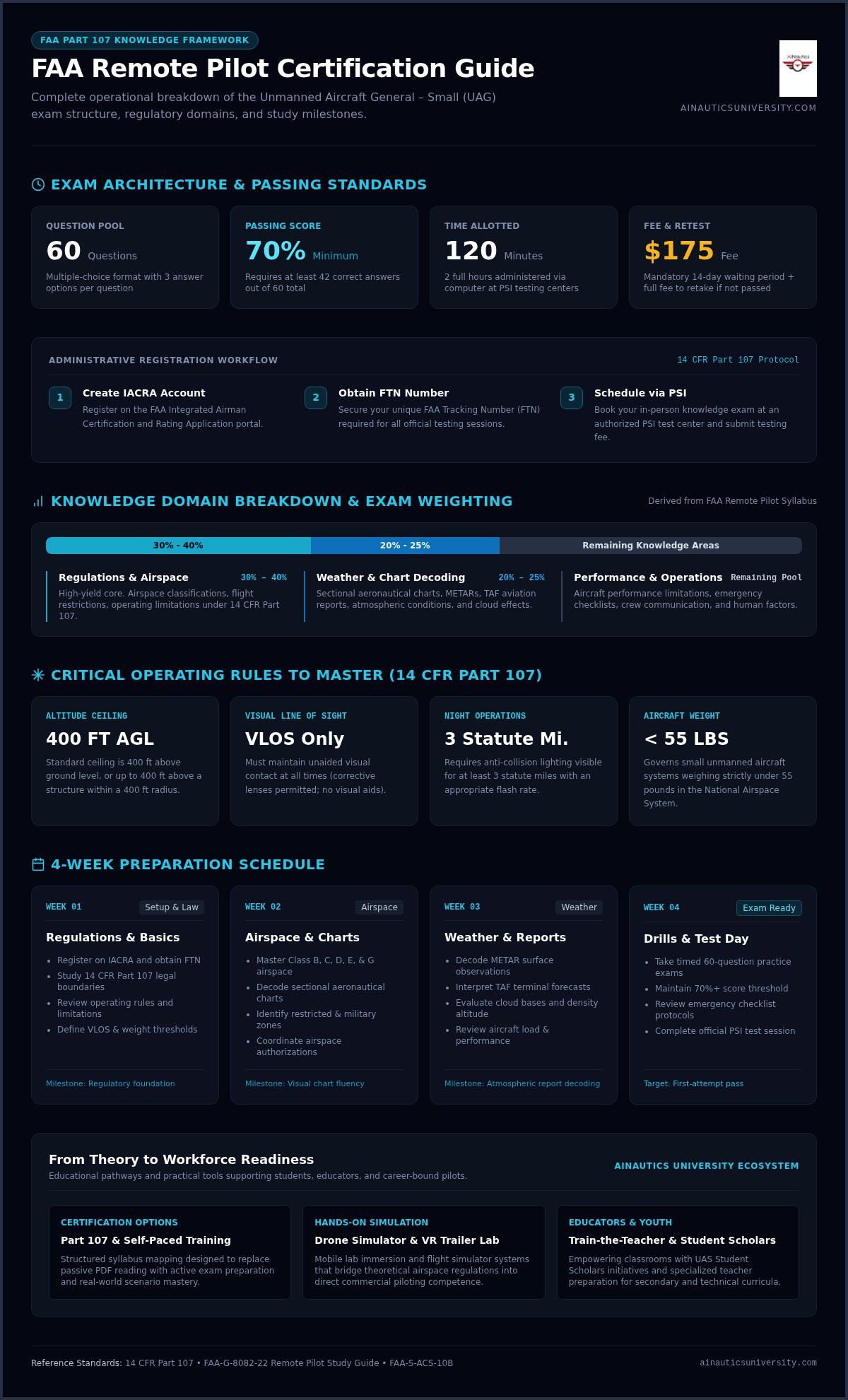
The UAG exam contains 60 multiple-choice questions administered in person on computers at authorized PSI testing centers. Candidates have two hours (120 minutes) to complete the test, and each question presents three potential answer options. You must earn a score of 70 percent or higher, which means answering at least 42 questions correctly. To register, applicants first create a free account on the FAA Integrated Airman Certification and Rating Application (IACRA) system to secure an FAA Tracking Number (FTN). You then schedule the exam through PSI Services and pay the mandatory $175 testing fee. If you don't pass, the FAA mandates a 14-day waiting period and another full fee before retesting.
Official FAA Handbooks vs. Comprehensive Prep Outlines
Relying solely on an unguided FAA Part 107 study guide pdf leaves critical blind spots. The official handbooks present regulatory text without explaining how concepts interact on test day or in the field. Understanding the history of federal drone regulations in the United States helps put safety mandates in perspective, but memorizing legal text alone won't teach you how to coordinate airspace authorizations quickly under pressure.
Effective exam prep breaks down dense government material into clear, practical milestones:
- Targeted syllabus mapping: Connecting abstract regulations directly to realistic operational flight scenarios.
- Interactive visual aids: Decoupling complex sectional charts from black-and-white government text.
- Progressive knowledge checks: Testing retention with focused drills instead of passive reading.
For aspiring pilots, pairing self-paced review with structured drone training for beginners bridges the gap between raw theory and actionable operational mastery.
The 5 Core Knowledge Areas Covered in the Part 107 Exam Syllabus
The Federal Aviation Administration evaluates remote pilot applicants across five discrete operational areas outlined in the official FAA Remote Pilot Study Guide PDF. While question pools rotate constantly, questions are heavily weighted toward regulations and airspace operations, which routinely account for roughly 30 to 40 percent of test questions. Weather theory and chart decoding represent another 20 to 25 percent, leaving the remaining portion to aircraft performance, emergency checklists, and human factors. Mastering how these concepts intersect is vital. Grounding your preparation in professional Part 107 drone training ensures you learn to apply these regulations rather than simply trying to guess your way through practice exams.
Aviation Regulations and Operating Limitations (14 CFR Part 107)
Every commercial flight begins with core operating rules. Remote pilots in command must maintain visual line of sight at all times without visual aids other than corrective lenses. The standard ceiling is 400 feet above ground level, though you can fly up to 400 feet above a structure if remaining within a 400-foot radius. Night operations require approved anti-collision lighting visible for three statute miles with an appropriate flash rate. Flying over people or moving vehicles depends on specific aircraft risk categories. Additionally, any flight mishap causing serious injury, loss of consciousness, or property damage exceeding $500 requires formal accident reporting within 10 calendar days.
National Airspace System Classification and Operating Requirements
Airspace questions trip up many unprepared applicants. Controlled airspace includes Class B, C, D, and designated surface Class E rings surrounding towered or instrument-heavy airports. Operating inside controlled airspace requires prior air traffic control authorization, which pilots obtain using the Low Altitude Authorization and Notification Capability (LAANC) system. In contrast, Class G airspace is uncontrolled, allowing standard drone operations below 400 feet without air traffic clearance. Candidates must also identify special-use airspaces, including prohibited zones, active military operations areas, and restricted sectors requiring strict avoidance.
Aviation Weather, Loading, Performance, and Human Factors
Safe piloting requires assessing environmental variables and physical limits. High density altitude caused by heat or elevation thins the air, drastically reducing propeller thrust and battery flight endurance. Shifting payloads alter the center of gravity, risking control instability. Beyond aircraft mechanics, the syllabus emphasizes aeronautical decision-making and crew resource management. Applying structured communication protocols and physiological self-assessments protects the flight crew against fatigue, spatial disorientation, and rushed operational decisions. Exploring structured self-paced certification pathways can give you the guided frameworks needed to master these operational human factors before exam day.
Deciphering Sectional Charts and Weather Reports for the FAA Exam
When you sit down at the testing facility, you won't rely on digital map software. The testing proctor hands you a physical spiral-bound booklet: FAA-CT-8080-2H, the Airman Knowledge Testing Supplement. While a standard FAA Part 107 study guide pdf summarizes chart rules, navigating these physical, high-density diagrams and coded weather reports under pressure demands systematic practice. On aeronautical charts, numbers inside parentheses show Above Ground Level (AGL) heights, while standard numbers indicate true elevation above Mean Sea Level (MSL).
| Aviation Tool | Primary Purpose | Key Elements to Examine |
|---|---|---|
| VFR Sectional Chart | Visual navigation and airspace boundary identification | Airspace line colors, ceiling and floor fractions, obstacle elevations |
| METAR Report | Real-time surface weather observation at an airport | Wind velocity, visibility in statute miles, cloud coverage heights |
| TAF Report | Weather forecast over 24- to 30-hour operating windows | Expected ceiling changes, wind shifts, temporary weather hazards |
Mastering VFR Sectional Aeronautical Charts and Legends
Aeronautical charts use specific colors to establish airspace boundaries. Solid blue circles mark high-traffic Class B airspace, solid magenta lines define Class C hubs, and dashed blue circles outline Class D airport towers. Dashed magenta boundaries indicate Class E airspace extending down to the surface, requiring LAANC authorization. In each chart quadrangle, look at the Maximum Elevation Figures (MEF); these large bold numbers show the altitude of the highest terrain or obstacle plus a margin of safety. Airport data blocks provide essential radio details; an asterisk next to a tower frequency indicates part-time tower operations under 14 CFR Part 107 federal regulations.
Interpreting METAR and TAF Aviation Weather Forecasts
Raw weather strings can look like a foreign language at first. A standard METAR observation like KDFW 121753Z 18012KT 10SM OVC015 22/16 A2992 breaks down predictably: Dallas-Fort Worth, observed on the 12th day at 1753 Zulu, wind from 180 degrees at 12 knots, 10 statute miles visibility, overcast clouds at 1,500 feet, temperature 22°C with a dew point of 16°C, and an altimeter setting of 29.92. Remember that the FAA only considers Broken (BKN) or Overcast (OVC) layers to be official cloud ceilings. Reviewing these codes through an annotated FAA Part 107 study guide pdf helps you evaluate cloud clearance rules before launching your mission.
A 4-Week Study Schedule: Transforming PDF Theory into a Passing Score
Industry data indicates that non-aviation beginners typically require 15 to 30 hours of dedicated preparation to pass the commercial remote pilot exam. Simply skimming an unorganized FAA Part 107 study guide pdf without a structured timeline often leads to burnout and information overload. Committing to a disciplined four-week roadmap organizes dense subject matter into manageable 45-minute daily sessions. This methodical pace allows students, parents, and educators to master complex aviation concepts while balancing existing academic or professional schedules.
Weeks 1 & 2: Regulatory Fundamentals and Airspace Mastery
Spend your first seven days building regulatory literacy. Focus your study on 14 CFR Part 107 rules, drone registration thresholds, night operation requirements, and mandatory accident reporting criteria. End the week with a quick 20-question baseline quiz to verify your retention of legal boundaries.
Dedicate week two entirely to deciphering the National Airspace System. Practice reading airspace classes, obstacle clearance heights, and control tower frequencies directly from sectional charts. Test yourself on classifying airspace boundaries and identifying when an operation requires automated authorization through LAANC. By the end of week two, take another targeted quiz to ensure you can interpret sectional figures without hesitation.
Weeks 3 & 4: Weather Data, Scenario Analysis, and Mock Exams
Turn your attention during week three to meteorology, aircraft loading, and operational physiology. Drill raw METAR and TAF weather strings daily until reading coded ceiling and visibility data becomes second nature. Review how high density altitude diminishes rotor lift and battery performance, and study the IMSAFE checklist alongside crew resource management protocols.
Reserve week four for realistic mock testing. Complete at least three full-length 60-question practice exams under strict two-hour time limits without looking at study notes. When you review your results, cross-reference every missed question against the official Airman Certification Standards (ACS) subject codes to pinpoint your final weak spots. If you want a structured curriculum that eliminates guesswork and keeps you accountable, enroll in AINautics University Self-Paced Certification to master the material on your own schedule.
Beyond the PDF: Moving from Written Certification to Commercial Operations
Passing the written knowledge test proves legal compliance, but holding a paper certificate doesn't automatically make someone an accomplished remote pilot. A standard FAA Part 107 study guide pdf prepares candidates to decode airspace classes and memorize regulatory operating ceilings. Real commercial operations require active stick skills, mission planning, and calm risk management during unexpected field situations. Bridging theoretical study into professional flight competence demands purposeful, hands-on flight experience.
Developing Real-World Cockpit Discipline with Drone Simulators
Reading about contingency procedures in a handbook cannot replicate the sudden stress of a lost-link event or an unexpected obstacle in your flight path. Integrating an advanced Drone Simulator allows aspiring pilots to build vital stick-and-rudder muscle memory without risking expensive airframes. In realistic simulated environments, operators encounter severe crosswinds, battery voltage drops, sensor failures, and visual line-of-sight challenges.
Practicing these emergency scenarios develops genuine cockpit discipline. Pilots learn to cycle through checklists methodically, cross-check their instruments, and maintain composure under pressure. This bridge between written regulations and manual control transforms book knowledge into instinctive operational safety, preparing candidates to meet rigorous commercial standards.
Empowering Educators and High School Student Scholars
Aviation education extends beyond individual operators; it builds community-wide career opportunities. High schools, technical centers, and colleges are actively embedding aerospace credentials into modern STEM classrooms. By adopting a comprehensive drone curriculum for educators, academic programs turn theoretical aviation concepts into accredited workforce pathways.
Educators often start this journey through the Train-the-Teacher Program, which equips instructors with the operational frameworks and teaching tools needed to lead accredited drone courses. In parallel, programs like the UAS Student Scholars initiative connect motivated high school students directly to emerging technical careers. Programs such as the UAS scholarship for high school students ensure motivated learners can access advanced training regardless of background.
To eliminate logistical barriers, the VR Trailer Mobile Lab travels directly to schools and community campuses, delivering immersive simulation suites and hands-on flight labs on site. Moving beyond a static FAA Part 107 study guide pdf into real-world flight operations opens lasting career avenues. Take the next step in your professional development by exploring structured Part 107 Training and hands-on simulation pathways with AINautics University.
Chart Your Flight Path to Commercial Drone Mastery
Earning your Remote Pilot Certificate requires more than passive memorization. While an official FAA Part 107 study guide pdf provides indispensable baseline knowledge, true operational confidence comes from understanding sectional charts, decoding weather reports, and practicing disciplined cockpit decision-making before you ever take off.
As a Service-Disabled Veteran-Owned Small Business (SDVOSB), AINautics University helps turn exam preparation into professional workforce readiness. Through immersive Drone Simulator platforms, mobile lab environments, and proven UAS Student Scholars and Train-the-Teacher curriculum pathways, learners gain the practical skills demanded by today's aviation sector. You don't have to navigate this journey alone.
Accelerate your flight path with AINautics University Drone Training Solutions and take your first step toward commercial flight success today.
Frequently Asked Questions
What is the official FAA Part 107 study guide PDF?
The official FAA Part 107 study guide PDF is FAA-G-8082-22, titled Remote Pilot - Small Unmanned Aircraft Systems Study Guide. Published by the Federal Aviation Administration, this free document outlines the core subject areas tested on the Unmanned Aircraft General exam. It covers federal regulations, airspace classifications, basic flight physics, and weather theory, giving candidates a foundational curriculum blueprint for initial certification.
How much does it cost to take the FAA Part 107 remote pilot exam?
The initial Part 107 aeronautical knowledge exam costs $175 paid directly to PSI Services, the FAA's contracted testing administrator. Creating an FAA Tracking Number through the IACRA portal is completely free. If you need to retake the test after an unsuccessful attempt, you must pay the full $175 fee again. Recurrent training completed every 24 calendar months online through FAASafety.gov is entirely free.
Can you pass the FAA Part 107 test by only studying a free PDF?
While candidates can pass using only a free FAA Part 107 study guide pdf, relying exclusively on static reading significantly increases test difficulty. Official PDFs lack interactive chart exercises and scenario-based questions that reflect the current exam pool. Supplementing your reading with practice drills, structured Part 107 Training, or flight simulation helps demystify complex sectional charts and ensures you master real operational decision-making rather than simple memorization.
How long should you study before taking the FAA Part 107 test?
Most candidates without prior aviation experience require approximately 15 to 30 hours of focused study to pass comfortably. Spreading this preparation over three to four weeks in short daily sessions builds stronger retention than cramming. Spending dedicated time each week analyzing sectional charts, decoding weather reports, and completing timed practice exams helps ensure you score well above the 70 percent passing threshold on test day.
What happens if you fail the FAA Part 107 exam on your first attempt?
If you score below the 70 percent passing mark, you must wait 14 calendar days before you can retest. You must also pay the full $175 testing fee to PSI Services for your next attempt. Your score report provides specific Airman Certification Standards learning codes identifying each missed question, allowing you to target your review on weak areas before booking another appointment.
Do you need a pilot's license before getting an FAA Part 107 certificate?
No, you do not need any prior aviation background or pilot license to earn a remote pilot certificate. Any individual who is at least 16 years old, can read and speak English, and passes the 60-question knowledge exam is eligible. Existing Part 61 manned aircraft pilots follow a streamlined path with an online course, but non-pilots simply register through IACRA and complete the PSI exam.
How do high schools and teachers integrate Part 107 exam prep into classrooms?
High schools integrate drone education into Career and Technical Education programs using structured turnkey curricula and teacher credentialing pathways. Programs like the Train-the-Teacher Program equip educators to lead accredited classes, while the UAS Student Scholars initiative connects students directly to industry certifications. Schools can also bring mobile flight labs and simulation suites on campus, giving learners hands-on aerospace skills alongside their classroom exam prep.

Article by
AINautics University Team
The team behind AINautics University, dedicated to drone education and FAA Part 107 certification prep, VR flight simulation, and STEM training programs for students and educators.


