
With over 481,700 certificated remote pilots now registered with the FAA, the competition for flight missions has reached a new peak. You might have noticed that the average salary for certified drone pilot roles in 2026 ranges from $42,000 for entry-level work to over $200,000 for specialized defense contracts. It's natural to feel uncertain about the return on investment for your training when online data seems so contradictory. You want a career that pays well, but you need to know which industries are actually worth your time.
We understand that building a bridge between a basic license and a professional career is a significant challenge. This guide clears the confusion by providing exact salary benchmarks for different drone niches. You'll discover the current earning potential for Part 107 pilots and learn how specialized training can maximize your salary in the 2026 UAS industry. We will explore high-paying specialized roles, the impact of AINautics University's Part 107 Training, and how tools like the Drone Simulator build the mission-readiness employers demand. Whether you're a student in the UAS Student Scholars program or an educator exploring the Train-the-Teacher track, this roadmap gives you the confidence to choose the right path forward.
Key Takeaways
- Establish the 2026 average salary for certified drone pilot positions and see how entry-level pay compares to specialized technical roles.
- Pinpoint the highest-paying sectors, including infrastructure inspection and defense, where specialized sensor data mastery significantly increases your market value.
- Uncover the growing demand for UAS instructors and how the Train-the-Teacher Program helps you secure stable career paths in K-12 and higher education.
- See how immersive technology, such as the Drone Simulator and VR Trailer Mobile Lab, reduces operational risk and qualifies you for high-tier commercial contracts.
- Learn to leverage the UAS Student Scholars program and workforce marketplaces to transition seamlessly from your Part 107 certification into a high-paying career.
Average Salary for Certified Drone Pilots in 2026: The National Baseline
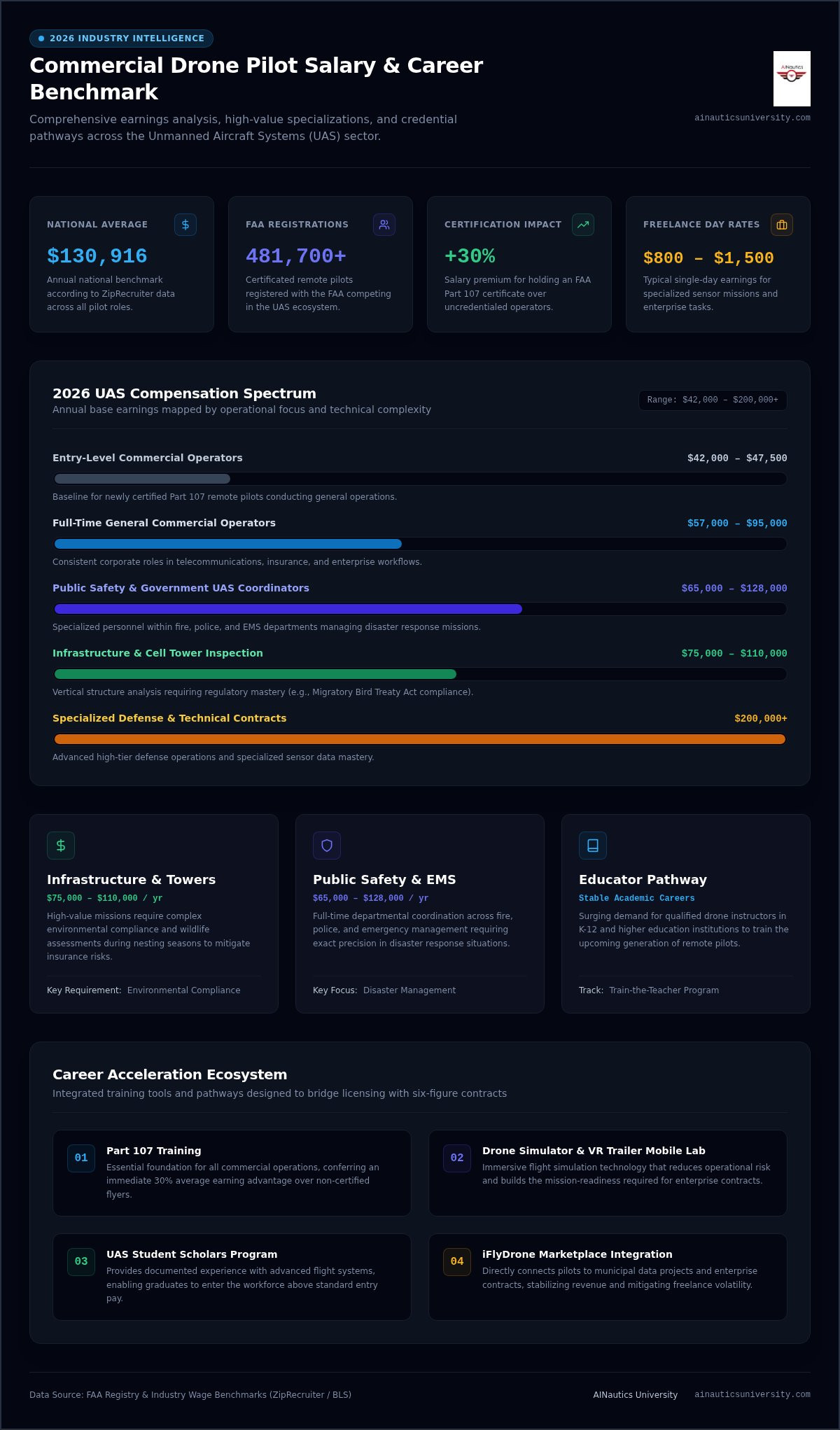
Understanding the financial landscape of the Unmanned Aircraft Systems (UAS) industry is vital for anyone entering the field in 2026. Current benchmarks show that the average salary for certified drone pilot roles currently sits at approximately $130,916 per year, according to ZipRecruiter data. However, this figure represents a broad spectrum of the workforce. Full-time general commercial operators realistically see a range between $57,000 and $95,000 annually. The industry has matured, and the "average" is often skewed by a large volume of part-time recreational flyers who hold a license but do not perform high-value technical missions. For those focused on professional growth, holding an FAA Part 107 certificate provides a roughly 30% salary premium over uncredentialed operators, as commercial clients and municipal agencies now mandate strict compliance.
Full-Time vs. Freelance Earning Structures
Your choice between corporate employment and independent contracting will dictate your daily operations and long-term stability. Corporate roles in sectors like telecommunications and insurance offer consistent benefits and predictable schedules. These positions prioritize pilots who can integrate into larger enterprise workflows. Conversely, freelance pilots often command impressive day rates ranging from $800 to $1,500 for specialized sensor missions. To bridge the gap between training and consistent work, many professionals utilize the iFlyDrone marketplace. This platform connects pilots directly to municipal data projects and enterprise contracts, providing a reliable stream of work that bypasses the typical "feast or famine" cycle of independent freelancing.
Entry-Level Expectations for New Part 107 Pilots
If you're just starting your journey, it's important to set realistic expectations. Entry-level commercial operators in 2026 typically start with salaries between $42,000 and $47,500. While this is the baseline, you can accelerate your progress through specialized preparation. Students who participate in the UAS Student Scholars program often enter the workforce with higher starting pay because they possess documented experience with advanced flight systems. Initial certification through AINautics University's Part 107 Training is the essential floor for your career, but it's the first step in a larger journey. High-earning pilots don't just fly; they master the art of data collection and interpretation. By focusing on mission-readiness early, you position yourself to move quickly from entry-level roles into the six-figure technical brackets that define the modern industry.
High-Paying Specializations: Where the Money Is in UAS
While the national average salary for certified drone pilot positions provides an encouraging baseline, the most significant financial growth happens in specialized technical missions. Pilots who move beyond basic photography into sectors like infrastructure inspection and public safety often see their earning potential double. This shift is reflected in the Bureau of Labor Statistics commercial pilot wage data, which highlights how advanced certifications and technical expertise drive higher wage percentiles across the broader aviation industry.
Infrastructure and Tower Inspection Salaries
Cell tower and vertical structure inspections are among the most lucrative niches in 2026. These roles typically pay between $75,000 and $110,000 annually because they require more than just basic flight skills. High-value pilots must understand complex regulatory requirements and environmental compliance to protect themselves and their clients. For instance, expertise in Migratory Bird Treaty Act compliance is essential when inspecting towers during nesting seasons. Pilots who can provide documented wildlife assessments for insurance companies command a significant premium. They mitigate legal and operational risk, which justifies a higher day rate. Mastery of these specific protocols is a core component of the specialized training offered to professional-track students.
Public Safety and Government UAS Roles
Government and public safety sectors offer some of the most stable high-paying careers in the industry. Full-time UAS coordinators within fire, police, and EMS departments often earn between $65,000 and $128,000 depending on the agency size and location. These roles focus on emergency management and disaster response missions where precision is critical. There is also a major advantage for veteran pilots in this space. Because AINautics University is a Service-Disabled Veteran-Owned Small Business (SDVOSB), we emphasize how this status helps pilots and organizations navigate federal contracting opportunities more effectively.
The ultimate salary multiplier in 2026 is mission planning. It's no longer enough to simply "fly the drone." The highest earners are those who can design a flight path that maximizes data quality while minimizing operational risk. This skill set transforms a pilot from a tool operator into a strategic asset. Whether you are conducting volumetric analysis on a construction site or performing a thermal inspection of a utility grid, your ability to plan and execute complex missions is what defines your value in the modern UAS marketplace. By focusing on these high-demand skills, you can move well beyond the standard average salary for certified drone pilot roles.
The Educator Pathway: Salary Outlook for Drone Teachers
The UAS industry isn't just expanding in the field; it's exploding in the classroom. As school districts rush to implement STEM and Career and Technical Education (CTE) pathways, the demand for qualified instructors has reached a critical point. While the average salary for certified drone pilot roles in technical sectors is high, the educational track offers unique stability and competitive pay. Full-time high school CTE drone instructors currently average $62,971 annually. This pathway allows experienced pilots to transition their flight skills into a leadership role that shapes the next generation of aviators.
K-12 Drone Program Leadership
Educators who lead these programs often access salary supplements through district stipends and CTE funding models. By launching a 90-day program, teachers can quickly establish a standardized curriculum that meets state requirements. This alignment is crucial for securing grant funding and professional recognition. Through the Train-the-Teacher Program, educators become UAS Teacher Scholars, gaining the mastery needed to lead accredited courses. This expertise doesn't just benefit the students; it positions the teacher as a subject matter expert who can command higher pay for professional development coaching and district-wide UAS coordination.
Professional Development and Workforce Training
The opportunities for educators extend far beyond the K-12 environment. Community colleges and universities are actively seeking UAS technology instructors, with salary ranges spanning from $65,000 to $128,379 depending on tenure. Many of these institutions participate in the FAA UAS Collegiate Training Initiative, which helps standardize the workforce pipeline. Outside of traditional academia, enterprise flight departments need "Train-the-Trainer" experts to maintain safety standards. These consultants often earn significant hourly wages, sometimes reaching over $64 per hour, to prepare corporate teams for complex missions.
Linking your educational mastery to your career growth is a strategic move. Whether you're helping students through Part 107 Training or guiding them in the UAS Student Scholars program, your value as an educator is tied to your ability to interpret complex regulations and flight data. By becoming a certified leader, you ensure that your personal average salary for certified drone pilot roles remains at the top of the industry curve while enjoying the long-term benefits of an educational career.
How Immersive Training Technology Impacts Your Paycheck
In 2026, the technical gap between a hobbyist and a high-earner is defined by immersive training. While the average salary for certified drone pilot roles starts at a baseline level, those who utilize high-fidelity simulation and virtual reality (VR) technologies often command a premium. This is because employers prioritize risk mitigation. A pilot who has logged fifty hours in a scenario-based simulator is a safer bet than one who has only practiced in open fields. This reduced operational risk directly impacts insurance tiers, making the pilot more attractive to enterprise flight departments and reducing the overhead costs for their employers.
The AINautics Drone Simulator Advantage
Using the AINautics Drone Simulator allows you to build critical muscle memory without the financial risk of crashing expensive enterprise hardware. You can practice emergency procedures, high-wind landings, and complex sensor operations in a controlled digital environment. These simulation hours translate into tangible professional credibility during the hiring process. When you can show an employer a log of specific mission scenarios you've mastered, you move to the front of the line. Mastery of simulation protocols serves as a documented proof of competency that justifies higher starting wages for new pilots.
Hands-On Experience via Mobile Labs
The VR Trailer Mobile Lab takes this preparation a step further by bringing immersive, hands-on autonomous systems education directly to training cohorts. This technology bridges the gap between theoretical knowledge and the high-stakes reality of commercial flight operations. In the 2026 market, being "mission-ready" on day one is the most effective way to bypass low-paying entry-level roles. Instead of spending months in basic observation positions, pilots with VR-based mission experience can jump straight into technical data collection missions that pay significantly more.
For those looking to accelerate their entry into the industry, Self-Paced Certification models offer the fastest time-to-value. You don't have to wait for a traditional semester to end to start earning. By combining rapid Part 107 Training with immersive tech, you can reach the average salary for certified drone pilot benchmarks much sooner than traditional paths allow. If you are ready to elevate your technical skills and earning potential, explore our immersive training options today.
Maximizing Your ROI with AINautics University
Investing in your education is the most direct way to influence your career trajectory. At AINautics University, we move beyond simple test preparation to provide a comprehensive "Learn → Train → Certify → Fly → Work" pipeline. This structured approach ensures that you don't just hold a certificate; you possess the technical mastery required by the modern workforce. For younger aviators, the UAS Student Scholars certification serves as a powerful career booster. It signals to employers that the pilot has met rigorous industry standards before even entering the professional market, helping them secure positions that pay well above the entry-level baseline.
The 90-Day Career Launch Strategy
You can accelerate from zero experience to a workforce-ready Part 107 pilot in just three months. Our STEM-aligned curriculum is designed for immediate professional application, focusing on the skills that industries actually need in 2026. By utilizing Self-Paced Certification options, you can balance your training with your current schedule while preparing for high-stakes missions. This efficiency is critical for maximizing your return on investment. If you are just starting, our Drone Training for Beginners: 2026 Guide to UAS Mastery provides the foundational knowledge needed to begin this 90-day journey toward professional certification.
Connecting to the Workforce Marketplace
The final step in maximizing your earning potential is finding the right missions. AINautics prepares pilots specifically for the iFlyDrone marketplace, a platform that eliminates the friction of finding high-paying municipal and enterprise work. Instead of searching for individual contracts, you can leverage a national-scale network to ensure consistent annual earnings. This connection to real-world demand is why many of our graduates quickly reach the national average salary for certified drone pilot roles. As a Service-Disabled Veteran-Owned Small Business (SDVOSB), we take pride in being the bridge between your initial Part 107 Training and a lucrative, long-term career.
The UAS industry is no longer a niche hobby; it's a multi-billion dollar professional field. Your ability to command a high salary depends on your choice of training provider and your commitment to specialization. By choosing a path that integrates advanced simulation, expert instruction, and direct market access, you position yourself at the top of the 2026 workforce. Don't leave your career growth to chance. Start your high-paying drone career today by enrolling in our professional certification programs.
Secure Your Future in the 2026 UAS Workforce
The drone industry has evolved far beyond basic flight. In 2026, professional success belongs to those who master the intersection of technology and data. While the average salary for certified drone pilot roles offers an encouraging baseline, your true earning potential is defined by your willingness to specialize. We've seen how technical niches like infrastructure inspection and educator pathways provide long-term stability and high-tier pay. By utilizing immersive tools like the Drone Simulator, you can build the mission-readiness that modern employers demand.
AINautics University is a Service-Disabled Veteran-Owned Small Business dedicated to bridging the gap between training and employment. Our STEM-aligned curriculum and the national iFlyDrone workforce marketplace provide the support you need to thrive. Whether you're a student starting your journey or an educator leading a new program, the tools for professional growth are within reach. It's time to transform your interest in aviation into a sustainable, high-paying career.
Enroll in AINautics Part 107 Training and Start Your High-Paying Career Today. Your future in the skies starts with the right preparation.
Frequently Asked Questions
What is the average salary for a Part 107 certified drone pilot in 2026?
The average salary for certified drone pilot roles in 2026 currently sits at approximately $130,916 annually, though full-time general commercial operators realistically see between $57,000 and $95,000. Entry-level pilots typically start between $42,000 and $47,500. Holding an FAA Part 107 certificate provides a 30% salary premium over uncredentialed operators. Programs like AINautics' Part 107 Training prepare you to exceed these baselines by focusing on workforce-ready skills rather than just passing the exam.
Do self-employed drone pilots make more than salaried employees?
Self-employed pilots often command higher hourly rates, ranging from $80 to $250 per hour for specialized missions. However, salaried corporate roles offer greater stability and benefits like health insurance. Many pilots use the iFlyDrone workforce marketplace to combine the flexibility of freelance work with the consistent demand of municipal contracts. This hybrid approach helps independent operators maintain high annual earnings without the administrative burden of traditional business development.
How much more do specialized drone inspectors earn compared to photographers?
Technical inspectors earn significantly more than general aerial photographers due to the complexity of the data collected. While real estate photographers might earn a standard day rate, specialized infrastructure inspectors often see annual salaries between $75,000 and $110,000. Pilots who master vertical structure inspections or Migratory Bird Treaty Act compliance provide higher value to insurers. Mastery of these specialized sensors and regulatory protocols is essential for moving into high-tier pay brackets.
Can a drone pilot salary reach six figures in the United States?
Yes, six-figure salaries are common for pilots in aerospace, defense, and critical infrastructure sectors. Technical roles in LiDAR surveying and photogrammetry often reach $115,000 or more. Senior UAS operators in the defense industry can see annual compensation exceeding $200,000. Achieving these levels requires advanced mission planning and data interpretation skills beyond basic flight. Utilizing tools like the AINautics Drone Simulator helps you gain the experience needed for these lucrative technical roles.
Does having advanced simulator training increase my starting salary?
Advanced simulator training directly impacts your starting salary by proving mission-readiness to potential employers. Pilots who log hours on the AINautics Drone Simulator demonstrate reduced operational risk, which qualifies them for better insurance tiers and higher-paying enterprise contracts. Employers prioritize candidates who can handle emergency procedures and complex sensor operations in a controlled environment. This documented experience allows you to bypass entry-level observation roles and secure technical positions with better pay.
What are the highest-paying industries for drone pilots right now?
The highest-paying sectors in 2026 include aerospace and defense, utility inspection, and large-scale construction mapping. Defense UAS operators can earn over $215,000, while energy sector pilots performing thermal inspections often see salaries above $110,000. Public safety and government roles also offer high stability and competitive wages. Joining the UAS Student Scholars program provides a direct path into these high-demand industries by aligning your training with the specific technical needs of these sectors.
Is there a salary difference between recreational and commercial drone certifications?
Recreational flyers do not have a salary baseline because they cannot legally perform commercial work without an FAA Part 107 certificate. Commercial pilots earn a significant premium because they can legally accept payment for flight services. Holding a professional certification through AINautics' Part 107 Training is the legal requirement for all high-paying missions. Commercial clients, municipalities, and insurance providers only work with certified remote pilots who can demonstrate compliance with federal safety regulations. This certification is the foundation for any professional average salary for certified drone pilot roles.
How do drone educator salaries compare to commercial pilot roles?
Drone educator salaries are highly competitive, with high school CTE instructors averaging around $62,971 annually. Higher education UAS technology instructors can earn up to $128,379 depending on the institution. While some specialized commercial roles pay more, the educator pathway offers exceptional job stability and benefits. Through the Train-the-Teacher Program, educators can also earn additional stipends for leading district-wide UAS initiatives, making it a lucrative alternative to standard field operations.

Article by
AINautics University Team
The team behind AINautics University, dedicated to drone education and FAA Part 107 certification prep, VR flight simulation, and STEM training programs for students and educators.


