
Before choosing a takeoff spot, identify the purpose of your flight. That is the first step in understanding how to fly drones legally: recreational flights follow recreational-flyer rules, while many work-related or other non-recreational flights fall under FAA Part 107.
Registration, Remote ID, TRUST, airspace authorization, and operating limits can all affect a flight. Which checks apply depends on the aircraft and operation, so a map or app alone cannot confirm that a planned flight is permitted.
This guide offers a practical sequence: identify the rules tied to your purpose, check pilot and aircraft requirements, review the airspace and location, then complete preflight checks. Structured study, including AINautics University’s Part 107 Training and Self-Paced Certification, can help learners understand the Part 107 pathway. Students and educators can use the same foundations as they explore drone learning and careers in UAS.
Key Takeaways
- To understand how to fly drones legally, identify the flight’s purpose and the FAA rules that apply.
- Check pilot qualifications, registration, identification, and aircraft requirements for the specific operation.
- Review the airspace and location before choosing a launch site, and determine whether authorization or additional restrictions apply.
- Use a consistent preflight sequence to assess site access, weather, and other conditions before making a go-or-no-go decision.
- Build confidence with structured learning and applied practice, and use current FAA guidance as the authority for compliance.
How to Fly a Drone Legally: Start With the Purpose of Your Flight
Before checking a location or preparing your drone, identify why you plan to fly. The purpose helps determine which FAA compliance pathway applies. Recreational flights follow the recreational-flyer framework, while many other small uncrewed aircraft operations fall under Part 107. This is the first key decision when learning how to fly drones legally.
Owning a drone does not determine which rules apply, and neither does the setting. A student flying purely for recreation and a student collecting footage for a school project may have different purposes. Do not assume that a school, club, or educational activity automatically creates an exemption. Compensation can be relevant, but payment alone does not settle which rules apply. These examples are not legal determinations for a particular flight.
Does recreational or non-recreational purpose change the rules?
Recreational flyers must meet the FAA’s recreational requirements, including passing the free Recreational UAS Safety Test (TRUST) and carrying proof of passage while flying. Other requirements may also apply, depending on the aircraft and operation. A flight connected to work or another non-recreational purpose may need to follow Part 107. Do not assume that a school, club, or educational activity automatically qualifies as recreational.
For a broad overview of the legal framework, see Regulation of UAVs in the United States. Use current FAA guidance to determine what applies to your planned flight.
When should a new pilot learn about Part 107?
Learn about Part 107 before accepting a work-related flight or planning an operation that is not solely recreational. Part 107 is the FAA framework for many non-recreational small drone operations. A person acting as remote pilot in command under Part 107 needs a Remote Pilot Certificate. This is distinct from recreational-flyer requirements, so completing TRUST does not qualify someone to conduct a Part 107 operation.
Start by describing the planned flight: its purpose, who will conduct it, and how the resulting data or footage will be used. Then compare those details with current FAA guidance before deciding which rules apply. AINautics University’s Part 107 Training and Self-Paced Certification can help learners study the pathway, but do not replace FAA requirements. For more detail, continue to the FAA Part 107 training guide.
Which FAA Requirements Should You Check Before a Drone Flight?
Once you have identified the flight’s purpose, check the requirements that apply to you, your aircraft, and the planned operation. No single rule covers every drone or flight. The FAA’s FAA Getting Started Guide can help you find guidance for recreational and non-recreational flying.
- Pilot qualification: Confirm whether the operation requires a Remote Pilot Certificate or, for recreational flying, completion of applicable knowledge and safety requirements.
- Registration: Check whether the aircraft must be registered under current FAA criteria. Requirements can vary with the aircraft and type of operation.
- Identification: Determine whether Remote ID applies to your drone and operation, and whether the aircraft must display registration markings.
- Aircraft and operation: Review requirements tied to the drone’s characteristics and how you plan to use it.
How do registration and Remote ID apply to your drone?
Registration and Remote ID are separate checks. When registration is required, it connects an aircraft to its FAA registration record. When the Remote ID rule applies, the system broadcasts identification and location information during flight. Whether either requirement applies depends on current FAA criteria and your specific aircraft and operation. Before launch, verify registration, required markings, and Remote ID status using current FAA guidance rather than relying on a general rule of thumb.
What should recreational flyers know about TRUST?
TRUST is the FAA’s Recreational UAS Safety Test. It covers safety information recreational flyers need to know. Complete it when required for your flight and keep proof of passage available as FAA guidance directs. TRUST and a Part 107 Remote Pilot Certificate serve different pathways: completing the recreational knowledge requirement does not qualify you to conduct a Part 107 operation. If your planned use may fall under Part 107, study the applicable Part 107 rules and regulations and verify the details with the FAA.
Before each flight, confirm your pilot qualification, aircraft registration and marking status, Remote ID applicability, and any aircraft- or operation-specific requirements. For learners preparing to study the Part 107 pathway, AINautics University’s Part 107 Training offers structured learning.
Where Can You Fly a Drone Legally, and When Do You Need Authorization?
A location that looks open on a map may still have airspace limits or local access rules. Controlled airspace, often found around airports, requires FAA authorization before drone flight. Other airspace may not require that authorization, but it is not automatically free of restrictions. Temporary flight restrictions and other location-specific limits can also affect where and when you fly.
Use the FAA’s FAA Airspace Rules to understand the rules and find current location-checking resources. Treat maps and apps as research tools, not legal guarantees. They may not settle questions about land access, privacy, or every restriction affecting your operation.
| Location or airspace situation | What to do before flying |
|---|---|
| Area that appears open to drone flights | Check current FAA airspace information and temporary restrictions. Confirm site access and other applicable rules. |
| Controlled airspace | Obtain FAA authorization before flying. LAANC, the Low Altitude Authorization and Notification Capability, can provide near-real-time automated authorization through participating services where available. |
| Restricted or otherwise specially limited area | Review the applicable restriction and determine whether the planned flight is permitted. Do not assume a standard authorization or app result covers every restriction. |
How can you check airspace before choosing a launch site?
Check the exact launch location, not just the city or general area. Review current FAA resources for the airspace and any active restrictions, then request authorization if required. LAANC can streamline eligible authorization requests in participating areas, but it does not guarantee approval or replace checks for other limits. Recheck close to flight time because restrictions can change.
Do parks, schools, and private property have additional rules?
Yes. FAA authorization concerns airspace, but it does not automatically grant permission to take off from or land on property. A park manager, school, or property owner may set access rules, and local restrictions vary by jurisdiction. Privacy and recording may also be governed by rules beyond FAA flight authorization. Confirm both the airspace status and whether you can use the proposed launch site.
For how to fly drones legally, treat the location check as two connected reviews: verify that the flight is permitted in the airspace, then confirm that you can lawfully access and use the takeoff site. If either answer is unclear, pause and resolve it before launch.
What to Do Before Takeoff: A Legal Drone Preflight Sequence
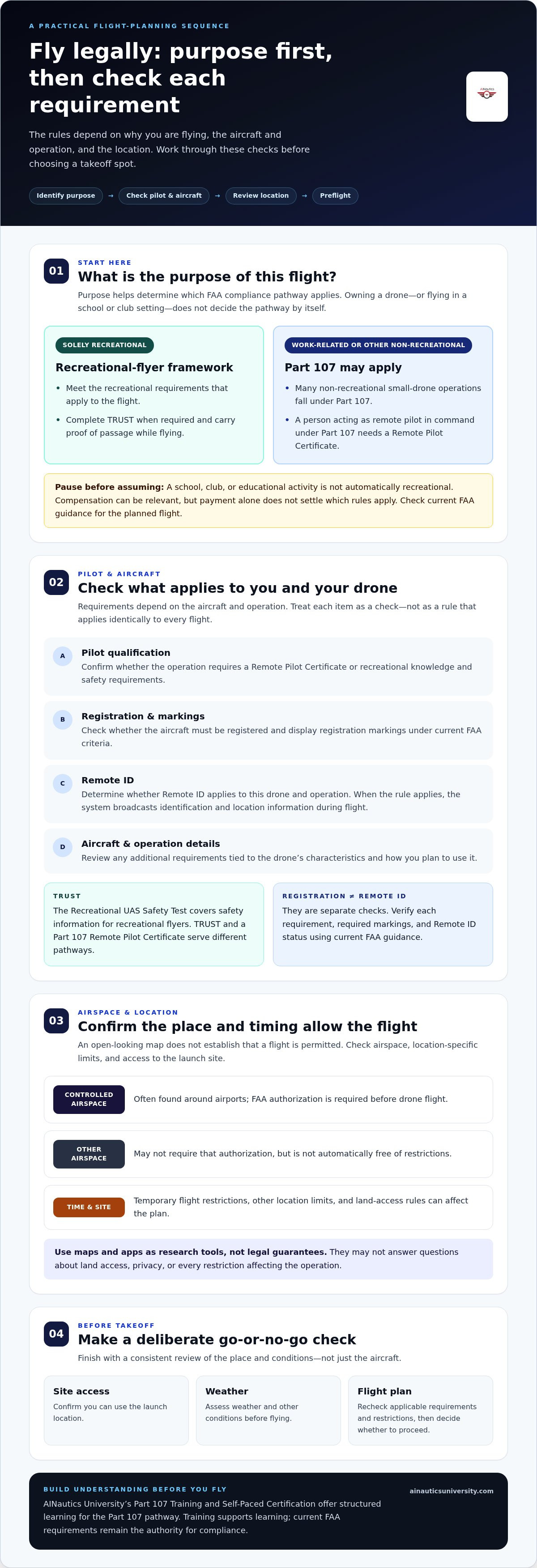
A consistent preflight review turns legal requirements into practical decisions. Follow the steps in order, and use current FAA guidance whenever the answer depends on your aircraft or operation.
A repeatable preflight compliance checklist
- Identify the operation. Write down the flight’s purpose and determine which FAA pathway applies, such as recreational rules or Part 107.
- Confirm pilot eligibility. Check that the person operating the drone meets the applicable pilot qualification and knowledge requirements.
- Review the aircraft and records. Check whether registration, markings, Remote ID, or other aircraft-specific requirements apply. Have required documents or proof available for the flight.
- Check the exact site and airspace. Review current FAA information for the launch location, including controlled airspace and temporary restrictions. Separately confirm that you can access and use the launch site.
- Obtain required authorization. If the operation needs FAA authorization, secure it before flight and confirm that its conditions fit the planned operation.
- Assess conditions and decide. Review the weather and conditions at the site. Consider whether they allow you to operate safely and within applicable limits. Record your checks and make a clear go-or-no-go decision.
In plain English: identify the flight’s purpose, confirm pilot and aircraft requirements, check the site and airspace, obtain any required authorization, assess conditions, and document whether the flight can proceed.
What should you do when a rule or restriction is unclear?
Pause. Do not launch while a required approval is missing or a relevant rule remains uncertain. Consult current FAA guidance and resolve the question before proceeding. Keep records of approvals and planning decisions when relevant to the operation, so your go-or-no-go choice is clear later.
Review weather as deliberately as airspace. Conditions can affect whether you can safely control the aircraft and complete the planned operation. If they make that uncertain, postpone the flight rather than treating a completed checklist as permission to launch.
For students and new pilots, learning the sequence before field practice makes each check easier to apply. AINautics University’s Part 107 Training can help learners build knowledge for applicable operations. Explore Part 107 Training as you strengthen your understanding of how to fly drones legally and prepare for responsible flight.
Build the Skills to Fly Legally With Confidence
Knowing how to fly drones legally takes more than memorizing rules. FAA requirements can depend on the flight’s purpose, the aircraft, and operating conditions. Use current FAA guidance as the authority for decisions about a specific flight. Structured learning can help you understand requirements before moving from study to applied practice.
How can students and new pilots prepare for responsible flight?
Build knowledge and practical readiness step by step. Learn the rules for your intended operation, then use supervised, scenario-based practice to work through flight planning and decision-making. A simulator lets you practice scenarios and build familiarity, but it does not replace any FAA-required qualification, authorization, or real-world preflight review.
AINautics University’s Part 107 Training and Self-Paced Certification support learners preparing to study the Part 107 pathway. The Drone Simulator complements that learning with scenario-based practice. Together, these resources help students and new pilots build a foundation for further UAS learning.
How can educators make compliance part of drone learning?
Educators can teach responsible drone use alongside technical skills, adapting lessons to learners’ needs and experience. AINautics University’s Train-the-Teacher Program supports educators bringing drone learning into educational settings. The UAS Student Scholars program gives students a learning pathway as they explore the field, and the VR Trailer Mobile Lab provides a hands-on educational resource.
In any classroom or program, connect practice to the compliance questions students will face: What is the flight’s purpose? Which rules apply? What must be checked before launch? A simulator or other learning activity can help rehearse decisions, but it cannot authorize a flight or replace current FAA guidance. Keep that distinction clear as students progress toward applied practice.
AINautics University’s Part 107 Training, Self-Paced Certification, Drone Simulator, Train-the-Teacher Program, VR Trailer Mobile Lab, and UAS Student Scholars program offer learning options for students, new pilots, and educators.
Prepare for Your Next Flight With Confidence
Flying legally starts with a clear decision about the flight’s purpose. Match the operation to the applicable FAA pathway, confirm pilot and aircraft requirements, and check airspace and site rules before deciding to launch. A consistent preflight review helps turn those steps into a confident go-or-no-go decision.
For anyone learning how to fly drones legally, keep current FAA guidance close at hand. Rules and restrictions can depend on the aircraft, operation, and location, so do not rely on assumptions or a single map or app to settle every question.
Structured learning can help you build knowledge before moving into applied practice. AINautics University’s Part 107 Training and Self-Paced Certification support study, while the Drone Simulator and educator-focused programs connect foundational learning with practical scenarios.
Explore AINautics University drone training and take your next step toward informed, responsible flight. Every careful check strengthens your skills and helps you prepare for future opportunities in the UAS field.
Frequently Asked Questions
Can I fly a drone without a license in the United States?
Sometimes. Whether you need a Part 107 Remote Pilot Certificate depends on the flight’s purpose and the rules for that operation. Some recreational flyers may not need this certificate, but other requirements can still apply, including knowledge, aircraft, and airspace rules. To understand how to fly drones legally, check current FAA guidance for your situation before taking off. Being new to flying or using a small drone does not automatically create an exemption.
Do I need Part 107 to fly a drone for school?
Not necessarily. A school setting alone does not determine which FAA rules apply. The flight’s purpose and details matter. Before planning, identify who will operate the drone, what the flight is intended to accomplish, and how the operation fits current FAA guidance. Do not assume that a class project, school club, or other educational activity is automatically exempt from applicable requirements. Review the rules for the specific flight before choosing a compliance pathway.
Can I fly a drone in controlled airspace?
Some drone flights in controlled airspace may be allowed if you obtain the required FAA authorization and follow its conditions. The process and limits depend on the location and operation. Check current FAA resources for the exact site before planning to launch. A map or app can help with your review, but its display alone does not grant permission. If authorization is required and you have not obtained it, do not proceed with that flight.
Do I need to register my drone and use Remote ID?
It depends on current FAA criteria and the drone and operation involved. Registration and Remote ID are separate requirements, and exceptions may apply, so do not rely on a general rule of thumb. Review current FAA registration and Remote ID guidance for your specific aircraft before flying. Also check whether the drone needs registration markings or must meet other applicable operating requirements. Resolve any uncertainty before takeoff rather than assuming an exemption.
What is TRUST, and do recreational drone flyers need to take it?
TRUST is the FAA’s recreational flyer knowledge and safety test. Whether you need to complete it depends on whether your flight qualifies as recreational under current FAA rules. TRUST is not the same as a Part 107 Remote Pilot Certificate, and completing one does not substitute for the other. Check FAA guidance, complete any applicable knowledge and safety steps before flying, and retain or carry proof of passage as the FAA directs.
Can I fly a drone over people or near an airport?
These flights can involve additional operating limits, airspace rules, or authorization requirements. Whether a flight is allowed depends on the aircraft, operation, location, and current FAA rules. Review the relevant guidance and airspace information before planning. Do not treat nearby people or an airport as a minor detail, and do not rely on distance alone to decide a flight is permitted. Resolve the applicable restrictions before takeoff.
Are drone laws the same in every state and city?
FAA rules apply nationally, but they may not address every rule affecting a flight. Land managers, property owners, and state or local authorities may set additional restrictions involving access, takeoff, landing, or recording. Requirements vary by location, so check the rules for the specific site you plan to use. FAA airspace authorization, when required, does not by itself settle whether you can access or use the launch location.
Ready to build your knowledge before your next flight? Explore AINautics University’s drone training and educational programs.

Article by
AINautics University Team
The team behind AINautics University, dedicated to drone education and FAA Part 107 certification prep, VR flight simulation, and STEM training programs for students and educators.


