
The course with the strongest “certification” label may not be the one that best fits your goal. UAS certification training can help you prepare for the FAA Part 107 knowledge test, but completing a course isn’t the same as earning the FAA Remote Pilot Certificate. Knowing the difference helps you choose a path with confidence.
It’s also reasonable to wonder whether self-paced study will provide enough structure, or how classroom learning can build practical UAS skills. The right format depends on your goal: preparing for the FAA exam, supporting a student’s learning, or building a foundation for a future career.
This guide compares common learning paths and explains what to look for in each. You’ll see how Part 107 preparation relates to the Remote Pilot Certificate, where self-paced options can fit, and how tools such as AINautics University’s Drone Simulator, VR Trailer Mobile Lab, Train-the-Teacher Program, and UAS Student Scholars can support learning. Use these distinctions to identify a practical next step for your education or career goals.
Key Takeaways
- Match your learning format to your schedule, need for guidance, and opportunities to practice.
- Use UAS certification training to build knowledge for the FAA Part 107 test, while treating the Remote Pilot Certificate as a separate FAA credential.
- Compare programs by curriculum, practice resources, instructor support, and clearly stated outcomes.
- Choose a pathway suited to your role, from individual exam preparation to classroom instruction and teacher development.
- Plan a next step that builds on foundational learning and supports your longer-term UAS education or career goals.
What Does UAS Certification Training Prepare You to Do?
UAS certification training prepares learners with knowledge and skills related to unmanned aircraft systems, but completing a course does not itself award an FAA certificate. UAS means “unmanned aircraft system”: an aircraft flown without a pilot onboard, together with the equipment and controls used to operate it. The aircraft is often called a drone. For an overview of the technology and its applications, see Unmanned Aerial Vehicle.
Training can build understanding of aviation concepts, safe operations, and the material covered in Part 107 exam preparation. The learning goal depends on who’s taking the course. A student might be exploring a future in UAS, a parent might be helping a learner compare options, and an educator might be planning classroom instruction. Each can benefit from learning, even if earning an FAA credential isn’t the immediate aim.
What does “UAS certification training” mean?
The term can describe learning designed to prepare someone for an assessment or credentialing process. It doesn’t mean every course completion results in a certificate from the FAA. For example, finishing a training module on airspace concepts shows that a learner has completed that module. It isn’t the same as passing the FAA knowledge test or receiving an FAA-issued Remote Pilot Certificate.
AINautics University offers Part 107 Training and Self-Paced Certification for learners pursuing foundational study and Part 107 preparation. A Drone Simulator can complement that learning with scenario-based practice. These are distinct steps: education builds knowledge, practice supports skill development, and the FAA controls its credentialing process.
How does Part 107 training fit into the bigger picture?
Part 107 training supports preparation for the FAA aeronautical knowledge test associated with the Remote Pilot Certificate. To earn the certificate, an eligible applicant must meet FAA requirements, pass the required knowledge test, and complete the FAA’s application process. The FAA, not a training provider, issues the credential. Course completion alone doesn’t satisfy those steps.
Requirements and application details can change, so use the FAA’s Part 107 resources for current official guidance. For more focused exam preparation, consult the Professional FAA Part 107 Drone Training guide. Use it alongside FAA information to understand the difference between preparing for the test and completing the official process.
Part 107 can be one foundation for further learning, not a complete career plan. Students can build toward applied UAS skills, while educators can develop their teaching through AINautics University’s Train-the-Teacher Program. Start by identifying your goal, then choose learning and practice opportunities that move you toward it.
Online, Self-Paced, or Blended: How UAS Training Formats Differ
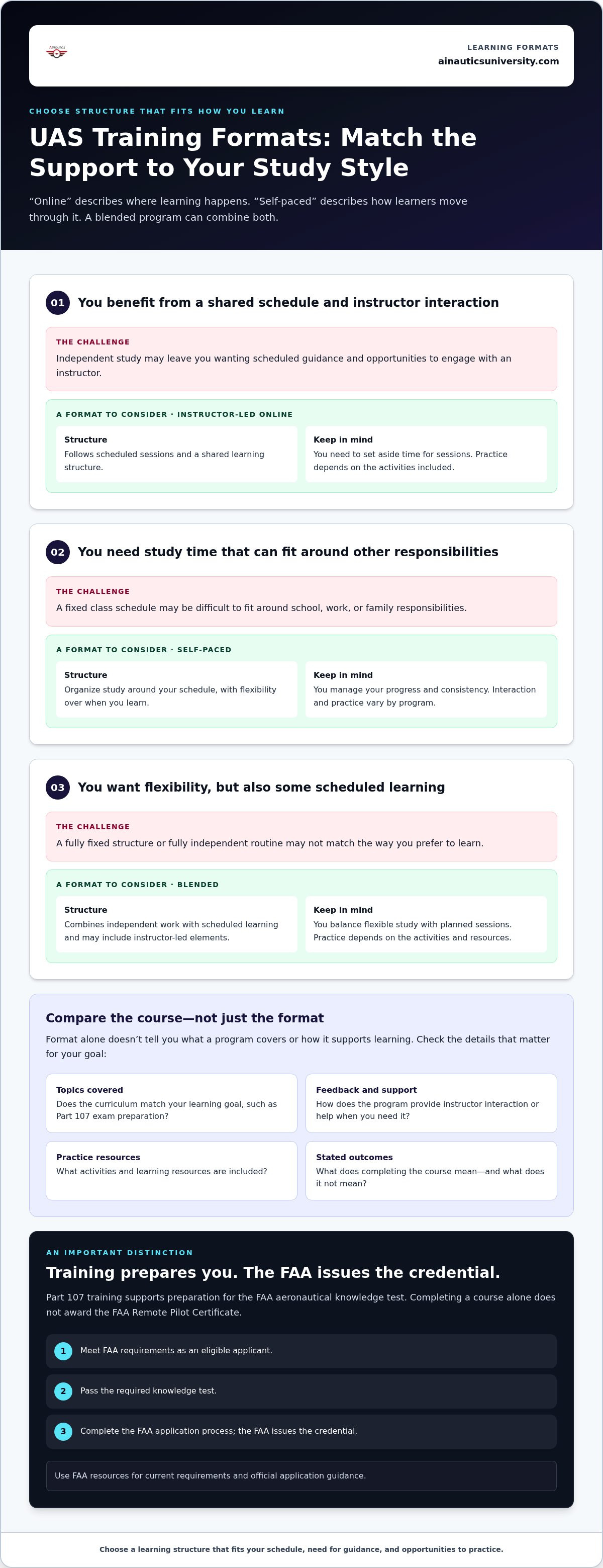
The best format depends on how you learn and what kind of support helps you stay engaged. Compare the structure, not just the label: “online” describes where learning happens, while “self-paced” describes how learners move through it. Programs can combine these approaches, so consider how each format fits your schedule and learning habits.
Instructor-led online: Pacing: follows scheduled sessions. Interaction: creates opportunities to engage with an instructor. Practice: depends on the activities included. Scheduling: requires time set aside for sessions. Independence: learners follow a shared structure.
Self-paced: Pacing: learners organize study around their schedule. Interaction: varies by program. Practice: depends on the resources provided. Scheduling: offers flexibility for study time. Independence: requires learners to manage progress and consistency.
Blended: Pacing: combines independent work with scheduled learning. Interaction: may include both instructor-led and independent elements. Practice: depends on the activities and resources. Scheduling: mixes flexible study with planned sessions. Independence: learners balance both structures.
These are broad comparisons, not guarantees about a particular course. Format alone doesn’t tell you which topics a program covers, how feedback works, or whether it includes practical activities. Those details matter, especially if your goal is FAA Part 107 exam preparation rather than general classroom learning. For official steps and eligibility information, consult the FAA’s Become a Certificated Remote Pilot guidance.
What can self-paced UAS certification training offer?
Self-paced learning can make it easier to fit study around school, work, or family responsibilities. It also asks learners to set a routine and keep moving without relying on a fixed class schedule. Before choosing this format, consider how much structure you need, how you’ll seek feedback, and whether you can study consistently. AINautics University offers Self-Paced Certification for learners who want to organize their study independently. Build a routine, track the topics you cover, and set aside time to revisit concepts that remain unclear.
When might simulation or guided learning be useful?
Simulation can help learners explore scenarios and practice decision-making in a learning environment. It can support UAS education, but it doesn’t guarantee flight proficiency or replace FAA requirements. AINautics University’s Drone Simulator and VR Trailer Mobile Lab offer immersive educational resources that can complement instruction. For more on this approach, look for the immersive drone training technology guide.
Choose the format that supports your next learning step. Explore AINautics University learning options to compare paths for individual study, practical learning, and educator development.
How to Compare UAS Certification Training Programs Fairly
Compare programs against the same criteria, then choose the one that fits your learning goal. A polished label or broad promise doesn’t tell you what you’ll study, how you’ll learn, or what course completion means. Look for specific, understandable details you can compare side by side.
Which course details should learners compare?
Use this checklist to assess each program’s published information:
- Curriculum scope: Identify the topics covered and whether the program is designed for FAA Part 107 exam preparation, general UAS education, or another learning goal.
- Learning format: Check whether instruction is self-paced, scheduled, or blended, and whether that structure fits your routine and learning preferences.
- Practice resources: Look for a clear description of activities, simulation, or other learning resources. Don’t assume a format includes practice unless it says so.
- Learning support: Look for details about instructor guidance and feedback. Knowing what support is available can help you decide whether the program suits the way you learn.
- Stated outcomes: Distinguish completing lessons or a course from passing an FAA knowledge test and earning an FAA-issued Remote Pilot Certificate.
Keep course information separate from official requirements. A training program can explain its curriculum and learning approach, but the FAA sets the credentialing process. Use the FAA’s Become a Drone Pilot guide to check current eligibility and certificate steps. Treat claims about exam success or credentials carefully: preparation can support learning, but it shouldn’t be presented as a guarantee of passing or certification.
How can learners judge whether a format suits them?
Self-paced study isn’t automatically unsupported or insufficient. Its suitability depends on the learner’s habits and the structure available. If you study independently and can maintain a routine, a flexible format may fit. If scheduled lessons or guidance help you stay engaged, prioritize programs that explain how instruction and feedback work. Compare the support described, rather than inferring it from the words “online” or “self-paced.”
Then match resources to your goal. A learner preparing for an FAA exam may prioritize relevant study content; someone seeking broader applied learning may value opportunities to work through UAS scenarios. AINautics University offers Self-Paced Certification, a Drone Simulator, a VR Trailer Mobile Lab, and a Train-the-Teacher Program for different educational needs. Compare each option with your objective: independent study, scenario-based learning, immersive educational activities, or educator development.
Apply the same checklist to every option. That makes UAS certification training easier to evaluate based on evidence and personal fit, rather than marketing language or assumptions about what a course delivers.
Which UAS Certification Training Path Fits Students, Parents, and Educators?
Start with the learner’s goal, then choose a learning path that fits. UAS certification training can mean exam preparation for an individual, introductory learning for a student, or curriculum planning for a classroom. These goals can overlap, but they aren’t interchangeable. A student exploring drones doesn’t necessarily need the same starting point as someone preparing for the FAA Part 107 knowledge test or a teacher building a course.
What should students and parents consider first?
Talk through the learner’s age, current experience, interests, and educational goals. Is the student curious about how drones are used, looking for classroom enrichment, or beginning to explore FAA Part 107? A clear goal helps families choose between foundational learning and focused exam preparation.
AINautics University’s UAS Student Scholars program offers a student-focused way to explore UAS education. Treat this kind of learning as a step in exploration and skill development, not a promise of a particular career outcome or FAA certificate. Families exploring student pathways can also read the UAS Scholarship 2026 guide. For exam-focused preparation, consider the learner’s needs alongside the Part 107 resources discussed earlier.
How can educators plan a classroom training pathway?
Separate teacher development from student certification preparation. Educators may first need support in planning and delivering UAS learning, while students may need age-appropriate foundational instruction or, where suitable, individual preparation for an FAA process. A classroom curriculum should have a clear learning purpose; it doesn’t automatically make every student a certification candidate.
AINautics University’s Train-the-Teacher Program supports educator development, and its curriculum can align with state and district education standards. This helps educators connect UAS learning with classroom goals. The VR Trailer Mobile Lab is another educational resource for immersive learning. For practical planning ideas, explore the drone curriculum for educators guide.
Use this sequence to narrow the options: define the learner’s goal, identify whether the priority is individual study or classroom learning, then select a format and resources that support that purpose. Students and families can explore UAS Student Scholars, while educators can consider teacher development and curriculum alignment. AINautics University’s UAS education programs support these different learning contexts.
Turn UAS Certification Training into a Clear Next Step
A useful learning plan turns interest into action. Keep three things distinct: a course can help you prepare, practical resources can support learning, and the FAA manages its own process for issuing an official Remote Pilot Certificate. Your next step should match your goal, whether you’re studying for Part 107, exploring UAS for school, or planning classroom learning.
What steps can learners take after choosing a format?
Start with one clear objective. If you’re preparing for the FAA knowledge test, review current FAA guidance to identify the topics and application steps relevant to you. Then choose a study routine that fits your schedule. Set recurring study times, track the topics you’ve covered, and note what you still need to understand.
Build in support that fits your learning style. Independent learners may prefer self-paced study. Learners who want to explore scenarios may find simulation useful as a complement to instruction. These resources support learning, but they don’t guarantee exam success, flight proficiency, or a career outcome.
Check your progress as you go. Can you explain the material in your own words? Do you need more structure, practice, or educator guidance? Your answers can shape the next stage, whether that means reviewing concepts, continuing practical learning, or exploring a more advanced area of UAS education.
How does AINautics University support different learning goals?
AINautics University’s offerings can fit into a broader pathway. Part 107 Training and Self-Paced Certification support learners interested in Part 107 preparation. For practical learning, the Drone Simulator and VR Trailer Mobile Lab can complement foundational instruction. Educators can use the Train-the-Teacher Program as they plan classroom learning, with curriculum that can align with state and district education standards. UAS Student Scholars provides another student-focused route for exploring UAS education.
Think of these as distinct supports, not interchangeable credentials. A course helps you learn; a simulator or mobile lab can support educational activities; teacher development can inform classroom planning. The FAA remains the source for official certificate requirements and application steps. Keep that distinction clear as you choose what to do next.
Your next step doesn’t need to solve every future question. Choose one: begin Part 107 preparation, establish a self-paced study routine, explore simulation-based learning, or plan UAS instruction for students. AINautics University’s training and education programs can support the path you choose.
Choose Your Next Step in UAS Learning
The right UAS certification training path starts with your goal. Compare formats based on the structure, support, and practice that help you learn, then choose one immediate step, whether that’s preparing for Part 107, exploring UAS skills, or planning classroom learning. Keep preparation separate from the FAA’s credentialing process: completing a course alone doesn’t award the Remote Pilot Certificate.
AINautics University offers Part 107 Training and Self-Paced Certification for learners focused on preparation. Its Drone Simulator and VR Trailer Mobile Lab support practical and immersive learning, while the Train-the-Teacher Program supports educator development. UAS Student Scholars provides a student-focused way to explore UAS education.
Explore AINautics University’s UAS training and learning options and choose a starting point that fits your goals.
Frequently Asked Questions
Is UAS certification training the same as getting an FAA Remote Pilot Certificate?
No. UAS certification training helps learners build knowledge or prepare for an FAA knowledge test, but completing a course does not itself award an FAA Remote Pilot Certificate. The FAA sets the eligibility, testing, and application process and issues the certificate. Treat training completion and earning the official credential as separate milestones, and use current FAA guidance for the steps that apply to your situation.
Can I complete UAS certification training online or at my own pace?
Some learning options are online or self-paced, though formats vary by program. Self-paced study can help you organize learning around school, work, or family commitments, but it also requires you to manage your study routine. AINautics University offers Self-Paced Certification as one learning option. Before starting, consider how you’ll stay consistent and whether you prefer scheduled instruction or independent study.
How do I choose between self-paced and instructor-supported UAS training?
Choose based on the structure and feedback that help you learn. Self-paced study may suit you if you can set a routine and work independently. Instructor-supported learning may be a better fit if scheduled lessons or opportunities to ask questions help you stay engaged. Compare course descriptions for pacing, instructor interaction, practice resources, and learning support rather than assuming every program offers the same features.
Does UAS certification training include hands-on drone practice?
Practice opportunities depend on the learning program, so review what its description includes. A Drone Simulator can support scenario-based learning in a simulated setting, while a VR Trailer Mobile Lab provides immersive educational activities. These resources can complement instruction, but they aren’t the same as flying a physical aircraft and don’t guarantee flight proficiency. Keep practice goals distinct from FAA credential requirements.
Is Part 107 training suitable for beginners?
Part 107 training can be a starting point for learners who are new to UAS and want to prepare for the FAA knowledge test. Begin by identifying what you already understand and what needs more study, such as aviation concepts or operating considerations. Choose a format that supports your learning habits, and use FAA resources for current eligibility and certificate steps. Course completion alone doesn’t award the certificate.
Can educators use UAS certification training in a school program?
Yes. Educators can use UAS learning as part of classroom instruction while keeping teacher development, student curriculum, and individual FAA exam preparation distinct. AINautics University’s Train-the-Teacher Program supports educator-focused learning, and curriculum can align with state and district education standards. The VR Trailer Mobile Lab is another educational resource. A classroom program can introduce UAS concepts without making every student a certification candidate.
What should I do after completing UAS certification training?
Review what you’ve learned and choose a next step that matches your goal. If you’re pursuing the Remote Pilot Certificate, consult current FAA information about testing and application requirements, then follow the official process. If your goal is broader UAS education, consider what practical learning or additional study would help you progress. Reassess your needs as you go; training doesn’t guarantee certification or a particular career outcome.

Article by
AINautics University Team
The team behind AINautics University, dedicated to drone education and FAA Part 107 certification prep, VR flight simulation, and STEM training programs for students and educators.


