
What makes a school drone program successful isn’t simply knowing how to fly. It’s knowing how to turn UAS skills into meaningful classroom learning. Effective drone professional development for teachers builds confidence with the technology and prepares educators to teach it safely, purposefully, and in ways that support student goals.
Before introducing drones, teachers need to consider what students will learn, how training fits into staff schedules, and how lessons connect to the curriculum. Flight practice alone won’t answer those questions. Educators also need a plan for linking technical knowledge to standards, student projects, and ongoing classroom use.
This article explains what useful training should include, how to compare learning formats, and how to connect educator learning with classroom implementation. AINautics University’s Train-the-Teacher Program, Drone Simulator, VR Trailer Mobile Lab, and curriculum alignment support can help schools move from initial training toward a practical UAS program.
Key Takeaways
- Drone professional development for teachers should connect UAS knowledge with instructional practice, not stop at flight basics.
- Compare self-paced and instructor-led learning by looking at practice opportunities, curriculum relevance, and staff access.
- Use learning goals, staff readiness, and district priorities to plan a practical path from training to classroom integration.
- Align drone lessons with state and district standards, CTE pathways, and STEM or STEAM initiatives to strengthen their classroom relevance.
- AINautics University’s Train-the-Teacher Program, UAS Teacher Scholars models, and simulation-based learning can support educator development.
Why Drone Professional Development for Teachers Needs More Than Flight Basics
A teacher may learn to control a drone and still feel unprepared to lead a classroom activity. Students need clear learning goals, age-appropriate instruction, and an educator who can connect the technology to the subject at hand. Effective drone professional development for teachers builds both UAS confidence and instructional readiness.
Pilot training focuses on operating an aircraft. Professional development goes further: it helps teachers understand how drones work, plan supervised learning activities, explain safe practices, and guide students toward a learning outcome. Technical familiarity supports confident teaching, while curriculum planning gives each flight, simulation, or data activity a clear purpose.
What teachers need before introducing drones
Start with the fundamentals. Teachers should be able to explain that a drone is an aircraft operated without a pilot on board, recognize that UAS refers to the aircraft and the systems used to operate it, and understand basic controls and flight behavior. A concise overview of unmanned aerial vehicles can provide background on different types and applications.
Then practise before teaching. A simulator lets educators build familiarity with controls and common flight tasks before leading student activities. Rehearsal also gives teachers time to refine directions, transitions, and ways to keep a lesson focused. Personal experience flying a drone is helpful, but it isn’t the same as instructional readiness. Teachers also need to explain concepts in accessible language, set expectations, and adapt activities to students’ developmental levels.
Readiness means knowing what students will do, what the educator will demonstrate, and how the activity will be supervised. It also means understanding that operating requirements depend on the intended flight. Teachers should use current FAA guidance when planning operations rather than assuming a drone lesson is exempt from applicable rules because it takes place at school.
Why professional development should connect to learning goals
A drone can support learning across subjects, but the activity should follow the objective, not the novelty of the equipment. In math, students might interpret measurements or compare routes on a map. In science, they could observe patterns in a landscape using images prepared for classroom analysis. In technology or career-focused learning, they might investigate how UAS tools are used in different fields. Match the task to students’ age, curriculum, and learning environment.
Before choosing an activity, write down what students should know or be able to do by the end. Then decide whether a drone flight, simulator exercise, or data-based classroom task best supports that outcome. This keeps the technology purposeful and gives educators a way to assess learning beyond whether a student can operate the controls.
For more ideas on connecting drone activities with classroom subjects, explore this drone curriculum for educators guide. Clear objectives, practical preparation, and age-appropriate instruction help teachers move from understanding how a drone works to planning learning experiences that serve students and school goals.
What Effective Drone Professional Development for Teachers Should Teach
Strong educator training combines two kinds of readiness: understanding how UAS work and knowing how to teach with them. Teachers need clear explanations of operational safety and applicable rules, along with practice turning that knowledge into classroom decisions. That combination makes drone professional development for teachers more than a technical orientation or a test-preparation course.
A useful learning sequence moves from concepts to guided practice. Educators build familiarity with aircraft components, controls, flight behavior, and common UAS terms, then apply that knowledge to lesson planning and facilitation. A Drone Simulator can provide a place to rehearse control decisions and teaching prompts before leading a student activity. Simulation builds confidence, but it does not replace operational preparation.
Build UAS knowledge and instructional confidence
Training should make technical language teachable. Educators can practise explaining what a flight control does, how a drone responds, and why an activity needs clear roles and boundaries. Scenario-based exercises add practical context. For example, teachers can rehearse how to pause an activity if a student is unsure of an instruction or conditions differ from the lesson plan. The goal is sound judgment alongside subject knowledge.
Compliance belongs in that preparation, too. Teachers should learn how to identify which FAA rules and school procedures apply to a planned operation, and where to find current guidance. Certification preparation is a separate learning objective. AINautics University’s Part 107 Training can support knowledge-test preparation, while broader educator development focuses on designing lessons, teaching concepts, and guiding students. Certification alone doesn’t provide a curriculum or classroom teaching plan.
Connect educator learning to curriculum and workforce awareness
Once educators can explain the fundamentals, they can connect UAS learning to STEM, STEAM, and CTE pathways. A lesson might use drone imagery to prompt students to interpret patterns, ask questions about land use, or explore how aerial data supports work in agriculture. The UC Davis Drone Curriculum offers an example of drone learning tied to an applied agricultural context.
Career awareness adds another dimension. Teachers can introduce how UAS skills relate to fields such as agriculture, public safety, construction, engineering, or filmmaking, while keeping each activity grounded in its course objective. For more context on possible career paths, explore this future of drone careers outlook.
AINautics University’s Train-the-Teacher Program connects UAS knowledge with practical instruction. Start with the learning outcomes, then choose the operational preparation and teaching practice that support them.
How to Compare Drone Professional Development Formats for Your School
The right training format depends on what educators need to learn, when they can learn it, and how the school plans to use UAS instruction. Compare options against the same criteria instead of choosing based on delivery style alone. Self-paced learning can suit staff with varied schedules, while guided sessions or immersive practice can support shared planning and applied learning.
When self-paced or instructor-led learning may fit
Self-paced learning lets educators work through material around existing responsibilities. It can help staff build foundational knowledge independently, especially when shared meeting time is limited. Instructor-led sessions create space for questions, discussion, and structured practice with a facilitator guiding the learning. Neither format is automatically better. Compare what teachers will do, how they’ll practise, and how training connects to classroom use.
Self-paced learning
Delivery format: Educators progress through learning materials independently.
Practice opportunities: Look for activities that let teachers apply concepts, not just review them.
Curriculum relevance: Check whether learning tasks connect to instructional planning.
Staff access: Useful when staff need flexibility across different schedules.
Instructor-led learning
Delivery format: Educators learn together in guided sessions.
Practice opportunities: Facilitated exercises can support discussion and feedback.
Curriculum relevance: Shared planning can help teams connect training to school goals.
Staff access: Educators need to participate at scheduled times.
Simulation-based practice
Delivery format: Teachers rehearse UAS scenarios in a simulated learning environment.
Practice opportunities: Educators can practise decisions and teaching prompts without treating simulation as a substitute for operational preparation.
Curriculum relevance: Scenarios can be tied to lesson goals and teaching situations.
Staff access: Consider how simulation fits into the school’s training plan.
In-person mobile-lab experience
Delivery format: An immersive learning experience is brought to participating schools through a mobile lab.
Practice opportunities: Educators can engage with applied learning activities.
Curriculum relevance: Connect the experience to subjects, student projects, and program goals.
Staff access: Plan participation around staff availability and school resources.
Where simulation and mobile learning experiences fit
Use simulation when educators need a repeatable way to rehearse scenarios, discuss choices, and prepare to facilitate an activity. In-person learning can add a shared, applied dimension, helping a staff team work through ideas together. AINautics University’s Drone Simulator and VR Trailer Mobile Lab support these approaches alongside scalable LMS and in-person training.
Before selecting a format, identify the school’s instructional goals, staff availability, and resources for continued learning. Then match the training activities to those needs. A blended approach can combine flexible study with guided practice when each part has a clear purpose. Schools comparing experiential options can explore immersive drone training technology as one part of that decision.
Turn Teacher Training into a Sustainable School Drone Program
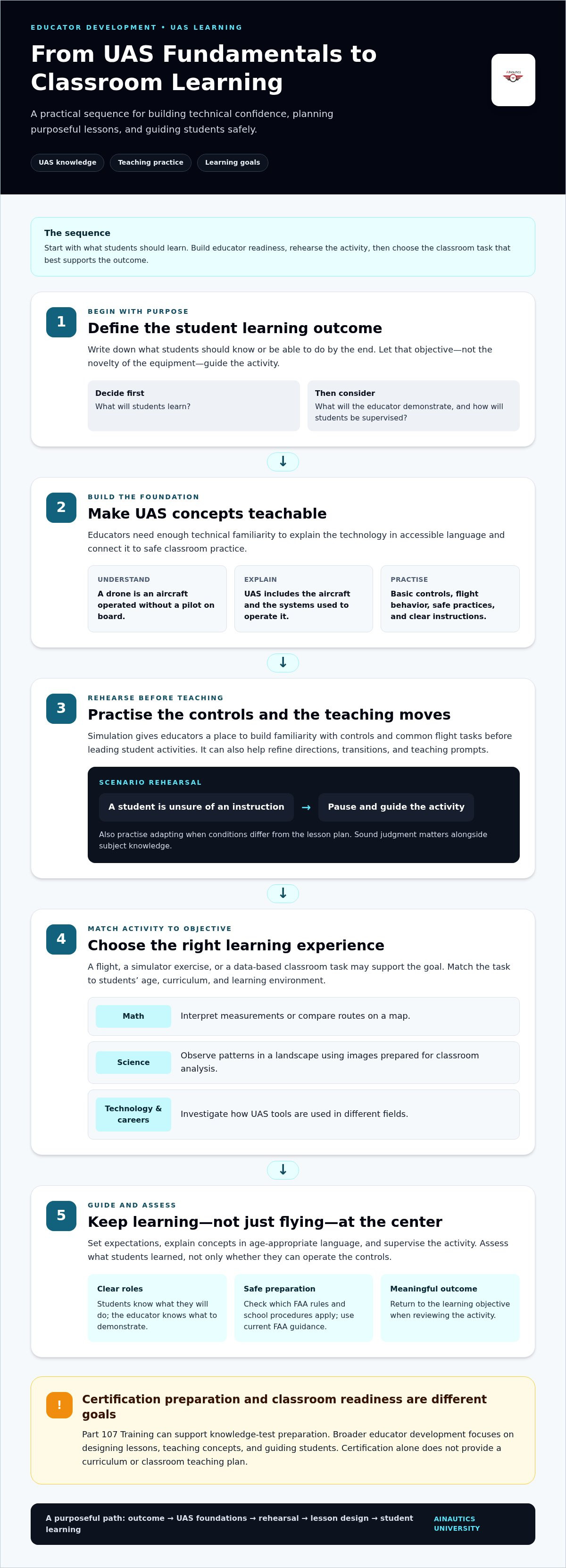
Training becomes useful when educators can apply it within a program with clear goals, responsibilities, and a plan for continued learning. Treat implementation as a sequence: establish what students should learn, prepare staff, connect lessons to school priorities, and review how the program is working. This keeps professional development connected to classroom practice rather than making it a one-time event.
- Set the learning goals. Define what students should understand or be able to do, and identify which grades or courses will take part. These goals guide activity choices and teacher preparation.
- Map school priorities. Review district and state standards, CTE pathways, and STEM or STEAM initiatives. Identify where UAS learning can reinforce existing coursework rather than compete with it.
- Prepare staff and clarify responsibilities. Identify who will lead instruction, coordinate activities, and support program planning. Match educator learning to those roles and the lessons staff expect to deliver.
- Plan classroom integration. Develop activities that fit grade-level needs, available learning time, and intended outcomes. Tailored curriculum can connect UAS learning with state and district standards.
- Review and refine. Set points to revisit student learning, educator confidence, and the fit between activities and school goals. Use what the team learns to adjust instruction and identify future training needs.
Align training with school standards and classroom needs
Start with the curriculum, not the equipment. Identify the standards and priorities that matter to participating teachers, then choose activities that support them. A lesson designed for one grade or subject may need a different level of explanation or a different task for another. A classroom integration guide for drone curriculum can offer further ideas for connecting UAS learning with instruction.
Alignment also helps decision-makers define success. In one class, it might mean students can interpret information gathered through a drone-related activity. In another, it could mean connecting a project to a CTE pathway. Choose outcomes that reflect the school’s instructional aims, then build teacher preparation around them.
Plan for continuity after the initial training
A school program needs attention beyond its launch. Decide how educators will share teaching resources, address questions as lessons develop, and identify when curriculum needs updating. Review student outcomes and teacher confidence as the program grows, then use those observations to guide adjustments. The school’s ongoing plan should extend beyond any single training session.
AINautics University’s structured Launch a Drone Program in 90 Days supports schools moving from planning to flight operations. The 90-day timeframe refers to the implementation rollout, not the duration of teacher training. AINautics University’s drone program implementation support connects educator preparation with a coordinated school launch.
AINautics University’s Train-the-Teacher Pathway for Classroom-Ready UAS Learning
Schools need educator preparation that connects UAS knowledge to the realities of teaching: course objectives, student readiness, and the school’s approach to implementation. AINautics University’s Train-the-Teacher Program supports that educator-focused bridge. It helps schools connect teacher learning, curriculum, and classroom practice instead of treating technical instruction as the whole program.
Match AINautics University resources to educator goals
Begin by identifying what teachers need to do next. The Train-the-Teacher Program and UAS Teacher Scholars models help frame educator development around classroom use. Identify which staff need foundational UAS knowledge, which are preparing to lead lessons, and how teacher learning can connect with existing curriculum and school priorities.
Experiential learning can complement that preparation. AINautics University’s Drone Simulator provides simulation-based learning, while the VR Trailer Mobile Lab supports immersive educator learning in a mobile-lab setting. These resources give schools ways to include practice and engagement with UAS concepts in professional development. Choose a mix that reflects the school’s goals, staff access, and planned learning activities.
Certification preparation has a separate purpose. AINautics University’s Part 107 Training is a certification-learning pathway, while educator development also addresses how to teach and integrate UAS into classroom learning. Distinguish these objectives when planning staff preparation. A teacher may need certification-related learning for a particular role, while curriculum planning and instructional practice remain separate parts of building a classroom program.
Choose a practical next step for your school
Make the first step specific. Identify the classes or pathways the school wants to support, the student learning goals, and the staff-development priorities. Then plan how training, instructional materials, and rollout will work together. Curriculum development can align lessons with state and district standards, CTE pathways, and STEM or STEAM initiatives, helping educators connect UAS activities to the school’s existing direction.
Next, map what educators will learn to what students will experience. For example, a school might pair teacher learning with a curriculum-planning discussion, then identify how simulation or the mobile lab could support educator practice. Decide who will coordinate implementation and when the team will review progress. This creates a practical bridge from professional learning to classroom use without assuming one training session can address every program need.
Effective drone professional development for teachers is strongest when educators can see how their learning supports instruction and school goals. AINautics University’s educator programs connect teacher preparation, curriculum alignment, and UAS program planning.
Take the Next Step Toward Classroom-Ready UAS Learning
Start with one practical decision: identify the classroom or pathway where UAS learning could make a meaningful contribution. Bring educators and school leaders together to define an instructional goal, clarify who will move it forward, and decide what evidence would show that students are learning. A focused starting point gives your team a way to build thoughtfully and shape future steps around classroom needs.
Purposeful drone professional development for teachers helps educators turn curiosity about UAS into informed instructional choices and gives schools a foundation for continued growth. You don’t need to solve every implementation question at once. Begin with a clear goal and a team ready to learn.
Explore AINautics University’s educator programs to plan a next step that fits your school’s goals and connects teacher preparation with classroom-ready UAS learning.
Frequently Asked Questions
Can teachers lead drone lessons without an aviation background?
Yes. An aviation background isn’t a prerequisite for teaching drone concepts, but educators need preparation suited to what students will do. A teacher can start with classroom analysis of drone images, terminology, or simulator exercises, then build toward supervised flight activities as their skills and school procedures allow. Drone professional development for teachers can help bridge the gap by preparing educators to explain controls, plan lessons, and recognize when an activity needs additional operational preparation.
Does every teacher need an FAA Part 107 certificate to teach about drones?
No, not every teacher needs a Part 107 certificate simply to teach drone concepts or use non-flight materials. Whether certification is needed depends on how a drone is operated and which FAA rules apply. Under current FAA guidance, K-12 educational flights generally fall under Part 107 unless they qualify for the recreational exception through a qualifying institution or program. Schools should review current FAA guidance for the specific operation they plan.
How can a school fit drone professional development into teachers’ schedules?
Choose a delivery plan that fits existing staff schedules. Self-paced learning through an LMS lets educators work around teaching responsibilities, while scheduled in-person sessions bring a team together for discussion and shared planning. For example, a school might use flexible coursework for foundational learning, then reserve a staff meeting to develop a lesson. Set a clear goal for each session so the time leads to a useful instructional next step.
What happens if a school has limited experience with drones?
Start with a shared orientation and a manageable first use case rather than trying to launch a complex flight activity immediately. Teachers can learn core terms, use the Drone Simulator, and identify what they need to prepare for their planned lessons. A Train-the-Teacher approach can help build educator capacity as the school develops its curriculum and implementation plan. Progress can be gradual, with each activity building on staff experience.
Can drone professional development support both STEM and CTE learning?
Yes. Drone learning can support different objectives across STEM and CTE. In STEM, students might explore design constraints by examining how a proposed change affects a model. In CTE, they could practise documenting a workflow or communicating findings related to an industry task. Teachers can adapt the challenge to the course and connect assessment to existing standards. Not every relevant lesson needs to involve flying a drone.
How can a district evaluate whether teacher drone training is effective?
Check whether educators can turn what they learned into usable instruction, not only whether they completed training. Compare a draft lesson before and after professional development using criteria such as objective alignment, clear student directions, and an assessment method. Then review student work or exit responses against the lesson objective. Ask teachers which concepts still feel uncertain, and use the findings to shape follow-up learning or revise instructional materials.
Is a drone simulator useful for teacher professional development?
Yes. A simulator gives teachers a repeatable setting to practise controls and rehearse how they’ll explain a task, pause an activity, or respond to a scenario. It can also help a faculty team discuss teaching choices before students participate. Treat simulation as one part of preparation, not proof that an educator is ready for every real-world operation. Flight plans and applicable FAA requirements need separate attention.

Article by
AINautics University Team
The team behind AINautics University, dedicated to drone education and FAA Part 107 certification prep, VR flight simulation, and STEM training programs for students and educators.


