
A four-year UAS degree may be the wrong first step for a future drone pilot, but a useful investment for someone aiming to design autonomous systems. So, is a college degree in UAS worth it? The answer depends less on the drone and more on the career you want to build around it.
It’s reasonable to want clear value before committing years to study and tuition. Depending on the role, employers may prioritize a specific credential, technical expertise, or demonstrated flight skills. A degree can provide deeper academic and technical preparation, while focused certification and hands-on practice may be a more direct fit for an operational flying goal.
This guide compares UAS degrees with certificates and practical training so you can weigh their value against your goals, budget, and timeline. You’ll see where a degree may support specialized careers, when Part 107 preparation or simulator practice may be a better fit, and how to build a learning plan around a target role. AINautics University’s Part 107 Training and Drone Simulator can complement a broader education path.
Key Takeaways
- Decide whether a UAS degree fits by starting with the role you want and its education requirements.
- Consider what academic study can add, and remember that a degree title alone doesn’t demonstrate every practical skill or flight authorization.
- Compare degree programs, certificates, self-paced study, and hands-on training by depth, flexibility, practice, and commitment.
- To answer “is a college degree in UAS worth it,” assess the curriculum and full investment against your goals and circumstances.
- Map a learning sequence from foundational study to focused practice, with next steps tailored to students, parents, or educators.
Is a College Degree in UAS Worth It? Start With the Career You Want
A degree can be worthwhile when its coursework and applied learning support the work you’re aiming to do. Its value depends on career requirements, your learning goals, and the opportunities you’ll have to practise. Before weighing tuition or course titles, choose a role to investigate. A drone operator, an aerial-data analyst, and an engineer developing aircraft systems may need very different preparation.
UAS means unmanned aircraft systems. The term refers to more than the aircraft alone; the Unmanned Aerial Vehicle (UAV) or Unmanned Aircraft System (UAS) entry provides an overview of terminology and applications. Academic study and flight authorization are separate. A college credential reflects completion of a program, while operating commercially in the United States may require an FAA Remote Pilot Certificate under Part 107. A degree by itself isn’t that authorization, and a certificate doesn’t establish every skill a particular job may demand. Check current FAA guidance and the qualifications specified for the role you’re considering.
A degree isn’t automatically required for every drone-related job. Some roles focus on operating aircraft; others involve data, software, engineering, or program management. Requirements vary by employer and position. Review job postings and their qualification criteria rather than relying on broad claims that the industry always requires, or never requires, a degree.
What does a college degree in UAS teach?
Coursework may draw on aviation, technology, data, or operations, but program titles don’t tell the whole story. Curricula vary, so compare course plans by subject, progression, projects, and opportunities to practise. Academic study can build a foundation for understanding systems and concepts, but it may not develop every operational skill or satisfy a role’s requirements. Look for a clear connection between the learning and the work you hope to do.
For example, someone interested in aerial-data work can check whether a program includes relevant data skills and applied projects. A learner drawn to aircraft development can look for a stronger technical foundation. These are ways to compare programs, not guarantees that a particular degree prepares someone for a specific job.
Which goals might make a degree worthwhile?
A degree may suit learners who want structured study, broader technical foundations, or a pathway into related fields. It may also fit someone who values sustained academic learning before settling on one precise role. Those are valid reasons to study, but educational value is not a promise of employment. A credential alone can’t guarantee a hiring outcome.
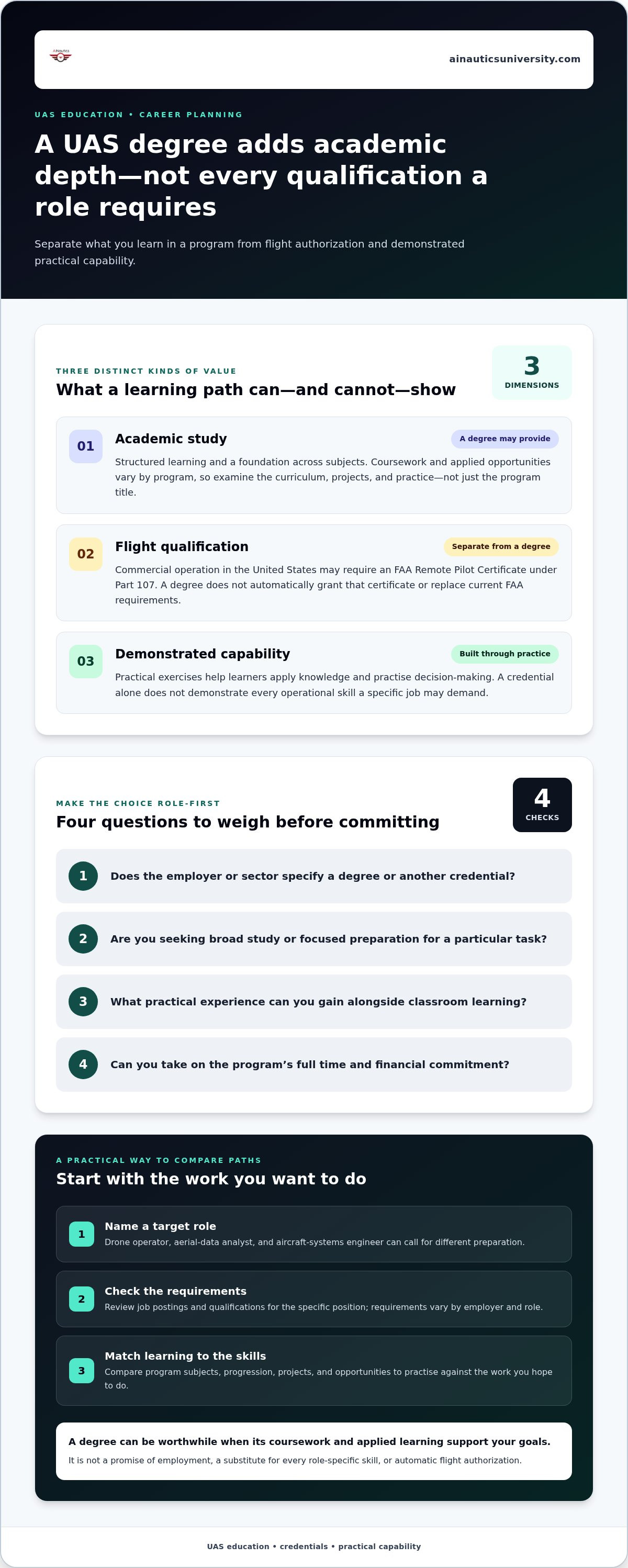
Start with the work, then choose the learning path. Write down a target role, the skills it calls for, and the evidence you’ll need to demonstrate those skills. Then consider four questions:
- Does the role’s employer or sector specify a degree or another credential?
- Do you want broad study or focused preparation for a particular task?
- What practical experience can you gain alongside classroom learning?
- Can you take on the program’s full time and financial commitment?
If your answers point toward a degree, compare programs by their curriculum and practical components, not just their names. If they point toward a narrower goal, focused training may be a useful complement or alternative. That’s a practical way to decide whether a college degree in UAS is worth it for you.
What a UAS Degree Adds, and What It Cannot Replace
A UAS degree can provide structured academic study, but its value comes from what learners study and practise, not just the credential’s name. A program may build knowledge across subjects, connect concepts over time, and include projects or practical exercises. Keep these benefits distinct: coursework develops understanding, practice lets learners apply it, and a separate credential may address a specific qualification.
For a broader perspective on how one university presents the potential academic and career value, explore Capitol Technology University’s benefits of a degree in Unmanned and Autonomous Systems. Use that perspective as a starting point, then compare it with the curriculum and career requirements relevant to your own goals.
How do Part 107 training and a degree differ?
Part 107 preparation focuses on knowledge relevant to the FAA remote-pilot certificate. A college degree covers the subjects and learning outcomes set by its program. These paths can complement each other, but they aren’t interchangeable: earning a degree doesn’t automatically grant a Part 107 certificate or satisfy every FAA requirement. AINautics University’s FAA Part 107 training guide offers focused context for learners considering certificate preparation.
A degree shows academic achievement; a flight credential addresses a separate qualification, and demonstrated capability comes from applying skills in practice. Keep those forms of value distinct when assessing a program. If a position calls for a certificate, confirm current FAA requirements. If it calls for specific technical or operational skills, look for evidence that your education and practice will build them.
Why applied learning matters alongside classroom study
Classroom learning can explain concepts and systems. Applied exercises give learners a chance to use that knowledge, recognize gaps, and practise making decisions. Simulation and scenario-based activities support rehearsal in a learning environment. They complement instruction, but do not prove proficiency by themselves or guarantee employment.
For example, a learner might study flight-planning concepts, then use a simulator to rehearse a scenario and reflect on the decisions made. AINautics University’s Drone Simulator provides a resource for practice, while its overview of immersive drone training technology discusses how simulation can fit into UAS education. Pair practice with feedback and further study where needed.
When comparing options, look for alignment across three things: what the role requires, what the program teaches, and what learners can demonstrate through coursework or practice. AINautics University’s Part 107 Training and self-paced certification options can be considered alongside broader academic study, depending on your goals.
UAS Degree vs. Certificate, Self-Paced Study, or Hands-On Training
These paths differ in scope, structure, and opportunities to apply new knowledge. A degree typically offers a broader academic pathway, while a certificate or focused course concentrates on a defined subject. Self-paced study gives learners more control over when they work through material; hands-on training emphasizes practice. Curricula, support, and outcomes vary, so compare the actual learning experience rather than relying on a credential’s title.
| Learning path | Purpose and depth | Flexibility and practice | Commitment and possible next step |
|---|---|---|---|
| Degree | Broader academic study; subjects and depth vary by institution. | Structure differs across programs; review the amount and type of applied work. | Consider the full program commitment and how you’ll build role-specific experience. |
| Certificate or focused training | Concentrates on a particular topic or learning goal rather than a broad curriculum. | Format and practice opportunities depend on the course. | Compare completion requirements and identify what learning may follow. |
| Self-paced study | Lets learners work through focused material independently. | Offers scheduling flexibility; practical activities depend on the program. | Set a study routine and identify where feedback or practice would help. |
| Hands-on training | Emphasizes applying concepts through practical activities. | Practice format and amount vary; it can complement other study. | Choose activities tied to a skill goal, then assess what you still need to learn. |
No pathway is automatically best for every learner. Employers and roles set different qualifications, so compare actual job requirements instead of assuming employers universally prefer a degree or that a certificate substitutes for one.
When might a focused certificate fit better?
A focused certificate may suit someone aiming to learn a defined skill or prepare for a specific qualification, rather than pursue broad academic study. Compare the topics covered, opportunities to practise, learner support, and stated completion requirements. The right fit depends on whether the course addresses your immediate learning goal and how you plan to build on it.
Consider your preferred learning structure, too. Independent study can offer scheduling flexibility, while a course with clearly described practice may help you apply concepts as you go. Review the format and expected work before deciding.
When might a degree and focused training work together?
Academic study and focused training can serve different parts of a learning plan. A learner might pursue broad coursework, then add targeted instruction or scenario-based practice to develop a skill relevant to a chosen role. Introductory material can help clarify what to study next; this drone training for beginners guide offers foundational learning context.
Map each option to a specific goal: what you want to understand, what you want to practise, and what evidence of learning would be useful. AINautics University learning resources can complement broader academic study as part of that plan.
How to Decide Whether a UAS Degree Is Worth Your Investment
A sound decision starts with a clear comparison, not a promise about future earnings. Ask whether the program supports your goals, what you’ll gain from its curriculum, and whether its demands fit your circumstances. Use these five steps to evaluate your choice.
- Define a role. Select a position or area of work you want to explore. Review current job postings and note the qualifications and capabilities they describe. Separate requirements from preferences, and record where expectations differ between employers.
- Inspect the curriculum. Read course descriptions and connect them to the knowledge you want to build. Look for progression from introductory material to advanced study, and note gaps between the published courses and your goals.
- Compare practice. Identify documented projects, simulations, field activities, or other applied work. Consider whether these experiences help you use relevant concepts and show what you’ve learned. Don’t assume practical components from the degree title alone.
- Calculate the commitment. Account for tuition, fees, materials, travel, and time. Include schedule demands and published expenses that may affect your ability to complete the program.
- Assess fit. Review published outcomes and accreditation information directly with the institution. Compare the program’s structure and expectations with your learning preferences and circumstances.
Match program content to a real learning goal
Translate your career interest into learning goals you can check against the course plan. If you’re considering data-focused work, look for coursework and projects that explicitly address relevant data skills. If your interest is operations, identify the subjects and activities the program says it covers. Keep a simple comparison of documented content, applied opportunities, and skills you would still need to develop.
This approach separates concrete program details from assumptions based on a title or general description. Use the institution’s published materials to establish what the program says it includes before weighing whether it fits.
Compare full commitment, not tuition alone
Make a personal estimate using current published figures and your own schedule. Add tuition and fees to materials, travel, and other stated expenses. Then consider the time required for classes, assignments, and applied activities, including how those demands fit around work or family responsibilities. Compare funding options and financial-aid terms using each institution’s current information.
A degree decision should reflect both the learning gained and its total commitment. You don’t need to predict a salary or calculate a payback period to make a thoughtful choice. Judge whether the curriculum, practice opportunities, and overall demands make sense for the role and learning goals you’ve identified.
Build a UAS Education Path That Moves From Learning to Practice
Turn career exploration into a plan you can revisit. Start with a role or area that interests you, identify what you want to learn, and choose a practical way to explore it. As you gain experience, update your plan based on what engages you and which skills you want to strengthen. You don’t have to decide your entire future at once.
- Choose a direction to explore. Identify a role or field that interests you and note the capabilities it involves.
- Set a learning goal. Decide what you want to understand or practise next.
- Choose a relevant activity. Connect study with an exercise, project, or classroom activity that lets you apply new ideas.
- Reflect and adjust. Record what you learned, what challenged you, and what you want to explore next.
For a broader view of possible pathways, explore the future of drone careers. Use it as a starting point for research, then connect areas of interest to the qualifications and capabilities described in relevant roles.
A practical next step for students and career explorers
Choose one role to investigate and look at the work it involves. Make a short list of relevant knowledge and capabilities, then decide which one you’d like to explore first. A focused study goal can make a large field feel more manageable. For example, learn about an application of UAS technology, then consider whether the related work matches your interests.
Keep a brief record of your questions, learning activities, and next steps. This gives you a useful reference when you revisit your plans or compare career directions. Treat each new experience as a chance to refine your goals, not as a permanent commitment.
A next step for parents and educators
Parents can support students by asking what they’re curious about, helping them research roles, and making space to compare learning routes. Keep the conversation open. A learner’s goals may change as they encounter new subjects and activities.
Educators can connect classroom concepts with exploration of autonomous systems. AINautics University’s UAS Student Scholars program supports student learners, and its Train-the-Teacher Program helps educators integrate autonomous systems into curricula. The VR Trailer Mobile Lab and Drone Simulator can also support hands-on learning. These resources can help schools connect classroom experiences with future study and work.
Learners, families, and educators can explore AINautics University learning resources as they plan educational next steps. Keep asking questions, build on each learning experience, and let each step bring your goals into sharper focus.
Turn Your UAS Goals Into a Learning Plan
The strongest next step isn’t necessarily the longest program. It’s the one that helps you build toward a clear goal while leaving room to adapt as your interests and experience grow. Whether you’re a student exploring possibilities, a parent supporting a decision, or an educator shaping classroom learning, choose a practical action you can take now.
Still asking, is a college degree in UAS worth it? Use your target role and the learning you want to gain as your guide. A degree, focused training, and practice can each play a different part in your path. AINautics University offers Part 107 Training, Self-Paced Certification, a Drone Simulator, and the UAS Student Scholars program to support different educational goals.
Explore AINautics University training and learning resources to find educational support aligned with your goals. Start with one purposeful step, then keep building your knowledge and capability.
Frequently Asked Questions
Is a college degree in UAS worth it for becoming a drone pilot?
It can be valuable if you want broader technical study, but it isn’t automatically necessary for a pilot-focused goal. Consider the work you want to do, the qualifications it requires, and whether a degree’s curriculum offers relevant learning and practice. Someone aiming to operate drones in a specific industry, for example, can compare role requirements with focused flight preparation and applied experience before committing to a broader academic program.
Do you need a college degree to fly drones commercially in the United States?
No, a college degree is not generally the FAA credential for commercial small-drone operations. Many such operations follow Part 107 requirements, which include holding the appropriate FAA Remote Pilot Certificate. Specific circumstances can affect which rules apply, so review current FAA guidance for the intended operation. Also check employer requirements: a company may set education or experience preferences beyond flight-related requirements.
Is a UAS degree better than an FAA Part 107 certificate?
Neither is universally better because they serve different purposes. A degree represents academic study, while a Part 107 Remote Pilot Certificate addresses an FAA qualification for applicable operations. A student interested in piloting may prioritize certificate preparation; someone pursuing broader technical study may value a degree. Some learners may need both, depending on their target role. Compare each credential with the actual requirements, not just its title.
What jobs can you pursue with a UAS degree?
Depending on the curriculum and your additional skills, a UAS degree may relate to work in aircraft systems, engineering, operations, data analysis, or research. A program’s title alone doesn’t establish preparation for a specific position. Review course content, projects, and job descriptions for roles that interest you. A data-focused role, for instance, may call for analytical tools or subject knowledge beyond flight operations, so plan to develop those capabilities too.
Can you work in the drone industry without a college degree?
Yes, some drone-related roles may be accessible without a degree, depending on the employer and the work involved. Relevant qualifications, technical skills, practical experience, or a portfolio may matter for particular positions. A pilot-oriented path can involve learning applicable FAA requirements and building experience; a software or engineering role may call for different preparation. Check real job postings to see what employers request for your target role.
How much does a college degree in UAS cost compared with certificate training?
Costs vary by institution, program length, location, and training format, so there isn’t one reliable price comparison for every learner. Review current published tuition and fee information, then include materials, travel, and time away from other commitments. Compare that total with the specific certificate or training option you’re considering. For a fair comparison, check what each path includes and don’t assume a lower-cost option covers the same learning goals.
What should I look for when comparing UAS college programs?
Compare the curriculum with the roles you’re considering. Review course descriptions, practical projects, simulation or field activities, stated program outcomes, and published accreditation information. Use these details to note what the program describes and where information is missing. Also consider scheduling, total commitment, and whether you’ll need separate preparation for a role-specific qualification. A side-by-side comparison helps reveal meaningful differences between program titles.

Article by
AINautics University Team
The team behind AINautics University, dedicated to drone education and FAA Part 107 certification prep, VR flight simulation, and STEM training programs for students and educators.


